

12.13: Exercises
- Page ID
- 560885

\( \newcommand{\vecs}[1]{\overset { \scriptstyle \rightharpoonup} {\mathbf{#1}} } \)
\( \newcommand{\vecd}[1]{\overset{-\!-\!\rightharpoonup}{\vphantom{a}\smash {#1}}} \)
\( \newcommand{\dsum}{\displaystyle\sum\limits} \)
\( \newcommand{\dint}{\displaystyle\int\limits} \)
\( \newcommand{\dlim}{\displaystyle\lim\limits} \)
\( \newcommand{\id}{\mathrm{id}}\) \( \newcommand{\Span}{\mathrm{span}}\)
( \newcommand{\kernel}{\mathrm{null}\,}\) \( \newcommand{\range}{\mathrm{range}\,}\)
\( \newcommand{\RealPart}{\mathrm{Re}}\) \( \newcommand{\ImaginaryPart}{\mathrm{Im}}\)
\( \newcommand{\Argument}{\mathrm{Arg}}\) \( \newcommand{\norm}[1]{\| #1 \|}\)
\( \newcommand{\inner}[2]{\langle #1, #2 \rangle}\)
\( \newcommand{\Span}{\mathrm{span}}\)
\( \newcommand{\id}{\mathrm{id}}\)
\( \newcommand{\Span}{\mathrm{span}}\)
\( \newcommand{\kernel}{\mathrm{null}\,}\)
\( \newcommand{\range}{\mathrm{range}\,}\)
\( \newcommand{\RealPart}{\mathrm{Re}}\)
\( \newcommand{\ImaginaryPart}{\mathrm{Im}}\)
\( \newcommand{\Argument}{\mathrm{Arg}}\)
\( \newcommand{\norm}[1]{\| #1 \|}\)
\( \newcommand{\inner}[2]{\langle #1, #2 \rangle}\)
\( \newcommand{\Span}{\mathrm{span}}\) \( \newcommand{\AA}{\unicode[.8,0]{x212B}}\)
\( \newcommand{\vectorA}[1]{\vec{#1}} % arrow\)
\( \newcommand{\vectorAt}[1]{\vec{\text{#1}}} % arrow\)
\( \newcommand{\vectorB}[1]{\overset { \scriptstyle \rightharpoonup} {\mathbf{#1}} } \)
\( \newcommand{\vectorC}[1]{\textbf{#1}} \)
\( \newcommand{\vectorD}[1]{\overrightarrow{#1}} \)
\( \newcommand{\vectorDt}[1]{\overrightarrow{\text{#1}}} \)
\( \newcommand{\vectE}[1]{\overset{-\!-\!\rightharpoonup}{\vphantom{a}\smash{\mathbf {#1}}}} \)
\( \newcommand{\vecs}[1]{\overset { \scriptstyle \rightharpoonup} {\mathbf{#1}} } \)
\(\newcommand{\longvect}{\overrightarrow}\)
\( \newcommand{\vecd}[1]{\overset{-\!-\!\rightharpoonup}{\vphantom{a}\smash {#1}}} \)
\(\newcommand{\ket}[1]{\left| #1 \right>}\)
\(\newcommand{\bra}[1]{\left< #1 \right|}\)
\(\newcommand{\braket}[2]{\left< #1 \vphantom{#2} \right| \left. #2 \vphantom{#1} \right>}\)
\(\newcommand{\braopket}[3]{\left< #1 \vphantom{#2}\vphantom{#3} \right| #2 \vphantom{#1}\vphantom{#3} \left| #3 \vphantom{#1}\vphantom{#2} \right>}\)
\(\newcommand{\qmvec}[1]{\mathbf{\vec{#1}}}\)
\(\newcommand{\op}[1]{\hat{\mathbf{#1}}}\)
\(\newcommand{\expect}[1]{\langle #1 \rangle}\)
\(\newcommand{\dfn}[1]{\emph{\textbf{#1}}}\)
\(\newcommand{\avec}{\mathbf a}\) \(\newcommand{\bvec}{\mathbf b}\) \(\newcommand{\cvec}{\mathbf c}\) \(\newcommand{\dvec}{\mathbf d}\) \(\newcommand{\dtil}{\widetilde{\mathbf d}}\) \(\newcommand{\evec}{\mathbf e}\) \(\newcommand{\fvec}{\mathbf f}\) \(\newcommand{\nvec}{\mathbf n}\) \(\newcommand{\pvec}{\mathbf p}\) \(\newcommand{\qvec}{\mathbf q}\) \(\newcommand{\svec}{\mathbf s}\) \(\newcommand{\tvec}{\mathbf t}\) \(\newcommand{\uvec}{\mathbf u}\) \(\newcommand{\vvec}{\mathbf v}\) \(\newcommand{\wvec}{\mathbf w}\) \(\newcommand{\xvec}{\mathbf x}\) \(\newcommand{\yvec}{\mathbf y}\) \(\newcommand{\zvec}{\mathbf z}\) \(\newcommand{\rvec}{\mathbf r}\) \(\newcommand{\mvec}{\mathbf m}\) \(\newcommand{\zerovec}{\mathbf 0}\) \(\newcommand{\onevec}{\mathbf 1}\) \(\newcommand{\real}{\mathbb R}\) \(\newcommand{\twovec}[2]{\left[\begin{array}{r}#1 \\ #2 \end{array}\right]}\) \(\newcommand{\ctwovec}[2]{\left[\begin{array}{c}#1 \\ #2 \end{array}\right]}\) \(\newcommand{\threevec}[3]{\left[\begin{array}{r}#1 \\ #2 \\ #3 \end{array}\right]}\) \(\newcommand{\cthreevec}[3]{\left[\begin{array}{c}#1 \\ #2 \\ #3 \end{array}\right]}\) \(\newcommand{\fourvec}[4]{\left[\begin{array}{r}#1 \\ #2 \\ #3 \\ #4 \end{array}\right]}\) \(\newcommand{\cfourvec}[4]{\left[\begin{array}{c}#1 \\ #2 \\ #3 \\ #4 \end{array}\right]}\) \(\newcommand{\fivevec}[5]{\left[\begin{array}{r}#1 \\ #2 \\ #3 \\ #4 \\ #5 \\ \end{array}\right]}\) \(\newcommand{\cfivevec}[5]{\left[\begin{array}{c}#1 \\ #2 \\ #3 \\ #4 \\ #5 \\ \end{array}\right]}\) \(\newcommand{\mattwo}[4]{\left[\begin{array}{rr}#1 \amp #2 \\ #3 \amp #4 \\ \end{array}\right]}\) \(\newcommand{\laspan}[1]{\text{Span}\{#1\}}\) \(\newcommand{\bcal}{\cal B}\) \(\newcommand{\ccal}{\cal C}\) \(\newcommand{\scal}{\cal S}\) \(\newcommand{\wcal}{\cal W}\) \(\newcommand{\ecal}{\cal E}\) \(\newcommand{\coords}[2]{\left\{#1\right\}_{#2}}\) \(\newcommand{\gray}[1]{\color{gray}{#1}}\) \(\newcommand{\lgray}[1]{\color{lightgray}{#1}}\) \(\newcommand{\rank}{\operatorname{rank}}\) \(\newcommand{\row}{\text{Row}}\) \(\newcommand{\col}{\text{Col}}\) \(\renewcommand{\row}{\text{Row}}\) \(\newcommand{\nul}{\text{Nul}}\) \(\newcommand{\var}{\text{Var}}\) \(\newcommand{\corr}{\text{corr}}\) \(\newcommand{\len}[1]{\left|#1\right|}\) \(\newcommand{\bbar}{\overline{\bvec}}\) \(\newcommand{\bhat}{\widehat{\bvec}}\) \(\newcommand{\bperp}{\bvec^\perp}\) \(\newcommand{\xhat}{\widehat{\xvec}}\) \(\newcommand{\vhat}{\widehat{\vvec}}\) \(\newcommand{\uhat}{\widehat{\uvec}}\) \(\newcommand{\what}{\widehat{\wvec}}\) \(\newcommand{\Sighat}{\widehat{\Sigma}}\) \(\newcommand{\lt}{<}\) \(\newcommand{\gt}{>}\) \(\newcommand{\amp}{&}\) \(\definecolor{fillinmathshade}{gray}{0.9}\)
Questions
Unless a problem states otherwise, temperatures in kelvin are found from \(T(\text{K}) = T(^\circ\text{C}) + 273.15\), and \(R = 8.314\text{ J mol}^{-1}\text{ K}^{-1}\). Problems marked (PhET) require the PhET Reactions & Rates simulation; problems marked (optional) go beyond the CHMA12 learning outcomes.
12.2: Chemical Reaction Rates
12.2.1. What is the difference between average rate, initial rate, and instantaneous rate?
12.2.2. Ozone decomposes to oxygen according to the equation \(\ce{2O3(g) -> 3O2(g)}\). Write the equation that relates the rate expressions for this reaction in terms of the disappearance of \(\ce{O3}\) and the formation of oxygen.
12.2.3. In the nuclear industry, chlorine trifluoride is used to prepare uranium hexafluoride, a volatile compound of uranium used in the separation of uranium isotopes. Chlorine trifluoride is prepared by the reaction \(\ce{Cl2(g) + 3F2(g) -> 2ClF3(g)}\). Write the equation that relates the rate expressions for this reaction in terms of the disappearance of \(\ce{Cl2}\) and \(\ce{F2}\) and the formation of \(\ce{ClF3}\).
12.2.4. A study of the rate of dimerization of \(\ce{C4H6}\) gave the data shown in the table:
\[\ce{2C4H6 -> C8H12}\]
| Time (s) | 0 | 1600 | 3200 | 4800 | 6200 |
|---|---|---|---|---|---|
| \([\ce{C4H6}]\) (M) | 1.00 × 10⁻² | 5.04 × 10⁻³ | 3.37 × 10⁻³ | 2.53 × 10⁻³ | 2.08 × 10⁻³ |
a. Determine the average rate of disappearance of \(\ce{C4H6}\) between 0 s and 1600 s, and between 1600 s and 3200 s.
b. Estimate the instantaneous rate of disappearance of \(\ce{C4H6}\) at 3200 s from a graph of \([\ce{C4H6}]\) versus time. What are the units of this rate?
c. Use your answers to parts (a) and (b) to determine the average rate of formation of \(\ce{C8H12}\) between 0 s and 1600 s and the instantaneous rate of formation of \(\ce{C8H12}\) at 3200 s.
12.2.5. A study of the rate of the reaction represented as \(\ce{2A -> B}\) gave the following data:
| Time (s) | 0.0 | 5.0 | 10.0 | 15.0 | 20.0 | 25.0 | 35.0 |
|---|---|---|---|---|---|---|---|
| [A] (M) | 1.00 | 0.952 | 0.625 | 0.465 | 0.370 | 0.308 | 0.230 |
a. Determine the average rate of disappearance of A between 0.0 s and 10.0 s, and between 10.0 s and 20.0 s.
b. Estimate the instantaneous rate of disappearance of A at 15.0 s from a graph of [A] versus time. What are the units of this rate?
c. Use the rates found in parts (a) and (b) to determine the average rate of formation of B between 0.0 s and 10.0 s, and the instantaneous rate of formation of B at 15.0 s.
12.2.6. Consider the following reaction in aqueous solution:
\[\ce{5Br^-(aq) + BrO3^-(aq) + 6H^+(aq) -> 3Br2(aq) + 3H2O(l)}\]
If the rate of disappearance of \(\ce{Br^-}(aq)\) at a particular moment during the reaction is \(3.5 \times 10^{-4}\text{ M s}^{-1}\), what is the rate of appearance of \(\ce{Br2}(aq)\) at that moment?
12.2.7. For the reaction \(\ce{2A + B -> 3C}\), B is consumed at a rate of \(0.030\text{ M s}^{-1}\). At what rate is C formed?
a) \(0.010\text{ M s}^{-1}\)
b) \(0.030\text{ M s}^{-1}\)
c) \(0.060\text{ M s}^{-1}\)
d) \(0.090\text{ M s}^{-1}\)
12.2.8. In the Haber process, \(\ce{N2(g) + 3H2(g) -> 2NH3(g)}\), ammonia is formed at a rate of \(0.40\text{ M min}^{-1}\).
a. At what rate is \(\ce{H2}\) consumed?
b. At what rate is \(\ce{N2}\) consumed?
c. What is the rate of the reaction?
12.2.9. Which statement best explains why the rate of most reactions is greatest at the start of the reaction?
a) The rate constant decreases as the reaction proceeds.
b) The concentrations of the reactants are highest at the start.
c) The products act as catalysts.
d) The temperature is highest at the start.
12.2.10. Hydrogen peroxide decomposes according to \(\ce{2H2O2(aq) -> 2H2O(l) + O2(g)}\). In one experiment, \([\ce{H2O2}]\) fell from 1.000 M to 0.500 M in 6.00 h.
a. Calculate the average rate of disappearance of \(\ce{H2O2}\) in M s−1.
b. Calculate the average rate of formation of \(\ce{O2}\) over the same interval.
12.2.11. a. Explain why the instantaneous rate at a given time is found from the slope of a tangent line rather than from a straight line between two data points.
b. Why is a negative sign placed in front of the rate expression written for a reactant?
12.2.12. Dinitrogen pentoxide decomposes according to \(\ce{2N2O5(g) -> 4NO2(g) + O2(g)}\). At a certain moment, \(\ce{O2}\) is being formed at \(1.5 \times 10^{-5}\text{ M s}^{-1}\).
a. At what rate is \(\ce{N2O5}\) being consumed?
b. At what rate is \(\ce{NO2}\) being formed?
12.2.13. Which of the following is an appropriate unit for the rate of a reaction in solution?
a) \(\text{M s}^{-1}\)
b) \(\text{s}^{-1}\)
c) \(\text{M}\)
d) \(\text{M}^{-1}\text{ s}^{-1}\)
12.2.14. Suggest a property that could be measured over time to follow the rate of each of the following reactions:
a. a reaction in which a coloured product forms from colourless reactants
b. a reaction in a sealed, rigid container in which gaseous products form from a solid reactant
c. a reaction in aqueous solution that produces \(\ce{H+}\) ions
12.2.15. For the reaction \(\ce{A -> 2B}\), the following data were collected:
| Time (s) | 0 | 20 | 40 |
|---|---|---|---|
| [B] (M) | 0 | 0.36 | 0.58 |
a. Calculate the average rate of formation of B between 0 s and 20 s and between 20 s and 40 s.
b. Calculate the average rate of disappearance of A over each interval.
c. Explain why the rate is smaller in the second interval.
12.3: Factors Affecting Reaction Rates
12.3.1. Describe the effect of each of the following on the rate of the reaction of magnesium metal with a solution of hydrochloric acid: the molarity of the hydrochloric acid, the temperature of the solution, and the size of the pieces of magnesium.
12.3.2. (PhET) Go to the PhET Reactions & Rates interactive. Use the Single Collision tab to represent how the collision between monatomic oxygen (O) and carbon monoxide (CO) results in the breaking of one bond and the formation of another. Pull back on the red plunger to release the atom and observe the results. Then, click on “Reload Launcher” and change to “Angled shot” to see the difference.
a. What happens when the angle of the collision is changed?
b. Explain how this is relevant to rate of reaction.
12.3.3. (PhET) In the PhET Reactions & Rates interactive, use the “Many Collisions” tab to observe how multiple atoms and molecules interact under varying conditions. Select a molecule to pump into the chamber. Set the initial temperature and select the current amounts of each reactant. Select “Show bonds” under Options. How is the rate of the reaction affected by concentration and temperature?
12.3.4. (PhET) In the PhET Reactions & Rates interactive, on the Many Collisions tab, set up a simulation with 15 molecules of A and 10 molecules of BC. Select “Show Bonds” under Options.
a. Leave the Initial Temperature at the default setting. Observe the reaction. Is the rate of reaction fast or slow?
b. Click “Pause” and then “Reset All,” and then enter 15 molecules of A and 10 molecules of BC once again. Select “Show Bonds” under Options. This time, increase the initial temperature until, on the graph, the total average energy line is completely above the potential energy curve. Describe what happens to the reaction.
12.3.5. Which change would not increase the rate of the reaction \(\ce{Zn(s) + 2HCl(aq) -> ZnCl2(aq) + H2(g)}\)?
a) using powdered zinc instead of a single piece
b) using 2.0 M HCl instead of 1.0 M HCl
c) warming the acid from 20 °C to 40 °C
d) replacing small zinc granules with a few large lumps of the same total mass
12.3.6. A log burns slowly in a fireplace, but fine sawdust suspended in air can ignite explosively. Explain this difference.
12.3.7. Explain, in terms of reaction rates, why food stored in a refrigerator spoils more slowly than food left on the counter.
12.3.8. Which metal reacts most rapidly with water at room temperature?
a) potassium
b) magnesium
c) iron
d) copper
12.3.9. When aqueous solutions of \(\ce{AgNO3}\) and \(\ce{NaCl}\) are mixed, \(\ce{AgCl}\) precipitates instantly. In contrast, a mixture of methane and oxygen can be stored at room temperature for years without reacting. Explain the difference in rate.
12.3.10. Many reactions near room temperature roughly double in rate for every 10 °C rise in temperature. A reaction takes 60 min to reach a certain extent of completion at 20 °C. Estimate how long it would take at:
a. 40 °C
b. 10 °C
12.3.11. Explain why reactions between gases, or between substances dissolved in the same solution, are generally faster than reactions between two solids.
12.3.12. A catalyst increases the rate of a reaction by:
a) raising the temperature of the reaction mixture
b) increasing the energy of each collision
c) providing an alternative pathway with a lower activation energy
d) shifting the equilibrium position toward products
12.3.13. Two identical strips of magnesium ribbon are placed in 1.0 M HCl and 2.0 M HCl at the same temperature.
a. In which acid is hydrogen gas produced faster? Explain.
b. How does the rate of gas production change as each reaction proceeds? Explain.
12.3.14. Two 1.0 g samples of marble (\(\ce{CaCO3}\)), one as chips and one as powder, are each added to the same volume of excess 1.0 M HCl. The volume of \(\ce{CO2}\) produced is measured over time.
a. Which sample produces \(\ce{CO2}\) faster? Explain.
b. Will the final volume of \(\ce{CO2}\) be different for the two samples? Explain.
12.3.15. For each change, identify the factor responsible for the change in rate (chemical nature, physical state/surface area, temperature, concentration, or catalyst):
a. adding a small amount of solid \(\ce{MnO2}\) to hydrogen peroxide makes it bubble rapidly
b. a crushed antacid tablet dissolves and fizzes faster than a whole tablet
c. a glowing splint bursts into flame in pure oxygen but only glows in air
d. food cooks faster in a pressure cooker, where water boils at about 120 °C
12.4: Rate Laws
12.4.1. How do the rate of a reaction and its rate constant differ?
12.4.2. Doubling the concentration of a reactant increases the rate of a reaction four times. With this knowledge, answer the following questions:
a. What is the order of the reaction with respect to that reactant?
b. Tripling the concentration of a different reactant increases the rate of a reaction three times. What is the order of the reaction with respect to that reactant?
12.4.3. Tripling the concentration of a reactant increases the rate of a reaction nine times. With this knowledge, answer the following questions:
a. What is the order of the reaction with respect to that reactant?
b. Increasing the concentration of a reactant by a factor of four increases the rate of a reaction four times. What is the order of the reaction with respect to that reactant?
12.4.4. How much and in what direction will each of the following affect the rate of the reaction \(\ce{CO(g) + NO2(g) -> CO2(g) + NO(g)}\) if the rate law for the reaction is \(\text{rate} = k[\ce{NO2}]^2\)?
a. Decreasing the pressure of \(\ce{NO2}\) from 0.50 atm to 0.250 atm.
b. Increasing the concentration of CO from 0.01 M to 0.03 M.
12.4.5. How will each of the following affect the rate of the reaction \(\ce{CO(g) + NO2(g) -> CO2(g) + NO(g)}\) if the rate law for the reaction is \(\text{rate} = k[\ce{NO2}][\ce{CO}]\)?
a. Increasing the pressure of \(\ce{NO2}\) from 0.1 atm to 0.3 atm
b. Increasing the concentration of CO from 0.02 M to 0.06 M.
12.4.6. Regular flights of supersonic aircraft in the stratosphere are of concern because such aircraft produce nitric oxide, NO, as a byproduct in the exhaust of their engines. Nitric oxide reacts with ozone, and it has been suggested that this could contribute to depletion of the ozone layer. The reaction \(\ce{NO + O3 -> NO2 + O2}\) is first order with respect to both NO and \(\ce{O3}\) with a rate constant of \(2.20 \times 10^{7}\text{ L mol}^{-1}\text{ s}^{-1}\). What is the instantaneous rate of disappearance of NO when \([\ce{NO}] = 3.3 \times 10^{-6}\text{ M}\) and \([\ce{O3}] = 5.9 \times 10^{-7}\text{ M}\)?
12.4.7. Radioactive phosphorus is used in the study of biochemical reaction mechanisms because phosphorus atoms are components of many biochemical molecules. The location of the phosphorus (and the location of the molecule it is bound in) can be detected from the electrons (beta particles) it produces:
\[\ce{^{32}_{15}P -> ^{32}_{16}S + e^-}\]
\[\text{rate} = (4.85\times10^{-2}\text{ day}^{-1})[\ce{^{32}P}]\]
What is the instantaneous rate of production of electrons in a sample with a phosphorus concentration of 0.0033 M?
12.4.8. The rate constant for the radioactive decay of \(\ce{^{14}C}\) is \(1.21 \times 10^{-4}\text{ year}^{-1}\). The products of the decay are nitrogen atoms and electrons (beta particles):
\[\ce{^{14}_{6}C -> ^{14}_{7}N + e^-}\]
\[\text{rate} = k[\ce{^{14}C}]\]
What is the instantaneous rate of production of N atoms in a sample with a carbon-14 content of \(6.5 \times 10^{-9}\text{ M}\)?
12.4.9. Using the rate constant given in 12.4.8, what is the instantaneous rate of production of N atoms in a sample with a carbon-14 content of \(1.5 \times 10^{-9}\text{ M}\)?
12.4.10. The decomposition of acetaldehyde is a second order reaction with a rate constant of \(4.71 \times 10^{-8}\text{ L mol}^{-1}\text{ s}^{-1}\). What is the instantaneous rate of decomposition of acetaldehyde in a solution with a concentration of \(5.55 \times 10^{-4}\text{ M}\)?
12.4.11. Alcohol is removed from the bloodstream by a series of metabolic reactions. The first reaction produces acetaldehyde; then other products are formed. The following data have been determined for the rate at which alcohol is removed from the blood of an average male, although individual rates can vary by 25–30%. Women metabolize alcohol a little more slowly than men:
| \([\ce{C2H5OH}]\) (M) | 4.4 × 10⁻² | 3.3 × 10⁻² | 2.2 × 10⁻² |
|---|---|---|---|
| Rate (mol L−1 h−1) | 2.0 × 10⁻² | 2.0 × 10⁻² | 2.0 × 10⁻² |
Determine the rate equation, the rate constant, and the overall order for this reaction.
12.4.12. Under certain conditions the decomposition of ammonia on a metal surface gives the following data:
| \([\ce{NH3}]\) (M) | 1.0 × 10⁻³ | 2.0 × 10⁻³ | 3.0 × 10⁻³ |
|---|---|---|---|
| Rate (mol L−1 h−1) | 1.5 × 10⁻⁶ | 1.5 × 10⁻⁶ | 1.5 × 10⁻⁶ |
Determine the rate equation, the rate constant, and the overall order for this reaction.
12.4.13. Nitrosyl chloride, NOCl, decomposes to NO and \(\ce{Cl2}\).
\[\ce{2NOCl(g) -> 2NO(g) + Cl2(g)}\]
Determine the rate equation, the rate constant, and the overall order for this reaction from the following data:
| [NOCl] (M) | 0.10 | 0.20 | 0.30 |
|---|---|---|---|
| Rate (mol L−1 h−1) | 8.0 × 10⁻¹⁰ | 3.2 × 10⁻⁹ | 7.2 × 10⁻⁹ |
12.4.14. From the following data, determine the rate equation, the rate constant, and the order with respect to A for the reaction \(\ce{A -> 2C}\).
| [A] (M) | 1.33 × 10⁻² | 2.66 × 10⁻² | 3.99 × 10⁻² |
|---|---|---|---|
| Rate (mol L−1 h−1) | 3.80 × 10⁻⁷ | 1.52 × 10⁻⁶ | 3.42 × 10⁻⁶ |
12.4.15. Nitrogen(II) oxide reacts with chlorine according to the equation:
\[\ce{2NO(g) + Cl2(g) -> 2NOCl(g)}\]
The following initial rates of reaction have been observed for certain reactant concentrations:
| [NO] (mol L−1) | \([\ce{Cl2}]\) (mol L−1) | Rate (mol L−1 h−1) |
|---|---|---|
| 0.50 | 0.50 | 1.14 |
| 1.00 | 0.50 | 4.56 |
| 1.00 | 1.00 | 9.12 |
What is the rate equation that describes the rate’s dependence on the concentrations of NO and \(\ce{Cl2}\)? What is the rate constant? What are the orders with respect to each reactant?
12.4.16. Hydrogen reacts with nitrogen monoxide to form dinitrogen monoxide (laughing gas) according to the equation:
\[\ce{H2(g) + 2NO(g) -> N2O(g) + H2O(g)}\]
Determine the rate equation, the rate constant, and the orders with respect to each reactant from the following data:
| [NO] (M) | 0.30 | 0.60 | 0.60 |
|---|---|---|---|
| \([\ce{H2}]\) (M) | 0.35 | 0.35 | 0.70 |
| Rate (mol L−1 s−1) | 2.835 × 10⁻³ | 1.134 × 10⁻² | 2.268 × 10⁻² |
12.4.17. For the reaction \(\ce{A -> B + C}\), the following data were obtained at 30 °C:
| [A] (M) | 0.230 | 0.356 | 0.557 |
|---|---|---|---|
| Rate (mol L−1 s−1) | 4.17 × 10⁻⁴ | 9.99 × 10⁻⁴ | 2.44 × 10⁻³ |
a. What is the order of the reaction with respect to [A], and what is the rate equation?
b. What is the rate constant?
12.4.18. For the reaction \(\ce{Q -> W + X}\), the following data were obtained at 30 °C:
| \([\ce{Q}]_\text{initial}\) (M) | 0.170 | 0.212 | 0.357 |
|---|---|---|---|
| Rate (mol L−1 s−1) | 6.68 × 10⁻³ | 1.04 × 10⁻² | 2.94 × 10⁻² |
a. What is the order of the reaction with respect to [Q], and what is the rate equation?
b. What is the rate constant?
12.4.19. The rate constant for the first-order decomposition at 45 °C of dinitrogen pentoxide, \(\ce{N2O5}\), dissolved in chloroform, \(\ce{CHCl3}\), is \(6.2 \times 10^{-4}\text{ min}^{-1}\).
\[\ce{2N2O5 -> 4NO2 + O2}\]
What is the rate of the reaction when \([\ce{N2O5}] = 0.40\text{ M}\)?
12.4.20. The annual production of \(\ce{HNO3}\) in 2013 was 60 million metric tons. Most of that was prepared by the following sequence of reactions, each run in a separate reaction vessel.
(a) \(\ce{4NH3(g) + 5O2(g) -> 4NO(g) + 6H2O(g)}\)
(b) \(\ce{2NO(g) + O2(g) -> 2NO2(g)}\)
(c) \(\ce{3NO2(g) + H2O(l) -> 2HNO3(aq) + NO(g)}\)
The first reaction is run by burning ammonia in air over a platinum catalyst. This reaction is fast. The reaction in equation (c) is also fast. The second reaction limits the rate at which nitric acid can be prepared from ammonia. If equation (b) is second order in NO and first order in \(\ce{O2}\), what is the rate of formation of \(\ce{NO2}\) when the oxygen concentration is 0.50 M and the nitric oxide concentration is 0.75 M? The rate constant for the reaction is \(5.8 \times 10^{-6}\text{ L}^2\text{ mol}^{-2}\text{ s}^{-1}\).
12.4.21. The following data have been determined for the reaction:
\[\ce{I^- + OCl^- -> IO^- + Cl^-}\]
| Trial | 1 | 2 | 3 |
|---|---|---|---|
| \([\ce{I^-}]_\text{initial}\) (M) | 0.10 | 0.20 | 0.30 |
| \([\ce{OCl^-}]_\text{initial}\) (M) | 0.050 | 0.050 | 0.010 |
| Rate (mol L−1 s−1) | 3.05 × 10⁻⁴ | 6.20 × 10⁻⁴ | 1.83 × 10⁻⁴ |
Determine the rate equation and the rate constant for this reaction.
12.4.22. In the reaction \(\ce{2NO + Cl2 -> 2NOCl}\), the reactants and products are gases at the temperature of the reaction. The following rate data were measured for three experiments:
| Initial \(P_{\ce{NO}}\) (atm) | Initial \(P_{\ce{Cl2}}\) (atm) | Initial rate (atm s−1) |
|---|---|---|
| 0.50 | 0.50 | 5.1 × 10⁻³ |
| 1.0 | 1.0 | 4.0 × 10⁻² |
| 0.50 | 1.0 | 1.0 × 10⁻² |
a. From these data, write the rate equation for this gas reaction. What order is the reaction in NO, \(\ce{Cl2}\), and overall?
b. Calculate the specific rate constant for this reaction.
12.5: Integrated Rate Laws
12.5.1. Describe how graphical methods can be used to determine the order of a reaction and its rate constant from a series of data that includes the concentration of A at varying times.
12.5.2. Use the data provided to graphically determine the order and rate constant of the following reaction: \(\ce{SO2Cl2 -> SO2 + Cl2}\)
| Time (s) | 0 | 5.00 × 10³ | 1.00 × 10⁴ | 1.50 × 10⁴ | 2.50 × 10⁴ | 3.00 × 10⁴ | 4.00 × 10⁴ |
|---|---|---|---|---|---|---|---|
| \([\ce{SO2Cl2}]\) (M) | 0.100 | 0.0896 | 0.0802 | 0.0719 | 0.0577 | 0.0517 | 0.0415 |
12.5.3. Use the data provided in a graphical method to determine the order and rate constant of the following reaction. If more than one plot appears linear, explain why.
\[\ce{2P -> Q + W}\]
| Time (s) | 9.0 | 13.0 | 18.0 | 22.0 | 25.0 |
|---|---|---|---|---|---|
| [P] (M) | 1.077 × 10⁻³ | 1.068 × 10⁻³ | 1.055 × 10⁻³ | 1.046 × 10⁻³ | 1.039 × 10⁻³ |
12.5.4. Pure ozone decomposes slowly to oxygen, \(\ce{2O3(g) -> 3O2(g)}\). Use the data provided in a graphical method and determine the order and rate constant of the reaction.
| Time (h) | 0 | 2.0 × 10³ | 7.6 × 10³ | 1.23 × 10⁴ | 1.43 × 10⁴ | 1.70 × 10⁴ |
|---|---|---|---|---|---|---|
| \([\ce{O3}]\) (M) | 1.00 × 10⁻⁵ | 4.98 × 10⁻⁶ | 2.07 × 10⁻⁶ | 1.39 × 10⁻⁶ | 1.22 × 10⁻⁶ | 1.05 × 10⁻⁶ |
12.5.5. From the given data, use a graphical method to determine the order and rate constant of the following reaction:
\[\ce{2X -> Y + Z}\]
| Time (s) | 5.0 | 10.0 | 15.0 | 20.0 | 25.0 | 30.0 | 35.0 | 40.0 |
|---|---|---|---|---|---|---|---|---|
| [X] (M) | 0.0990 | 0.0497 | 0.0332 | 0.0249 | 0.0200 | 0.0166 | 0.0143 | 0.0125 |
12.5.6. What is the half-life for the first-order decay of phosphorus-32, \(\ce{^{32}_{15}P -> ^{32}_{16}S + e^-}\)? The rate constant for the decay is \(4.85 \times 10^{-2}\text{ day}^{-1}\).
12.5.7. What is the half-life for the first-order decay of carbon-14, \(\ce{^{14}_{6}C -> ^{14}_{7}N + e^-}\)? The rate constant for the decay is \(1.21 \times 10^{-4}\text{ year}^{-1}\).
12.5.8. What is the half-life for the decomposition of NOCl when the concentration of NOCl is 0.15 M? The rate constant for this second-order reaction is \(8.0 \times 10^{-8}\text{ L mol}^{-1}\text{ s}^{-1}\).
12.5.9. What is the half-life for the decomposition of \(\ce{O3}\) when the concentration of \(\ce{O3}\) is \(2.35 \times 10^{-6}\text{ M}\)? The rate constant for this second-order reaction is \(50.4\text{ L mol}^{-1}\text{ h}^{-1}\).
12.5.10. The reaction of compound A to give compounds C and D was found to be second-order in A. The rate constant for the reaction was determined to be \(2.42\text{ L mol}^{-1}\text{ s}^{-1}\). If the initial concentration is 0.500 mol/L, what is the value of \(t_{1/2}\)?
12.5.11. The half-life of a reaction of compound A to give compounds D and E is 8.50 minutes when the initial concentration of A is 0.150 mol/L. How long will it take for the concentration to drop to 0.0300 mol/L if the reaction is (a) first order with respect to A or (b) second order with respect to A?
12.5.12. Some bacteria are resistant to the antibiotic penicillin because they produce penicillinase, an enzyme with a molar mass of \(3 \times 10^{4}\text{ g mol}^{-1}\) that converts penicillin into inactive molecules. Although the kinetics of enzyme-catalyzed reactions can be complex, at low concentrations this reaction can be described by a rate equation that is first order in the catalyst (penicillinase) and that also involves the concentration of penicillin. From the following data for 1.0 L of a solution containing 0.15 µg (\(0.15 \times 10^{-6}\text{ g}\)) of penicillinase, determine the order of the reaction with respect to penicillin and the value of the rate constant.
| [Penicillin] (M) | Rate (mol L−1 min−1) |
|---|---|
| 2.0 × 10⁻⁶ | 1.0 × 10⁻¹⁰ |
| 3.0 × 10⁻⁶ | 1.5 × 10⁻¹⁰ |
| 4.0 × 10⁻⁶ | 2.0 × 10⁻¹⁰ |
12.5.13. Both technetium-99 and thallium-201 are used to image heart muscle in patients with suspected heart problems. The half-lives are 6 h and 73 h, respectively. What percent of the radioactivity would remain for each of the isotopes after 2 days (48 h)?
12.5.14. There are two molecules with the formula \(\ce{C3H6}\). Propene, \(\ce{CH3CH=CH2}\), is the monomer of the polymer polypropylene, which is used for indoor-outdoor carpets. Cyclopropane is used as an anesthetic:

When heated to 499 °C, cyclopropane rearranges (isomerizes) and forms propene with a rate constant of \(5.95 \times 10^{-4}\text{ s}^{-1}\). What is the half-life of this reaction? What fraction of the cyclopropane remains after 0.75 h at 499 °C?
12.5.15. Fluorine-18 is a radioactive isotope that decays by positron emission to form oxygen-18 with a half-life of 109.7 min. (A positron is a particle with the mass of an electron and a single unit of positive charge; the nuclear equation is \(\ce{^{18}_{9}F -> ^{18}_{8}O + ^{0}_{+1}e}\).) Physicians use 18F to study the brain by injecting a quantity of fluoro-substituted glucose into the blood of a patient. The glucose accumulates in the regions where the brain is active and needs nourishment.
a. What is the rate constant for the decomposition of fluorine-18?
b. If a sample of glucose containing radioactive fluorine-18 is injected into the blood, what percent of the radioactivity will remain after 5.59 h?
c. How long does it take for 99.99% of the 18F to decay?
12.5.16. Suppose that the half-life of steroids taken by an athlete is 42 days. Assuming that the steroids biodegrade by a first-order process, how long would it take for \(\dfrac{1}{64}\) of the initial dose to remain in the athlete’s body?
12.5.17. Recently, the skeleton of King Richard III was found under a parking lot in England. If tissue samples from the skeleton contain about 93.79% of the carbon-14 expected in living tissue, what year did King Richard III die? The half-life for carbon-14 is 5730 years.
12.5.18. Nitroglycerine is an extremely sensitive explosive. In a series of carefully controlled experiments, samples of the explosive were heated to 160 °C and their first-order decomposition studied. Determine the average rate constants for each experiment using the following data:
| Initial \([\ce{C3H5N3O9}]\) (M) | 4.88 | 3.52 | 2.29 | 1.81 | 5.33 | 4.05 | 2.95 | 1.72 |
|---|---|---|---|---|---|---|---|---|
| t (s) | 300 | 300 | 300 | 300 | 180 | 180 | 180 | 180 |
| % Decomposed | 52.0 | 52.9 | 53.2 | 53.9 | 34.6 | 35.9 | 36.0 | 35.4 |
12.5.19. For the past 10 years, the unsaturated hydrocarbon 1,3-butadiene (\(\ce{CH2=CH-CH=CH2}\)) has ranked 38th among the top 50 industrial chemicals. It is used primarily for the manufacture of synthetic rubber. An isomer exists also as cyclobutene:

The isomerization of cyclobutene to butadiene is first-order and the rate constant has been measured as \(2.0 \times 10^{-4}\text{ s}^{-1}\) at 150 °C in a 0.53-L flask. Determine the partial pressure of cyclobutene and its concentration after 30.0 minutes if an isomerization reaction is carried out at 150 °C with an initial pressure of 55 torr.
12.5.20. Starting from the zero-order integrated rate law, \([\ce{A}] = [\ce{A}]_0 - kt\) (see the derivation box in Section 12.5), derive the expression for the half-life of a zero-order reaction. Explain why the half-life depends on the initial concentration.
12.5.21. The decomposition of ammonia on a hot tungsten surface is zero order, with \(k = 2.5 \times 10^{-4}\text{ M s}^{-1}\). If \([\ce{NH3}]_0 = 0.0400\text{ M}\):
a. What is \([\ce{NH3}]\) after 60.0 s?
b. How long does it take for all of the ammonia to decompose?
c. What is the half-life of this reaction under these conditions?
12.5.22. Starting from the second-order integrated rate law, \(\dfrac{1}{[\ce{A}]} = \dfrac{1}{[\ce{A}]_0} + kt\), derive the expression for the half-life of a second-order reaction. How does each successive half-life compare with the one before it?
12.6: Collision Theory
12.6.1. Chemical reactions occur when reactants collide. What are two factors that may prevent a collision from producing a chemical reaction?
12.6.2. When every collision between reactants leads to a reaction, what determines the rate at which the reaction occurs?
12.6.3. What is the activation energy of a reaction, and how is this energy related to the activated complex of the reaction?
12.6.4. Describe how graphical methods can be used to determine the activation energy of a reaction from a series of data that includes the rate of reaction at varying temperatures.
12.6.5. How does an increase in temperature affect rate of reaction? Explain this effect in terms of the collision theory of the reaction rate.
12.6.6. The rate of a certain reaction doubles for every 10 °C rise in temperature.
a. How much faster does the reaction proceed at 45 °C than at 25 °C?
b. How much faster does the reaction proceed at 95 °C than at 25 °C?
12.6.7. In an experiment, a sample of \(\ce{NaClO3}\) was 90% decomposed in 48 min. Approximately how long would this decomposition have taken if the sample had been heated 20 °C higher? (Assume the rate doubles for every 10 °C rise, as in 12.6.6.)
12.6.8. The rate constant at 325 °C for the decomposition reaction \(\ce{C4H8 -> 2C2H4}\) is \(6.1 \times 10^{-8}\text{ s}^{-1}\), and the activation energy is 261 kJ per mole of \(\ce{C4H8}\). Determine the frequency factor for the reaction.
12.6.9. The rate constant for the decomposition of acetaldehyde (\(\ce{CH3CHO}\)), to methane (\(\ce{CH4}\)), and carbon monoxide (CO), in the gas phase is \(1.1 \times 10^{-2}\text{ L mol}^{-1}\text{ s}^{-1}\) at 703 K and \(4.95\text{ L mol}^{-1}\text{ s}^{-1}\) at 865 K. Determine the activation energy for this decomposition.
12.6.10. An elevated level of the enzyme alkaline phosphatase (ALP) in the serum is an indication of possible liver or bone disorder. The level of serum ALP is so low that it is very difficult to measure directly. However, ALP catalyzes a number of reactions, and its relative concentration can be determined by measuring the rate of one of these reactions under controlled conditions. One such reaction is the conversion of p-nitrophenyl phosphate (PNPP) to p-nitrophenoxide ion (PNP) and phosphate ion. Control of temperature during the test is very important; the rate of the reaction increases 1.47 times if the temperature changes from 30 °C to 37 °C. What is the activation energy for the ALP–catalyzed conversion of PNPP to PNP and phosphate?
12.6.11. In terms of collision theory, to which of the following is the rate of a chemical reaction proportional?
a) the change in free energy per second
b) the change in temperature per second
c) the number of collisions per second
d) the number of product molecules
12.6.12. Hydrogen iodide, HI, decomposes in the gas phase to produce hydrogen, \(\ce{H2}\), and iodine, \(\ce{I2}\). The value of the rate constant, \(k\), for the reaction was measured at several different temperatures and the data are shown here:
| Temperature (K) | k (M−1 s−1) |
|---|---|
| 555 | 6.23 × 10⁻⁷ |
| 575 | 2.42 × 10⁻⁶ |
| 645 | 1.44 × 10⁻⁴ |
| 700 | 2.01 × 10⁻³ |
What is the value of the activation energy (in kJ/mol) for this reaction?
12.6.13. The element Co exists in two oxidation states, Co(II) and Co(III), and the ions form many complexes. The rate at which one of the complexes of Co(III) was reduced by Fe(II) in water was measured. Determine the activation energy of the reaction from the following data:
| T (K) | k (s−1) |
|---|---|
| 293 | 0.054 |
| 298 | 0.100 |
12.6.14. The hydrolysis of the sugar sucrose to the sugars glucose and fructose,
\[\ce{C12H22O11 + H2O -> C6H12O6 + C6H12O6}\]
follows a first-order rate equation for the disappearance of sucrose: rate = \(k[\ce{C12H22O11}]\). (The products of the reaction, glucose and fructose, have the same molecular formulas but differ in the arrangement of the atoms in their molecules.)
a. In neutral solution, \(k = 2.1 \times 10^{-11}\text{ s}^{-1}\) at 27 °C and \(8.5 \times 10^{-11}\text{ s}^{-1}\) at 37 °C. Determine the activation energy, the frequency factor, and the rate constant for this equation at 47 °C (assuming the kinetics remain consistent with the Arrhenius equation at this temperature).
b. When a solution of sucrose with an initial concentration of 0.150 M reaches equilibrium, the concentration of sucrose is \(1.65 \times 10^{-7}\text{ M}\). How long will it take the solution to reach equilibrium at 27 °C in the absence of a catalyst? Because the concentration of sucrose at equilibrium is so low, assume that the reaction is irreversible.
c. Why does assuming that the reaction is irreversible simplify the calculation in part (b)?
12.6.15. (PhET) Use the PhET Reactions & Rates interactive simulation to simulate a system. On the “Single collision” tab of the simulation applet, enable the “Energy view” by clicking the “+” icon. Select the first \(\ce{A + BC -> AB + C}\) reaction (A is yellow, B is purple, and C is navy blue). Using the “straight shot” default option, try launching the A atom with varying amounts of energy. What changes when the Total Energy line at launch is below the transition state of the Potential Energy line? Why? What happens when it is above the transition state? Why?
12.6.16. (PhET) Use the PhET Reactions & Rates interactive simulation to simulate a system. On the “Single collision” tab of the simulation applet, enable the “Energy view” by clicking the “+” icon. Select the first \(\ce{A + BC -> AB + C}\) reaction (A is yellow, B is purple, and C is navy blue). Using the “angled shot” option, try launching the A atom with varying angles, but with more Total energy than the transition state. What happens when the A atom hits the BC molecule from different directions? Why?
12.6.17. A one-step reaction has a reaction diagram in which the reactants lie at 50 kJ, the transition state at 120 kJ, and the products at 20 kJ (all per mole of reaction).
a. What is the activation energy of the forward reaction?
b. What is \(\Delta E\) for the reaction? Is it exothermic or endothermic?
c. What is the activation energy of the reverse reaction?
12.6.18. A one-step endothermic reaction has \(\Delta H = +40\text{ kJ mol}^{-1}\) and a forward activation energy of \(95\text{ kJ mol}^{-1}\). What is the activation energy of the reverse reaction?
a) 40 kJ mol−1
b) 55 kJ mol−1
c) 95 kJ mol−1
d) 135 kJ mol−1
12.6.19. Compare a transition state (activated complex) with a reaction intermediate.
a. Where does each appear on a reaction diagram?
b. Which one can, in principle, be detected or isolated? Explain.
12.7: Reaction Mechanisms
12.7.1. Why are elementary reactions involving three or more reactants very uncommon?
12.7.2. In general, can we predict the effect of doubling the concentration of A on the rate of the overall reaction \(\ce{A + B -> C}\)? Can we predict the effect if the reaction is known to be an elementary reaction?
12.7.3. Phosgene, \(\ce{COCl2}\), one of the poison gases used during World War I, is formed from chlorine and carbon monoxide. The mechanism is thought to proceed by:
| step 1: | \(\ce{Cl + CO -> COCl}\) |
|---|---|
| step 2: | \(\ce{COCl + Cl2 -> COCl2 + Cl}\) |
a. Write the overall reaction equation.
b. Identify any reaction intermediates.
c. Identify any catalysts.
12.7.4. Define these terms:
a. unimolecular reaction
b. bimolecular reaction
c. elementary reaction
d. overall reaction
12.7.5. What is the rate equation for the elementary termolecular reaction \(\ce{A + 2B -> products}\)? For \(\ce{3A -> products}\)?
12.7.6. Given the following reactions and the corresponding rate laws, in which of the reactions might the elementary reaction and the overall reaction be the same?
a. \(\ce{Cl2 + CO -> Cl2CO}\) \(\quad \text{rate} = k[\ce{Cl2}]^{3/2}[\ce{CO}]\)
b. \(\ce{PCl3 + Cl2 -> PCl5}\) \(\quad \text{rate} = k[\ce{PCl3}][\ce{Cl2}]\)
c. \(\ce{2NO + H2 -> N2 + H2O}\) \(\quad \text{rate} = k[\ce{NO}][\ce{H2}]\)
d. \(\ce{2NO + O2 -> 2NO2}\) \(\quad \text{rate} = k[\ce{NO}]^2[\ce{O2}]\)
e. \(\ce{NO + O3 -> NO2 + O2}\) \(\quad \text{rate} = k[\ce{NO}][\ce{O3}]\)
12.7.7. Write the rate equation for each of the following elementary reactions:
a. \(\ce{O3 ->[sunlight] O2 + O}\)
b. \(\ce{O3 + Cl -> O2 + ClO}\)
c. \(\ce{ClO + O -> Cl + O2}\)
d. \(\ce{O3 + NO -> NO2 + O2}\)
e. \(\ce{NO2 + O -> NO + O2}\)
12.7.8. Nitrogen(II) oxide, NO, reacts with hydrogen, \(\ce{H2}\), according to the following equation:
\[\ce{2NO + 2H2 -> N2 + 2H2O}\]
What would the rate law be if the mechanism for this reaction were:
\[\ce{2NO + H2 -> N2 + H2O2} \quad \text{(slow)}\]
\[\ce{H2O2 + H2 -> 2H2O} \quad \text{(fast)}\]
12.7.9. (Optional: chain reactions are beyond the CHMA12 learning outcomes.) Consider the reaction
\[\ce{CH4 + Cl2 -> CH3Cl + HCl} \quad \text{(occurs under light)}\]
The mechanism is a chain reaction involving Cl atoms and \(\ce{CH3}\) radicals. Which of the following steps does not terminate this chain reaction?
a) \(\ce{CH3 + Cl -> CH3Cl}\)
b) \(\ce{CH3 + HCl -> CH4 + Cl}\)
c) \(\ce{CH3 + CH3 -> C2H6}\)
d) \(\ce{Cl + Cl -> Cl2}\)
12.7.10. Experiments were conducted to study the rate of the reaction represented by this equation.
\[\ce{2NO(g) + 2H2(g) -> N2(g) + 2H2O(g)}\]
Initial concentrations and rates of reaction are given here.
| Experiment | Initial [NO] (mol L−1) | Initial \([\ce{H2}]\) (mol L−1) | Initial rate of formation of \(\ce{N2}\) (mol L−1 min−1) |
|---|---|---|---|
| 1 | 0.0060 | 0.0010 | 1.8 × 10⁻⁴ |
| 2 | 0.0060 | 0.0020 | 3.6 × 10⁻⁴ |
| 3 | 0.0010 | 0.0060 | 0.30 × 10⁻⁴ |
| 4 | 0.0020 | 0.0060 | 1.2 × 10⁻⁴ |
a. Determine the order for each of the reactants, NO and \(\ce{H2}\), from the data given and show your reasoning.
b. Write the overall rate law for the reaction.
c. Calculate the value of the rate constant, \(k\), for the reaction. Include units.
d. For experiment 2, calculate the concentration of NO remaining when exactly one-half of the original amount of \(\ce{H2}\) had been consumed.
e. The following sequence of elementary steps is a proposed mechanism for the reaction.
Step 1: \(\ce{NO + NO <=> N2O2}\) (fast)
Step 2: \(\ce{N2O2 + H2 -> H2O + N2O}\)
Step 3: \(\ce{N2O + H2 -> N2 + H2O}\)
Based on the data presented, which of these is the rate-determining step? Show that the mechanism is consistent with the observed rate law for the reaction and the overall stoichiometry of the reaction.
12.7.11. The reaction of CO with \(\ce{Cl2}\) gives phosgene (\(\ce{COCl2}\)), a poison gas that was used in World War I. Use the mechanism shown here to complete the following exercises:
Step 1: \(\ce{Cl2(g) <=> 2Cl(g)}\) (fast; \(k_1\) is the forward and \(k_{-1}\) the reverse rate constant)
Step 2: \(\ce{CO(g) + Cl(g) -> COCl(g)}\) (slow; rate constant \(k_2\))
Step 3: \(\ce{COCl(g) + Cl(g) -> COCl2(g)}\) (fast; rate constant \(k_3\))
a. Write the overall reaction.
b. Identify all intermediates.
c. Write the rate law for each elementary reaction.
d. Write the overall rate law expression.
12.7.12. The reaction \(\ce{2NO(g) + O2(g) -> 2NO2(g)}\) is thought to occur by the mechanism:
Step 1: \(\ce{NO + NO <=> N2O2}\) (fast equilibrium; \(k_1\), \(k_{-1}\))
Step 2: \(\ce{N2O2 + O2 -> 2NO2}\) (slow; \(k_2\))
a. Identify the intermediate.
b. Derive the rate law predicted by this mechanism.
12.7.13. The reaction \(\ce{H2(g) + I2(g) -> 2HI(g)}\) has the experimental rate law rate = \(k[\ce{H2}][\ce{I2}]\). A proposed mechanism is:
Step 1: \(\ce{I2 <=> 2I}\) (fast equilibrium)
Step 2: \(\ce{H2 + 2I -> 2HI}\) (slow)
Show that this mechanism is consistent with both the overall equation and the experimental rate law.
12.7.14. The reaction \(\ce{2NO2(g) + F2(g) -> 2NO2F(g)}\) has the experimental rate law rate = \(k[\ce{NO2}][\ce{F2}]\). Which mechanism is consistent with this rate law?
a) A single termolecular step: \(\ce{2NO2 + F2 -> 2NO2F}\)
b) \(\ce{NO2 + F2 -> NO2F + F}\) (slow); \(\ce{NO2 + F -> NO2F}\) (fast)
c) \(\ce{F2 <=> 2F}\) (fast); \(\ce{NO2 + F -> NO2F}\) (slow, occurs twice)
d) \(\ce{NO2 + NO2 <=> N2O4}\) (fast); \(\ce{N2O4 + F2 -> 2NO2F}\) (slow)
12.7.15. Which statement about a reaction intermediate is correct?
a) It appears in the balanced overall equation.
b) It is formed in one elementary step and consumed in a later step.
c) It is the same thing as the transition state.
d) It must appear in the experimental rate law.
12.8: Catalysis
12.8.1. Account for the increase in reaction rate brought about by a catalyst.
12.8.2. Compare the functions of homogeneous and heterogeneous catalysts.
12.8.3. Consider this scenario and answer the following questions: Chlorine atoms resulting from decomposition of chlorofluoromethanes, such as \(\ce{CCl2F2}\), catalyze the decomposition of ozone in the atmosphere. One simplified mechanism for the decomposition is:
\[\ce{O3 ->[sunlight] O2 + O}\]
\[\ce{O3 + Cl -> O2 + ClO}\]
\[\ce{ClO + O -> Cl + O2}\]
a. Explain why chlorine atoms are catalysts in the gas-phase transformation \(\ce{2O3 -> 3O2}\).
b. Nitric oxide is also involved in the decomposition of ozone by the mechanism:
\[\ce{O3 ->[sunlight] O2 + O}\]
\[\ce{O3 + NO -> NO2 + O2}\]
\[\ce{NO2 + O -> NO + O2}\]
Is NO a catalyst for the decomposition? Explain your answer.
12.8.4. For each of the following pairs of reaction diagrams, identify which of the pair is catalyzed:
a.
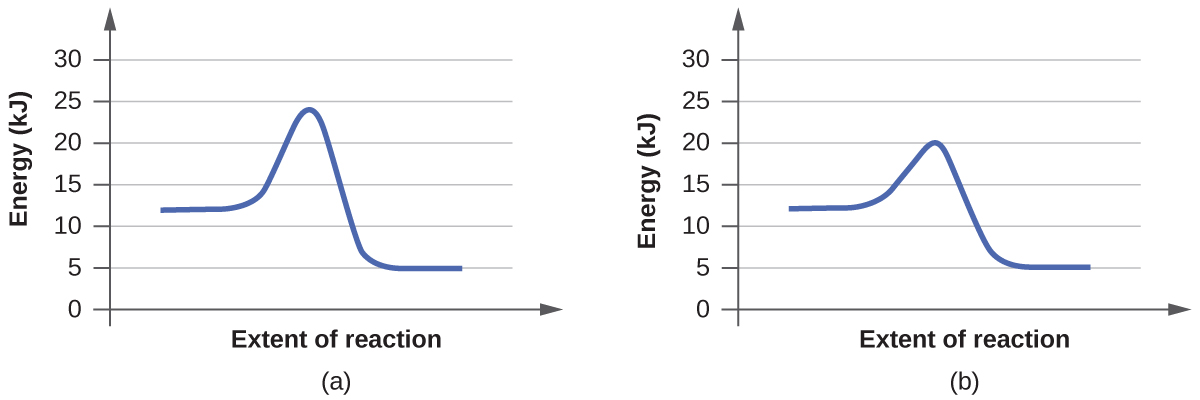
b.

12.8.5. For each of the following pairs of reaction diagrams, identify which of the pair is catalyzed:
a.

b.

12.8.6. For each of the following reaction diagrams, estimate the activation energy (\(E_\text{a}\)) of the reaction:
a.

b.

12.8.7. For each of the following reaction diagrams, estimate the activation energy (\(E_\text{a}\)) of the reaction:
a.

b.

12.8.8. Which statement about a catalyst is false?
a) It lowers the activation energy of a reaction.
b) It is regenerated by the end of the reaction.
c) It changes \(\Delta H\) for the reaction.
d) It speeds up the forward and reverse reactions.
12.8.9. Classify each catalyst as homogeneous or heterogeneous:
a. platinum, palladium and rhodium in an automobile catalytic converter acting on exhaust gases
b. chlorine atoms catalyzing the destruction of ozone in the stratosphere
c. \(\ce{H+}(aq)\) catalyzing the hydrolysis of sucrose in aqueous solution
d. solid iron in the Haber process, \(\ce{N2(g) + 3H2(g) -> 2NH3(g)}\)
12.8.10. Explain why adding a catalyst to a reaction mixture allows equilibrium to be reached faster but does not change the equilibrium constant.
12.8.11. A catalyst lowers the activation energy of a reaction from \(75\text{ kJ mol}^{-1}\) to \(50\text{ kJ mol}^{-1}\) at 298 K. Assuming the frequency factor \(A\) is unchanged, by what factor does the rate constant increase?
12.8.12. An enzyme lowers the activation energy of a reaction in the body from \(86\text{ kJ mol}^{-1}\) to \(46\text{ kJ mol}^{-1}\). Assuming the frequency factor is unchanged, by what factor does the enzyme increase the rate at 37 °C?
12.8.13. a. What is the active site of an enzyme?
b. Describe the difference between the lock-and-key model and the induced-fit model of enzyme–substrate binding.
12.8.14. Ethene reacts with hydrogen on the surface of nickel metal to form ethane, \(\ce{C2H4(g) + H2(g) -> C2H6(g)}\). List the main steps by which this heterogeneous catalyst works.
12.8.15. The decomposition of hydrogen peroxide is catalyzed by iodide ion by the mechanism:
Step 1: \(\ce{H2O2 + I^- -> H2O + IO^-}\) (slow)
Step 2: \(\ce{H2O2 + IO^- -> H2O + O2 + I^-}\) (fast)
a. Write the overall reaction.
b. Identify the catalyst and the intermediate.
c. Write the rate law predicted by this mechanism.
d. Is this homogeneous or heterogeneous catalysis?
12.9: Enzyme Kinetics - A Canadian Connection
12.9.1. For an enzyme-catalyzed reaction that follows Michaelis–Menten kinetics, what is the order of the reaction with respect to the substrate when \([\ce{S}] \gg K_M\)?
a) zero order
b) first order
c) second order
d) it depends on \([\ce{E}]_0\)
12.9.2. Brown found that the invertase-catalyzed hydrolysis of sucrose appeared to be first order in sucrose at low sucrose concentrations but zero order at high sucrose concentrations. Explain, in terms of the enzyme’s active sites, why no single rate law of the form \(\text{rate} = k[\text{sucrose}]^n\) can describe the reaction over the full range of concentrations.
12.9.3. Consider the mechanism
\[\ce{E + S <=> ES} \quad \text{(fast)} \qquad \ce{ES -> E + P} \quad \text{(slow)}\]
a. Write the overall reaction.
b. Identify the catalyst and the intermediate.
c. What is the molecularity of the second step, and what is its rate law?
12.9.4. Starting from the rate law for the slow step, \(\text{rate} = k_2[\ce{ES}]\), the pre-equilibrium condition \(k_1[\ce{E}][\ce{S}] = k_{-1}[\ce{ES}]\), and the mass balance \([\ce{E}]_0 = [\ce{E}] + [\ce{ES}]\), derive the expression
\[v_0 = \frac{k_2[\ce{E}]_0[\ce{S}]}{K_d + [\ce{S}]}, \qquad K_d = \frac{k_{-1}}{k_1}\]
12.9.5. The Michaelis constant, \(K_M\), is equal to the substrate concentration at which the initial rate is:
a) equal to \(V_{\max}\)
b) equal to \(V_{\max}/2\)
c) equal to \(2V_{\max}\)
d) zero
12.9.6. a. Show that the Michaelis–Menten equation reduces to a first-order rate law in S when \([\ce{S}] \ll K_M\), and give the apparent first-order rate constant.
b. Show that it reduces to a zero-order rate law when \([\ce{S}] \gg K_M\).
12.9.7. An enzyme has \(K_M = 2.5\text{ mM}\) and \(V_{\max} = 8.0 \times 10^{-5}\text{ M s}^{-1}\). Calculate the initial rate at each substrate concentration and express it as a fraction of \(V_{\max}\):
a. 0.50 mM
b. 2.5 mM
c. 25 mM
12.9.8. An enzyme has \(K_M = 0.20\text{ mM}\). What substrate concentration is needed for the enzyme to operate at 75% of \(V_{\max}\)?
12.9.9. A solution containing \(5.0\text{ nM}\) of an enzyme has \(V_{\max} = 2.0 \times 10^{-5}\text{ M s}^{-1}\).
a. Calculate the turnover number, \(k_\text{cat}\).
b. What does this value mean at the molecular level?
12.9.10. The concentration of enzyme in an assay is doubled while everything else is kept the same. What happens to (a) \(V_{\max}\) and (b) \(K_M\)? Explain.
12.9.11. A Lineweaver–Burk plot for an enzyme has a \(y\)-intercept of \(0.025\text{ s µM}^{-1}\) and a slope of \(0.050\text{ mM s µM}^{-1}\).
a. Determine \(V_{\max}\) and \(K_M\).
b. What is the \(x\)-intercept of the plot?
12.9.12. The following initial rates were measured for an enzyme-catalyzed reaction with \([\ce{E}]_0 = 2.0\text{ nM}\):
| [S] (mM) | 0.25 | 0.50 | 1.0 | 2.0 | 4.0 |
|---|---|---|---|---|---|
| \(v_0\) (µM s−1) | 6.0 | 10.0 | 15.0 | 20.0 | 24.0 |
Use a Lineweaver–Burk plot to determine \(V_{\max}\), \(K_M\), and \(k_\text{cat}\).
12.9.13. Enzyme A has \(K_M = 0.050\text{ mM}\) and enzyme B has \(K_M = 5.0\text{ mM}\) for the same substrate. The substrate concentration in the cell is 0.50 mM.
a. Calculate \(v_0/V_{\max}\) for each enzyme.
b. Which enzyme binds the substrate more tightly (in the pre-equilibrium picture)? Explain.
12.9.14. For an enzyme, \(k_1 = 1.0 \times 10^{7}\text{ M}^{-1}\text{ s}^{-1}\), \(k_{-1} = 1.0 \times 10^{3}\text{ s}^{-1}\), and \(k_2 = 50\text{ s}^{-1}\).
a. Calculate \(K_d = k_{-1}/k_1\) and the steady-state value \(K_M = (k_{-1} + k_2)/k_1\).
b. Is the pre-equilibrium approximation reasonable for this enzyme? Explain.
12.9.15. Alcohol dehydrogenase has a \(K_M\) for ethanol of about 1 mM. A blood alcohol content of 0.08% (0.80 g L−1) corresponds to about 17 mM ethanol.
a. Calculate \(v_0/V_{\max}\) at 17 mM and at 1.0 mM ethanol.
b. Use your answers to explain why alcohol is eliminated at a nearly constant rate (compare 12.4.11), and when this stops being true.
Solutions
S12.2: Chemical Reaction Rates
S12.2.1. Types of Reaction Rates
The average rate is the change in concentration divided by the time interval over which it occurs. The instantaneous rate is the rate at one moment, given by the slope of the tangent to the concentration–time curve at that time. The initial rate is the instantaneous rate at \(t = 0\).
S12.2.2. Relative Rates of Ozone Decomposition
Divide each rate of change by the species' coefficient; reactant terms are negative.
\[\text{rate} = -\frac{1}{2}\frac{\Delta[\ce{O3}]}{\Delta t} = \frac{1}{3}\frac{\Delta[\ce{O2}]}{\Delta t}\]
S12.2.3. Relative Rates in the Preparation of ClF3
\[\text{rate} = -\frac{\Delta[\ce{Cl2}]}{\Delta t} = -\frac{1}{3}\frac{\Delta[\ce{F2}]}{\Delta t} = \frac{1}{2}\frac{\Delta[\ce{ClF3}]}{\Delta t}\]
S12.2.4. Average and Instantaneous Rates: Butadiene Dimerization
a. \(\dfrac{1.00\times10^{-2} - 5.04\times10^{-3}}{1600\text{ s}} = \mathbf{3.10\times10^{-6}\text{ M s}^{-1}}\) and \(\dfrac{5.04\times10^{-3} - 3.37\times10^{-3}}{1600\text{ s}} = \mathbf{1.04\times10^{-6}\text{ M s}^{-1}}\)
b. The slope of the tangent at 3200 s (estimated from the points at 1600 s and 4800 s) gives \(\mathbf{\approx 7.8\times10^{-7}\text{ M s}^{-1}}\); any careful graphical estimate between about 7 and 8 × 10⁻⁷ M s−1 is acceptable.
c. One \(\ce{C8H12}\) forms for every two \(\ce{C4H6}\) consumed, so the rates are halved: average \(\mathbf{1.55\times10^{-6}\text{ M s}^{-1}}\) and instantaneous \(\mathbf{\approx 3.9\times10^{-7}\text{ M s}^{-1}}\).
S12.2.5. Average and Instantaneous Rates for 2A → B
a. \(\dfrac{1.00 - 0.625}{10.0\text{ s}} = \mathbf{0.0375\text{ M s}^{-1}}\) and \(\dfrac{0.625 - 0.370}{10.0\text{ s}} = \mathbf{0.0255\text{ M s}^{-1}}\)
b. The tangent at 15.0 s (estimated from the points at 10.0 s and 20.0 s) gives \(\mathbf{\approx 0.026\text{ M s}^{-1}}\).
c. One B forms for every two A consumed, so the rates are halved: \(\mathbf{0.0188\text{ M s}^{-1}}\) (average) and \(\mathbf{\approx 0.013\text{ M s}^{-1}}\) (instantaneous at 15.0 s).
S12.2.6. Relative Rates in Bromide Oxidation
Three \(\ce{Br2}\) form for every five \(\ce{Br^-}\) consumed.
\[\frac{\Delta[\ce{Br2}]}{\Delta t} = \frac{3}{5}\left(3.5\times10^{-4}\text{ M s}^{-1}\right) = \mathbf{2.1\times10^{-4}\text{ M s}^{-1}}\]
S12.2.7. Relative Rates: Multiple Choice
Answer: d)
Three C form for every one B consumed, so C forms at \(3 \times 0.030 = 0.090\text{ M s}^{-1}\).
S12.2.8. Rates in the Haber Process
a. \(\tfrac{3}{2}(0.40) = \mathbf{0.60\text{ M min}^{-1}}\)
b. \(\tfrac{1}{2}(0.40) = \mathbf{0.20\text{ M min}^{-1}}\)
c. \(\text{rate} = \tfrac{1}{2}\dfrac{\Delta[\ce{NH3}]}{\Delta t} = \mathbf{0.20\text{ M min}^{-1}}\), the same as the rate of consumption of \(\ce{N2}\), whose coefficient is 1.
S12.2.9. Why Rates Slow Down
Answer: b)
As reactants are consumed their concentrations fall, so collisions between reactant particles become less frequent and the rate decreases; the rate constant itself does not change.
S12.2.10. Average Rates: Decomposition of Hydrogen Peroxide
a. \(\dfrac{1.000\text{ M} - 0.500\text{ M}}{(6.00\text{ h})(3600\text{ s h}^{-1})} = \mathbf{2.31\times10^{-5}\text{ M s}^{-1}}\)
b. One \(\ce{O2}\) forms for every two \(\ce{H2O2}\) consumed: \(\mathbf{1.16\times10^{-5}\text{ M s}^{-1}}\).
S12.2.11. Interpreting Rate Expressions
a. The rate changes continuously, so a line between two points gives only the average over that interval; the tangent gives the rate at a single moment.
b. A reactant's concentration decreases, so \(\Delta[\text{reactant}]/\Delta t\) is negative; the negative sign makes the reported rate positive.
S12.2.12. Relative Rates: Decomposition of N2O5
a. \(2(1.5\times10^{-5}) = \mathbf{3.0\times10^{-5}\text{ M s}^{-1}}\)
b. \(4(1.5\times10^{-5}) = \mathbf{6.0\times10^{-5}\text{ M s}^{-1}}\)
S12.2.13. Units of Reaction Rate
Answer: a)
A rate is a change in concentration per unit time, so it has units of concentration divided by time (mol L−1 s−1, or M s−1).
S12.2.14. Choosing a Property to Monitor
a. The absorbance of the solution (spectrophotometry), which is proportional to the concentration of the coloured product.
b. The total pressure, which rises as gas is produced.
c. The pH (or the electrical conductivity) of the solution.
S12.2.15. Rates from Product Data
a. \(\dfrac{0.36\text{ M}}{20\text{ s}} = \mathbf{0.018\text{ M s}^{-1}}\) and \(\dfrac{0.58 - 0.36}{20\text{ s}} = \mathbf{0.011\text{ M s}^{-1}}\)
b. Half the rate of formation of B: \(\mathbf{0.0090\text{ M s}^{-1}}\) and \(\mathbf{0.0055\text{ M s}^{-1}}\).
c. A is being used up, so its concentration and therefore the rate decrease with time.
S12.3: Factors Affecting Reaction Rates
S12.3.1. Factors in the Reaction of Magnesium with Acid
A higher molarity of HCl increases the rate because collisions with \(\ce{H+}\) are more frequent. A higher temperature increases the rate because more collisions have at least the activation energy. Smaller pieces of magnesium increase the rate because they have more surface area exposed to the acid.
S12.3.2. Collision Orientation (PhET)
a. At most angles the O atom bounces off without reacting; a reaction occurs only when it strikes the correct end of the CO molecule.
b. Only collisions with a suitable orientation can lead to reaction, so the rate depends on the fraction of collisions that are correctly oriented, not just on how many collisions occur.
S12.3.3. Concentration and Temperature (PhET)
Increasing the concentration increases the rate because collisions become more frequent. Increasing the temperature increases the rate because particles move faster and a larger fraction of collisions have at least the activation energy.
S12.3.4. Energy Thresholds in a Closed Chamber (PhET)
a. Slow: at the default temperature few collisions have enough energy to reach the transition state.
b. The reaction becomes fast because most collisions now exceed the activation energy; at this high energy the reverse reaction also becomes fast, so the system quickly reaches a mixture of reactants and products (equilibrium).
S12.3.5. Factors That Do Not Increase the Rate
Answer: d)
Large lumps have less surface area exposed to the acid than small granules of the same mass, so fewer collisions occur per second and the rate decreases.
S12.3.6. Surface Area and Explosions
Suspended sawdust has an enormous surface area in contact with oxygen, so a huge number of collisions between wood and \(\ce{O2}\) occur each second. The combustion is therefore extremely fast and releases its heat almost at once, whereas a log can react only at its outer surface.
S12.3.7. Temperature and Food Spoilage
Spoilage is caused by chemical and enzyme-catalyzed reactions. At the lower temperature, fewer molecular collisions have at least the activation energy, so these reactions (and microbial growth) are much slower.
S12.3.8. The Chemical Nature of the Reactants
Answer: a)
Potassium has the lowest ionization energy of the four metals, so it loses its electron most readily and reacts vigorously with water; the others react slowly or not at all.
S12.3.9. Ionic versus Covalent Reactions
The precipitation reaction only requires oppositely charged ions that are already free in solution to come together, so it has almost no energy barrier. The combustion of methane requires strong covalent C–H and O=O bonds to break, so it has a large activation energy and does not occur at room temperature without a spark.
S12.3.10. The 10 °C Rule of Thumb
a. A 20 °C rise doubles the rate twice (×4), so the time is \(60/4 = \mathbf{15\text{ min}}\).
b. A 10 °C drop halves the rate, so the time doubles to \(\mathbf{120\text{ min}}\).
S12.3.11. Physical State of the Reactants
In gases and solutions the reactant particles are mobile and thoroughly mixed, so they collide frequently. In solids the particles are fixed in place and can react only where the two solids touch, so collisions are rare.
S12.3.12. How Catalysts Increase Rates
Answer: c)
The lower activation energy of the new pathway means a larger fraction of collisions are successful; the catalyst does not change the temperature, the collision energies, or the position of equilibrium.
S12.3.13. Concentration and the Course of a Reaction
a. In 2.0 M HCl, because the higher \([\ce{H+}]\) gives more frequent collisions with the metal surface.
b. The rate decreases with time, because \(\ce{H+}\) is consumed and the magnesium surface shrinks.
S12.3.14. Marble Chips versus Powdered Marble
a. The powder, because its larger surface area allows more collisions with \(\ce{H+}\) per second.
b. No. Both samples contain the same amount of \(\ce{CaCO3}\) and the acid is in excess, so the same total amount of \(\ce{CO2}\) forms; only the time taken differs.
S12.3.15. Identifying the Factor
a. catalyst
b. physical state (surface area)
c. concentration (of \(\ce{O2}\))
d. temperature
S12.4: Rate Laws
S12.4.1. Reaction Rate versus Rate Constant
The rate is the change in concentration per unit time; it changes as the reactant concentrations change. The rate constant \(k\) is the proportionality constant in the rate law; it does not depend on concentration but does depend on temperature (and on the presence of a catalyst).
S12.4.2. Order from Concentration Changes I
a. \(2^x = 4\), so the reaction is second order in that reactant.
b. \(3^y = 3\), so it is first order in that reactant.
S12.4.3. Order from Concentration Changes II
a. \(3^x = 9\), so \(x = 2\): second order.
b. \(4^y = 4\), so \(y = 1\): first order.
S12.4.4. Using a Second-Order Rate Law
a. Halving \([\ce{NO2}]\) changes the rate by \((1/2)^2\): the rate decreases to 1/4 of its original value.
b. CO does not appear in the rate law (zero order), so the rate is unchanged.
S12.4.5. Using a First-Order-in-Each Rate Law
a. The reaction is first order in \(\ce{NO2}\), so tripling its pressure triples the rate.
b. The reaction is first order in CO, so tripling its concentration triples the rate.
S12.4.6. Rate of Ozone Destruction by NO
\[\text{rate} = k[\ce{NO}][\ce{O3}] = (2.20\times10^{7})(3.3\times10^{-6})(5.9\times10^{-7}) = \mathbf{4.3\times10^{-5}\text{ M s}^{-1}}\]
S12.4.7. Rate of Beta Emission from Phosphorus-32
One electron is produced per \(\ce{^{32}P}\) nucleus that decays.
\[\text{rate} = (4.85\times10^{-2}\text{ day}^{-1})(0.0033\text{ M}) = \mathbf{1.6\times10^{-4}\text{ M day}^{-1}}\]
S12.4.8. Rate of Nitrogen Production from Carbon-14
\[\text{rate} = (1.21\times10^{-4}\text{ yr}^{-1})(6.5\times10^{-9}\text{ M}) = \mathbf{7.9\times10^{-13}\text{ M yr}^{-1}}\]
S12.4.9. Rate at a Lower Carbon-14 Content
\[\text{rate} = (1.21\times10^{-4}\text{ yr}^{-1})(1.5\times10^{-9}\text{ M}) = \mathbf{1.8\times10^{-13}\text{ M yr}^{-1}}\]
S12.4.10. Second-Order Decomposition of Acetaldehyde
\[\text{rate} = k[\ce{CH3CHO}]^2 = (4.71\times10^{-8})(5.55\times10^{-4})^2 = \mathbf{1.45\times10^{-14}\text{ M s}^{-1}}\]
S12.4.11. Zero-Order Removal of Alcohol from Blood
The rate does not change when the concentration changes, so the reaction is zero order: \(\text{rate} = k\), with \(\mathbf{k = 2.0\times10^{-2}\text{ mol L}^{-1}\text{ h}^{-1}}\) and an overall order of 0.
S12.4.12. Zero-Order Decomposition of Ammonia on a Metal Surface
The rate is independent of \([\ce{NH3}]\) because the metal surface is saturated, so the reaction is zero order: \(\text{rate} = k\), with \(\mathbf{k = 1.5\times10^{-6}\text{ mol L}^{-1}\text{ h}^{-1}}\) and an overall order of 0.
S12.4.13. Rate Law for the Decomposition of NOCl
Doubling [NOCl] quadruples the rate, so the reaction is second order: \(\text{rate} = k[\ce{NOCl}]^2\) (overall order 2).
\[k = \frac{8.0\times10^{-10}\text{ mol L}^{-1}\text{ h}^{-1}}{(0.10\text{ M})^2} = \mathbf{8.0\times10^{-8}\text{ L mol}^{-1}\text{ h}^{-1}}\]
S12.4.14. Rate Law for A → 2C
Doubling [A] quadruples the rate, so the reaction is second order in A: \(\text{rate} = k[\ce{A}]^2\).
\[k = \frac{3.80\times10^{-7}}{(1.33\times10^{-2})^2} = \mathbf{2.15\times10^{-3}\text{ L mol}^{-1}\text{ h}^{-1}}\]
S12.4.15. Method of Initial Rates: NO and Cl2
Doubling [NO] (trials 1→2) quadruples the rate, so the reaction is second order in NO; doubling \([\ce{Cl2}]\) (trials 2→3) doubles the rate, so it is first order in \(\ce{Cl2}\).
\[\text{rate} = k[\ce{NO}]^2[\ce{Cl2}] \qquad k = \frac{1.14}{(0.50)^2(0.50)} = \mathbf{9.12\text{ L}^2\text{ mol}^{-2}\text{ h}^{-1}}\]
S12.4.16. Method of Initial Rates: Formation of Laughing Gas
Doubling [NO] quadruples the rate (second order in NO); doubling \([\ce{H2}]\) doubles the rate (first order in \(\ce{H2}\)).
\[\text{rate} = k[\ce{NO}]^2[\ce{H2}] \qquad k = \frac{2.835\times10^{-3}}{(0.30)^2(0.35)} = \mathbf{0.0900\text{ L}^2\text{ mol}^{-2}\text{ s}^{-1}}\]
S12.4.17. Order from Non-Integer Concentration Ratios: A → B + C
a. Using trials 1 and 2: \(\dfrac{9.99\times10^{-4}}{4.17\times10^{-4}} = \left(\dfrac{0.356}{0.230}\right)^x\), so \(2.40 = 1.548^x\) and \(x = 2\). The reaction is second order: \(\mathbf{\text{rate} = k[\ce{A}]^2}\).
b. \(k = \dfrac{4.17\times10^{-4}}{(0.230)^2} = \mathbf{7.88\times10^{-3}\text{ L mol}^{-1}\text{ s}^{-1}}\)
S12.4.18. Order from Non-Integer Concentration Ratios: Q → W + X
a. \(\dfrac{2.94\times10^{-2}}{6.68\times10^{-3}} = \left(\dfrac{0.357}{0.170}\right)^x\) gives \(4.40 = 2.10^x\), so \(x = 2\): \(\mathbf{\text{rate} = k[\ce{Q}]^2}\).
b. \(k = \dfrac{6.68\times10^{-3}}{(0.170)^2} = \mathbf{0.231\text{ L mol}^{-1}\text{ s}^{-1}}\)
S12.4.19. Rate of N2O5 Decomposition
\[\text{rate} = k[\ce{N2O5}] = (6.2\times10^{-4}\text{ min}^{-1})(0.40\text{ M}) = \mathbf{2.5\times10^{-4}\text{ M min}^{-1}}\]
S12.4.20. Rate-Limiting Step in Nitric Acid Production
The rate of reaction (b) is \(k[\ce{NO}]^2[\ce{O2}] = (5.8\times10^{-6})(0.75)^2(0.50) = 1.6\times10^{-6}\text{ M s}^{-1}\). Two \(\ce{NO2}\) form per reaction, so \(\ce{NO2}\) is formed at \(\mathbf{3.3\times10^{-6}\text{ M s}^{-1}}\).
S12.4.21. Method of Initial Rates: Hypoiodite Formation
Doubling \([\ce{I^-}]\) (trials 1→2) doubles the rate, so the reaction is first order in \(\ce{I^-}\); trial 3 then requires first order in \(\ce{OCl^-}\) (\(6.20\times10^{-4}\times\tfrac{0.30}{0.20}\times\tfrac{0.010}{0.050} = 1.86\times10^{-4}\)).
\[\text{rate} = k[\ce{I^-}][\ce{OCl^-}] \qquad k = \frac{3.05\times10^{-4}}{(0.10)(0.050)} = \mathbf{6.1\times10^{-2}\text{ L mol}^{-1}\text{ s}^{-1}}\]
S12.4.22. Rate Law from Partial Pressures
a. Doubling \(P_{\ce{Cl2}}\) (experiments 1→3) doubles the rate, and doubling \(P_{\ce{NO}}\) (3→2) quadruples it: \(\text{rate} = kP_{\ce{NO}}^2P_{\ce{Cl2}}\), second order in NO, first order in \(\ce{Cl2}\), third order overall.
b. \(k = \dfrac{5.1\times10^{-3}}{(0.50)^2(0.50)} = \mathbf{4.1\times10^{-2}\text{ atm}^{-2}\text{ s}^{-1}}\)
S12.5: Integrated Rate Laws
S12.5.1. Using Graphs to Find Reaction Order
Plot \([\ce{A}]\), \(\ln[\ce{A}]\), and \(1/[\ce{A}]\) against time; the plot that is a straight line identifies the order (zero, first, or second order, respectively). The rate constant comes from the slope: \(k = -\text{slope}\) for zero- and first-order plots and \(k = +\text{slope}\) for the second-order plot.
S12.5.2. Graphical Analysis: Decomposition of SO2Cl2
A plot of \(\ln[\ce{SO2Cl2}]\) versus time is linear (the \([\ce{SO2Cl2}]\) and \(1/[\ce{SO2Cl2}]\) plots are curved), so the reaction is first order. The slope is \(-2.20\times10^{-5}\text{ s}^{-1}\), so \(\mathbf{k = 2.20\times10^{-5}\text{ s}^{-1}}\).
S12.5.3. When the Data Cannot Decide the Order
Plots of [P], \(\ln[\ce{P}]\), and \(1/[\ce{P}]\) versus time are all essentially linear (\(R^2 \approx 0.9995\) for each), so the order cannot be determined from these data. Only about 3.5% of P reacts over the time studied, and over such a small change every curve looks straight; data covering at least one or two half-lives are needed. (If the zero-order plot is used, \(k = 2.4\times10^{-6}\text{ M s}^{-1}\).)
S12.5.4. Graphical Analysis: Decomposition of Ozone
Only the plot of \(1/[\ce{O3}]\) versus time is linear, so the reaction is second order. Its slope gives \(\mathbf{k = 50.2\text{ L mol}^{-1}\text{ h}^{-1}}\).
S12.5.5. Graphical Analysis: 2X → Y + Z
Only the plot of \(1/[\ce{X}]\) versus time is linear, so the reaction is second order. Its slope gives \(\mathbf{k = 2.00\text{ L mol}^{-1}\text{ s}^{-1}}\).
S12.5.6. Half-Life of Phosphorus-32
\[t_{1/2} = \frac{\ln 2}{k} = \frac{0.693}{4.85\times10^{-2}\text{ day}^{-1}} = \mathbf{14.3\text{ days}}\]
S12.5.7. Half-Life of Carbon-14
\[t_{1/2} = \frac{0.693}{1.21\times10^{-4}\text{ yr}^{-1}} = \mathbf{5.73\times10^{3}\text{ years}}\]
S12.5.8. Second-Order Half-Life: NOCl
\[t_{1/2} = \frac{1}{k[\ce{A}]_0} = \frac{1}{(8.0\times10^{-8})(0.15)} = \mathbf{8.3\times10^{7}\text{ s}}\]
S12.5.9. Second-Order Half-Life: Ozone
\[t_{1/2} = \frac{1}{(50.4)(2.35\times10^{-6})} = \mathbf{8.44\times10^{3}\text{ h}}\]
S12.5.10. Second-Order Half-Life: Compound A
\[t_{1/2} = \frac{1}{(2.42)(0.500)} = \mathbf{0.826\text{ s}}\]
S12.5.11. Time to Reach a Concentration: First versus Second Order
a. \(k = 0.693/8.50 = 0.0815\text{ min}^{-1}\), so \(t = \dfrac{\ln(0.150/0.0300)}{0.0815} = \mathbf{19.7\text{ min}}\).
b. \(k = \dfrac{1}{(8.50)(0.150)} = 0.784\text{ L mol}^{-1}\text{ min}^{-1}\), so \(t = \dfrac{1}{0.784}\left(\dfrac{1}{0.0300} - \dfrac{1}{0.150}\right) = \mathbf{34.0\text{ min}}\).
S12.5.12. Kinetics of Penicillinase
The rate is proportional to [penicillin], so the reaction is first order in penicillin: \(\text{rate} = k[\text{enzyme}][\text{penicillin}]\). The enzyme concentration is \((0.15\times10^{-6}\text{ g})/(3\times10^{4}\text{ g mol}^{-1})/(1.0\text{ L}) = 5.0\times10^{-12}\text{ M}\).
\[k = \frac{1.0\times10^{-10}}{(5.0\times10^{-12})(2.0\times10^{-6})} = \mathbf{1.0\times10^{7}\text{ L mol}^{-1}\text{ min}^{-1}}\]
S12.5.13. Medical Isotopes: Tc-99m and Tl-201
Fraction remaining \(= (1/2)^{t/t_{1/2}}\).
Technetium: \((1/2)^{48/6} = (1/2)^{8} = \mathbf{0.39\%}\). Thallium: \((1/2)^{48/73} = \mathbf{63\%}\).
S12.5.14. Isomerization of Cyclopropane
\(t_{1/2} = 0.693/(5.95\times10^{-4}\text{ s}^{-1}) = \mathbf{1.16\times10^{3}\text{ s}}\) (19.4 min). After 0.75 h (2700 s):
\[\frac{[\ce{A}]}{[\ce{A}]_0} = e^{-(5.95\times10^{-4})(2700)} = \mathbf{0.20}\]
S12.5.15. Fluorine-18 in Medical Imaging
a. \(k = 0.693/109.7\text{ min} = \mathbf{6.32\times10^{-3}\text{ min}^{-1}}\)
b. \(5.59\text{ h} = 335.4\text{ min}\): \(e^{-(6.32\times10^{-3})(335.4)} = 0.120\), so \(\mathbf{12.0\%}\) remains.
c. When 0.01% remains, \(t = \dfrac{\ln(100/0.01)}{6.32\times10^{-3}} = \mathbf{1.46\times10^{3}\text{ min}}\) (24.3 h).
S12.5.16. Biodegradation of Steroids
\(\tfrac{1}{64} = (\tfrac{1}{2})^6\), so six half-lives are needed: \(6 \times 42 = \mathbf{252\text{ days}}\).
S12.5.17. Radiocarbon Dating of King Richard III
\(k = 0.693/5730 = 1.21\times10^{-4}\text{ yr}^{-1}\), so \(t = \dfrac{-\ln(0.9379)}{1.21\times10^{-4}} = 530\text{ years}\). The skeleton was found in 2012, so he died in about 1482 (historical records give 1485).
S12.5.18. First-Order Decomposition of Nitroglycerine
For each experiment, \(k = -\ln(1 - f)/t\), where \(f\) is the fraction decomposed; e.g. \(-\ln(0.480)/300\text{ s} = 2.45\times10^{-3}\text{ s}^{-1}\).
| [A]0 (M) | 4.88 | 3.52 | 2.29 | 1.81 | 5.33 | 4.05 | 2.95 | 1.72 |
|---|---|---|---|---|---|---|---|---|
| k (10−3 s−1) | 2.45 | 2.51 | 2.53 | 2.58 | 2.36 | 2.47 | 2.48 | 2.43 |
The average is \(\mathbf{2.48\times10^{-3}\text{ s}^{-1}}\); \(k\) does not depend on the initial concentration, as expected for a first-order reaction.
S12.5.19. Isomerization of Cyclobutene
The fraction remaining after 1800 s is \(e^{-(2.0\times10^{-4})(1800)} = 0.698\), so \(P = (55\text{ torr})(0.698) = \mathbf{38\text{ torr}}\). The initial concentration is \(P/RT = (55/760\text{ atm})/(0.08206 \times 423.15\text{ K}) = 2.08\times10^{-3}\text{ M}\), so the final concentration is \(\mathbf{1.45\times10^{-3}\text{ M}}\).
S12.5.20. Deriving the Zero-Order Half-Life
At \(t = t_{1/2}\), \([\ce{A}] = [\ce{A}]_0/2\):
\[\frac{[\ce{A}]_0}{2} = [\ce{A}]_0 - kt_{1/2} \quad\Rightarrow\quad \mathbf{t_{1/2} = \frac{[\ce{A}]_0}{2k}}\]
Because A is consumed at a constant rate, a larger starting amount takes proportionally longer to fall by half.
S12.5.21. Zero-Order Decomposition of Ammonia on Tungsten
a. \([\ce{NH3}] = 0.0400 - (2.5\times10^{-4})(60.0) = \mathbf{0.0250\text{ M}}\)
b. \(t = [\ce{NH3}]_0/k = 0.0400/2.5\times10^{-4} = \mathbf{160\text{ s}}\)
c. \(t_{1/2} = [\ce{NH3}]_0/2k = \mathbf{80.0\text{ s}}\)
S12.5.22. Deriving the Second-Order Half-Life
Substituting \([\ce{A}] = [\ce{A}]_0/2\) gives \(\dfrac{2}{[\ce{A}]_0} - \dfrac{1}{[\ce{A}]_0} = kt_{1/2}\), so \(\mathbf{t_{1/2} = \dfrac{1}{k[\ce{A}]_0}}\). Each half-life starts from half the previous concentration, so each successive half-life is twice as long as the one before.
S12.6: Collision Theory
S12.6.1. Requirements for an Effective Collision
The colliding particles may not have enough energy (at least the activation energy), or they may not be oriented correctly for the necessary bonds to break and form.
S12.6.2. When Every Collision Is Effective
The rate equals the collision frequency, which depends on the concentrations of the reactants and on how fast the particles move (the temperature).
S12.6.3. Activation Energy and the Activated Complex
The activation energy is the minimum energy that colliding reactants must have for a reaction to occur. It equals the difference in energy between the activated complex (the transition state at the top of the energy barrier) and the reactants.
S12.6.4. Arrhenius Plots
Plot \(\ln k\) against \(1/T\) (in K); the result is a straight line with slope \(-E_\text{a}/R\). The activation energy is therefore \(E_\text{a} = -R \times \text{slope}\).
S12.6.5. Temperature and Collision Theory
Raising the temperature increases the rate. Molecules move faster and collide more often, but the main effect is that a much larger fraction of collisions have at least the activation energy.
S12.6.6. Doubling the Rate Every 10 °C
a. A 20 °C rise is two doublings: \(2^2 = \mathbf{4\ times}\) faster.
b. A 70 °C rise is seven doublings: \(2^7 = \mathbf{128\ times}\) faster.
S12.6.7. Decomposition of NaClO3 at a Higher Temperature
A 20 °C rise makes the reaction about 4 times faster, so the time is about \(48/4 = \mathbf{12\text{ min}}\).
S12.6.8. Frequency Factor for Cyclobutane Decomposition
\[A = \frac{k}{e^{-E_\text{a}/RT}} = \frac{6.1\times10^{-8}\text{ s}^{-1}}{e^{-(261\,000)/(8.314)(598.15)}} = \mathbf{3.8\times10^{15}\text{ s}^{-1}}\]
S12.6.9. Activation Energy for Acetaldehyde Decomposition
\[\ln\frac{k_2}{k_1} = \frac{E_\text{a}}{R}\left(\frac{1}{T_1} - \frac{1}{T_2}\right) \;\Rightarrow\; E_\text{a} = \frac{(8.314)\ln(4.95/0.011)}{(1/703 - 1/865)} = \mathbf{191\text{ kJ mol}^{-1}}\]
S12.6.10. Temperature Control in the ALP Assay
\[E_\text{a} = \frac{R\ln(1.47)}{(1/303.15 - 1/310.15)} = \frac{(8.314)(0.385)}{7.45\times10^{-5}\text{ K}^{-1}} = \mathbf{43.0\text{ kJ mol}^{-1}}\]
S12.6.11. What the Rate Is Proportional To
Answer: c)
Collision theory states that the rate is proportional to the number of collisions per second (more precisely, to the number of effective collisions per second).
S12.6.12. Arrhenius Plot for HI Decomposition
A plot of \(\ln k\) versus \(1/T\) is linear with slope \(-2.17\times10^{4}\text{ K}\).
\[E_\text{a} = -R \times \text{slope} = (8.314)(2.17\times10^{4}) = \mathbf{180\text{ kJ mol}^{-1}}\]
S12.6.13. Activation Energy for Reduction of a Cobalt(III) Complex
\[E_\text{a} = \frac{R\ln(0.100/0.054)}{(1/293 - 1/298)} = \frac{(8.314)(0.616)}{5.73\times10^{-5}\text{ K}^{-1}} = \mathbf{89\text{ kJ mol}^{-1}}\]
S12.6.14. Kinetics of Sucrose Hydrolysis
a. \(E_\text{a} = \dfrac{R\ln(8.5/2.1)}{(1/300.15 - 1/310.15)} = \mathbf{108\text{ kJ mol}^{-1}}\); \(A = k/e^{-E_\text{a}/RT} = \mathbf{1.4\times10^{8}\text{ s}^{-1}}\); at 320.15 K, \(\mathbf{k = 3.2\times10^{-10}\text{ s}^{-1}}\).
b. \(t = \dfrac{\ln(0.150/1.65\times10^{-7})}{2.1\times10^{-11}\text{ s}^{-1}} = \mathbf{6.5\times10^{11}\text{ s}}\) (about 21 000 years).
c. If the reverse reaction can be ignored, the simple first-order integrated rate law applies; otherwise the rate of the reverse reaction would also have to be included.
S12.6.15. Energy and the Transition State (PhET)
Below the transition state, A bounces off BC and no reaction occurs, because the collision does not have enough energy to reach the activated complex. Above the transition state, the collision can pass over the barrier, so AB and C form.
S12.6.16. Orientation and the Transition State (PhET)
A reacts only when it strikes the B end of BC; at other angles it bounces off even though it has enough energy. A successful collision needs both sufficient energy and the correct orientation.
S12.6.17. Reading a Reaction Diagram
a. \(E_\text{a,f} = 120 - 50 = \mathbf{70\text{ kJ}}\)
b. \(\Delta E = 20 - 50 = \mathbf{-30\text{ kJ}}\); the reaction is exothermic.
c. \(E_\text{a,r} = 120 - 20 = \mathbf{100\text{ kJ}}\), which equals \(E_\text{a,f} - \Delta E\).
S12.6.18. Activation Energy of the Reverse Reaction
Answer: b)
The products lie 40 kJ mol−1 above the reactants, so the barrier from the product side is \(95 - 40 = 55\text{ kJ mol}^{-1}\).
S12.6.19. Transition States versus Intermediates
a. A transition state is at an energy maximum (the top of a barrier); an intermediate is in an energy minimum (a valley) between two transition states.
b. An intermediate, because it is a real species with a finite lifetime. A transition state exists only for the instant at which bonds are partly broken and partly formed, so it cannot be isolated.
S12.7: Reaction Mechanisms
S12.7.1. Why Termolecular Steps Are Rare
A termolecular step requires three particles to collide at the same instant with enough energy and the correct orientation, which is very improbable. Most mechanisms therefore consist of unimolecular and bimolecular steps.
S12.7.2. Predicting Rate Laws from Equations
No; the rate law of an overall reaction must be determined by experiment. Yes, if the reaction is elementary: rate = \(k[\ce{A}][\ce{B}]\), so doubling [A] doubles the rate.
S12.7.3. Mechanism for the Formation of Phosgene
a. Adding the steps and cancelling species that appear on both sides gives \(\mathbf{\ce{CO + Cl2 -> COCl2}}\).
b. \(\mathbf{\ce{COCl}}\) is an intermediate: it is formed in step 1 and consumed in step 2.
c. \(\mathbf{\ce{Cl}}\) is a catalyst: it is consumed in step 1 and regenerated in step 2.
S12.7.4. Mechanism Vocabulary
a. An elementary step in which a single particle rearranges or decomposes.
b. An elementary step in which two particles collide and react.
c. A single step in a mechanism that occurs exactly as written; its rate law follows from its molecularity.
d. The net change, equal to the sum of the elementary steps; its rate law must be found by experiment.
S12.7.5. Rate Laws for Termolecular Steps
For an elementary step the orders equal the coefficients: \(\mathbf{\text{rate} = k[\ce{A}][\ce{B}]^2}\) and \(\mathbf{\text{rate} = k[\ce{A}]^3}\).
S12.7.6. Could the Reaction Be Elementary?
(b), (d), and (e): in each, the orders match the coefficients. In (a) the order is fractional and in (c) the order in NO (1) does not match its coefficient (2), so these cannot be single elementary steps.
S12.7.7. Rate Laws for Elementary Steps
a. rate = \(k[\ce{O3}]\)
b. rate = \(k[\ce{O3}][\ce{Cl}]\)
c. rate = \(k[\ce{ClO}][\ce{O}]\)
d. rate = \(k[\ce{O3}][\ce{NO}]\)
e. rate = \(k[\ce{NO2}][\ce{O}]\)
S12.7.8. Rate Law from a Slow First Step
The rate is set by the slow first step, whose rate law follows from its coefficients: \(\mathbf{\text{rate} = k[\ce{NO}]^2[\ce{H2}]}\).
S12.7.9. Chain Termination (optional)
Answer: b)
This step consumes one radical but produces another (Cl), so the chain continues; steps a, c and d combine two radicals into a stable molecule and end the chain.
S12.7.10. Rate Law and Mechanism for the NO–H2 Reaction
a. Doubling \([\ce{H2}]\) (1→2) doubles the rate: first order in \(\ce{H2}\). Doubling [NO] (3→4) quadruples the rate: second order in NO.
b. \(\mathbf{\text{rate} = k[\ce{NO}]^2[\ce{H2}]}\)
c. \(k = \dfrac{1.8\times10^{-4}}{(0.0060)^2(0.0010)} = \mathbf{5.0\times10^{3}\text{ L}^2\text{ mol}^{-2}\text{ min}^{-1}}\)
d. NO and \(\ce{H2}\) react 1:1, so 0.0010 M of each is consumed: \([\ce{NO}] = 0.0060 - 0.0010 = \mathbf{0.0050\text{ M}}\).
e. Step 2. With step 1 a fast equilibrium, \([\ce{N2O2}] = K[\ce{NO}]^2\), so rate \(= k_2[\ce{N2O2}][\ce{H2}] = k_2K[\ce{NO}]^2[\ce{H2}]\), which matches the observed rate law. Adding the three steps gives \(\ce{2NO + 2H2 -> N2 + 2H2O}\).
S12.7.11. Fast Pre-Equilibrium in Phosgene Formation
a. \(\mathbf{\ce{CO + Cl2 -> COCl2}}\)
b. \(\mathbf{\ce{Cl}}\) and \(\mathbf{\ce{COCl}}\)
c. Step 1: \(\text{rate}_1 = k_1[\ce{Cl2}]\), \(\text{rate}_{-1} = k_{-1}[\ce{Cl}]^2\); step 2: \(\text{rate}_2 = k_2[\ce{CO}][\ce{Cl}]\); step 3: \(\text{rate}_3 = k_3[\ce{COCl}][\ce{Cl}]\).
d. The slow step gives rate \(= k_2[\ce{CO}][\ce{Cl}]\); from the fast equilibrium, \([\ce{Cl}] = (k_1/k_{-1})^{1/2}[\ce{Cl2}]^{1/2}\), so
\[\text{rate} = k_2\left(\frac{k_1}{k_{-1}}\right)^{1/2}[\ce{CO}][\ce{Cl2}]^{1/2}\]
S12.7.12. Fast Pre-Equilibrium: Oxidation of NO
a. \(\mathbf{\ce{N2O2}}\)
b. The slow step gives rate \(= k_2[\ce{N2O2}][\ce{O2}]\). At equilibrium in step 1, \(k_1[\ce{NO}]^2 = k_{-1}[\ce{N2O2}]\), so
\[\text{rate} = \frac{k_2k_1}{k_{-1}}[\ce{NO}]^2[\ce{O2}] = \mathbf{k[\ce{NO}]^2[\ce{O2}]}\]
S12.7.13. Testing a Mechanism: Formation of HI
The steps add to \(\ce{H2 + I2 -> 2HI}\) once the intermediate I cancels. The slow step gives rate \(= k_2[\ce{H2}][\ce{I}]^2\), and the fast equilibrium gives \([\ce{I}]^2 = K[\ce{I2}]\), so rate \(= k_2K[\ce{H2}][\ce{I2}]\), which matches the experiment.
S12.7.14. Choosing a Plausible Mechanism
Answer: b)
Its slow first step gives rate = \(k[\ce{NO2}][\ce{F2}]\), and the steps add to the overall equation; mechanism a predicts \([\ce{NO2}]^2[\ce{F2}]\), c predicts \([\ce{NO2}][\ce{F2}]^{1/2}\), and d predicts \([\ce{NO2}]^2[\ce{F2}]\).
S12.7.15. Properties of Intermediates
Answer: b)
An intermediate cancels when the steps are added, so it does not appear in the overall equation or in the experimental rate law, and unlike a transition state it sits in an energy minimum.
S12.8: Catalysis
S12.8.1. How a Catalyst Increases the Rate
A catalyst provides an alternative pathway (mechanism) with a lower activation energy. At the same temperature a larger fraction of collisions then have enough energy to react, and the catalyst is regenerated at the end of the pathway.
S12.8.2. Homogeneous versus Heterogeneous Catalysts
A homogeneous catalyst is in the same phase as the reactants and acts by forming intermediates with them in solution or in the gas phase. A heterogeneous catalyst is in a different phase, usually a solid; reactants adsorb on its surface, react there, and the products desorb.
S12.8.3. Catalytic Destruction of Ozone
a. Cl is consumed in the second step and regenerated in the third, so it does not appear in the overall equation but speeds up the reaction.
b. Yes. NO is consumed in the second step and regenerated in the third, so it acts as a catalyst in the same way.
S12.8.4. Identifying Catalyzed Pathways I
a. Diagram (b): its barrier peaks at about 20 kJ, compared with about 24 kJ for (a), from the same reactants.
b. Diagram (b): its barrier peaks at about 32 kJ, compared with about 43 kJ for (a).
S12.8.5. Identifying Catalyzed Pathways II
a. Diagram (b): the first barriers are the same (about 45 kJ), but the second barrier is lower (about 37 kJ versus 43 kJ).
b. Diagram (b): its first, highest barrier is lower (about 40 kJ versus 45 kJ) from the same reactant energy.
S12.8.6. Estimating Ea from One-Step Diagrams
\(E_\text{a}\) is the energy of the peak minus the energy of the reactants.
a. \(35 - 10 = \mathbf{25\text{ kJ}}\)
b. \(20 - 10 = \mathbf{10\text{ kJ}}\)
S12.8.7. Estimating Ea from Two-Step Diagrams
The activation energy of the reaction is the height of the highest transition state above the reactants.
a. \(45 - 35 = \mathbf{10\text{ kJ}}\) (the second step's barrier, from the intermediate at 25 kJ to 30 kJ, is only 5 kJ).
b. \(45 - 35 = \mathbf{10\text{ kJ}}\) (the second step's barrier, from the intermediate at 40 kJ to 45 kJ, is 5 kJ).
S12.8.8. Statements about Catalysts
Answer: c)
\(\Delta H\) depends only on the energies of the reactants and products, which a catalyst does not change; it only lowers the barrier between them.
S12.8.9. Classifying Catalysts
a. heterogeneous (solid catalyst, gaseous reactants)
b. homogeneous (all in the gas phase)
c. homogeneous (all in aqueous solution)
d. heterogeneous (solid catalyst, gaseous reactants)
S12.8.10. Catalysts and Equilibrium
A catalyst lowers the activation energies of the forward and reverse reactions by the same amount, so both rates increase by the same factor. Their ratio, and therefore \(K\), is unchanged; equilibrium is simply reached sooner.
S12.8.11. How Much Faster? Lowering Ea
\[\frac{k_\text{cat}}{k} = e^{(E_\text{a} - E_\text{a,cat})/RT} = e^{25\,000/(8.314)(298)} = e^{10.1} = \mathbf{2.4\times10^{4}}\]
S12.8.12. Enzyme Catalysis at Body Temperature
\[\frac{k_\text{enz}}{k} = e^{40\,000/(8.314)(310.15)} = e^{15.5} = \mathbf{5.5\times10^{6}}\]
S12.8.13. Models of Enzyme Action
a. The region of the enzyme where the substrate binds and the reaction takes place.
b. In the lock-and-key model the substrate fits a rigid active site of complementary shape; in the induced-fit model the active site changes shape as the substrate binds, giving a tighter fit.
S12.8.14. Steps in Heterogeneous Catalysis
The reactants adsorb onto the nickel surface, where the H–H bond is weakened and H atoms form. The H atoms move across the surface and add to the adsorbed ethene, and the product, ethane, desorbs, freeing the surface sites.
S12.8.15. Iodide-Catalyzed Decomposition of H2O2
a. \(\mathbf{\ce{2H2O2 -> 2H2O + O2}}\)
b. Catalyst: \(\mathbf{\ce{I^-}}\) (consumed, then regenerated). Intermediate: \(\mathbf{\ce{IO^-}}\) (formed, then consumed).
c. From the slow step: \(\mathbf{\text{rate} = k[\ce{H2O2}][\ce{I^-}]}\)
d. Homogeneous: everything is in aqueous solution.
S12.9: Enzyme Kinetics - A Canadian Connection
S12.9.1. Order at High Substrate Concentration
Answer: a)
When \([\ce{S}] \gg K_M\), \(v_0 \approx V_{\max}\): every active site is occupied, so adding more substrate does not change the rate.
S12.9.2. A Reaction That Seems to Change Order
At low [S], most active sites are empty, so doubling [S] doubles the number of ES complexes and the rate (first order). At high [S], essentially all active sites are occupied (the enzyme is saturated), so extra substrate cannot increase the rate (zero order). The apparent order changes because the fraction of occupied sites changes with [S].
S12.9.3. Reading the Michaelis–Menten Mechanism
a. \(\mathbf{\ce{S -> P}}\)
b. Catalyst: \(\mathbf{\ce{E}}\) (consumed in step 1, regenerated in step 2). Intermediate: \(\mathbf{\ce{ES}}\) (formed in step 1, consumed in step 2).
c. Unimolecular: \(\mathbf{\text{rate} = k_2[\ce{ES}]}\).
S12.9.4. Deriving the Michaelis–Menten Equation
Substitute \([\ce{E}] = [\ce{E}]_0 - [\ce{ES}]\) into the pre-equilibrium condition and collect the [ES] terms:
\[k_1([\ce{E}]_0 - [\ce{ES}])[\ce{S}] = k_{-1}[\ce{ES}] \;\Rightarrow\; [\ce{ES}] = \frac{k_1[\ce{E}]_0[\ce{S}]}{k_{-1} + k_1[\ce{S}]} = \frac{[\ce{E}]_0[\ce{S}]}{K_d + [\ce{S}]}\]
Multiplying by \(k_2\) gives \(\mathbf{v_0 = \dfrac{k_2[\ce{E}]_0[\ce{S}]}{K_d + [\ce{S}]}}\).
S12.9.5. The Meaning of KM
Answer: b)
Setting \([\ce{S}] = K_M\) in \(v_0 = V_{\max}[\ce{S}]/(K_M + [\ce{S}])\) gives \(v_0 = V_{\max}K_M/2K_M = V_{\max}/2\).
S12.9.6. Limiting Forms of the Michaelis–Menten Equation
a. If \([\ce{S}] \ll K_M\), then \(K_M + [\ce{S}] \approx K_M\), so \(v_0 \approx \dfrac{V_{\max}}{K_M}[\ce{S}]\): first order, with apparent rate constant \(\mathbf{V_{\max}/K_M}\).
b. If \([\ce{S}] \gg K_M\), then \(K_M + [\ce{S}] \approx [\ce{S}]\), so \(v_0 \approx \mathbf{V_{\max}}\), which does not depend on [S] (zero order).
S12.9.7. Calculating Initial Rates
Use \(v_0 = V_{\max}[\ce{S}]/(K_M + [\ce{S}])\), with [S] and \(K_M\) both in mM.
a. \(v_0 = \dfrac{(8.0\times10^{-5})(0.50)}{2.5 + 0.50} = \mathbf{1.3\times10^{-5}\text{ M s}^{-1}}\) (0.17 \(V_{\max}\))
b. \(v_0 = \mathbf{4.0\times10^{-5}\text{ M s}^{-1}}\) (0.50 \(V_{\max}\), since \([\ce{S}] = K_M\))
c. \(v_0 = \dfrac{(8.0\times10^{-5})(25)}{2.5 + 25} = \mathbf{7.3\times10^{-5}\text{ M s}^{-1}}\) (0.91 \(V_{\max}\))
S12.9.8. Substrate Needed for a Target Rate
\[0.75 = \frac{[\ce{S}]}{K_M + [\ce{S}]} \;\Rightarrow\; 0.25[\ce{S}] = 0.75K_M \;\Rightarrow\; [\ce{S}] = 3K_M = \mathbf{0.60\text{ mM}}\]
S12.9.9. Turnover Number
a. \(k_\text{cat} = \dfrac{V_{\max}}{[\ce{E}]_0} = \dfrac{2.0\times10^{-5}\text{ M s}^{-1}}{5.0\times10^{-9}\text{ M}} = \mathbf{4.0\times10^{3}\text{ s}^{-1}}\)
b. When the enzyme is saturated, each enzyme molecule converts about 4000 substrate molecules into product every second.
S12.9.10. Changing the Enzyme Concentration
a. \(V_{\max}\) doubles, because \(V_{\max} = k_\text{cat}[\ce{E}]_0\) is proportional to the total enzyme concentration.
b. \(K_M\) is unchanged: it depends only on the rate constants (\(k_1\), \(k_{-1}\), \(k_2\)), not on how much enzyme is present.
S12.9.11. Reading a Lineweaver–Burk Plot
a. \(V_{\max} = 1/(y\text{-intercept}) = \mathbf{40\text{ µM s}^{-1}}\), and \(K_M = \text{slope} \times V_{\max} = (0.050)(40) = \mathbf{2.0\text{ mM}}\).
b. \(x\text{-intercept} = -1/K_M = \mathbf{-0.50\text{ mM}^{-1}}\)
S12.9.12. Vmax, KM and kcat from Initial-Rate Data
A plot of \(1/v_0\) against \(1/[\ce{S}]\) is linear, with slope \(0.0333\text{ mM s µM}^{-1}\) and \(y\)-intercept \(0.0333\text{ s µM}^{-1}\).
\[V_{\max} = \frac{1}{0.0333} = \mathbf{30\text{ µM s}^{-1}} \qquad K_M = (0.0333)(30) = \mathbf{1.0\text{ mM}}\]
\[k_\text{cat} = \frac{30\times10^{-6}\text{ M s}^{-1}}{2.0\times10^{-9}\text{ M}} = \mathbf{1.5\times10^{4}\text{ s}^{-1}}\]
Check: at [S] = 1.0 mM = \(K_M\), the rate is 15.0 µM s−1 = \(V_{\max}/2\).
S12.9.13. Comparing Two Enzymes
a. A: \(\dfrac{0.50}{0.050 + 0.50} = \mathbf{0.91}\); B: \(\dfrac{0.50}{5.0 + 0.50} = \mathbf{0.091}\)
b. Enzyme A. In the pre-equilibrium picture \(K_M \approx K_d\), so a smaller \(K_M\) means the ES complex dissociates less, and A is nearly saturated at this substrate concentration.
S12.9.14. Pre-Equilibrium versus Steady State
a. \(K_d = \dfrac{1.0\times10^{3}}{1.0\times10^{7}} = \mathbf{1.0\times10^{-4}\text{ M}}\) and \(K_M = \dfrac{1.0\times10^{3} + 50}{1.0\times10^{7}} = \mathbf{1.05\times10^{-4}\text{ M}}\)
b. Yes. Because \(k_2 \ll k_{-1}\), ES falls apart much faster than it forms product, so the two constants differ by only 5%.
S12.9.15. Zero-Order Elimination of Alcohol
a. At 17 mM: \(\dfrac{17}{1 + 17} = \mathbf{0.94}\); at 1.0 mM: \(\dfrac{1.0}{1 + 1.0} = \mathbf{0.50}\).
b. At typical blood alcohol levels the enzyme is close to saturation, so the rate stays near \(V_{\max}\) and elimination is approximately zero order. Once the ethanol concentration falls to a few millimolar, comparable to \(K_M\), the rate drops and elimination begins to look first order.