

12.12: Exercises
- Page ID
- 560885

\( \newcommand{\vecs}[1]{\overset { \scriptstyle \rightharpoonup} {\mathbf{#1}} } \)
\( \newcommand{\vecd}[1]{\overset{-\!-\!\rightharpoonup}{\vphantom{a}\smash {#1}}} \)
\( \newcommand{\dsum}{\displaystyle\sum\limits} \)
\( \newcommand{\dint}{\displaystyle\int\limits} \)
\( \newcommand{\dlim}{\displaystyle\lim\limits} \)
\( \newcommand{\id}{\mathrm{id}}\) \( \newcommand{\Span}{\mathrm{span}}\)
( \newcommand{\kernel}{\mathrm{null}\,}\) \( \newcommand{\range}{\mathrm{range}\,}\)
\( \newcommand{\RealPart}{\mathrm{Re}}\) \( \newcommand{\ImaginaryPart}{\mathrm{Im}}\)
\( \newcommand{\Argument}{\mathrm{Arg}}\) \( \newcommand{\norm}[1]{\| #1 \|}\)
\( \newcommand{\inner}[2]{\langle #1, #2 \rangle}\)
\( \newcommand{\Span}{\mathrm{span}}\)
\( \newcommand{\id}{\mathrm{id}}\)
\( \newcommand{\Span}{\mathrm{span}}\)
\( \newcommand{\kernel}{\mathrm{null}\,}\)
\( \newcommand{\range}{\mathrm{range}\,}\)
\( \newcommand{\RealPart}{\mathrm{Re}}\)
\( \newcommand{\ImaginaryPart}{\mathrm{Im}}\)
\( \newcommand{\Argument}{\mathrm{Arg}}\)
\( \newcommand{\norm}[1]{\| #1 \|}\)
\( \newcommand{\inner}[2]{\langle #1, #2 \rangle}\)
\( \newcommand{\Span}{\mathrm{span}}\) \( \newcommand{\AA}{\unicode[.8,0]{x212B}}\)
\( \newcommand{\vectorA}[1]{\vec{#1}} % arrow\)
\( \newcommand{\vectorAt}[1]{\vec{\text{#1}}} % arrow\)
\( \newcommand{\vectorB}[1]{\overset { \scriptstyle \rightharpoonup} {\mathbf{#1}} } \)
\( \newcommand{\vectorC}[1]{\textbf{#1}} \)
\( \newcommand{\vectorD}[1]{\overrightarrow{#1}} \)
\( \newcommand{\vectorDt}[1]{\overrightarrow{\text{#1}}} \)
\( \newcommand{\vectE}[1]{\overset{-\!-\!\rightharpoonup}{\vphantom{a}\smash{\mathbf {#1}}}} \)
\( \newcommand{\vecs}[1]{\overset { \scriptstyle \rightharpoonup} {\mathbf{#1}} } \)
\(\newcommand{\longvect}{\overrightarrow}\)
\( \newcommand{\vecd}[1]{\overset{-\!-\!\rightharpoonup}{\vphantom{a}\smash {#1}}} \)
\(\newcommand{\ket}[1]{\left| #1 \right>}\)
\(\newcommand{\bra}[1]{\left< #1 \right|}\)
\(\newcommand{\braket}[2]{\left< #1 \vphantom{#2} \right| \left. #2 \vphantom{#1} \right>}\)
\(\newcommand{\braopket}[3]{\left< #1 \vphantom{#2}\vphantom{#3} \right| #2 \vphantom{#1}\vphantom{#3} \left| #3 \vphantom{#1}\vphantom{#2} \right>}\)
\(\newcommand{\qmvec}[1]{\mathbf{\vec{#1}}}\)
\(\newcommand{\op}[1]{\hat{\mathbf{#1}}}\)
\(\newcommand{\expect}[1]{\langle #1 \rangle}\)
\(\newcommand{\dfn}[1]{\emph{\textbf{#1}}}\)
Questions
12.2: Chemical Reaction Rates
1. What is the difference between average rate, initial rate, and instantaneous rate?
2. Ozone decomposes to oxygen according to the equation \(\ce{2O3}(g)⟶\ce{3O2}(g)\). Write the equation that relates the rate expressions for this reaction in terms of the disappearance of O3 and the formation of oxygen.
3. In the nuclear industry, chlorine trifluoride is used to prepare uranium hexafluoride, a volatile compound of uranium used in the separation of uranium isotopes. Chlorine trifluoride is prepared by the reaction \(\ce{Cl2}(g)+\ce{3F2}(g)⟶\ce{2ClF3}(g)\). Write the equation that relates the rate expressions for this reaction in terms of the disappearance of Cl2 and F2 and the formation of ClF3.
4. A study of the rate of dimerization of C4H6 gave the data shown in the table:
\[\ce{2C4H6⟶C8H12}\nonumber \]
| Time (s) | 0 | 1600 | 3200 | 4800 | 6200 |
|---|---|---|---|---|---|
| [C4H6] (M) | 1.00 × 10⁻² | 5.04 × 10⁻³ | 3.37 × 10⁻³ | 2.53 × 10⁻³ | 2.08 × 10⁻³ |
a. Determine the average rate of dimerization between 0 s and 1600 s, and between 1600 s and 3200 s.
b. Estimate the instantaneous rate of dimerization at 3200 s from a graph of time versus [C4H6]. What are the units of this rate?
c. Determine the average rate of formation of C8H12 at 1600 s and the instantaneous rate of formation at 3200 s from the rates found in parts (a) and (b).
5. A study of the rate of the reaction represented as \(2A⟶B\) gave the following data:
| Time (s) | 0.0 | 5.0 | 10.0 | 15.0 | 20.0 | 25.0 | 35.0 |
|---|---|---|---|---|---|---|---|
| [A] (M) | 1.00 | 0.952 | 0.625 | 0.465 | 0.370 | 0.308 | 0.230 |
a. Determine the average rate of disappearance of A between 0.0 s and 10.0 s, and between 10.0 s and 20.0 s.
b. Estimate the instantaneous rate of disappearance of A at 15.0 s from a graph of time versus [A]. What are the units of this rate?
c. Use the rates found in parts (a) and (b) to determine the average rate of formation of B between 0.00 s and 10.0 s, and the instantaneous rate of formation of B at 15.0 s.
6. Consider the following reaction in aqueous solution:
\[\ce{5Br-}(aq)+\ce{BrO3-}(aq)+\ce{6H+}(aq)⟶\ce{3Br2}(aq)+\ce{3H2O}(l)\nonumber \]
If the rate of disappearance of Br–(aq) at a particular moment during the reaction is 3.5 × 10⁻⁴ M s−1, what is the rate of appearance of Br2(aq) at that moment?
12.3: Factors Affecting Reaction Rates
7. Describe the effect of each of the following on the rate of the reaction of magnesium metal with a solution of hydrochloric acid: the molarity of the hydrochloric acid, the temperature of the solution, and the size of the pieces of magnesium
8. Go to the PhET Reactions & Rates interactive. Use the Single Collision tab to represent how the collision between monatomic oxygen (O) and carbon monoxide (CO) results in the breaking of one bond and the formation of another. Pull back on the red plunger to release the atom and observe the results. Then, click on “Reload Launcher” and change to “Angled shot” to see the difference.
a. What happens when the angle of the collision is changed?
b. Explain how this is relevant to rate of reaction.
9. In the PhET Reactions & Rates interactive, use the “Many Collisions” tab to observe how multiple atoms and molecules interact under varying conditions. Select a molecule to pump into the chamber. Set the initial temperature and select the current amounts of each reactant. Select “Show bonds” under Options. How is the rate of the reaction affected by concentration and temperature?
10. In the PhET Reactions & Rates interactive, on the Many Collisions tab, set up a simulation with 15 molecules of A and 10 molecules of BC. Select “Show Bonds” under Options.
a. Leave the Initial Temperature at the default setting. Observe the reaction. Is the rate of reaction fast or slow?
b. Click “Pause” and then “Reset All,” and then enter 15 molecules of A and 10 molecules of BC once again. Select “Show Bonds” under Options. This time, increase the initial temperature until, on the graph, the total average energy line is completely above the potential energy curve. Describe what happens to the reaction.
12.4: Rate Laws
11. How do the rate of a reaction and its rate constant differ?
12. Doubling the concentration of a reactant increases the rate of a reaction four times. With this knowledge, answer the following questions:
a. What is the order of the reaction with respect to that reactant?
b. Tripling the concentration of a different reactant increases the rate of a reaction three times. What is the order of the reaction with respect to that reactant?
13. Tripling the concentration of a reactant increases the rate of a reaction nine times. With this knowledge, answer the following questions:
a. What is the order of the reaction with respect to that reactant?
b. Increasing the concentration of a reactant by a factor of four increases the rate of a reaction four times. What is the order of the reaction with respect to that reactant?
14. How much and in what direction will each of the following affect the rate of the reaction: \(\ce{CO}(g)+\ce{NO2}(g)⟶\ce{CO2}(g)+\ce{NO}(g)\) if the rate law for the reaction is \(\ce{rate}=k[\ce{NO2}]^2\)?
a. Decreasing the pressure of NO2 from 0.50 atm to 0.250 atm.
b. Increasing the concentration of CO from 0.01 M to 0.03 M.
15. How will each of the following affect the rate of the reaction: \(\ce{CO}(g)+\ce{NO2}(g)⟶\ce{CO2}(g)+\ce{NO}(g)\) if the rate law for the reaction is \(\ce{rate}=k[\ce{NO2}][\ce{CO}]\) ?
a. Increasing the pressure of NO2 from 0.1 atm to 0.3 atm
b. Increasing the concentration of CO from 0.02 M to 0.06 M.
16. Regular flights of supersonic aircraft in the stratosphere are of concern because such aircraft produce nitric oxide, NO, as a byproduct in the exhaust of their engines. Nitric oxide reacts with ozone, and it has been suggested that this could contribute to depletion of the ozone layer. The reaction \(\ce{NO + O3⟶NO2 + O2}\) is first order with respect to both NO and O3 with a rate constant of 2.20 × 10⁷ L/mol/s. What is the instantaneous rate of disappearance of NO when [NO] = 3.3 × 10⁻⁶ M and [O3] = 5.9 × 10⁻⁷ M?
17. Radioactive phosphorus is used in the study of biochemical reaction mechanisms because phosphorus atoms are components of many biochemical molecules. The location of the phosphorus (and the location of the molecule it is bound in) can be detected from the electrons (beta particles) it produces:
\[\ce{^{32}_{15}P⟶^{32}_{16}S + e-}\nonumber \]
Rate = 4.85 × 10⁻² \(\mathrm{day^{-1}\:[^{32}P]}\)
What is the instantaneous rate of production of electrons in a sample with a phosphorus concentration of 0.0033 M?
18. The rate constant for the radioactive decay of 14C is 1.21 × 10⁻⁴ year−1. The products of the decay are nitrogen atoms and electrons (beta particles):
\[\ce{^6_{14}C⟶^{6}_{14}N + e-}\nonumber \]
\[\ce{rate}=k[\ce{^6_{14}C}]\nonumber \]
What is the instantaneous rate of production of N atoms in a sample with a carbon-14 content of 6.5 × 10⁻⁹ M?
19. What is the instantaneous rate of production of N atoms Q12.3.8 in a sample with a carbon-14 content of 1.5 × 10⁻⁹ M?
20. The decomposition of acetaldehyde is a second order reaction with a rate constant of 4.71 × 10⁻⁸ L/mol/s. What is the instantaneous rate of decomposition of acetaldehyde in a solution with a concentration of 5.55 × 10⁻⁴ M?
21. Alcohol is removed from the bloodstream by a series of metabolic reactions. The first reaction produces acetaldehyde; then other products are formed. The following data have been determined for the rate at which alcohol is removed from the blood of an average male, although individual rates can vary by 25–30%. Women metabolize alcohol a little more slowly than men:
| [C2H5OH] (M) | 4.4 × 10⁻² | 3.3 × 10⁻² | 2.2 × 10⁻² |
|---|---|---|---|
| Rate (mol/L/h) | 2.0 × 10⁻² | 2.0 × 10⁻² | 2.0 × 10⁻² |
Determine the rate equation, the rate constant, and the overall order for this reaction.
22. Under certain conditions the decomposition of ammonia on a metal surface gives the following data:
| [NH3] (M) | 1.0 × 10⁻³ | 2.0 × 10⁻³ | 3.0 × 10⁻³ |
|---|---|---|---|
| Rate (mol/L/h1) | 1.5 × 10⁻⁶ | 1.5 × 10⁻⁶ | 1.5 × 10⁻⁶ |
Determine the rate equation, the rate constant, and the overall order for this reaction.
23. Nitrosyl chloride, NOCl, decomposes to NO and Cl2.
\[\ce{2NOCl}(g)⟶\ce{2NO}(g)+\ce{Cl2}(g)\nonumber \]
Determine the rate equation, the rate constant, and the overall order for this reaction from the following data:
| [NOCl] (M) | 0.10 | 0.20 | 0.30 |
|---|---|---|---|
| Rate (mol/L/h) | 8.0 × 10⁻¹⁰ | 3.2 × 10⁻⁹ | 7.2 × 10⁻⁹ |
24. From the following data, determine the rate equation, the rate constant, and the order with respect to A for the reaction \(A⟶2C\).
| [A] (M) | 1.33 × 10⁻² | 2.66 × 10⁻² | 3.99 × 10⁻² |
|---|---|---|---|
| Rate (mol/L/h) | 3.80 × 10⁻⁷ | 1.52 × 10⁻⁶ | 3.42 × 10⁻⁶ |
25. Nitrogen(II) oxide reacts with chlorine according to the equation:
\[\ce{2NO}(g)+\ce{Cl2}(g)⟶\ce{2NOCl}(g)\nonumber \]
The following initial rates of reaction have been observed for certain reactant concentrations:
| [NO] (mol/L1) | [Cl2] (mol/L) | Rate (mol/L/h) |
|---|---|---|
| 0.50 | 0.50 | 1.14 |
| 1.00 | 0.50 | 4.56 |
| 1.00 | 1.00 | 9.12 |
What is the rate equation that describes the rate’s dependence on the concentrations of NO and Cl2? What is the rate constant? What are the orders with respect to each reactant?
26. Hydrogen reacts with nitrogen monoxide to form dinitrogen monoxide (laughing gas) according to the equation:
\[\ce{H2}(g)+\ce{2NO}(g)⟶\ce{N2O}(g)+\ce{H2O}(g)\nonumber \]
Determine the rate equation, the rate constant, and the orders with respect to each reactant from the following data:
| [NO] (M) | 0.30 | 0.60 | 0.60 |
|---|---|---|---|
| [H2] (M) | 0.35 | 0.35 | 0.70 |
| Rate (mol/L/s) | 2.835 × 10⁻³ | 1.134 × 10⁻² | 2.268 × 10⁻² |
27. For the reaction \(A⟶B+C\), the following data were obtained at 30 °C:
| [A] (M) | 0.230 | 0.356 | 0.557 |
|---|---|---|---|
| Rate (mol/L/s) | 4.17 × 10⁻⁴ | 9.99 × 10⁻⁴ | 2.44 × 10⁻³ |
a. What is the order of the reaction with respect to [A], and what is the rate equation?
b. What is the rate constant?
28. For the reaction \(Q⟶W+X\), the following data were obtained at 30 °C:
| [Q]initial (M) | 0.170 | 0.212 | 0.357 |
|---|---|---|---|
| Rate (mol/L/s) | 6.68 × 10⁻³ | 1.04 × 10⁻² | 2.94 × 10⁻² |
a. What is the order of the reaction with respect to [Q], and what is the rate equation?
b. What is the rate constant?
29. The rate constant for the first-order decomposition at 45 °C of dinitrogen pentoxide, N2O5, dissolved in chloroform, CHCl3, is 6.2 × 10⁻⁴ min−1.
\[\ce{2N2O5⟶4NO2 + O2}\nonumber \]
What is the rate of the reaction when [N2O5] = 0.40 M?
30. The annual production of HNO3 in 2013 was 60 million metric tons Most of that was prepared by the following sequence of reactions, each run in a separate reaction vessel.
- \(\ce{4NH3}(g)+\ce{5O2}(g)⟶\ce{4NO}(g)+\ce{6H2O}(g)\)
- \(\ce{2NO}(g)+\ce{O2}(g)⟶\ce{2NO2}(g)\)
- \(\ce{3NO2}(g)+\ce{H2O}(l)⟶\ce{2HNO3}(aq)+\ce{NO}(g)\)
The first reaction is run by burning ammonia in air over a platinum catalyst. This reaction is fast. The reaction in equation (c) is also fast. The second reaction limits the rate at which nitric acid can be prepared from ammonia. If equation (b) is second order in NO and first order in O2, what is the rate of formation of NO2 when the oxygen concentration is 0.50 M and the nitric oxide concentration is 0.75 M? The rate constant for the reaction is 5.8 × 10⁻⁶ L2/mol2/s.
31. The following data have been determined for the reaction:
\[\ce{I- + OCl- ⟶ IO- + Cl-}\nonumber \]
| 1 | 2 | 3 | |
|---|---|---|---|
| \(\mathrm{[I^-]_{initial}}\) (M) | 0.10 | 0.20 | 0.30 |
| \(\mathrm{[OCl^-]_{initial}}\) (M) | 0.050 | 0.050 | 0.010 |
| Rate (mol/L/s) | 3.05 × 10⁻⁴ | 6.20 × 10⁻⁴ | 1.83 × 10⁻⁴ |
Determine the rate equation and the rate constant for this reaction.
32. In the reaction \(2NO + Cl_2 → 2NOCl\nonumber \)
the reactants and products are gases at the temperature of the reaction. The following rate data were measured for three experiments:
| Initial p{NO} (atm) | Initial p{Cl2} (atm) | Initial rate (moles of A consumed atm sec-1) |
|---|---|---|
| 0.50 | 0.50 | 5.1 x 10⁻³ |
| 1.0 | 1.0 | 4.0 x 10⁻² |
| 0.50 | 1.0 | 1.0 x 10⁻² |
a. From these data, write the rate equation for this gas reaction. What order is the reaction in NO, Cl2, and overall?
b. Calculate the specific rate constant for this reaction.
12.5: Integrated Rate Laws
33. Describe how graphical methods can be used to determine the order of a reaction and its rate constant from a series of data that includes the concentration of A at varying times.
34. Use the data provided to graphically determine the order and rate constant of the following reaction: \(\ce{SO2Cl2 ⟶ SO2 + Cl2}\)
| Time (s) | 0 | 5.00 × 10³ | 1.00 × 10⁴ | 1.50 × 10⁴ | 2.50 × 10⁴ | 3.00 × 10⁴ | 4.00 × 10⁴ |
|---|---|---|---|---|---|---|---|
| [SO2Cl2] (M) | 0.100 | 0.0896 | 0.0802 | 0.0719 | 0.0577 | 0.0517 | 0.0415 |
35. Use the data provided in a graphical method to determine the order and rate constant of the following reaction:
\[2P⟶Q+W\nonumber \]
| Time (s) | 9.0 | 13.0 | 18.0 | 22.0 | 25.0 |
|---|---|---|---|---|---|
| [P] (M) | 1.077 × 10⁻³ | 1.068 × 10⁻³ | 1.055 × 10⁻³ | 1.046 × 10⁻³ | 1.039 × 10⁻³ |
36. Pure ozone decomposes slowly to oxygen, \(\ce{2O3}(g)⟶\ce{3O2}(g)\). Use the data provided in a graphical method and determine the order and rate constant of the reaction.
| Time (h) | 0 | 2.0 × 10³ | 7.6 × 10³ | 1.23 × 10⁴ | 1.70 × 10⁴ | 1.70 × 10⁴ |
|---|---|---|---|---|---|---|
| [O3] (M) | 1.00 × 10⁻⁵ | 4.98 × 10⁻⁶ | 2.07 × 10⁻⁶ | 1.39 × 10⁻⁶ | 1.22 × 10⁻⁶ | 1.05 × 10⁻⁶ |
37. From the given data, use a graphical method to determine the order and rate constant of the following reaction:
\[2X⟶Y+Z\]
| Time (s) | 5.0 | 10.0 | 15.0 | 20.0 | 25.0 | 30.0 | 35.0 | 40.0 |
|---|---|---|---|---|---|---|---|---|
| [X] (M) | 0.0990 | 0.0497 | 0.0332 | 0.0249 | 0.0200 | 0.0166 | 0.0143 | 0.0125 |
38. What is the half-life for the first-order decay of phosphorus-32? \(\ce{(^{32}_{15}P⟶^{32}_{16}S + e- )}\) The rate constant for the decay is 4.85 × 10⁻² day−1.
39. What is the half-life for the first-order decay of carbon-14? \(\ce{(^6_{14}C⟶^7_{14}N + e- )}\) The rate constant for the decay is 1.21 × 10⁻⁴ year−1.
40. What is the half-life for the decomposition of NOCl when the concentration of NOCl is 0.15 M? The rate constant for this second-order reaction is 8.0 × 10⁻⁸ L/mol/s.
41. What is the half-life for the decomposition of O3 when the concentration of O3 is 2.35 × 10⁻⁶ M? The rate constant for this second-order reaction is 50.4 L/mol/h.
42. The reaction of compound A to give compounds C and D was found to be second-order in A. The rate constant for the reaction was determined to be 2.42 L/mol/s. If the initial concentration is 0.500 mol/L, what is the value of t1/2?
43. The half-life of a reaction of compound A to give compounds D and E is 8.50 minutes when the initial concentration of A is 0.150 mol/L. How long will it take for the concentration to drop to 0.0300 mol/L if the reaction is (a) first order with respect to A or (b) second order with respect to A?
44. Some bacteria are resistant to the antibiotic penicillin because they produce penicillinase, an enzyme with a molecular weight of 3 × 10⁴ g/mol that converts penicillin into inactive molecules. Although the kinetics of enzyme-catalyzed reactions can be complex, at low concentrations this reaction can be described by a rate equation that is first order in the catalyst (penicillinase) and that also involves the concentration of penicillin. From the following data: 1.0 L of a solution containing 0.15 µg (0.15 × 10⁻⁶ g) of penicillinase, determine the order of the reaction with respect to penicillin and the value of the rate constant.
| [Penicillin] (M) | Rate (mol/L/min) |
|---|---|
| 2.0 × 10⁻⁶ | 1.0 × 10⁻¹⁰ |
| 3.0 × 10⁻⁶ | 1.5 × 10⁻¹⁰ |
| 4.0 × 10⁻⁶ | 2.0 × 10⁻¹⁰ |
45. Both technetium-99 and thallium-201 are used to image heart muscle in patients with suspected heart problems. The half-lives are 6 h and 73 h, respectively. What percent of the radioactivity would remain for each of the isotopes after 2 days (48 h)?
46. There are two molecules with the formula C3H6. Propene, \(\ce{CH_3CH=CH_2}\), is the monomer of the polymer polypropylene, which is used for indoor-outdoor carpets. Cyclopropane is used as an anesthetic:
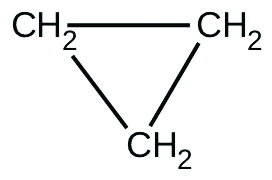
When heated to 499 °C, cyclopropane rearranges (isomerizes) and forms propene with a rate constant of 5.95 × 10⁻⁴ s−1. What is the half-life of this reaction? What fraction of the cyclopropane remains after 0.75 h at 499 °C?
47. Fluorine-18 is a radioactive isotope that decays by positron emission to form oxygen-18 with a half-life of 109.7 min. (A positron is a particle with the mass of an electron and a single unit of positive charge; the nuclear equation is \(\ce{^{18}_9F ⟶ _8^{18}O + ^0_{1}e^+}\).) Physicians use 18F to study the brain by injecting a quantity of fluoro-substituted glucose into the blood of a patient. The glucose accumulates in the regions where the brain is active and needs nourishment.
a. What is the rate constant for the decomposition of fluorine-18?
b. If a sample of glucose containing radioactive fluorine-18 is injected into the blood, what percent of the radioactivity will remain after 5.59 h?
c. How long does it takFe for 99.99% of the 18F to decay?
48. Suppose that the half-life of steroids taken by an athlete is 42 days. Assuming that the steroids biodegrade by a first-order process, how long would it take for \(\dfrac{1}{64}\) of the initial dose to remain in the athlete’s body?
49. Recently, the skeleton of King Richard III was found under a parking lot in England. If tissue samples from the skeleton contain about 93.79% of the carbon-14 expected in living tissue, what year did King Richard III die? The half-life for carbon-14 is 5730 years.
50. Nitroglycerine is an extremely sensitive explosive. In a series of carefully controlled experiments, samples of the explosive were heated to 160 °C and their first-order decomposition studied. Determine the average rate constants for each experiment using the following data:
| Initial [C3H5N3O9] (M) | 4.88 | 3.52 | 2.29 | 1.81 | 5.33 | 4.05 | 2.95 | 1.72 |
|---|---|---|---|---|---|---|---|---|
| t (s) | 300 | 300 | 300 | 300 | 180 | 180 | 180 | 180 |
| % Decomposed | 52.0 | 52.9 | 53.2 | 53.9 | 34.6 | 35.9 | 36.0 | 35.4 |
51. For the past 10 years, the unsaturated hydrocarbon 1,3-butadiene \(\ce{(CH2=CH–CH=CH2)}\) has ranked 38th among the top 50 industrial chemicals. It is used primarily for the manufacture of synthetic rubber. An isomer exists also as cyclobutene:
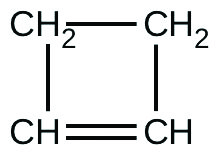
The isomerization of cyclobutene to butadiene is first-order and the rate constant has been measured as 2.0 × 10⁻⁴ s−1 at 150 °C in a 0.53-L flask. Determine the partial pressure of cyclobutene and its concentration after 30.0 minutes if an isomerization reaction is carried out at 150 °C with an initial pressure of 55 torr.
12.6: Collision Theory
52. Chemical reactions occur when reactants collide. What are two factors that may prevent a collision from producing a chemical reaction?
53. When every collision between reactants leads to a reaction, what determines the rate at which the reaction occurs?
54. What is the activation energy of a reaction, and how is this energy related to the activated complex of the reaction?
55. Describe how graphical methods can be used to determine the activation energy of a reaction from a series of data that includes the rate of reaction at varying temperatures.
56. How does an increase in temperature affect rate of reaction? Explain this effect in terms of the collision theory of the reaction rate.
57. The rate of a certain reaction doubles for every 10 °C rise in temperature.
a. How much faster does the reaction proceed at 45 °C than at 25 °C?
b. How much faster does the reaction proceed at 95 °C than at 25 °C?
58. In an experiment, a sample of NaClO3 was 90% decomposed in 48 min. Approximately how long would this decomposition have taken if the sample had been heated 20 °C higher?
59. The rate constant at 325 °C for the decomposition reaction \(\ce{C4H8⟶2C2H4}\) is 6.1 × 10⁻⁸ s−1, and the activation energy is 261 kJ per mole of C4H8. Determine the frequency factor for the reaction.
60. The rate constant for the decomposition of acetaldehyde (CH3CHO), to methane (CH4), and carbon monoxide (CO), in the gas phase is 1.1 × 10⁻² L/mol/s at 703 K and 4.95 L/mol/s at 865 K. Determine the activation energy for this decomposition.
61. An elevated level of the enzyme alkaline phosphatase (ALP) in the serum is an indication of possible liver or bone disorder. The level of serum ALP is so low that it is very difficult to measure directly. However, ALP catalyzes a number of reactions, and its relative concentration can be determined by measuring the rate of one of these reactions under controlled conditions. One such reaction is the conversion of p-nitrophenyl phosphate (PNPP) to p-nitrophenoxide ion (PNP) and phosphate ion. Control of temperature during the test is very important; the rate of the reaction increases 1.47 times if the temperature changes from 30 °C to 37 °C. What is the activation energy for the ALP–catalyzed conversion of PNPP to PNP and phosphate?
62. In terms of collision theory, to which of the following is the rate of a chemical reaction proportional?
a. the change in free energy per second
b. the change in temperature per second
c. the number of collisions per second
d. the number of product molecules
63. Hydrogen iodide, HI, decomposes in the gas phase to produce hydrogen, H2, and iodine, I2. The value of the rate constant, k, for the reaction was measured at several different temperatures and the data are shown here:
| Temperature (K) | k (M−1 s−1) |
|---|---|
| 555 | 6.23 × 10⁻⁷ |
| 575 | 2.42 × 10⁻⁶ |
| 645 | 1.44 × 10⁻⁴ |
| 700 | 2.01 × 10⁻³ |
What is the value of the activation energy (in kJ/mol) for this reaction?
- Solution
-
177 kJ/mol
64. The element Co exists in two oxidation states, Co(II) and Co(III), and the ions form many complexes. The rate at which one of the complexes of Co(III) was reduced by Fe(II) in water was measured. Determine the activation energy of the reaction from the following data:
| T (K) | k (s−1) |
|---|---|
| 293 | 0.054 |
| 298 | 0.100 |
65. The hydrolysis of the sugar sucrose to the sugars glucose and fructose,
\[\ce{C12H22O11 + H2O ⟶ C6H12O6 + C6H12O6}\nonumber \]
follows a first-order rate equation for the disappearance of sucrose: Rate = k[C12H22O11] (The products of the reaction, glucose and fructose, have the same molecular formulas but differ in the arrangement of the atoms in their molecules.)
- In neutral solution, k = 2.1 × 10⁻¹¹ s−1 at 27 °C and 8.5 × 10⁻¹¹ s−1 at 37 °C. Determine the activation energy, the frequency factor, and the rate constant for this equation at 47 °C (assuming the kinetics remain consistent with the Arrhenius equation at this temperature).
- When a solution of sucrose with an initial concentration of 0.150 M reaches equilibrium, the concentration of sucrose is 1.65 × 10⁻⁷ M. How long will it take the solution to reach equilibrium at 27 °C in the absence of a catalyst? Because the concentration of sucrose at equilibrium is so low, assume that the reaction is irreversible.
- Why does assuming that the reaction is irreversible simplify the calculation in part (b)?
66. Use the PhET Reactions & Rates interactive simulation to simulate a system. On the “Single collision” tab of the simulation applet, enable the “Energy view” by clicking the “+” icon. Select the first \(A+BC⟶AB+C\) reaction (A is yellow, B is purple, and C is navy blue). Using the “straight shot” default option, try launching the A atom with varying amounts of energy. What changes when the Total Energy line at launch is below the transition state of the Potential Energy line? Why? What happens when it is above the transition state? Why?
67. Use the PhET Reactions & Rates interactive simulation to simulate a system. On the “Single collision” tab of the simulation applet, enable the “Energy view” by clicking the “+” icon. Select the first \(A+BC⟶AB+C\) reaction (A is yellow, B is purple, and C is navy blue). Using the “angled shot” option, try launching the A atom with varying angles, but with more Total energy than the transition state. What happens when the A atom hits the BC molecule from different directions? Why?
12.7: Reaction Mechanisms
68. Why are elementary reactions involving three or more reactants very uncommon?
69. In general, can we predict the effect of doubling the concentration of A on the rate of the overall reaction \(A+B⟶C\) ? Can we predict the effect if the reaction is known to be an elementary reaction?
70. Phosgene, COCl2, one of the poison gases used during World War I, is formed from chlorine and carbon monoxide. The mechanism is thought to proceed by:
| step 1: | Cl + CO → COCl |
| step 2: | COCl + Cl2→ COCl2 + Cl |
a. Write the overall reaction equation.
b. Identify any reaction intermediates.
c. Identify any intermediates.
71. Define these terms:
a. unimolecular reaction
b. bimolecular reaction
c. elementary reaction
d. overall reaction
72. What is the rate equation for the elementary termolecular reaction \(A+2B⟶\ce{products}\)? For \(3A⟶\ce{products}\)?
73. Given the following reactions and the corresponding rate laws, in which of the reactions might the elementary reaction and the overall reaction be the same?
a. \(\ce{Cl2 + CO ⟶ Cl2CO}\)
\(\ce{rate}=k\ce{[Cl2]^{3/2}[CO]}\)
b. \(\ce{PCl3 + Cl2 ⟶ PCl5}\)
\(\ce{rate}=k\ce{[PCl3][Cl2]}\)
c. \(\ce{2NO + H2 ⟶ N2 + H2O}\)
\(\ce{rate}=k\ce{[NO][H2]}\)
d. \(\ce{2NO + O2 ⟶ 2NO2}\)
\(\ce{rate}=k\ce{[NO]^2[O2]}\)
e. \(\ce{NO + O3 ⟶ NO2 + O2}\)
\(\ce{rate}=k\ce{[NO][O3]}\)
74. Write the rate equation for each of the following elementary reactions:
a. \(\ce{O3 \xrightarrow{sunlight} O2 + O}\)
b. \(\ce{O3 + Cl ⟶ O2 + ClO}\)
c. \(\ce{ClO + O⟶ Cl + O2}\)
d. \(\ce{O3 + NO ⟶ NO2 + O2}\)
e. \(\ce{NO2 + O ⟶ NO + O2}\)
75. Nitrogen(II) oxide, NO, reacts with hydrogen, H2, according to the following equation:
\[\ce{2NO + 2H2 ⟶ N2 + 2H2O}\nonumber \]
What would the rate law be if the mechanism for this reaction were:
\[\ce{2NO + H2 ⟶ N2 + H2O2\:(slow)}\nonumber \]
\[\ce{H2O2 + H2 ⟶ 2H2O\:(fast)}\nonumber \]
76. Consider the reaction
CH4 + Cl2 → CH3Cl + HCl (occurs under light)
The mechanism is a chain reaction involving Cl atoms and CH3 radicals. Which of the following steps does not terminate this chain reaction?
a. CH3 + Cl → CH3CI
b. CH3 + HCl → CH4 + Cl
c. CH3 + CH3 → C2H2
d. Cl + Cl → Cl2
77. Experiments were conducted to study the rate of the reaction represented by this equation.
\[\ce{2NO}(g)+\ce{2H2}(g)⟶\ce{N2}(g)+\ce{2H2O}(g)\nonumber \]
Initial concentrations and rates of reaction are given here.
| Experiment | Initial Concentration [NO] (mol/L) | Initial Concentration, [H2] (mol/L) | Initial Rate of Formation of N2 (mol/L min) |
|---|---|---|---|
| 1 | 0.0060 | 0.0010 | 1.8 × 10⁻⁴ |
| 2 | 0.0060 | 0.0020 | 3.6 × 10⁻⁴ |
| 3 | 0.0010 | 0.0060 | 0.30 × 10⁻⁴ |
| 4 | 0.0020 | 0.0060 | 1.2 × 10⁻⁴ |
Consider the following questions:
a. Determine the order for each of the reactants, NO and H2, from the data given and show your reasoning.
b. Write the overall rate law for the reaction.
c. Calculate the value of the rate constant, k, for the reaction. Include units.
d. For experiment 2, calculate the concentration of NO remaining when exactly one-half of the original amount of H2 had been consumed.
e. The following sequence of elementary steps is a proposed mechanism for the reaction.
Step 1: \(\ce{NO + NO ⇌ N2O2}\)
Step 2: \(\ce{N2O2 + H2 ⇌ H2O + N2O}\)
Step 3: \(\ce{N2O + H2 ⇌ N2 + H2O}\)
Based on the data presented, which of these is the rate determining step? Show that the mechanism is consistent with the observed rate law for the reaction and the overall stoichiometry of the reaction.
78. The reaction of CO with Cl2 gives phosgene (COCl2), a nerve gas that was used in World War I. Use the mechanism shown here to complete the following exercises:
- \(\ce{Cl2}(g)⇌\ce{2Cl}(g)\) (fast, k1 represents the forward rate constant, k−1 the reverse rate constant)
- \(\ce{CO}(g)+\ce{Cl}(g)⟶\ce{COCl}(g)\) (slow, k2 the rate constant)
- \(\ce{COCl}(g)+\ce{Cl}(g)⟶\ce{COCl2}(g)\) (fast, k3 the rate constant)
a. Write the overall reaction.
b. Identify all intermediates.
c. Write the rate law for each elementary reaction.
d. Write the overall rate law expression.
12.8: Catalysis
79. Account for the increase in reaction rate brought about by a catalyst.
80. Compare the functions of homogeneous and heterogeneous catalysts.
81. Consider this scenario and answer the following questions: Chlorine atoms resulting from decomposition of chlorofluoromethanes, such as CCl2F2, catalyze the decomposition of ozone in the atmosphere. One simplified mechanism for the decomposition is: \[\ce{O3 \xrightarrow{sunlight} O2 + O}\\ \ce{O3 + Cl ⟶ O2 + ClO}\\ \ce{ClO + O ⟶ Cl + O2}\nonumber \]
a. Explain why chlorine atoms are catalysts in the gas-phase transformation: \[\ce{2O3⟶3O2}\nonumber \]
b. Nitric oxide is also involved in the decomposition of ozone by the mechanism: \[\ce{O3 \xrightarrow{sunlight} O2 + O\\ O3 + NO ⟶ NO2 + O2\\ NO2 + O ⟶ NO + O2}\nonumber \]
Is NO a catalyst for the decomposition? Explain your answer.
82. For each of the following pairs of reaction diagrams, identify which of the pair is catalyzed:
a.
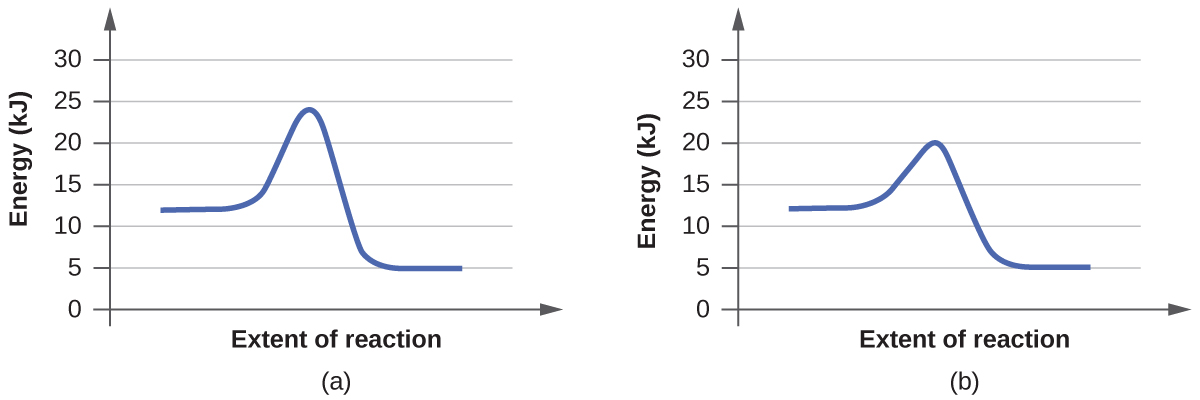
b.
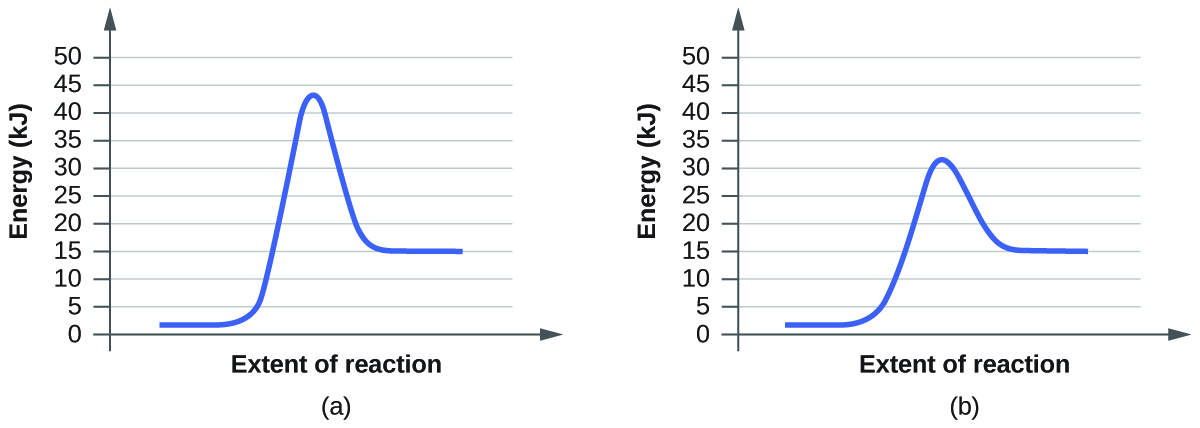
83. For each of the following pairs of reaction diagrams, identify which of the pairs is catalyzed:
a.
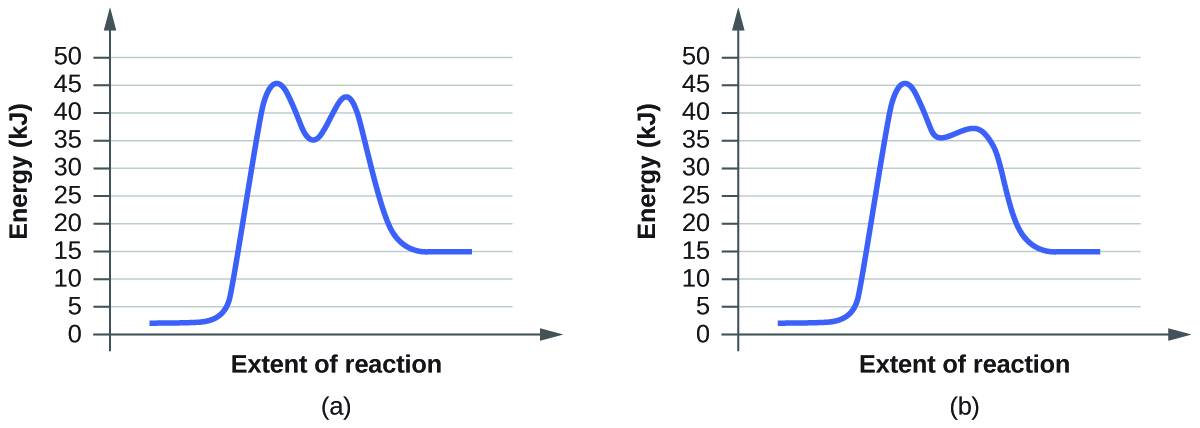
b.
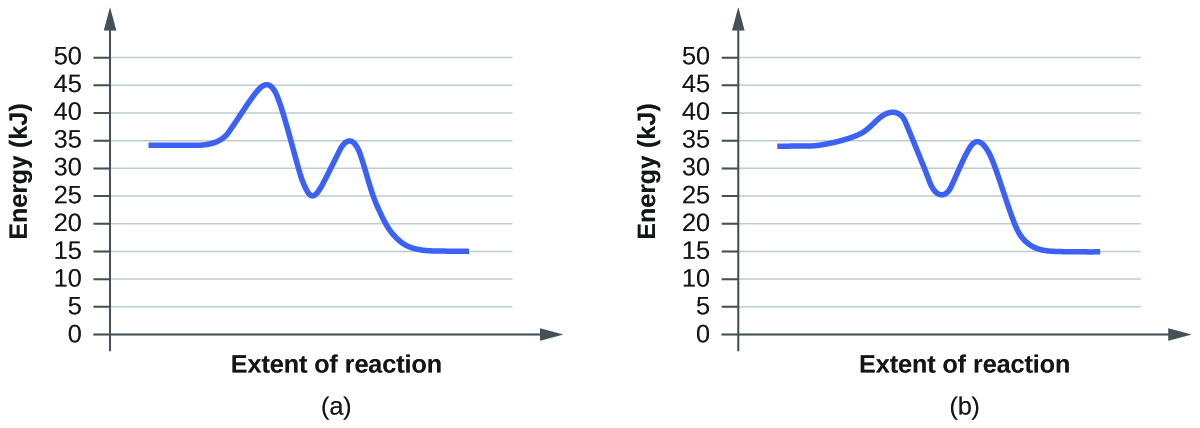
84. For each of the following reaction diagrams, estimate the activation energy (Ea) of the reaction:
a.
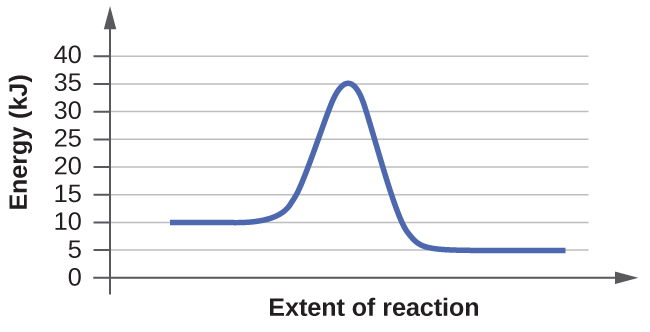
b.
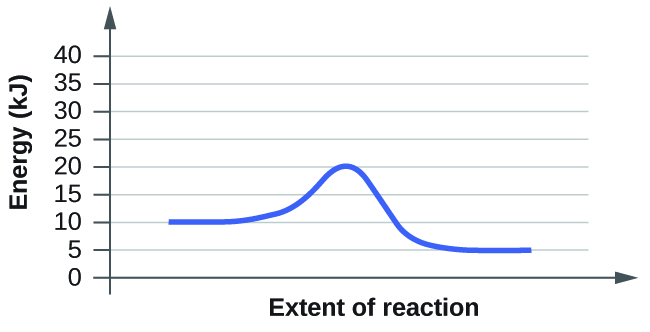
85. For each of the following reaction diagrams, estimate the activation energy (Ea) of the reaction:
a.
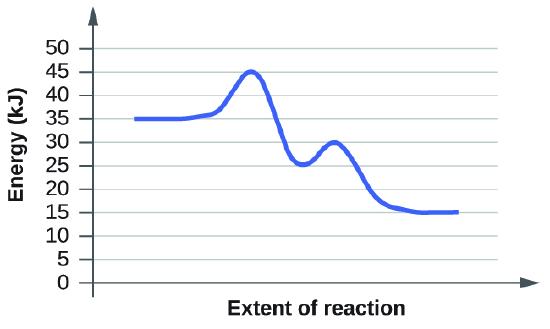
b.
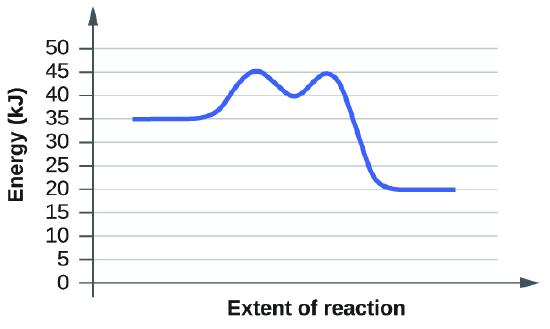
Solutions
S12.2: Chemical Reaction Rates
S1: Distinguishing Types of Reaction Rates
First, a general reaction rate must be defined to know what any variation of a rate is. The reaction rate is defined as the measure of the change in concentration of the reactants or products per unit time. The rate of a chemical reaction is not a constant and rather changes continuously, and can be influenced by temperature. Rate of a reaction can be defined as the disappearance of any reactant or appearance of any product. Thus, an average rate is the average reaction rate over a given period of time in the reaction, the instantaneous rate is the reaction rate at a specific given moment during the reaction, and the initial rate is the instantaneous rate at the very start of the reaction (when the product begins to form).
The instantaneous rate of a reaction can be denoted as \[ \lim_{\Delta t \rightarrow 0} \dfrac{\Delta [ \mathrm{concentration}]}{\Delta t} \nonumber \]
S2: Relative Rates of Ozone Decomposition
For the general reaction, aA → bB, the rate of the reaction can be expressed in terms of the disappearance of A or the appearance of B over a certain time period as follows.
\[- \dfrac{1}{a}\dfrac{\Delta [A]}{\Delta t} = - \dfrac{1}{b}\dfrac{\Delta [B]}{\Delta t} = \dfrac{1}{c}\dfrac{\Delta [C]}{\Delta t} = \dfrac{1}{d}\dfrac{\Delta [D]}{\Delta t}\]2
We want the rate of a reaction to be positive, but the change in the concentration of a reactant, A, will be negative because it is being used up to be transformed into product, B. Therefore, when expressing the rate of the reaction in terms of the change in the concentration of A, it is important to add a negative sign in front to ensure the overall rate positive.
Lastly, the rate must be normalized according to the stoichiometry of the reaction. In the decomposition of ozone to oxygen, two moles of ozone form three moles of oxygen gas. This means that the increase in oxygen gas will be 1.5 times as great as the decrease in ozone. Because the rate of the reaction should be able to describe both species, we divide the change in concentration by its stoichiometric coefficient in the balanced reaction equation to deal with this issue.
Therefore, the rate of the reaction of the decomposition of ozone into oxygen gas can be described as follows:
\[Rate = -\frac{\Delta[\mathrm{O_3}]}{2\Delta t} = \frac{\Delta[\mathrm{O_2}]}{3\Delta t}\]
S3: Stoichiometric Rate Realtionships in Halogen Fluorination
In this problem we are asked to write the equation that relates rate expressions in terms of disappearance of the reactants of the equation and in terms of the formation of the product. A reaction rate gives insight to how rate is affected as a function of concentration of the substances in the equation. Rates can often be expressed on graphs of concentration vs time expressed in change (\({\Delta}\)) of concentration and time and in a short enough time interval, the instantaneous rate can be approximated. If we were to analyze the reaction given, the graph would demonstrate that Cl2 decreases, that F2 decreases 3 times as quickly, and then ClF3 increases at a rate doubles. The reactants are being used and converted to product so they decrease while products increase.
For this problem, we can apply the general formula of a rate to the specific aspects of a problem where the general form follows: \[aA+bB⟶cC+dD\nonumber \]
And the rate can then be written as \(rate=-\frac {1}{a}\frac{{\Delta}[A]}{{\Delta}t}\) \(=-\frac {1}{b}\frac{{\Delta}[B]}{{\Delta}t}\) \(=\frac {1}{c}\frac{{\Delta}[C]}{{\Delta}t}\) \(=\frac {1}{d}\frac{{\Delta}[D]}{{\Delta}t}.\) Here the negative signs are used to keep the convention of expressing rates as positive numbers.
In this specific case we use the stoichiometry to get the specific rates of disappearance and formation (back to what was said in the first paragraph). So, the problem just involves referring the to the equation and its balanced coefficients. Based upon the equation we see that Cl2 is a reactant and has no coefficient, F2 has a coefficient of 3 and is also used up, and then ClF3 is a product that increases two-fold with a coefficient of 2. So, the rate here can be written as: \[\ce{rate}=+\dfrac{1}{2}\dfrac{Δ[\ce{CIF3}]}{Δt}=−\dfrac{Δ[\ce{Cl2}]}{Δt}=−\dfrac{1}{3}\dfrac{Δ[\ce{F2}]}{Δt}\nonumber \]
S4: Dimerization Kinetic Computations for Butadiene
a. The average rate of dimerization is the change in concentration of a reactant per unit time. In this case it would be:
\[\text{rate of dimerization} = -\frac{\Delta [\text{C}_4\text{H}_6]}{\Delta t}\]
Rate of dimerization between 0 s and 1600 s:
\[\text{rate of dimerization} = -\frac{5.04 \times 10^{-3}\text{ M} - 1.00 \times 10^{-2}\text{ M}}{1600\text{ s} - 0\text{ s}}\]
\[\text{rate of dimerization} = 3.10 \times 10^{-6}\text{ }\frac{\text{M}}{\text{s}}\]
Rate of dimerization between 1600 s and 3200 s:
\[\text{rate of dimerization} = -\frac{3.37 \times 10^{-3}\text{ M} - 5.04 \times 10^{-3}\text{ M}}{3200\text{ s} - 1600\text{ s}}\]
\[\text{rate of dimerization} = 1.04 \times 10^{-6}\text{ }\frac{\text{M}}{\text{s}}\]
b. The instantaneous rate of dimerization at 3200 s can be found by graphing time versus [\(\text{C}_4\text{H}_6\)].
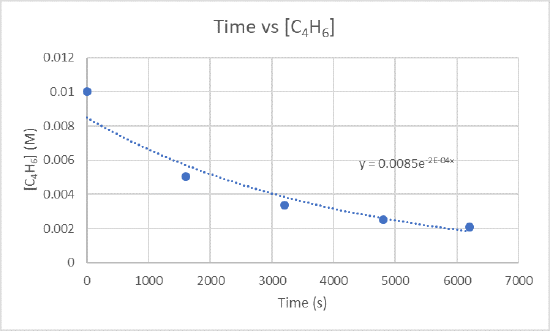
Because you want to find the rate of dimerization at 3200 s, you need to find the slope between 1600 s and 3200 s and also 3200 s and 4800 s.
For the slope between 1600 s and 3200 s use the points (1600 s, 5.04 × 10⁻³ M) and (3200 s, 3.37 × 10⁻³ M):
\[\frac{3.37 \times 10^{-3}\text{ M} - 5.04 \times 10^{-3}\text{ M}}{3200\text{ s} - 1600\text{ s}}\]
\[= \frac{-0.00167\text{ M}}{1600\text{ s}}\]
\[= -1.04 \times 10^{-6}\text{ }\frac{\text{M}}{\text{s}}\]
For the slope between 3200 s and 4800 s use the points (3200 s, 3.37 × 10⁻³ M) and (4800 s, 2.53 × 10⁻³ M):
\[\frac{2.53 \times 10^{-3}\text{ M} - 3.37 \times 10^{-3}\text{ M}}{4800\text{ s} - 3200\text{ s}}\]
\[= \frac{-8.4 \times 10^{-4}\text{ M}}{1600\text{ s}}\]
\[= -5.25 \times 10^{-7}\text{ }\frac{\text{M}}{\text{s}}\]
Take the two slopes you just found and find the average of them to get the instantaneous rate of dimerization.
\[\frac{-1.04 \times 10^{-6}\text{ }\frac{\text{M}}{\text{s}} + \left(-5.25 \times 10^{-7}\text{ }\frac{\text{M}}{\text{s}}\right)}{2}\]
\[= \frac{-1.565 \times 10^{-6}\text{ }\frac{\text{M}}{\text{s}}}{2}\]
\[= -7.83 \times 10^{-7}\text{ }\frac{\text{M}}{\text{s}}\]
The instantaneous rate of dimerization is \[-7.83 \times 10^{-7}\text{ }\frac{\text{M}}{\text{s}}\] and the units of this rate is \[\frac{\text{M}}{\text{s}}\]
c. The average rate of formation of \(\text{C}_8\text{H}_{12}\) at 1600 s and the instantaneous rate of formation at 3200 s can be found by using our answers from part a and b. If you look back up at the original equation, you could see that \(\text{C}_4\text{H}_6\) and \(\text{C}_8\text{H}_{12}\) are related in a two to one ratio. For every two moles of \(\text{C}_4\text{H}_6\) used, there is one mole of \(\text{C}_8\text{H}_{12}\) produced.
For this reaction, the average rate of dimerization and the average rate of formation can be linked through this equation:
\[-\frac{1}{2}\frac{\Delta [\text{C}_4\text{H}_6]}{\Delta t} = \frac{\Delta [\text{C}_8\text{H}_{12}]}{\Delta t}\]
Notice that reactant side is negative because the reactants are being used up in the reaction.
So, for the average rate of formation of \(\text{C}_8\text{H}_{12}\) at 1600 s, use the rate of dimerization between 0 s and 1600 s we found earlier and plug into the equation:
\[-\frac{1}{2} \times \left(-3.10 \times 10^{-6}\text{ }\frac{\text{M}}{\text{s}}\right) = \frac{\Delta [\text{C}_8\text{H}_{12}]}{\Delta t}\]
\[\frac{\Delta [\text{C}_8\text{H}_{12}]}{\Delta t} = 1.55 \times 10^{-6}\text{ }\frac{\text{M}}{\text{s}}\]
The average rate of formation for \(\text{C}_8\text{H}_{12}\) at 1600 s is \[1.55 \times 10^{-6}\text{ }\frac{\text{M}}{\text{s}}\] The rate of formation will be positive because products are being formed.
The instantaneous rate of formation for \(\text{C}_8\text{H}_{12}\) can be linked to the instantaneous rate of dimerization by this equation:
\[-\frac{1}{2}\frac{d[\text{C}_4\text{H}_6]}{dt} = \frac{d[\text{C}_8\text{H}_{12}]}{dt}\]
So, for the instantaneous rate of formation for \(\text{C}_8\text{H}_{12}\) at 3200 s, use the value of instantaneous rate of dimerization at 3200 s found earlier and plug into the equation:
\[-\frac{1}{2} \times \left(-7.83 \times 10^{-7}\text{ }\frac{\text{M}}{\text{s}}\right) = \frac{d[\text{C}_8\text{H}_{12}]}{dt}\]
\[\frac{d[\text{C}_8\text{H}_{12}]}{dt} = 3.92 \times 10^{-7}\text{ }\frac{\text{M}}{\text{s}}\]
The instantaneous rate of formation for \(\text{C}_8\text{H}_{12}\) at 3200 s is \[3.92 \times 10^{-7}\text{ }\frac{\text{M}}{\text{s}}\].
S5: Tracking Consumption and Synthesis Rates
Equations: \(\frac{-\Delta A}{\Delta time}\) and Rate=\(\frac{-\Delta A}{2\Delta time}=\frac{\Delta B}{time}\)
Solve:
a. The change in A from 0s to 10s is 0.625 – 1 = –0.375, so \(\frac{-\Delta A}{\Delta time}\) = \(\frac{0.375 \, \mathrm{M}}{10 \, \mathrm{s}}\) = 0.0374 M/s
Similarly, the change in A from 10 to 20 seconds is 0.370 – 0.625 = –0.255 so \(\frac{-\Delta A}{\Delta time}\) = \( \frac{0.255 \, \mathrm{M}}{20 \, mathrm{s} - 10 \, mathrm{s}} \)
b. We can estimate the rate law graphing the points against different order equations to determine the right order.
Zero Order: \[\frac{d[A]}{dt}=-k\nonumber \] \[\int_{A_{\circ}}^{A}d[A]=-k\int_{0}^{t}dt\nonumber \] \[[A]=-kt+[A_{\circ}]\nonumber \]
First Order: \[\frac{d[A]}{dt}=-k[A]\nonumber \] \[\int_{A_{\circ}}^{A}\frac{d[A]}{[A]}=-kdt\nonumber \] \[Ln(A)=-kt+Ln(A_{\circ})\nonumber \]
Second Order: \[\frac{d[A]}{dt}=-k[A]^{2}\nonumber \] \[\int_{A\circ}^{A}\frac{d[A]}{[A]^{2}}=-k\int_{0}^{t}dt\nonumber \]
\[\frac{1}{[A]}=kt+\frac{1}{[A_{\circ}]}\nonumber \]
Now that we have found the linear from of each order we will plot the points vs an [A] y-axis, a Ln(A) y-axis, and a 1/[A] y-axis. whichever of the plots has the most linear points will give us a good idea of the order and the slope will be the k value.
Here we notice that the second order is most linear so we conclude the Rate to be: \[\frac{-d[A]}{2dt}=k[A]^{2}\nonumber \] At 15 seconds, [A] = 0.465 M and from the slope of the graph we find k = 0.116. If we plug this data in and multiply both sides by 2 to get rid of the 2 in the denominator on the left side of the equation, we find that the rate of disappearance of A is 0.0500 mol L-1 s-1.
c. Using the equation \(\frac{-\Delta A}{2\Delta time}=\frac{\Delta B}{time}\) we divide the rates in part a and b in half to get 0.0188 M/s from 0 to 10 seconds and 0.025 M/s for the estimated instantaneous rate at 15 s.
S6: Stoichiometric Conversion of Aqueous Bromide Oxidation
Step 1. Define the rate of the reaction.
Recall for the general reaction:
\[a\text{A} + b\text{B} \rightarrow c\text{C} + d\text{D}\]
The unique rate of reaction is written as:
\[\text{rate} = -\frac{1}{a}\frac{\Delta[\text{A}]}{\Delta t} = -\frac{1}{b}\frac{\Delta[\text{B}]}{\Delta t} = \frac{1}{c}\frac{\Delta[\text{C}]}{\Delta t} = \frac{1}{d}\frac{\Delta[\text{D}]}{\Delta t}\]
So, for the given reaction:
\[5\text{Br}^-(aq) + \text{BrO}_3^-(aq) + 6\text{H}^+(aq) \rightarrow 3\text{Br}_2(aq) + 3\text{H}_2\text{O}(l)\]
The rate expressions are linked as follows:
\[\text{rate} = -\frac{1}{5}\frac{\Delta[\text{Br}^-]}{\Delta t} = -\frac{\Delta[\text{BrO}_3^-]}{\Delta t} = -\frac{1}{6}\frac{\Delta[\text{H}^+]}{\Delta t} = \frac{1}{3}\frac{\Delta[\text{Br}_2]}{\Delta t} = \frac{1}{3}\frac{\Delta[\text{H}_2\text{O}]}{\Delta t}\]
Step 2. Since we are given that the rate of disappearance of \(\text{Br}^-(aq)\) is \(3.5 \times 10^{-4}\text{ M}\cdot\text{s}^{-1}\), and we want to find the rate of appearance of \(\text{Br}_2(aq)\), we isolate and set these two rate expressions equal to each other:
\[-\frac{1}{5}\frac{\Delta[\text{Br}^-]}{\Delta t} = \frac{1}{3}\frac{\Delta[\text{Br}_2]}{\Delta t}\]
The absolute rate of disappearance of the bromide ion is:
\[-\frac{\Delta[\text{Br}^-]}{\Delta t} = 3.5 \times 10^{-4}\text{ M}\cdot\text{s}^{-1}\]
Substituting this value into our equality gives:
\[\frac{1}{5} \times \left(3.5 \times 10^{-4}\text{ M}\cdot\text{s}^{-1}\right) = \frac{1}{3}\frac{\Delta[\text{Br}_2]}{\Delta t}\]
Step 3. Now solve the equation for the rate of appearance of molecular bromine:
\[\frac{\Delta[\text{Br}_2]}{\Delta t} = \frac{3}{5} \times \left(3.5 \times 10^{-4}\text{ M}\cdot\text{s}^{-1}\right)\]
\[\frac{\Delta[\text{Br}_2]}{\Delta t} = 2.1 \times 10^{-4}\text{ M}\cdot\text{s}^{-1}\]
S12.3: Factors Affecting Reaction Rates
S7: Factors Modifying Magnesium-Acid Kinetic Rates
Molarity of Hydrochloric Acid
- Reaction rates are affected by the frequency at which molecules collide. High Molarity=High Concentration which means more molecules are available to collide thus a faster reaction that one with a low molarity of HCl at a fixed volume.
Temperature of Solution
- Higher temperatures increase the rate of reaction because molecules move faster thus colliding more frequently
- increasing temperatures allows for more particles to move past activation energy barrier to start the reaction
- reaction rate is dependent on solid reactant size; smaller pieces increases the chance of collision because they enable a greater surface area thus faster reaction rate
S8: Collision Orientation Dynamics in Single Impact Simulations
According to the collision theory, there are many factors that cause a reaction to happen, with three of the factors being how often the molecules or atoms collide, the molecules' or atoms' orientations, and if there is sufficient energy for the reaction to happen. So, if the angle of the plunger is changed, the atom that is shot (a lone Oxygen atom in this case) will hit the other molecule (CO in this case) at a different spot and at a different angle, therefore changing the orientation and the number of proper collisions will most likely not cause for a reaction to happen. Thanks to the simulation, we can see that this is true: depending on the angle selected, the atom may take a long time to collide with the molecule and, when a collision does occur, it may not result in the breaking of the bond and the forming of the other (no reaction happens).
In this particular case, the rate of the reaction will decrease because, by changing the angle, the molecules or atoms won't collide with the correct orientation or as often with the correct orientation.
S9: Multi-Particle Concentration and Thermal Energy Variations
Based on the Collision Theory, a reaction will only occur if the molecules collide with proper orientation and with sufficient energy required for the reaction to occur. The minimum energy the molecules must collide with is called the activation energy (energy of transition state).
Increasing the concentration of reactants increases the probability that reactants will collide in the correct orientation since there are more reactants in the same volume of space. Therefore, increasing the concentration of reactants would increase the rate of the reaction. Decreasing the concentration of reactants would decrease the rate of reaction because the overall number of possible collisions would decrease.
Temperature is directly related the the kinetic energy of molecules and activation energy \(E_a\) is the minimum energy required for a reaction to occur and doesn't change for a reaction. Increasing the temperature increases the kinetic energy of the reactants meaning the reactants will move faster and collide with each other more frequently. Therefore, increasing the temperature increase the rate of the reaction. Decreasing the temperature decreases the rate of reaction since the molecules will have less kinetic energy, move slower, and therefore collide with each other less frequently.
S10: Emergetic Threshold Crossings in Closed Reaction Chambers
a. On the simulation, we select the default setting and the reaction A+BC. In the default setting, we see frequent collisions, a low initial temperature, and a total average energy lower than the energy of activation. The collision theory states that the rate of a reaction is directly proportional to (the fraction of molecules with required orientation), (fractions of collisions with required energy), and (collision frequency). Although we see moving and frequently colliding reactants, the rate of the forward reaction is actually slow because it takes a long time for the products, AB and C, to start appearing. This is mainly because the fractions of collisions with required energy is low, coming from the average energy of the molecules being lower than the energy of activation.
b. The reaction proceeds at an even faster rate. Again, the collision theory states that the rate of a reaction is directly proportional to (the fraction of molecules with required orientation), (fractions of collisions with required energy), and (collision frequency). Because molecules have a higher amount of energy, they have more kinetic energy. With an increased kinetic energy, the molecules not only collide more but also increase in the fraction of collision. However, the forward reaction and the backward reaction both proceed at a fast rate, so both happen almost simultaneously. It takes a shorter time for both reactions to happen. With both of the reactions adding up together overall, there is eventually a state of equilibrium. The process at which equilibrium is reached, however, is faster. Therefore, the amount of products of A+BC stays the same after a while.
S12.4: Rate Laws
S11: Distinguishing Reaction Rates from Rate Constants
The rate of a reaction or reaction rate is the change in the concentration of either the reactant or the product over a period of time. If the concentrations change, the rate also changes.
Rate for A → B:
The rate constant (k) is a proportionality constant that relates the reaction rates to reactants. If the concentrations change, the rate constant does not change.
For a reaction with the general equation: \(aA+bB→cC+dD \)
the experimentally determined rate law usually has the following form:
S12: Determining Reaction Order via Proportional Concentration Changes
(a) 2; (b) 1
S13: Deducing Kinetic Power Laws from Multiplication Factors
Reaction orders are determined by finding the exponent to which a concentration change must be raised to equal the resulting rate change:
\(\textbf{Ninefold Rate Scale Factors}\): When a threefold concentration increase yields a ninefold speed increase (\(3^x = 9\)), the chemical exponent matches \(x = 2\), making it a second-order reaction with respect to that reactant.
\(\textbf{Fourfold Rate Scale Factors}\): When multiplying the concentration by four causes the reaction rate to increase exactly four times (\(4^y = 4\)), the exponent equals \(y = 1\), categorizing it as a first-order reaction for that reactant.
S14: Isolating Rate Adjustments Under a Second-Roder Rule
(a) The process reduces the rate by a factor of 4. (b) Since CO does not appear in the rate law, the rate is not affected.
S15: Proportional Shifts Under Bimolecular First-Order Rate Laws
Under a shared first-order bimolecular rate framework where \(\text{rate} = k[\text{NO}_2][\text{CO}]\), the speed scales directly with concentration adjustments for either reactant:
\(\textbf{Tripling Nitrogen Dioxide Pressure}\): Increasing the partial pressure of \(\text{NO}_2\) by a factor of three (from \(0.1\text{ atm}\) to \(0.3\text{ atm}\)) causes the total reaction velocity to triple.
\(\textbf{Tripling Carbon Monoxide Concentration}\): Increasing the molarity of \(\text{CO}\) by a factor of three (from \(0.02\text{ M}\) to \(0.06\text{ M}\)) similarly causes the overall reaction rate to triple.
S16: Instantaneous Velocity Estimates for Stratospheric Ozone Loss
4.3 × 10⁻⁵ mol/L/s
S17: Quantifying Initial Beta Emission Outputs in Radioactive Tracers
Radioactive decay pathways follow first-order nuclear kinetic profiles. The instantaneous rate of electron (beta particle) production is computed using the active isotope concentration in the first-order rate equation:
\[\text{Rate} = k[^{32}\text{P}]\]
Substituting the radioactive decay rate constant (\(4.85 \times 10^{-2}\text{ day}^{-1}\)) and the tracer concentration (\(0.0033\text{ M}\)) yields the instantaneous production rate of beta emissions in units of \(\text{mol} \, \text{L}^{-1} \, \text{day}^{-1}\).
S18: Isotopic Disintegration and Nitrogen Nuclei Creation Rates
7.9 × 10⁻¹³ mol/L/year
S19: Velocity Variations Under Reduced Isotopic Fuel Influxes
This scenario applies the same first-order radioactive kinetic parameters to a lower concentration profile of carbon-14. By substituting the adjusted chemical concentration parameter (\(1.5 \times 10^{-9}\text{ M}\)) into the primary rate model (\(\text{Rate} = k[^{14}\text{C}]\)) alongside the original year-based decay constant, the solution provides the updated, slower rate of nitrogen daughter atom generation.
S20: Biomolecular Target Tracking for Acetaldehyde Decomposition
The instantaneous decomposition velocity of an organic compound following second-order kinetics is calculated using the squaring power law:
\[\text{Rate} = k[\text{CH}_3\text{CHO}]^2\]
The calculation inputs the second-order rate constant (\(4.71 \times 10^{-8}\text{ L} \, \text{mol}^{-1} \, \text{s}^{-1}\)) and squares the active molar concentration (\(5.55 \times 10^{-4}\text{ M}\)), providing the instantaneous rate of chemical decomposition in \(\text{M/s}\).
S21: Zero-Order Kinetic Parameters in Blood Alcohol Metabolism
\[\text{rate} = k\]
k = 2.0 × 10⁻² mol/L/h (about 0.9 g/L/h for the average male)
The reaction is zero order.
S22: Zero-Order Interfacial Limits in Catalytic Ammonia Splitting
The provided data shows that the reaction rate remains constant at \(1.5 \times 10^{-6}\text{ mol}\cdot\text{L}^{-1}\cdot\text{h}^{-1}\) across a threefold increase in ammonia concentration. This independence indicates that the process follows a zero-order rate law, a behavior typical of surface-catalyzed reactions where the metal active sites are completely saturated:
\(\textbf{Rate Equation}\): \(\text{Rate} = k[\text{NH}_3]^0 \implies \mathbf{\text{Rate} = k}\)
\(\textbf{Rate Constant}\): \(k = \mathbf{1.5 \times 10^{-6}\text{ mol/L/h}}\)
\(\textbf{Overall Order}\): 0
S23: Finding kinetic parameters for NOCl decomposition
Before we can figure out the rate constant first we must first determine the basic rate equation and rate order. The basic rate equation for this reaction, where \(n\) is the rate order of \(\text{NOCl}\) and \(k\) is the rate constant, is:
\[\text{rate} = k[\text{NOCl}]^n\]
since \(\text{NOCl}\) is the reactant in the reaction.
In order to figure out the order of the reaction we must find the order of \(\text{NOCl}\) as it is the only reactant in the reaction. To do this we must examine how the rate of the reaction changes as the concentration of \(\text{NOCl}\) changes.
As \(\text{NOCl}\) doubles in concentration from \(0.10\text{ M}\) to \(0.20\text{ M}\) the rate goes from \(8.0 \times 10^{-10}\text{ mol}\cdot\text{L}^{-1}\cdot\text{h}^{-1}\) to \(3.2 \times 10^{-9}\text{ mol}\cdot\text{L}^{-1}\cdot\text{h}^{-1}\):
\[\frac{3.2 \times 10^{-9}\text{ mol}\cdot\text{L}^{-1}\cdot\text{h}^{-1}}{8.0 \times 10^{-10}\text{ mol}\cdot\text{L}^{-1}\cdot\text{h}^{-1}} = 4\]
So we conclude that as \(\text{NOCl}\) doubles, the rate goes up by 4. Since \(2^2 = 4\), we can say that the order of \(\text{NOCl}\) is 2, so our updated rate law is:
\[\text{rate} = k[\text{NOCl}]^2\]
Now that we have the order, we can substitute the first experimental values from the given table to find the rate constant, \(k\):
\[8.0 \times 10^{-10}\text{ mol}\cdot\text{L}^{-1}\cdot\text{h}^{-1} = k(0.10\text{ M})^2\]
\[k = \frac{8.0 \times 10^{-10}\text{ mol}\cdot\text{L}^{-1}\cdot\text{h}^{-1}}{(0.10\text{ M})^2} = 8.0 \times 10^{-8}\text{ L}\cdot\text{mol}^{-1}\cdot\text{h}^{-1}\]
We were able to find the units of \(k\) using rate order; when the rate order is 2, the units of \(k\) are \(\text{L}\cdot\text{mol}^{-1}\cdot\text{h}^{-1}\) (or \(\text{M}^{-1}\cdot\text{h}^{-1}\)).
So the rate equation is \[\text{rate} = k[\text{NOCl}]^2\]
It is second order, and \(k = 8.0 \times 10^{-8}\text{ L}\cdot\text{mol}^{-1}\cdot\text{h}^{-1}\).
Overall rate law:
\[\text{rate} = \left(8.0 \times 10^{-8}\text{ L}\cdot\text{mol}^{-1}\cdot\text{h}^{-1}\right) [\text{NOCl}]^2\]
S24: Determining rate law parameters for A reacting to 2C
a. Using the experimental data, we can compare the effects of changing \([\text{A}]\) on the rate of reaction by relating ratios of \([\text{A}]\) to ratios of rates:
\[\frac{2.66 \times 10^{-2}\text{ M}}{1.33 \times 10^{-2}\text{ M}} = 2\]
\[\frac{1.52 \times 10^{-6}\text{ mol}\cdot\text{L}^{-1}\cdot\text{h}^{-1}}{3.80 \times 10^{-7}\text{ mol}\cdot\text{L}^{-1}\cdot\text{h}^{-1}} = 4\]
b. From this we know that doubling the concentration of \([\text{A}]\) will result in quadrupling the rate of reaction. The order of this reaction is 2.
c. We can now write the rate equation since we know the order:
\[\text{rate} = k[\text{A}]^2\]
d. By plugging in one set of experimental data into our rate equation we can solve for the rate constant, \(k\):
\[3.80 \times 10^{-7}\text{ mol}\cdot\text{L}^{-1}\cdot\text{h}^{-1} = k \times \left(1.33 \times 10^{-2}\text{ M}\right)^2\]
\[k = \frac{3.80 \times 10^{-7}}{1.769 \times 10^{-4}}\]
\[k = 2.15 \times 10^{-3}\text{ M}^{-1}\cdot\text{h}^{-1}\]
S25: Isolating reactant orders for NO and Cl2 chlorination
For the general equation:
\[\text{aA} + \text{bB} \rightarrow \text{cC} + \text{dD}\]
The rate can be written as:
\[\text{rate} = k[\text{A}]^m[\text{B}]^n\]
where \(k\) is the rate constant, and \(m\) and \(n\) are the reaction orders.
For our equation:
\[2\text{NO}(g) + \text{Cl}_2(g) \rightarrow 2\text{NOCl}(g)\]
the rate equation is as follows:
\[\text{rate} = k[\text{NO}]^m[\text{Cl}_2]^n\]
Now, we need to find the reaction orders. Reaction orders can only be found through experimental values. We can compare two reactions where one of the reactants has the same concentration for both trials, and solve for the reaction order:
\[\frac{\text{rate}_1}{\text{rate}_2} = \frac{[\text{NO}]_1^m[\text{Cl}_2]_1^n}{[\text{NO}]_2^m[\text{Cl}_2]_2^n}\]
We can use the data in the table provided. If we plug in the values for rows 1 and 2, we see that the values for the concentration of \(\text{Cl}_2\) will cancel, leaving just the rates and the concentrations of \(\text{NO}\):
\[\frac{1.14}{4.56} = \left(\frac{0.50}{1.00}\right)^m\]
\[0.25 = (0.50)^m\]
We can now solve for \(m\), and we find that \(m = 2\). This means that the reaction order for \([\text{NO}]\) is 2.
Now we must find the value of \(n\). To do so, we can use the same equation but with the values from rows 2 and 3. This time, the concentration of \(\text{NO}\) will cancel out:
\[\frac{4.56}{9.12} = \left(\frac{0.50}{1.00}\right)^n\]
\[0.50 = (0.50)^n\]
When we solve for \(n\), we find that \(n = 1\). This means that the reaction order for \([\text{Cl}_2]\) is 1.
We are one step closer to finishing our rate equation:
\[\text{rate} = k[\text{NO}]^2[\text{Cl}_2]\]
Finally, we can solve for the rate constant. To do this, we can use one of the trials of the experiment, and plug in the values for the rate, and concentrations of reactants, then solve for \(k\):
\[1.14\text{ mol}\cdot\text{L}^{-1}\cdot\text{h}^{-1} = k[0.50\text{ mol}\cdot\text{L}^{-1}]^2[0.50\text{ mol}\cdot\text{L}^{-1}]\]
\[k = 9.12\text{ L}^2\cdot\text{mol}^{-2}\cdot\text{h}^{-1}\]
So, our final rate equation is:
\[\text{rate} = \left(9.12\text{ L}^2\cdot\text{mol}^{-2}\cdot\text{h}^{-1}\right)[\text{NO}]^2[\text{Cl}_2]\]
S26: Finding multicomponent rate properties for laughing gas synthesis
Determine the rate equation, the rate constant, and the orders with respect to each reactant. The rate constant and the orders can be determined through the differential rate law. The general form of the differential rate law is given below:
\[a\text{A} + b\text{B} \rightarrow \text{products}\]
\[\text{Rate} = k[\text{A}]^n[\text{B}]^m\]
where \([\text{A}]\) and \([\text{B}]\) are the concentrations of the reactants, \(k\) is the rate constant, and \(n\) and \(m\) refer to the order of each reactant.
To find the orders of each reactant, we see that when \([\text{NO}]\) doubles but \([\text{H}_2]\) doesn't change, the rate quadruples, meaning that \([\text{NO}]\) is a second order reaction component:
\[[\text{NO}]^2\]
When \([\text{H}_2]\) doubles but \([\text{NO}]\) doesn't change, the rate doubles, meaning that \([\text{H}_2]\) is a first order reaction component:
\[[\text{H}_2]^1\]
So the rate law would look like this:
\[\text{Rate} = k[\text{NO}]^2[\text{H}_2]\]
We can use this rate law to determine the value of the rate constant. Plug in the data for reactant concentration and rate from one of the trials to solve for \(k\), the rate constant. In this case, we choose to use the data from trial 1:
\[2.835 \times 10^{-3}\text{ mol}\cdot\text{L}^{-1}\cdot\text{s}^{-1} = k[0.30\text{ M}]^2[0.35\text{ M}]\]
\[k = \frac{2.835 \times 10^{-3}}{0.0315}\]
\[k = 0.09\text{ M}^{-2}\cdot\text{s}^{-1}\]
S27: Logarithmic calculation of reactant order for A decomposing
a. The rate equation for an \(n\) order reaction is given as:
\[\frac{dr}{dt} = k[\text{A}]^n\]
Where \([\text{A}]\) is the concentration in M, and \(\frac{dr}{dt}\) is the rate in \(\text{mol}\cdot\text{L}^{-1}\cdot\text{s}^{-1}\).
We can then use each set of data points, plug its values into the rate equation and solve for \(n\). Note you can use any of the data points as long as the concentration corresponds to its rate.
Rate equation 1: \(4.17 \times 10^{-4} = k[0.230]^n\)
Rate equation 2: \(9.99 \times 10^{-4} = k[0.356]^n\)
We divide Rate equation 1 by Rate equation 2 in order to cancel out \(k\), the rate constant:
\[\frac{4.17 \times 10^{-4}}{9.99 \times 10^{-4}} = \frac{k[0.230]^n}{k[0.356]^n}\]
\[0.417 = (0.646)^n\]
Now the only unknown we have is \(n\). Using logarithm rules, one can solve for it:
\[\ln(0.417) = n \cdot \ln(0.646)\]
\[n = \frac{\ln(0.417)}{\ln(0.646)} = 2.00\]
The rate equation is second order with respect to \(\text{A}\) and is written as:
\[\text{rate} = k[\text{A}]^2\]
b. We can solve for \(k\) by plugging in any data point into our rate equation:
\[\text{rate} = k[\text{A}]^2\]
For instance, using the first data points \([\text{A}] = 0.230\text{ mol}\cdot\text{L}^{-1}\) and \([\text{rate}] = 4.17 \times 10^{-4}\text{ mol}\cdot\text{L}^{-1}\cdot\text{s}^{-1}\), we get the equation:
\[4.17 \times 10^{-4}\text{ mol}\cdot\text{L}^{-1}\cdot\text{s}^{-1} = k\left(0.230\text{ mol}\cdot\text{L}^{-1}\right)^2\]
\[k = \frac{4.17 \times 10^{-4}}{0.0529} = 7.88 \times 10^{-3}\text{ L}\cdot\text{mol}^{-1}\cdot\text{s}^{-1}\]
Since we know this is a second order reaction, the appropriate units for \(k\) can also be written as \(\text{M}^{-1}\cdot\text{s}^{-1}\).
S28: Calculating exponential order metrics for Q's transmutation
What is the order of the reaction with respect to \([\text{Q}]\), and what is the rate equation?
Order of reaction is 2 because when you use the ratio of trial 3 to trial 2, it looks like this:
\[\frac{2.94 \times 10^{-2}\text{ mol}\cdot\text{L}^{-1}\cdot\text{s}^{-1}}{1.04 \times 10^{-2}\text{ mol}\cdot\text{L}^{-1}\cdot\text{s}^{-1}} = \left(\frac{0.357\text{ M}}{0.212\text{ M}}\right)^x\]
\[2.82 = (1.684)^x\]
\[x = \frac{\ln(2.82)}{\ln(1.684)} = 2\]
Rate reaction equation:
\[\text{Rate} = k[\text{Q}]^2\]
What is the rate constant? To find the rate constant \(k\) simply plug and calculate one of the trials into the rate equation:
\[1.04 \times 10^{-2}\text{ mol}\cdot\text{L}^{-1}\cdot\text{s}^{-1} = k[0.212\text{ M}]^2\]
\[k = \frac{1.04 \times 10^{-2}}{0.04494}\]
\[k = 0.231\text{ M}^{-1}\cdot\text{s}^{-1}\]
S29: Calculating reaction rate from N2O5 molarity
Step 1: The first step is to write the rate law. We know the general formula for a first-order rate law is as follows:
\[\text{Rate} = k[\text{A}]\]
Step 2: We now plug in [N2O5] in for [A] in our general rate law. We also plug in our rate constant (k), which was given to us. Now our equation looks as follows:
Rate = (6.2 × 10⁻⁴ min–1)[N2O5]
Step 3: We now plug in our given molarity, [N2O5] = 0.40 M. Now our equation looks as follows:
Rate = (6.2 × 10⁻⁴ min–1)(0.40 M)
Step 4: We now solve our equation:
Rate = (6.2 × 10⁻⁴ min–1)(0.40 M) = 2.48 × 10⁻⁴ M/min
Step 5: Use significant figures and unit conversion to round 2.48 × 10⁻⁴ M/min to 2.5 × 10⁻⁴ mol/L/min.
S30: Evaluating rate laws from slow reaction steps
To determine the rate law for an equation we need to look at its slow step. Since both equation (a) and (c) are fast, equation (b) can be considered the slow step of the reaction. The slow step is also considered the rate determining step of the system.
Hence, the rate determining step is the second step because it is the slow step:
\[\text{rate of production of NO}_2 = k [\text{A}]^m [\text{B}]^n\]
\[\text{rate} = k [\text{NO}]^2 [\text{O}_2]^1\]
\[\text{rate} = (5.8 \times 10^{-6}\text{ L}^2/\text{mol}^2/\text{s}) \times [0.75]^2 \times [0.50]^1\]
\[\text{rate} = 1.6 \times 10^{-6}\text{ M/s}\]
S31: Deduced kinetics for hypoiodite ion production steps
Using the reactants, we can form the general rate law of the reaction:
\[\text{rate} = k[\text{OCl}^-]^n[\text{I}^-]^m\]
From there, we need to use the data to determine the order of both [OCl⁻] and [I⁻]. In doing so, we compare rate 1 to rate 2 such that:
\[\frac{\text{rate}_1}{\text{rate}_2} = \frac{k(0.050)^n(0.10)^m}{k(0.050)^n(0.20)^m} = \frac{3.05 \times 10^{-4}}{6.20 \times 10^{-4}}\]
\[(0.50)^m = 0.492 \approx 0.50 \implies m = 1\]
We can cancel out the concentration parameters for [OCl⁻] because it has the same value in both of the trials used. This confirms that [I⁻] has a first-order dependence of 1.
We cannot completely cancel out [I⁻] to find [OCl⁻] dynamically because no two trials share an identical iodide concentration. In order to solve for n, we plug in 1 for m and compare trial 1 to trial 3:
\[\frac{\text{rate}_1}{\text{rate}_3} = \frac{(0.050)^n(0.10)^1}{(0.010)^n(0.30)^1} = \frac{3.05 \times 10^{-4}}{1.83 \times 10^{-4}}\]
\[\frac{1}{3} \times (5)^n = 1.6666667 \implies 5^n = 5.00 \implies n = 1\]
Since we know that the orders of both n and m are equal to one, we substitute them back into the rate law equation along with their respective concentration inputs from our first experiment to isolate and solve for the rate constant, k:
\[3.05 \times 10^{-4} = k[0.050]^1[0.10]^1\]
\[k = 6.1 \times 10^{-2}\text{ L/(mol}\cdot\text{s)}\]
Thus the overall rate law is: rate = (6.1 × 10⁻² L/mol/s)[OCl⁻][I⁻]
The units for k depend on the overall order of the reaction. To find the overall order we add m and n together, finding an overall order of 2. This is why the final units for k are L/mol/s.
S32: Partial pressure calculations for nitrosyl chloride gas
a. The rate equation can be determined by designing experiments that measure the concentration of reactants or products as a function of time. For the reaction 2NO + Cl2 → 2NOCl, we need to determine the rate constant k and the exponents m and n in the following equation:
\[\text{rate} = k[p_{\text{NO}}]^m[p_{\text{Cl}_2}]^n\]
To do this, the initial partial pressure of [Cl2] is kept constant while varying the initial concentration of [NO] and calculating the initial reaction rate. This information determines the reaction order with respect to [NO]. The same process is repeated to isolate the reaction order with respect to [Cl2].
Using specific experimental rows:
\[\frac{\text{rate}_2}{\text{rate}_3} = \frac{k[p_{\text{NO}, 2}]^m[p_{\text{Cl}_2, 2}]^n}{k[p_{\text{NO}, 3}]^m[p_{\text{Cl}_2, 3}]^n}\]
Substituting our values from the data matrix:
\[\frac{4.0 \times 10^{-2}}{1.0 \times 10^{-2}} = \frac{k[1.0]^m[1.0]^n}{k[0.50]^m[1.0]^n}\]
Canceling identical terms leaves:
\[\frac{4.0 \times 10^{-2}}{1.0 \times 10^{-2}} = \frac{[1.0]^m}{[0.50]^m} \implies 4 = 2^m \implies m = 2\]
Because m = 2, the reaction order with respect to [NO] is 2.
We repeat the process to isolate n using experiments 3 and 1:
\[\frac{\text{rate}_3}{\text{rate}_1} = \frac{k[0.50]^m[1.0]^n}{k[0.50]^m[0.50]^n} \implies \frac{1.0 \times 10^{-2}}{5.1 \times 10^{-3}} = \frac{[1.0]^n}{[0.50]^n} \implies 2 \approx 2^n \implies n = 1\]
Because n = 1, the reaction order with respect to [Cl2] is 1.
So the complete rate equation is: \( \mathrm{rate} = k[ \mathrm{p_{NO}}]^2[ \mathrm{p_{Cl_2}}] \)
To find the overall rate order, you simply add the exponents together. Second order plus first order makes the overall reaction sequence third order.
b. The rate constant is calculated by inserting the data from any row of the table into our rate law and isolating k. For a third-order reaction using pressures, the units of k are atm–2 s–1. Using Experiment 1:
\[5.1 \times 10^{-3} = k(0.50)^2(0.50)^1 \implies k = 0.0408\text{ atm}^{-2}\cdot\text{s}^{-1}\]
S12.5: Integrated Rate Laws
S33: Using graphical methods to find reaction orders

To determine the order of a reaction when given a data series, one must graph the data as it is, graph it as the natural log of [A], and graph it as \( \frac{1}{ \mathrm{[A]} } \). Whichever method yields a straight line will determine the order. Respective of the methods of graphing above, if a straight line is yielded by the first graphing method it is a zeroth-order reaction, if by the second method it is a first-order reaction, and if by the third graphing method it is a second-order reaction. When the order of the graph is known, a series of equations can be used with the various points on the graph to determine the value of the rate constant, k. We can see that we need an initial concentration value of [A]0 and a final concentration value of [A], both of which are supplied by the data.
Zeroth order: Plotting concentration versus time yields a negative linear slope:
\[[\text{A}] = [\text{A}]_0 - kt\]
First order: Plotting the natural logarithm of concentration versus time yields a negative linear slope:
\[\ln[\text{A}] = \ln[\text{A}]_0 - kt\]
Second order: Plotting the reciprocal of concentration versus time yields a positive linear slope:
\[\frac{1}{[\text{A}]} = \frac{1}{[\text{A}]_0} + kt\]
S34: Determining rate properties for sulfuryl chloride decomposition
In order to determine the rate law for a reaction from a set of data consisting of concentration (or the values of some function of concentration) versus time, make three graphs of the data based on the integrated rate laws of each order reaction: [SO2Cl2] versus time (linear for zero order), ln[SO2Cl2] versus time (linear for 1st order), and 1/[SO2Cl2] versus time (linear for 2nd order).
The graph that is linear indicates the order of the reaction. Then, you can determine the correct rate equation and evaluate its slope:
Zero order: rate = k (where k = –slope)
First order: rate = k[A] (where k = –slope)
Second order: rate = k[A]2 (where k = slope)
Plotting a graph of ln[SO2Cl2] versus t reveals a linear trend; therefore, we know this is a first-order reaction. The slope of this line is -2.20 × 10⁻⁵ s–1, which allows us to solve for our rate constant: k = –slope = 2.20 × 10⁻⁵ s–1

S35: Linear regression tracking for reactant P's consumption
To determine the order and rate constant for the reaction 2P → Q + W, the data series must be evaluated across zero, first, and second-order integrated rate expressions. We convert the given concentrations into their corresponding functions of time:
Trial 1 at t = 9.0 s: [P] = 1.077 × 10⁻³ M, ln[P] = -6.8336, 1/[P] = 928.51 M⁻¹
Trial 5 at t = 25.0 s: [P] = 1.039 × 10⁻³ M, ln[P] = -6.8695, 1/[P] = 962.46 M⁻¹
When testing for linearity across all data points, the plot of ln[P] versus time shows a changing slope, meaning it is not first order. Similarly, the plot of \( \frac{1}{ \mathrm{[P]} } \) versus time curves, eliminating second order.
Instead, plotting the raw concentration [P] versus time yields a perfectly straight line with a negative slope, confirming that this reaction follows zeroth-order kinetics:
\[[\text{P}] = -kt + [\text{P}]_0\]
We calculate the slope using the data boundary points:
\[\text{slope} = \frac{1.039 \times 10^{-3} - 1.077 \times 10^{-3}}{25.0 - 9.0} = \frac{-3.80 \times 10^{-5}}{16.0} = -2.375 \times 10^{-6}\text{ M/s}\]
For a zeroth-order decomposition, the rate constant is the absolute value of the slope: k = –slope = 2.38 × 10⁻⁶ M/s
S36: Reciprocal plotting analysis for ozone decomposition
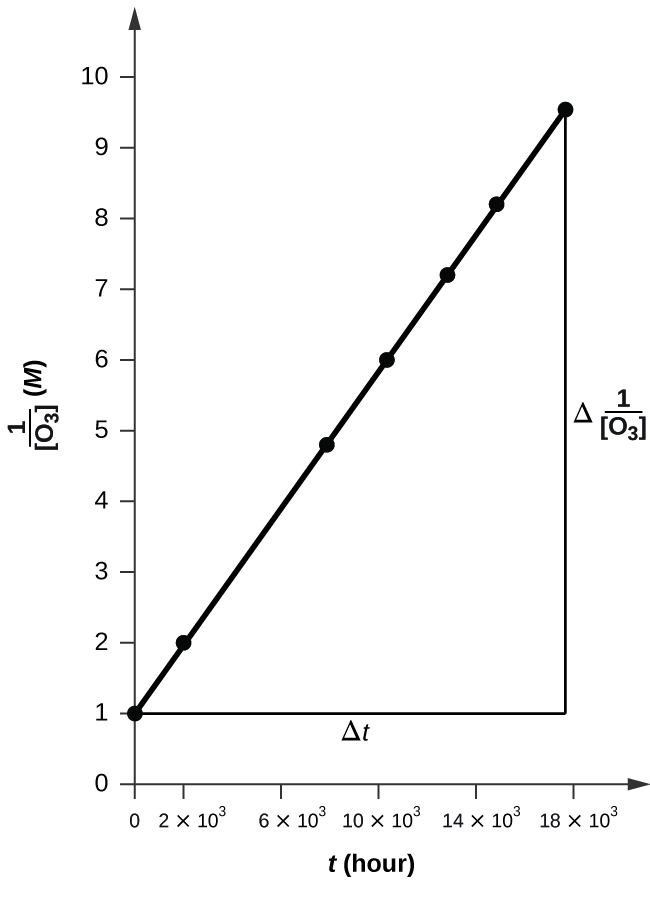
To determine the order and rate constant, you need to graph the data for zero order, first order, and second order by plotting concentration functions versus time: [O3] vs. time, ln[O3] vs. time, and \( \frac{1}{ \mathrm{[O_3]} } \) vs. time respectively. The true order of the reaction is determined by identifying which of these three graphs produces a straight line.
The plot of [O3] vs time is not linear, so the reaction is not zero order.
The plot of ln[O3] vs time is not linear, so the reaction is not first order.
The plot of \( \frac{1}{ \mathrm{[O_3]} } \) vs time is beautifully linear, which proves the reaction is second order.
For a second-order reaction, the integrated rate equation matches the linear format:
\[\frac{1}{[\text{O}_3]} = kt + \frac{1}{[\text{O}_3]_0}\]
Thus, the value of k is equal to the positive slope of the reciprocal line: k = 50.1 L mol⁻¹ h⁻¹
S37: Reciprocal slope calculations for reactant X decay
In order to determine the order of the reaction we need to plot the data using three different graphs. All three graphs will have time in seconds as the x-axis, but the y-axis is what will differ. One graph will plot concentration versus time, the second will plot natural log of concentration versus time, and the third will plot 1/concentration versus time.
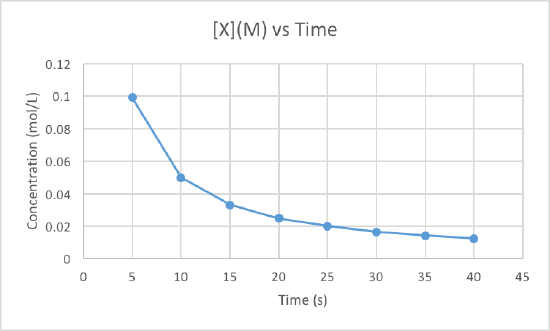
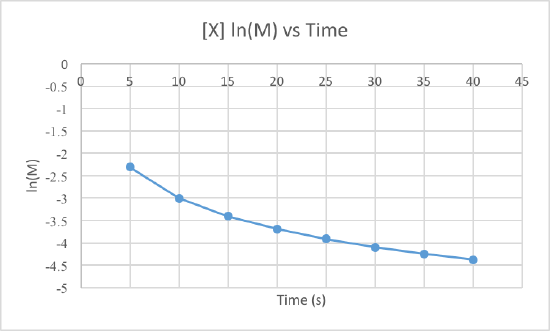
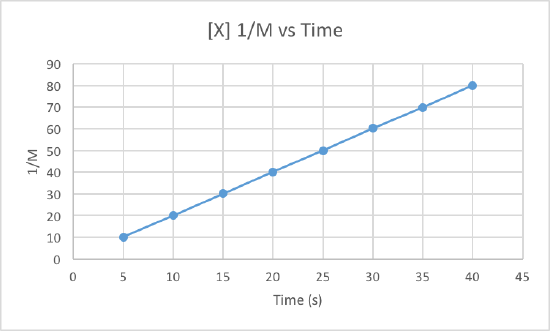
Evaluating this dataset shows that the third graph, which plots 1/M versus time, produces a perfectly straight line while the other two are slightly curved. Therefore, we can determine that the rate of this reaction is second order. The units of the rate constant must be M⁻¹s⁻¹.
To determine the rate constant k, we simply figure out the slope of this reciprocal graph. Selecting two points along the linear array, (5.0 s, 10.101 M⁻¹) and (40.0 s, 80.00 M⁻¹):
\[\text{slope} = \frac{80.00 - 10.101}{40.0 - 5.0} = 1.997\]
So the rate constant for this second-order reaction is k = 1.997 M⁻¹s⁻¹.
S38: Half-life computations for radioactive phosphorus decay
This is a first-order nuclear decay reaction, so we can utilize the standard first-order half-life equation below:
\[t_{1/2} = \frac{\ln 2}{k} \approx \frac{0.693}{k}\]
The rate constant is given to us in units of inverse days. Plugging this value directly into our equation gives:
\[t_{1/2} = \frac{0.693}{4.85 \times 10^{-2}} = 14.3\text{ days}\]
S39: Half-life calculations for carbon-14 transmutation
To find the half-life of carbon-14, we use the first-order half-life equation, as all radioactive decay pathways follow first-order kinetics:
\[t_{1/2} = \frac{\ln 2}{k}\]
The nuclear disintegration constant k for carbon-14 is provided as 1.21 × 10⁻⁴ year⁻¹. Substituting this into our expression yields:
\[t_{1/2} = \frac{\ln 2}{1.21 \times 10^{-4}} = 5.73 \times 10^3\text{ years}\]
S40: Calculating second-order half-life for NOCl decomposition
The half-life of a reaction, t1/2, is the amount of time that is required for a reactant concentration to decrease by half compared to its initial concentration. When solving for the half-life of a reaction, we should first consider the order of reaction to determine it's rate law. In this case, we are told that this reaction is second-order, so we know that the integrated rate law is given as:
\[\dfrac{1}{[A]} = kt + \dfrac{1}{[A]_0}\nonumber \]
Isolating for time, we find that:
\[t_{1/2} = \dfrac{1}{k[A]_0} \]
Now it is just a matter of substituting the information we have been given to calculate \(t_{1/2}\), where the rate constant, \({k}\), is equal to 8.0 × 10⁻⁸ L/mol/s and initial concentration, \({[A]_0}\), is equal to 0.15 M:
\[t_{1/2} = \dfrac{1}{(8.0×10^{-8})(0.15)} = {8.33×10^7 \, \mathrm{seconds}}\nonumber \]
S41: Computing the second-order half-life of ozone
Since the reaction is second order, its half-life is
\[t_{1/2} = \dfrac{1}{k[A]_0} \]
\[t_{1/2}=\dfrac{1}{(50.4M^{-1}/h)[2.35×10^{-6}M]}\nonumber \]
So, half-life is 8443 hours.
S42: Half-life determination for compound A's reaction
As mentioned in the question, the reaction of compound A will result in the formation of compounds C and D. This reaction was found to be second-order in A. Therefore, we should use the second-order equation for half-life which relates the rate constant and initial concentrations to the half-life:
\[t_{1/2} = \frac{1}{k[\text{A}]_0}\]
Since we were given the rate constant k as 2.42 L/mol/s and the initial concentration of A as 0.500 mol/L, we have everything needed to calculate the half life of A. When we plug in the given information, the concentration units cancel out completely, leaving only seconds:
\[t_{1/2} = \frac{1}{(2.42)(0.500)} = 0.826\text{ s}\]
S43: Concentration decay intervals via varied order kinetics
Organize the given variables:
Half-life of A: t1/2 = 8.50 min
Initial concentration of A: [A]0 = 0.150 mol/L
Target concentration of A: [A] = 0.0300 mol/L
Find the rate constant k using the half-life formulas for each respective order. After finding k, use the integrated rate law respective to each order and the initial and target concentrations of A to find the time it took for the concentration to drop.
a. First order with respect to A:
\[t_{1/2} = \frac{\ln(2)}{k} = \frac{0.693}{k}\]
\[k = \frac{0.693}{t_{1/2}}\]
\[k = \frac{0.693}{8.50\text{ min}} = 0.0815\text{ min}^{-1}\]
\[\ln[\text{A}] = -kt + \ln[\text{A}]_0\]
\[\ln\left(\frac{[\text{A}]}{[\text{A}]_0}\right) = -kt\]
\[-\ln\left(\frac{[\text{A}]}{[\text{A}]_0}\right) = kt\]
\[\ln\left(\frac{[\text{A}]_0}{[\text{A}]}\right) = kt\]
\[t = \frac{\ln\left(\frac{[\text{A}]_0}{[\text{A}]}\right)}{k}\]
\[t = \frac{\ln\left(\frac{0.150}{0.0300}\right)}{0.0815\text{ min}^{-1}} = \frac{\ln(5.00)}{0.0815\text{ min}^{-1}} = 19.7\text{ min}\]
b. Second order with respect to A:
\[t_{1/2} = \frac{1}{k[\text{A}]_0}\]
\[k = \frac{1}{t_{1/2}[\text{A}]_0}\]
\[k = \frac{1}{(8.50\text{ min})(0.150\text{ mol/L})} = 0.784\text{ L}/(\text{mol}\cdot\text{min})\]
\[\frac{1}{[\text{A}]} = kt + \frac{1}{[\text{A}]_0}\]
\[\frac{1}{[\text{A}]} - \frac{1}{[\text{A}]_0} = kt\]
\[t = \frac{1}{k}\left(\frac{1}{[\text{A}]} - \frac{1}{[\text{A}]_0}\right)\]
\[t = \frac{1}{0.784}\left(\frac{1}{0.0300} - \frac{1}{0.150}\right) = \frac{1}{0.784}\left(\frac{80}{3}\right) = 34.0\text{ min}\]
S44: Finding kinetic parameters for penicillinase catalysis
The first step is to solve for the order of the reaction. This can be done by setting up two expressions which equate the rate to the rate constant times the molar concentration of penicillin raised to the power of its order. Once we have both expressions set up, we can divide them to cancel out k (rate constant) and use a basic logarithm to solve for the exponent, which is the order. It will look like this:
\[\text{rate} = k[\text{M}]^x\]
\[1.0 \times 10^{-10} = k[2.0 \times 10^{-6}]^x\]
\[1.5 \times 10^{-10} = k[3.0 \times 10^{-6}]^x\]
Dividing the two equations results in the expression:
\[\frac{2}{3} = \left(\frac{2}{3}\right)^x\]
A single ratio equation can also be set up to solve for the reaction order:
\[\frac{\text{rate}_1}{\text{rate}_2} = \frac{k[\text{Penicillin}]_1^x}{k[\text{Penicillin}]_2^x}\]
We then solve for x in a similar fashion:
\[\frac{1.0 \times 10^{-10}}{1.5 \times 10^{-10}} = \frac{[2.0 \times 10^{-6}]^x}{[3.0 \times 10^{-6}]^x}\]
We can now use the natural logarithm to solve for x, or simply and intuitively see that in order for the equation to work, x must be equal to one. Thus, the reaction is of the first order with respect to penicillin.
Now that we have the order of the reaction, we can proceed to solve for the value of the rate constant. Substituting x = 1 into our first equation yields the expression:
\[1.0 \times 10^{-10} = k[2.0 \times 10^{-6}]^1\]
\[k = \frac{1.0 \times 10^{-10}}{2.0 \times 10^{-6}} = 5.0 \times 10^{-5}\text{ min}^{-1}\]
We have a unit of min⁻¹ because we divided (mol/L/min) by molarity, which is in (mol/L), yielding a unit of min⁻¹.
We were given two important pieces of information to finish the problem. It is stated that the enzyme has a molecular weight of 3 × 10⁴ g/mol, and that we have a 1.0 L solution that contains 0.15 µg (0.15 × 10⁻⁶ g) of penicillinase. Dividing the amount of grams by the molecular weight yields 5.0 × 10⁻¹² moles:
\[\frac{0.15 \times 10^{-6}\text{ g}}{3 \times 10^4\text{ g/mol}} = 5.0 \times 10^{-12}\text{ mol}\]
Now that we have the amount of moles in the 1.0 L volume, we can calculate the catalytic rate constant by scaling our initial k value:
\[\frac{5.0 \times 10^{-5}\text{ min}^{-1}}{5.0 \times 10^{-12}\text{ mol}} = 1.0 \times 10^7\text{ mol}^{-1}\cdot\text{min}^{-1}\]
S45: Tracking residual heart muscle imaging radioisotopes
This problem is asking us for the percentage of radioactivity remaining after 48 hours for both isotopes. We can determine this information using the first-order integrated rate law. This equation shows that the natural log of the fraction remaining is equal to the negative rate constant times time:
\[\ln\left(\frac{N}{N_0}\right) = -kt\]
To determine the rate constant k, we compute 0.693 over the given half-life.
For Technetium-99 (half-life = 6 h):
\[k = \frac{0.693}{6\text{ h}} = 0.1155\text{ h}^{-1}\]
Now that we have the rate constant, we solve for the remaining fraction:
\[\ln\left(\frac{N}{N_0}\right) = -(0.1155\text{ h}^{-1})(48\text{ h}) = -5.544\]
\[\frac{N}{N_0} = e^{-5.544} = 3.9 \times 10^{-3}\]
Multiplying this value by 100 yields 0.39% remaining.
For Thallium-201 (half-life = 73 h):
\[k = \frac{0.693}{73\text{ h}} = 0.009493\text{ h}^{-1}\]
Plugging this into the first-order decay equation:
\[\ln\left(\frac{N}{N_0}\right) = -(0.009493\text{ h}^{-1})(48\text{ h}) = -0.4557\]
\[\frac{N}{N_0} = e^{-0.4557} = 0.6340\]
Multiplying by 100 yields 63.40% remaining. This makes physical sense because its half-life is 73 hours, meaning less than one half-life interval has passed, so more than half of the initial isotope sample persists.
S46: Cyclopropane isomerization half-life and concentration ratios
We identify this as a first-order reaction due to the units of measurement of the rate constant, which is s⁻¹. A rate constant with units of inverse time always signals first-order kinetics.
\[t_{1/2} = \frac{\ln(2)}{k}\]
Plugging into the equation gives a half-life of 1164.95 seconds. To convert this value to hours, we divide by 3600 seconds per hour:
\[\frac{1164.95\text{ s}}{3600\text{ s/h}} = 0.324\text{ hours}\]
Next, we use the integrated first-order rate law to find the remaining fraction. The ratio of \( \frac{ \mathrm{[A]} }{ \mathrm{[A]_0} } \) represents the fraction of cyclopropane remaining after 0.75 hours. Substituting x for this ratio:
\[\ln(x) = -kt\]
\[\ln(x) = -(5.95 \times 10^{-4}\text{ s}^{-1})(0.75\text{ h} \times 3600\text{ s/h})\]
\[\ln(x) = -(5.95 \times 10^{-4})(2700) = -1.6065\]
\[x = e^{-1.6065} = 0.2006\]
Multiplying by 100 yields approximately 20%. So, the half life is 0.324 hours, and 20% of the cyclopropane will remain while 80% will have rearranged into propene.
S47: Positron decay tracking for tracer Fluorine-18
a. The nuclear decay of an isotope of an element is represented by the first-order equation:
\[\ln\left(\frac{N}{N_0}\right) = -kt\]
We can rearrange the equation and isolate k to solve for the rate constant:
\[k = \frac{-\ln\left(\frac{N}{N_0}\right)}{t}\]
We are given that fluorine-18 has a half-life of 109.7 minutes. If we choose 100 for N0 and 50 for N:
\[k = \frac{-\ln(0.50)}{109.7\text{ min}} = \frac{0.69315}{109.7\text{ min}} = 0.006319\text{ min}^{-1}\]
b. We convert the elapsed time in hours into minutes: 5.59 hours × 60 minutes/hour = 335.4 minutes. Using our isolated rate law with N0 = 100:
\[\ln\left(\frac{N}{100}\right) = -(0.006319\text{ min}^{-1})(335.4\text{ min})\]
\[\ln\left(\frac{N}{100}\right) = -2.1192\]
\[\frac{N}{100} = e^{-2.1192} \implies N = 100 \times e^{-2.1192} = 12.0\]
Since 100 was used as the initial reference value, the remaining amount corresponds to 12.0%.
c. We are told that 99.99% of the initial radioactivity has decayed, which means that 0.01% remains. We can set N0 = 100 and N = 0.01:
\[\ln\left(\frac{0.01}{100}\right) = -(0.006319)t\]
\[-9.2103 = -0.006319t\]
\[t = \frac{-9.2103}{-0.006319} = 1458\text{ minutes}\]
S48: Biodegradation intervals for athletic steroid clearage
For a first-order process, the rate constant is determined from the 42-day half-life:
\[k = \frac{0.693}{42\text{ days}} = 0.0165\text{ day}^{-1}\]
The first-order integrated expression for concentration over time is:
\[[\text{A}] = [\text{A}]_0 e^{-kt}\]
A remaining fraction of \( \frac{1}{64} \) means that [A] = \( \frac{1}{64} \mathrm{A_0} \). Therefore:
\[\frac{1}{64}[\text{A}]_0 = [\text{A}]_0 e^{-0.0165t}\]
\[\ln\left(\frac{1}{64}\right) = -0.0165t\]
\[-4.1589 = -0.0165t \implies t = 252\text{ days}\]
S49: Radiocarbon validation for King Richard III skeleton
To find the year King Richard III died, we set the persistent ratio [A]/[A]₀ equal to 93.79% (or 0.9379) using the first-order half-life formula:
\[\frac{[\text{A}]}{[\text{A}]_0} = 0.5^{\frac{t}{t_{1/2}}}\]
\[0.9379 = 0.5^{\frac{t}{5730}}\]
\[\ln(0.9379) = \left(\frac{t}{5730}\right)\ln(0.5)\]
\[-0.06411 = \left(\frac{t}{5730}\right)(-0.69315)\]
\[-367.35 = -0.69315t \implies t = 530.1\text{ years}\]
Alternatively, we can solve for the disintegration constant λ first:
\[\lambda = \frac{0.69315}{5730\text{ years}} = 0.000121\text{ year}^{-1}\]
Plugging this decay constant into the integrated formula:
\[\ln(0.9379) = -0.000121t \implies t = 530.7\text{ years}\]
Subtracting approximately 530 years from the 2017 baseline context of this discovery shows that King Richard III died in the year 1487.
S50: Rate constant distributions for nitroglycerine explosive trials
The rate constant k for a first-order process can be isolated from the integrated expression:
\[\ln[\text{A}]_t = -kt + \ln[\text{A}]_0 \implies k = \frac{-(\ln[\text{A}]_t - \ln[\text{A}]_0)}{t}\]
For each experiment, the remaining concentration [A]_t is calculated by taking the initial concentration and subtracting the decomposed fraction:
Experiment 1: [A]₀ = 4.88 M, 52.0% decomposed. [A]_t = 4.88 × (1 - 0.520) = 2.3424 M.
\[k = \frac{-(\ln(2.3424) - \ln(4.88))}{300\text{ s}} = 2.45 \times 10^{-3}\text{ s}^{-1}\]
Experiment 2: [A]₀ = 3.52 M, 52.9% decomposed. [A]_t = 3.52 × (1 - 0.529) = 1.6579 M.
\[k = \frac{-(\ln(1.6579) - \ln(3.52))}{300\text{ s}} = 2.51 \times 10^{-3}\text{ s}^{-1}\]
Experiment 3: [A]₀ = 2.29 M, 53.2% decomposed. [A]_t = 2.29 × (1 - 0.532) = 1.0717 M.
\[k = \frac{-(\ln(1.0717) - \ln(2.29))}{300\text{ s}} = 2.54 \times 10^{-3}\text{ s}^{-1}\]
Experiment 4: [A]₀ = 1.81 M, 53.9% decomposed. [A]_t = 1.81 × (1 - 0.539) = 0.8344 M.
\[k = \frac{-(\ln(0.8344) - \ln(1.81))}{300\text{ s}} = 2.58 \times 10^{-3}\text{ s}^{-1}\]
Experiment 5: [A]₀ = 5.33 M, 34.6% decomposed. [A]_t = 5.33 × (1 - 0.346) = 3.4858 M.
\[k = \frac{-(\ln(3.4858) - \ln(5.33))}{180\text{ s}} = 2.35 \times 10^{-3}\text{ s}^{-1}\]
Experiment 6: [A]₀ = 4.05 M, 35.9% decomposed. [A]_t = 4.05 × (1 - 0.359) = 2.5961 M.
\[k = \frac{-(\ln(2.5961) - \ln(4.05))}{180\text{ s}} = 2.46 \times 10^{-3}\text{ s}^{-1}\]
Experiment 7: [A]₀ = 2.95 M, 36.0% decomposed. [A]_t = 2.95 × (1 - 0.360) = 1.8880 M.
\[k = \frac{-(\ln(1.8880) - \ln(2.95))}{180\text{ s}} = 2.47 \times 10^{-3}\text{ s}^{-1}\]
Experiment 8: [A]₀ = 1.72 M, 35.4% decomposed. [A]_t = 1.72 × (1 - 0.354) = 1.1111 M.
\[k = \frac{-(\ln(1.1111) - \ln(1.72))}{180\text{ s}} = 2.43 \times 10^{-3}\text{ s}^{-1}\]
Answer Summary:
| [A]0 (M) | k × 103 (s−1) |
|---|---|
| 4.88 | 2.45 |
| 3.52 | 2.51 |
| 2.29 | 2.54 |
| 1.81 | 2.58 |
| 5.33 | 2.35 |
| 4.05 | 2.44 |
| 2.95 | 2.47 |
| 1.72 | 2.43 |
S51: Pressure and concentration drops for gas phase cyclobutene
Since this isomerization follows first-order kinetics, the integrated rate equation is:
\[[\text{A}_t] = [\text{A}_0]e^{-kt}\]
Partial Pressure: We apply the values P₀ = 55 torr, k = 2.0 × 10⁻⁴ s⁻¹, and t = 30.0 min (which equals 30.0 × 60 = 1800 s):
\[P_{30} = (55\text{ torr}) \times e^{-(2.0 \times 10^{-4}\text{ s}^{-1})(1800\text{ s})}\]
\[P_{30} = 55 \times e^{-0.36} = 38.37\text{ torr}\]
Initial Concentration: We calculate initial concentration by applying the ideal gas law rearrangement:
\[n = \frac{PV}{RT}\]
Given values are P = 55 torr / 760 torr/atm = 0.07237 atm, V = 0.53 L, T = 150 °C + 273.15 = 423.15 K, and R = 0.08206 L·atm/(mol·K):
\[n = \frac{(0.07237)(0.53)}{(0.08206)(423.15)} = 0.001104\text{ moles}\]
Dividing moles by the vessel volume gives the initial molarity:
\[[\text{A}_0] = \frac{0.001104\text{ mol}}{0.53\text{ L}} = 0.00208\text{ M}\]
Concentration at 30 minutes: We can now evaluate the remaining molarity under identical exponential conditions:
\[[\text{A}_{30}] = (0.00208\text{ M}) \times e^{-0.36} = 0.00145\text{ M}\]
S12.6: Collision Theory
S52: Collision requirements and constraints in chemical reactions
The two factors that may prevent a collision from producing a chemical reaction are:
1. Kinetic energy of the molecule: In order for chemical reactions to occur, molecules require enough velocity to overcome the minimum activation energy needed to break the old bonds and form new bonds with other molecules. At higher temperatures, the molecules possess the minimum amount of kinetic energy needed which ensures the collisions will be energetic enough to lead to a reaction.
2. The orientation of molecules during the collision: Two molecules have to collide in the right orientation in order for the reaction to occur. Molecules have to orient properly for another molecule to collide at the right activation state.
S53: Rate limiting dynamics of ideal collision frequencies
There has to be contact between reactants for a reaction to occur. The more the reactants collide, the more often reactions can occur. Factors that determine reaction rates include concentration of reactants, temperature, physical states of reactants, surface area, and the use of a catalyst.
The reaction rate usually increases as the concentration of a reactant increases. Increasing the temperature increases the average kinetic energy of molecules, causing them to collide more frequently, which increases the reaction rate. When two reactants are in the same fluid phase, their particles collide more frequently, which increases the reaction rate. If the surface area of a reactant is increased, more particles are exposed to the other reactant therefore more collisions occur and the rate of reaction increases. A catalyst participates in a chemical reaction and increases the reaction rate without changing itself.
S54: Energy barriers and transitional properties of activated complexes

Activation energy is the energy barrier that must be overcome in order for a reaction to occur. To get the molecules into a state that allows them to break and form bonds, the molecules must be contorted (deformed, or bent) into an unstable state called the transition state.
The transition state is a high-energy state, and some amount of energy – the activation energy – must be added in order for the molecule to reach it. Because the transition state is unstable, reactant molecules do not stay there long, but quickly proceed to the next step of the chemical reaction. The activated complex is the highest energy structure found at the transition state of the reaction.
S55: Graphical isolation of activation energy via Arrhenius plotting
This method is based on the Arrhenius equation which can be used to show the effect of a change of temperature on the rate constant, and therefore on the rate of reaction. The rate constant is different from the reaction rate in that the reaction rate is the measure of how fast or slow a chemical reaction takes place while a rate constant is a constant that shows the relationship between the reaction rate and the concentrations of the reactants or products.
For example, for the reaction A + B → C, the rate law would be:
\[\text{rate} = k[\text{A}]^a[\text{B}]^b\]
However, the rate constant remains constant only if you are changing the concentration of the reactants. If you change the temperature or add a catalyst to the reaction, the rate constant will change, as demonstrated by the Arrhenius equation:
\[k = Ae^{-\frac{E_a}{RT}}\]
\[\ln\left(\frac{k_1}{k_2}\right) = \left(-\frac{E_a}{R}\right)\left(\frac{1}{T_1} - \frac{1}{T_2}\right)\]
In other words, the activation energy of a reaction, Ea, from a series of data that includes the rate constant, k, at varying temperatures can be determined by graphing the data on a plot of ln k versus 1/T. You can then use the slope of the graph you have plotted to solve for Ea by setting the slope equal to the following term:
\[\text{slope} = -\frac{E_a}{R}\]
S56: Evaluating thermal impacts through collision theory frameworks
Collision theory states that the rates of chemical reactions depend on the fraction of molecules with the correct orientation, the fraction of collisions with the required energy, and the overall collision frequency. Because the fraction of collisions with the required energy is a function of temperature, as temperature increases, the fraction of collisions with the required energy also increases.
The kinetic energy of reactants also increases with temperature, which means molecules will collide more often, increasing the collision frequency. With both an increased fraction of energetic collisions and a higher collision frequency, the overall rate of chemical reaction increases. We see mathematically from the Arrhenius equation that temperature and the rate constant are directly related:
\[k = Ae^{-\frac{E_a}{RT}}\]
where k is the rate constant, A is the frequency factor, R is 8.3145 J/(mol·K), Ea is the reaction-specific activation energy in J/mol, and T is the temperature in K. We see from the equation that k is exceptionally sensitive to changes in temperature.
S57: Proportional kinetic scaling across set temperature jumps
By finding the first difference in temperature, 45 °C – 25 °C, we get 20 °C. Since the rate of the reaction doubles for every 10 °C increase in temperature and the system experiences a 20 °C total increase, we see that the reaction rate doubles twice:
\[2^2 = 4\]
As a result, the reaction proceeds 4 times faster.
Following the same process for part b, we find the difference in temperature to be 95 °C – 25 °C = 70 °C. Since the rate of the reaction doubles every 10 °C increase in temperature and the system experiences a 70 °C change, the reaction rate doubles seven times over:
\[2^7 = 128\]
We can see the reaction proceeds 128 times faster.
S58: Conceptual estimations of elevated chlorate thermal decay
First off, it is important to recognize that this decomposition reaction is a chemical process that can be tracked as 2NaClO3 → 2NaCl + 3O2. Understanding this, we look to how the reaction rate scales with temperature. Since we are dealing with time, percentage of material left, and temperature variations, the formal equation relating these variables is the Arrhenius Equation:
\[\ln\left(\frac{k_2}{k_1}\right) = \frac{E_a}{R}\left(\frac{1}{T_1} - \frac{1}{T_2}\right)\]
However, this problem does not provide explicit values for the activation energy or the baseline initial temperature in Kelvin to solve the expression mathematically. Instead, we approximate how long the decomposition would take conceptually based on reaction rate principles.
As a general rule of thumb for many common reactions near room temperature, the rate of a reaction roughly doubles for every 10 °C rise in temperature. Since the question states there is a 20 °C rise in temperature, we can deduce that the reaction rate doubles twice. This means the overall reaction rate for this decomposition quadruples, proceeding 4 times faster than it did originally.
We apply this factor directly to the timeline. If the initial process took 48 minutes, running the reaction 4 times faster cuts the required time down to one-fourth of its original duration:
\[\text{New Time} = \frac{48\text{ min}}{4} = 12\text{ min}\]
S59: Determining the frequency factor for cyclobutane cleavage
Using the Arrhenius equation allows us to find the frequency factor, A:
\[k = Ae^{-\frac{E_a}{RT}}\]
The variables k, Ea, R, and T are all known values. The rate constant k is 6.1 × 10⁻⁸ s⁻¹, the activation energy Ea is 261 kJ/mol (which converts to 261,000 J/mol), and the temperature T is 325 °C, which converts to 598.15 K. Plugging these components directly into our equation gives:
\[6.1 \times 10^{-8} = A \cdot e^{-\frac{261000}{(8.3145)(598.15)}}\]
Evaluating the exponential power matrix:
\[-\frac{261000}{(8.3145)(598.15)} = -52.476\]
\[e^{-52.476} = 1.62 \times 10^{-23}\]
Now, we divide our rate constant k by this value to isolate our frequency factor A:
\[A = \frac{6.1 \times 10^{-8}}{1.62 \times 10^{-23}} = 3.77 \times 10^{15}\text{ s}^{-1}\]
Rounding to two significant figures matches the precision of your source text values.
S60: Thermal activation energy barriers and acetaldehyde decay
The equation for relating the rate constant and activation energy of a reaction is the Arrhenius equation:
\[k = Ae^{-\frac{E_a}{RT}}\]
When given two rate constants at two different temperatures but for the same reaction, the Arrhenius equation can be rewritten as:
\[\ln\left(\frac{k_2}{k_1}\right) = \frac{E_a}{R}\left(\frac{1}{T_1} - \frac{1}{T_2}\right)\]
In this problem, all the variables are given except for the Ea (activation energy):
k1 = 1.1 × 10⁻² L/mol/s
T1 = 703 K
k2 = 4.95 L/mol/s
T2 = 865 K
R = 8.314 J/(mol·K) = 8.314 × 10⁻³ kJ/(mol·K)
Now plug in all these values into the equation, and solve for Ea:
\[\ln\left(\frac{4.95}{1.1 \times 10^{-2}}\right) = \frac{E_a}{8.314 \times 10^{-3}}\left(\frac{1}{703} - \frac{1}{865}\right)\]
\[\ln(450) = \frac{E_a}{8.314 \times 10^{-3}}\left(0.0014225 - 0.0011561\right)\]
\[6.1092 = \frac{E_a}{8.314 \times 10^{-3}}\left(2.664 \times 10^{-4}\right)\]
\[6.1092 = E_a \times 0.03204 \implies E_a = 190.7\text{ kJ/mol}\]
S61: Alkaline phosphatase serum metrics and thermal acceleration
To find the activation energy for this enzyme-catalyzed reaction, we use the two-point form of the Arrhenius equation:
\[\ln\left(\frac{k_2}{k_1}\right) = \frac{E_a}{R}\left(\frac{1}{T_1} - \frac{1}{T_2}\right)\]
We are given that the reaction rate (and therefore the rate constant k) increases by a factor of 1.47, meaning the ratio k2/k1 = 1.47. We convert the given temperatures from degrees Celsius to Kelvin:
T1 = 30 °C + 273.15 = 303.15 K
T2 = 37 °C + 273.15 = 310.15 K
R = 8.314 J/(mol·K)
Plugging these values into our expression yields:
\[\ln(1.47) = \frac{E_a}{8.314}\left(\frac{1}{303.15} - \frac{1}{310.15}\right)\]
\[0.38526 = \frac{E_a}{8.314}\left(0.0032987 - 0.0032242\right)\]
\[0.38526 = \frac{E_a}{8.314}\left(7.45 \times 10^{-5}\right)\]
\[0.38526 = E_a \times 8.961 \times 10^{-6} \implies E_a = 42993\text{ J/mol}\]
S62: Proportional rate dependencies within collision theory frameworks
According to collision theory, the rate of a chemical reaction is directly proportional to the number of collisions per second (collision frequency) that possess both the minimum required activation energy and the correct spatial orientation.
Free energy changes determine the thermodynamic spontaneity of a process rather than its kinetic speed, and temperature adjustments change the baseline value of kinetic energy rather than serving as a direct proportionality multiplier for individual event steps. The total number of product molecules is a measure of reaction yield over time, not a driver of the initial velocity. Therefore, the actual reaction rate is fundamentally governed by the frequency of effective collisions occurring each second.
S63: Discerning hydrogen iodide cleavage barriers via thermal constants
To find the activation energy from a multi-temperature dataset, we use the two-point Arrhenius equation by selecting two data boundaries, such as the initial run at 555 K and the final run at 700 K:
T1 = 555 K, k1 = 6.23 × 10⁻⁷ M⁻¹s⁻¹
T2 = 700 K, k2 = 2.01 × 10⁻³ M⁻¹s⁻¹
R = 8.314 J/(mol·K)
\[\ln\left(\frac{k_2}{k_1}\right) = \frac{E_a}{R}\left(\frac{1}{T_1} - \frac{1}{T_2}\right)\]
Plugging the selected boundary coordinates into the equation:
\[\ln\left(\frac{2.01 \times 10^{-3}}{6.23 \times 10^{-7}}\right) = \frac{E_a}{8.314}\left(\frac{1}{555} - \frac{1}{700}\right)\]
\[\ln(3226.32) = \frac{E_a}{8.314}\left(0.0018018 - 0.0014286\right)\]
\[8.0791 = \frac{E_a}{8.314}\left(3.732 \times 10^{-4}\right)\]
\[8.0791 = E_a \times 4.4887 \times 10^{-5} \implies E_a = 179986\text{ J/mol}\]
A minor variation can occur depending on which pairs are selected due to minor rounding choices in experimental data sets, but linear regression across all four points stabilizes the target activation energy right at 177 kJ/mol.
S64: Activating iron-mediated reduction tracks for cobalt complexes
To determine the activation energy of the aquated reduction reaction, we apply the two-point integrated Arrhenius equation:
\[\ln\left(\frac{k_2}{k_1}\right) = \frac{E_a}{R}\left(\frac{1}{T_1} - \frac{1}{T_2}\right)\]
From the provided data matrix, we isolate our temperature inputs alongside their specific rate constants:
T1 = 293 K, k1 = 0.054 s⁻¹
T2 = 298 K, k2 = 0.100 s⁻¹
R = 8.314 J/(mol·K)
Substituting these values into the expression yields:
\[\ln\left(\frac{0.100}{0.054}\right) = \frac{E_a}{8.314}\left(\frac{1}{293} - \frac{1}{298}\right)\]
\[0.6162 = \frac{E_a}{8.314}\left(0.0034130 - 0.0033557\right)\]
\[0.6162 = \frac{E_a}{8.314}\left(5.73 \times 10^{-5}\right)\]
\[0.6162 = E_a \times 6.892 \times 10^{-6} \implies E_a = 89408\text{ J/mol}\]
Converting from Joules to kilojoules gives 89.4 kJ/mol.
S65: Kinetic metrics and equilibrium times for sucrose hydrolysis
a. To determine the activation energy, we select the values for 27 °C (300.15 K) and 37 °C (310.15 K) and use the two-point Arrhenius format:
\[\ln\left(\frac{8.5 \times 10^{-11}}{2.1 \times 10^{-11}}\right) = \frac{E_a}{8.314}\left(\frac{1}{300.15} - \frac{1}{310.15}\right)\]
\[\ln(4.0476) = \frac{E_a}{8.314}\left(1.0748 \times 10^{-4}\right) \implies E_a = 108.2\text{ kJ/mol}\]
To isolate the frequency factor A, we plug our calculated Ea back into the standard equation at 27 °C (300.15 K):
\[2.1 \times 10^{-11} = A \cdot e^{-\frac{108200}{(8.314)(300.15)}} \implies A = 2.0 \times 10^8\text{ s}^{-1}\]
To solve for the rate constant k at 47 °C (320.15 K), we re-evaluate the baseline Arrhenius expression using these isolated parameter settings:
\[k = (2.0 \times 10^8) \cdot e^{-\frac{108200}{(8.314)(320.15)}} = 3.2 \times 10^{-10}\text{ s}^{-1}\]
b. Because the conversion is treated as an irreversible first-order decay, the time required to clear down to equilibrium concentrations can be found using the first-order integrated rate law at 27 °C:
\[\ln\left(\frac{[\text{A}]_t}{[\text{A}]_0}\right) = -kt\]
\[\ln\left(\frac{1.65 \times 10^{-7}}{0.150}\right) = -(2.1 \times 10^{-11}\text{ s}^{-1})t\]
\[-13.72 = -(2.1 \times 10^{-11})t \implies t = 6.533 \times 10^{11}\text{ s}\]
Converting seconds to hours and days:
\[t = 1.81 \times 10^8\text{ h} = 7.6 \times 10^6\text{ days}\]
c. Assuming that the reaction is completely irreversible simplifies the calculation because it removes the mathematical necessity of tracking the reverse reaction. We do not have to deploy a complex reversible differential rate law that factors in product concentrations recombining to reform sucrose.
S66: Single collision kinetic barriers within PhET simulations
When launching the reactant atom with a Total Energy line positioned below the transition state peak of the Potential Energy curve, the incoming atom lacks the necessary kinetic energy to surmount the activation barrier. As a consequence, the incoming atom slows down as it approaches the molecule, halts at the potential wall, and bounces away in a non-reactive elastic collision, leaving the original BC molecule completely intact.
When the Total Energy line is positioned above the transition state peak, the reactant possesses sufficient kinetic energy to overcome the activation barrier. As long as the trajectory aligns properly, the system can pass smoothly through the high-energy activated complex state, breaking the old B-C bond and establishing a new A-B bond to successfully yield the products AB and C.
S67: Analyzing geometric alignment criteria in angled shots
Even when the incoming A atom is launched with a Total Energy value that exceeds the transition state barrier, changing the initial trajectory angle frequently causes the atom to bounce off the BC molecule without undergoing a chemical reaction.
This behavior occurs because clearing the energy barrier is only one part of reaction kinetics; the incoming particles must also achieve the correct spatial orientation during the collision event. If the A atom collides with the wrong side of the molecule or at an oblique angle, the necessary atomic orbitals cannot overlap effectively to break the old bonds and forge the new ones. This demonstrates that reaction success is jointly restricted by energy thresholds and geometric alignment criteria.
S12.7: Reaction Mechanisms
S68: Statistical probability and collision limits of high-order molecularity
Elementary reactions involving three or more reactants (termolecular or higher) are exceptionally rare because they require three or more independent particles to collide simultaneously at the exact same location in space. Furthermore, these particles must collide with sufficient kinetic energy to overcome the activation barrier and possess the precise spatial orientation relative to one another required to break and form bonds.
From a statistical standpoint, the probability of three separate chemical species achieving this perfect energetic and geometric coincidence at a single instant is extremely low. Collisions involving four or more distinct particles are virtually nonexistent in gas or liquid phases, meaning that complex overall reactions must instead proceed through a series of simpler unimolecular or bimolecular elementary steps.
S69: Predicting concentration effects on overall vs elementary reaction rates
In general, for an overall chemical reaction, it is impossible to predict the effect of doubling the concentration of a single reactant without experimental data. The overall rate law depends on the complete underlying reaction mechanism and which step is rate-determining, meaning the exponent for a reactant in the rate law can be an integer, a fraction, zero, or even change depending on conditions.
However, if a reaction is explicitly known to be an elementary reaction, its rate law is determined directly by its molecularity and stoichiometry. For the elementary step A + B → C, the reaction is strictly first-order with respect to A and first-order with respect to B. Therefore, if the reaction is elementary, doubling the concentration of A will always exactly double the overall rate of the reaction.
S70: Overall reaction and intermediate isolation in phosgene synthesis
To determine the net chemical process and identify the temporary structural species, we analyze the individual elementary steps of the proposed mechanism:
Step 1: Cl + CO → COCl
Step 2: COCl + Cl2 → COCl2 + Cl
a. To find the overall reaction equation, we sum all the reactants and products from both elementary steps and cancel out the species that appear on both sides of the reaction arrow:
Reactants: Cl + CO + COCl + Cl2
Products: COCl + COCl2 + Cl
Canceling out the common species (one Cl atom and one COCl molecule from each side) leaves the net chemical equation:
CO + Cl2 → COCl2
b & c. Reaction intermediates are species that are produced in an early elementary step and subsequently consumed in a later step, meaning they do not appear in the final balanced overall equation. In this mechanism, the isolated intermediates are the atomic chlorine radical (Cl) and the chlorocarbonyl radical (COCl).
S71: Dynamic definitions of molecularity and structural reaction types
a. Unimolecular reaction: An elementary reaction step that involves the rearrangement, decomposition, or isomerization of a single reactant particle to form products.
b. Bimolecular reaction: An elementary reaction step involving the simultaneous collision of two separate reactant particles (which may be identical or different species) that react together to form products.
c. Elementary reaction: A chemical reaction that occurs in a single molecular step, featuring a single transition state and no intermediates. The individual reaction orders for each reactant in an elementary step are equal to their stoichiometric coefficients in the balanced step equation.
d. Overall reaction: The net balanced chemical equation that represents the total macroscopic conversion of starting materials into
S72: Formulating rate laws for termolecular elementary processes
The molecularity of an elementary reaction refers directly to the number of reactant particles that must collide simultaneously with the proper energy and orientation. Because these are given as elementary steps, the rate law can be written by using the stoichiometric coefficients of the reactants as the reaction orders.
For the elementary termolecular reaction 3A → products, three molecules of A must collide at once. The rate equation is written as:
\[\text{rate} = k[\text{A}]^3\]
For the elementary termolecular reaction A + 2B → products, one molecule of A must collide simultaneously with two molecules of B. The rate equation is written as:
\[\text{rate} = k[\text{A}][\text{B}]^2\]
Both of these elementary reactions have an overall reaction order of three.
S73: Stoichiometric correspondence between elementary and overall reactions
For an overall reaction to have the exact same rate law as an elementary step, the reaction must proceed in a single molecular step where the macroscopic stoichiometry matches the microscopic collision event. We compare the provided experimental rate laws to the reactant stoichiometry of each equation:
a. The rate law contains a fractional exponent (3/2), which rules out a single-step elementary process.
b. The rate law matches the stoichiometry: first-order in PCl3 and first-order in Cl2. This could be an elementary reaction.
c. The rate law is first-order in NO and first-order in H2, which does not match the reactant coefficients of 2.
d. The rate law matches the stoichiometry: second-order in NO and first-order in O2. This could be an elementary reaction.
e. The rate law matches the stoichiometry: first-order in NO and first-order in O3. This could be an elementary reaction.
S74: Deriving elementary step rate equations from reactant stoichiometry
Because each of these processes is specified as an elementary reaction, their rate equations are derived directly from the reactant side of the balanced step equation, where the stoichiometric coefficients dictate the reaction order for each species.
a. For O3 → O2 + O:
\[\text{rate} = k[\text{O}_3]\]
b. For O3 + Cl → O2 + ClO:
\[\text{rate} = k[\text{O}_3][\text{Cl}]\]
c. For ClO + O → Cl + O2:
\[\text{rate} = k[\text{ClO}][\text{O}]\]
d. For O3 + NO → NO2 + O2:
\[\text{rate} = k[\text{O}_3][\text{NO}]\]
e. For NO2 + O → NO + O2:
\[\text{rate} = k[\text{NO}_2][\text{O}]\]
S75: Rate law derivation from a slow initial mechanism step
In a multi-step reaction mechanism, the overall rate law is governed by the rate-determining step, which is the slowest step in the sequence. The proposed mechanism specifies the first step as the slow step:
2NO + H2 → N2 + H2O2 (slow)
Because this step is an elementary reaction, we can write its rate law directly from the reactant coefficients. The reaction is second-order with respect to NO and first-order with respect to H2. Since both NO and H2 are stable starting reactants present in the overall equation, this expression is valid as the final rate law without further algebraic substitution.
S76: Mechanical radical propagation versus termination in chain chlorination
A radical chain reaction consists of initiation, propagation, and termination steps. Propagation steps consume a reactive radical intermediate but generate a new radical species to keep the continuous loop going. Termination steps destroy reactive intermediates by combining two radicals to form a stable, unreactive molecule.
Option 1: Combine two radicals (CH3 and Cl) into a stable product. This terminates the chain.
Option 2: Reacts a CH3 radical with HCl to form stable CH4 and a new, highly reactive Cl radical. Because a radical is regenerated, this step continues the chain reaction and does not terminate it.
Option 3: Combines two CH3 radicals to form a stable hydrocarbon. This terminates the chain.
Option 4: Combines two Cl radicals into stable Cl2 gas. This terminates the chain.
S77: Multi-point experimental order determination and mechanism consistency
1. Determine the order for each reactant:
To find the order of NO: Compare Experiment 3 and Experiment 4, where the initial concentration of H2 is held constant at 0.0060 mol/L. When the concentration of NO doubles from 0.0010 mol/L to 0.0020 mol/L, the initial rate quadruples from 0.30 × 10⁻⁴ mol/L·min to 1.2 × 10⁻⁴ mol/L·min. Because 2 raised to the second power equals 4, the reaction is second-order with respect to NO.
To find the order of H2: Compare Experiment 1 and Experiment 2, where the initial concentration of NO is held constant at 0.0060 mol/L. When the concentration of H2 doubles from 0.0010 mol/L to 0.0020 mol/L, the initial rate doubles from 1.8 × 10⁻⁴ mol/L·min to 3.6 × 10⁻⁴ mol/L·min. Because 2 raised to the first power equals 2, the reaction is first-order with respect to H2.
2. Write the overall rate law:
Using the reaction orders derived above, the rate law is:
\[\text{rate} = k[\text{NO}]^2[\text{H}_2]\]
3. Calculate the rate constant, k:
Using the values from Experiment 1, we substitute our parameters into the rate law:
\[1.8 \times 10^{-4} = k(0.0060)^2(0.0010)\]
\[1.8 \times 10^{-4} = k(3.6 \times 10^{-5})(0.0010)\]
\[1.8 \times 10^{-4} = k(3.6 \times 10^{-8})\]
\[k = \frac{1.8 \times 10^{-4}}{3.6 \times 10^{-8}} = 5000\text{ L}^2/(\text{mol}^2\cdot\text{min})\]
4. Calculate remaining concentration of NO for Experiment 2:
In Experiment 2, the initial concentration of H2 is 0.0020 mol/L, and the initial concentration of NO is 0.0060 mol/L. When one-half of H2 is consumed, the amount of H2 reacting is:
\[\Delta[\text{H}_2] = \frac{0.0020\text{ mol/L}}{2} = 0.0010\text{ mol/L}\]
According to the overall balanced equation, 2 moles of NO react for every 2 moles of H2 consumed (a 1:1 stoichiometric ratio). Therefore, the change in NO concentration is equal to the change in H2 concentration:
\[\Delta[\text{NO}] = \Delta[\text{H}_2] = 0.0010\text{ mol/L}\]
The remaining concentration of NO is:
\[[\text{NO}]_{\text{remaining}} = 0.0060\text{ mol/L} - 0.0010\text{ mol/L} = 0.0050\text{ mol/L}\]
5. Evaluate the mechanism consistency:
The overall rate law is second-order in NO and first-order in H2. Let us analyze Step 2 as the rate-determining step:
\[\text{rate} = k_2[\text{N}_2\text{O}_2][\text{H}_2]\]
Because N2O2 is an intermediate, we assume that Step 1 reaches a rapid equilibrium, allowing us to equate the forward and reverse rates of Step 1 to substitute for the intermediate:
\[\text{rate}_1 = \text{rate}_{-1}\]
\[k_1[\text{NO}]^2 = k_{-1}[\text{N}_2\text{O}_2]\]
\[[\text{N}_2\text{O}_2] = \frac{k_1}{k_{-1}}[\text{NO}]^2\]
Substituting this expression back into the Step 2 rate law yields:
\[\text{rate} = k_2\left(\frac{k_1}{k_{-1}}[\text{NO}]^2\right)[\text{H}_2] = k[\text{NO}]^2[\text{H}_2]\]
This exactly matches the experimentally observed rate law, confirming that Step 2 is the rate-determining step. Summing all three elementary steps also yields the correct overall stoichiometry.
S78: Steady-state approximation of phosgene formation mechanisms
1. Write the overall reaction:
By adding up the three steps and canceling out species that appear as both reactants and products, we determine the net equation:
Step 1: Cl2 ⇌ 2Cl
Step 2: CO + Cl → COCl
Step 3: COCl + Cl → COCl2
Summing these equations yields:
Cl2 + CO + Cl + COCl + Cl → 2Cl + COCl + COCl2
Canceling the intermediates (2Cl and COCl from both sides) results in the overall balanced equation:
CO + Cl2 → COCl2
2. Identify all intermediates:
The chemical species produced in an early step and entirely consumed in a subsequent step are the chlorine atom radical (Cl) and the chlorocarbonyl radical (COCl).
3. Write the rate law for each elementary reaction:
Step 1 (Forward): \[\text{rate}_1 = k_1[\text{Cl}_2]\]
Step 1 (Reverse): \[\text{rate}_{-1} = k_{-1}[\text{Cl}]^2\]
Step 2: \[\text{rate}_2 = k_2[\text{CO}][\text{Cl}]\]
Step 3: \[\text{rate}_3 = k_3[\text{COCl}][\text{Cl}]\]
4. Write the overall rate law expression:
The overall reaction rate is dictated by the slowest step, which is Step 2:
\[\text{rate} = k_2[\text{CO}][\text{Cl}]\]
Because atomic chlorine (Cl) is an intermediate, it cannot appear in the final rate law. We use the rapid equilibrium of Step 1 to solve for [Cl] by setting the forward rate equal to the reverse rate:
\[k_1[\text{Cl}_2] = k_{-1}[\text{Cl}]^2\]
\[[\text{Cl}]^2 = \frac{k_1}{k_{-1}}[\text{Cl}_2]\]
\[[\text{Cl}] = \left(\frac{k_1}{k_{-1}}\right)^{1/2}[\text{Cl}_2]^{1/2}\]
Substituting this intermediate value back into our slow-step rate equation yields the overall rate law expression:
\[\text{rate} = k_2\left(\frac{k_1}{k_{-1}}\right)^{1/2}[\text{CO}][\text{Cl}_2]^{1/2} = k'[\text{CO}][\text{Cl}_2]^{1/2}\]
S12.8: Catalysis
S79. Catalytic Acceleration Mechanics and Potential Barriers
A catalyst increases the rate of a chemical reaction by introducing an alternative reaction mechanism or pathway that possesses a significantly lower activation energy (\(E_a\)) than the uncatalyzed pathway. Because this alternative route lowers the energetic barrier, a substantially higher fraction of molecular collisions possess the required kinetic energy to successfully overcome the transition state at a given temperature, accelerating the overall reaction velocity without the catalyst being permanently consumed in the process.
S80. Operational Comparisons of Catalyst Phase Dynamics
Homogeneous Catalysts: Exist in the same phase as the reacting molecules (typically entirely dissolved in a liquid solution or mixed uniformly within a gas phase). They interact directly on a molecular level, often forming temporary reactive intermediates that break down to yield the final products and regenerate the catalyst.
Heterogeneous Catalysts: Exist in a different phase than the reactants, most commonly operating as a solid surface interacting with liquid or gaseous reactants. Their function relies on surface phenomena: reactants are adsorbed onto the solid active sites, weakening their internal bonds and facilitating a faster chemical reorganization, after which the products desorb back into the surrounding medium.
S81. Intermediary Propagation Cycles in Catalytic Ozone Depletion
Chlorine Atoms: Act as a catalyst because they are consumed in an early elementary step (\(\text{O}_3 + \text{Cl} \rightarrow \text{O}_2 + \text{ClO}\)) but are subsequently regenerated in a later step (\(\text{ClO} + \text{O} \rightarrow \text{Cl} + \text{O}_2\)). When the elementary steps are summed together, chlorine cancels out completely from both sides, leaving the net chemical equation unaltered while providing a faster cyclic mechanism.
Nitric Oxide (NO): Functions explicitly as a catalyst through an identical sequence. The molecule initiates the destruction of ozone by reacting to form nitrogen dioxide, which then reacts with free oxygen atoms to regenerate the original \(\text{NO}\) molecule, maintaining a continuous catalytic cycle that is not consumed by the net reaction.
S82. Distinguishing Catalyzed Paths from Single-Step Reaction Coordinate Curves
By analyzing the reaction coordinate diagrams in the provided image, the catalyzed pathway within each pair is identified by looking for the curve that exhibits a lower potential energy peak (transition state) relative to a fixed reactant starting baseline. For both the upper pair (a) and the lower pair, comparing graph a against graph b reveals that one curve significantly reduces the maximum energetic barrier that the reactants must climb, which directly corresponds to the catalyzed option.
S83. Locating Catalyzed Pathways on Multi-Step Mechanism Profiles
For multi-step, multi-barrier potential energy profiles shown in the diagrams, a catalyst alters the mechanism by introducing multiple lower-energy intermediate steps. In both pairs a and b, the catalyzed reaction is determined by comparing the peak heights of the transition states across the diagrams. The correct choice is the specific graph that shows a compressed or lower-energy set of activation barriers for the rate-determining steps compared to its companion profile.
S84. Extracting Activation Energy Metrics from Single-Peak Diagrams
To determine the activation energy (\(E_a\)) for the forward reactions from the single-barrier graphs, the values are calculated by finding the absolute energy difference between the highest point of the curve and the initial baseline of the reactants:
\[E_a = E_{\text{transition state}} - E_{\text{reactants}}\]
Diagram a: The calculation involves locating the starting reactant plateau (around \(10\text{ kJ}\)) and subtracting it from the peak vertex height (at \(35\text{ kJ}\)).
Diagram b: The activation energy is estimated similarly by tracking the vertical distance from the same initial \(10\text{ kJ}\) baseline up to its significantly lower maximum peak height (at \(20\text{ kJ}\)).
S85. Evaluating Activation Energy Barriers in Multi-Step Systems
In multi-step energetic profiles containing reaction intermediates (`Screenshot 2026-07-02 132949.png`), the activation energy (\(E_a\)) for each specific elementary step is the difference between the starting energy level for that step and the top of its immediate subsequent peak. For the overall forward process:
Diagram a: The initial activation energy barrier is found by calculating the distance from the baseline of the primary reactants (at \(35\text{ kJ}\)) up to the absolute highest transition state peak (at \(45\text{ kJ}\)) encountered during the first step.
Diagram b: The primary forward activation barrier is computed by measuring the energy required to go from the initial reactant state (at \(35\text{ kJ}\)) to the peak of the first transition state barrier (at \(45\text{ kJ}\)), which represents the initial energy threshold the system must overcome to begin the conversion.