

LAB 11 - SYNTHESIS OF HAND LOTION
- Page ID
- 506288

\( \newcommand{\vecs}[1]{\overset { \scriptstyle \rightharpoonup} {\mathbf{#1}} } \)
\( \newcommand{\vecd}[1]{\overset{-\!-\!\rightharpoonup}{\vphantom{a}\smash {#1}}} \)
\( \newcommand{\dsum}{\displaystyle\sum\limits} \)
\( \newcommand{\dint}{\displaystyle\int\limits} \)
\( \newcommand{\dlim}{\displaystyle\lim\limits} \)
\( \newcommand{\id}{\mathrm{id}}\) \( \newcommand{\Span}{\mathrm{span}}\)
( \newcommand{\kernel}{\mathrm{null}\,}\) \( \newcommand{\range}{\mathrm{range}\,}\)
\( \newcommand{\RealPart}{\mathrm{Re}}\) \( \newcommand{\ImaginaryPart}{\mathrm{Im}}\)
\( \newcommand{\Argument}{\mathrm{Arg}}\) \( \newcommand{\norm}[1]{\| #1 \|}\)
\( \newcommand{\inner}[2]{\langle #1, #2 \rangle}\)
\( \newcommand{\Span}{\mathrm{span}}\)
\( \newcommand{\id}{\mathrm{id}}\)
\( \newcommand{\Span}{\mathrm{span}}\)
\( \newcommand{\kernel}{\mathrm{null}\,}\)
\( \newcommand{\range}{\mathrm{range}\,}\)
\( \newcommand{\RealPart}{\mathrm{Re}}\)
\( \newcommand{\ImaginaryPart}{\mathrm{Im}}\)
\( \newcommand{\Argument}{\mathrm{Arg}}\)
\( \newcommand{\norm}[1]{\| #1 \|}\)
\( \newcommand{\inner}[2]{\langle #1, #2 \rangle}\)
\( \newcommand{\Span}{\mathrm{span}}\) \( \newcommand{\AA}{\unicode[.8,0]{x212B}}\)
\( \newcommand{\vectorA}[1]{\vec{#1}} % arrow\)
\( \newcommand{\vectorAt}[1]{\vec{\text{#1}}} % arrow\)
\( \newcommand{\vectorB}[1]{\overset { \scriptstyle \rightharpoonup} {\mathbf{#1}} } \)
\( \newcommand{\vectorC}[1]{\textbf{#1}} \)
\( \newcommand{\vectorD}[1]{\overrightarrow{#1}} \)
\( \newcommand{\vectorDt}[1]{\overrightarrow{\text{#1}}} \)
\( \newcommand{\vectE}[1]{\overset{-\!-\!\rightharpoonup}{\vphantom{a}\smash{\mathbf {#1}}}} \)
\( \newcommand{\vecs}[1]{\overset { \scriptstyle \rightharpoonup} {\mathbf{#1}} } \)
\(\newcommand{\longvect}{\overrightarrow}\)
\( \newcommand{\vecd}[1]{\overset{-\!-\!\rightharpoonup}{\vphantom{a}\smash {#1}}} \)
\(\newcommand{\avec}{\mathbf a}\) \(\newcommand{\bvec}{\mathbf b}\) \(\newcommand{\cvec}{\mathbf c}\) \(\newcommand{\dvec}{\mathbf d}\) \(\newcommand{\dtil}{\widetilde{\mathbf d}}\) \(\newcommand{\evec}{\mathbf e}\) \(\newcommand{\fvec}{\mathbf f}\) \(\newcommand{\nvec}{\mathbf n}\) \(\newcommand{\pvec}{\mathbf p}\) \(\newcommand{\qvec}{\mathbf q}\) \(\newcommand{\svec}{\mathbf s}\) \(\newcommand{\tvec}{\mathbf t}\) \(\newcommand{\uvec}{\mathbf u}\) \(\newcommand{\vvec}{\mathbf v}\) \(\newcommand{\wvec}{\mathbf w}\) \(\newcommand{\xvec}{\mathbf x}\) \(\newcommand{\yvec}{\mathbf y}\) \(\newcommand{\zvec}{\mathbf z}\) \(\newcommand{\rvec}{\mathbf r}\) \(\newcommand{\mvec}{\mathbf m}\) \(\newcommand{\zerovec}{\mathbf 0}\) \(\newcommand{\onevec}{\mathbf 1}\) \(\newcommand{\real}{\mathbb R}\) \(\newcommand{\twovec}[2]{\left[\begin{array}{r}#1 \\ #2 \end{array}\right]}\) \(\newcommand{\ctwovec}[2]{\left[\begin{array}{c}#1 \\ #2 \end{array}\right]}\) \(\newcommand{\threevec}[3]{\left[\begin{array}{r}#1 \\ #2 \\ #3 \end{array}\right]}\) \(\newcommand{\cthreevec}[3]{\left[\begin{array}{c}#1 \\ #2 \\ #3 \end{array}\right]}\) \(\newcommand{\fourvec}[4]{\left[\begin{array}{r}#1 \\ #2 \\ #3 \\ #4 \end{array}\right]}\) \(\newcommand{\cfourvec}[4]{\left[\begin{array}{c}#1 \\ #2 \\ #3 \\ #4 \end{array}\right]}\) \(\newcommand{\fivevec}[5]{\left[\begin{array}{r}#1 \\ #2 \\ #3 \\ #4 \\ #5 \\ \end{array}\right]}\) \(\newcommand{\cfivevec}[5]{\left[\begin{array}{c}#1 \\ #2 \\ #3 \\ #4 \\ #5 \\ \end{array}\right]}\) \(\newcommand{\mattwo}[4]{\left[\begin{array}{rr}#1 \amp #2 \\ #3 \amp #4 \\ \end{array}\right]}\) \(\newcommand{\laspan}[1]{\text{Span}\{#1\}}\) \(\newcommand{\bcal}{\cal B}\) \(\newcommand{\ccal}{\cal C}\) \(\newcommand{\scal}{\cal S}\) \(\newcommand{\wcal}{\cal W}\) \(\newcommand{\ecal}{\cal E}\) \(\newcommand{\coords}[2]{\left\{#1\right\}_{#2}}\) \(\newcommand{\gray}[1]{\color{gray}{#1}}\) \(\newcommand{\lgray}[1]{\color{lightgray}{#1}}\) \(\newcommand{\rank}{\operatorname{rank}}\) \(\newcommand{\row}{\text{Row}}\) \(\newcommand{\col}{\text{Col}}\) \(\renewcommand{\row}{\text{Row}}\) \(\newcommand{\nul}{\text{Nul}}\) \(\newcommand{\var}{\text{Var}}\) \(\newcommand{\corr}{\text{corr}}\) \(\newcommand{\len}[1]{\left|#1\right|}\) \(\newcommand{\bbar}{\overline{\bvec}}\) \(\newcommand{\bhat}{\widehat{\bvec}}\) \(\newcommand{\bperp}{\bvec^\perp}\) \(\newcommand{\xhat}{\widehat{\xvec}}\) \(\newcommand{\vhat}{\widehat{\vvec}}\) \(\newcommand{\uhat}{\widehat{\uvec}}\) \(\newcommand{\what}{\widehat{\wvec}}\) \(\newcommand{\Sighat}{\widehat{\Sigma}}\) \(\newcommand{\lt}{<}\) \(\newcommand{\gt}{>}\) \(\newcommand{\amp}{&}\) \(\definecolor{fillinmathshade}{gray}{0.9}\)The purpose of this experiment is to:
- Synthesize a simple hand lotion
- Understand the chemistry behind emulsions and their applications in cosmetic products.
INTRODUCTION
Hand lotion is an emulsion, which is a mixture of two immiscible liquids (like oil and water) stabilized by an emulsifying agent. The oil component provides moisturizing benefits, while the water component allows for easy spreading and absorption. Emulsifying agents, such as stearic acid and triethanolamine, help to keep the oil and water phases combined.
The hand lotion formulated in this lab contains three polar ingredients: water, triethanolamine, and glycerol.
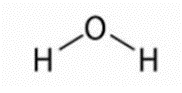

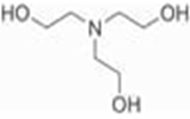
Figure \(\PageIndex{1}\): Water Figure \(\PageIndex{2}\): Glycerol Figure \(\PageIndex{3}\): Triethanolamine
And four non-polar ingredients: stearic acid, Cetyl alcohol, lanolin, and mineral oil.


Figure \(\PageIndex{4}\): Stearic Acid(CH3-(CH2)16-COOH) Figure \(\PageIndex{5}\): Cetyl alcohol (CH3-(CH2)15-OH)
Lanolin is a complex mixture of waxes. It primarily consists of long-chain waxy esters (approximately 97% by weight), with the remainder comprising lanolin alcohols, lanolin acids, and lanolin hydrocarbons.
Mineral oil: Mixture of higher alkanes from a mineral source, particularly a distillate of petroleum, distinct from edible vegetable oils.
Understanding Hand Lotion Formulation
Before we delve into the procedure, it's essential to understand the basic components of a hand lotion:
|
|
Components |
Function |
Common Examples |
|---|---|---|---|
|
1 |
Emulsifiers |
Help to combine oil and water |
Cetyl Alcohol: While primarily an emollient, it can also act as an emulsifier under certain conditions. Stearic Acid: When neutralized with an alkali (like triethanolamine), it forms a soap-based emulsifier. |
|
2 |
Humectants |
Attract and retain moisture. |
Glycerin, hyaluronic acid, sorbitol. |
|
3 |
Emollients |
Soften and smooth the skin. |
Mineral oil, lanolin, shea butter, and cocoa butter. |
|
4 |
Thickening agents |
Increase the viscosity of the lotion. |
Carbomer, xanthan gum, cetearyl alcohol. |
|
5 |
Preservatives |
Prevent microbial growth. |
Phenoxyethanol, benzyl alcohol, parabens (controversial), sorbic acid. |
|
6 |
Fragrance and color |
Aesthetic purposes |
In this lab, we will make a hand lotion using polar and nonpolar ingredients. We will examine the concept of emulsions, the function of each ingredient, and the process of creating a stable cosmetic product. This is a basic formulation. It is important to perform thorough testing and stability studies before applying any product to the skin.
1) Always wear goggles that protect against chemical splashes when conducting this experiment.
2) It's advised to wear gloves during the experiment.
3) Exercise caution when dealing with hot equipment and liquids.
4) Avoid inhaling vapors from essential oils or preservatives. Perform this experiment under a fume hood.
5) If chemicals come into contact with skin or eyes, rinse thoroughly with water.
6) Dispose of all waste in the designated containers, as instructed by your instructor.
7) When you're finished, thoroughly clean your glassware and workspace, then return all equipment and chemicals to their proper places.
8) Be sure to wash your hands before you leave.
EQUIPMENT AND CHEMICALS NEEDED
| EQUIPMENT | EQUIPMENT | EQUIPMENT | CHEMICALS |
|---|---|---|---|
| 250 mL beaker | Magnetic stir bar | Triethanolamine (2.0 mL) | Distilled water (50.0 mL) |
| 100 mL beaker | Glass stirring rod | Cetyl alcohol (1.0 g) | Essential oil for fragrance (optional, 5-10 drops) |
| Hot plate with magnetic stirrer | Digital scale | Lanolin (anhydrous) (2.0 g) | Preservative (optional, e.g., phenoxyethanol, 0.5 mL) |
| Thermometer | Graduated cylinder | Glycerol (Glycerin) (2.0 mL) | Students bring their favorite lotion for comparison during tests. |
| Pipettes | Small containers for the finished product | Stearic acid (3.0 g) | - |
| pH strips | - | Mineral oil (10.0 mL) | - |
EXPERIMENTAL PROCEDURE
Part A: Synthesis of Lotion
1. Water Phase: In a clean 150.0 mL beaker, combine 50.0 mL of distilled water and 3.0 mL of glycerol, also called glycerin. Place the beaker on a hot plate with a magnetic stirrer and gently stir the water phase, heating the mixture to 70.0°C.
2. Oil Phase: In a separate, clean 100.0 mL beaker, combine 10.0 mL of mineral oil, 3.0 g of stearic acid, 1.0 g of cetyl alcohol, and 2.0 g of anhydrous lanolin.
3. Heat the second beaker to approximately 70.0°C on a hot plate, stirring gently using a magnetic stirrer, until all the compounds have melted and formed a homogeneous liquid—oil Phase.
4. Emulsification: Once both mixtures have reached 70.0°C and have formed a homogeneous phase, slowly pour the oil phase (beaker 2) into the water phase (beaker 1) while stirring constantly.
5. Continue heating and stirring the mixture vigorously for about 5 minutes (for a finer mixture).
6. Turn off the hot plate and continue stirring until the mixture cools to approximately 45.0°C or to room temperature, at which point a smooth emulsion forms (for a fine mixture, continue stirring using a magnetic stirrer or a homogenizer).
7. For a thicker texture, remove the beaker from the heat and allow it to cool to room temperature or about 45.0°C, stirring occasionally.
8. Neutralization and Thickening: i) Add 1.0 mL of triethanolamine to the mixture and stir vigorously for 2-3 minutes.
ii) Check the pH; if it is not around pH 6, add more triethanolamine drop wise.
iii) Allow the mixture to cool to room temperature while stirring occasionally. Cool the emulsion gradually to avoid phase separation. This step neutralizes the stearic acid, which contributes to the emulsion's stabilization.
9. Additional Ingredients: Once cooled, add 0.5 mL of preservative and 5 -10 drops of essential oil (if desired) for fragrance. Stir to combine.
10. Cooling and Packaging: Allow the lotion to cool completely before transferring it to clean, airtight containers. Transfer the lotion to small containers for storage.
Remember: This is the basic formulation for a hand cream. Commercial hand lotion production involves more complex ingredients, precise measurements, strict quality control, and thorough testing and stability studies before any product is used on the skin.
If time or the instructor permits, students can experiment with different combinations of ingredients to achieve the desired texture and feel, comparing the results with and without the addition of triethanolamine or stearic acid. Each group can try additional combinations and compare them with the rest of the class.
For a richer lotion, increase the amount of emollients (such as lanolin and mineral oil).
-For a lighter lotion, reduce the number of emulsifiers and thickeners.
Part B: Tests
- pH Test:
Utilize pH paper to measure the pH of your lotion and document the result in your data table. Assess the pH of a provided commercial lotion, as well as that of your favorite lotion.
- Stability Test:
Leave the samples of the lotion you prepared, along with a commercial lotion, at room temperature for 24 hours or until the next class to check for separation.
- Spreadability Test:
Apply a small amount of the lotion you prepared, along with a commercial lotion, on a watch glass to assess consistency and spreadability.
PRE-LAB QUESTIONS
Name ____________________________________
- What is an emulsion? Give three examples of emulsions in everyday life.
- Why is it important to use a preservative in cosmetic products?
- What role does stearic acid play in this formulation?
- Why is triethanolamine added to the mixture?
5. How is the water and oil phase mixed into a stable homogeneous phase while preparing the hand lotion?
DATA AND OBSERVATIONS
Name _________________________Lab Partner(s) ______________________________
Ingredients |
Amounts |
|---|---|
|
Volume of distilled water |
|
|
Glycerol |
|
|
Mineral oil |
|
|
Stearic acid |
|
|
Cetyl alcohol |
|
|
Anhydrous lanolin |
|
|
Triethanolamine |
|
|
Preservative if used |
Name: Volume: |
|
Essential oil, if used |
Name: |
|
Number of Drops: |
|
Tests |
|
|
pH Test |
|
|
pH of prepared hand lotion |
|
|
pH of commercial hand lotion |
|
|
Stability Test |
|
|
Prepared hand lotion |
|
|
Commercial hand lotion |
|
|
Spreadability Test |
|
|
Prepared hand lotion |
|
|
Commercial hand lotion |
POST-LAB QUESTIONS
1. Describe the appearance and texture of your hand lotion. How does it compare to commercial products?
2. What was the pH of your lotion? Why is pH important in skincare products?
3. Did you notice any separation or instability in your lotion after 24 hours? If so, what could have caused it?
4. How might you modify this formulation to create a thicker or thinner lotion?
5. Discuss the significance of each ingredient in the lotion and how it contributes to the final product.
6. What challenges did you face during the synthesis process, and how did you resolve them?
7. How can you scale this process for commercial production? What additional factors need to be considered?
8. After preparation, the hand cream appeared smooth and uniform, but most of the water and oil had separated after a week of storage. What do you think went wrong with the preparation?
Please click here to access the Pre-Lab, Data Tables, and Post-Lab in Word or PDF format. Complete them and upload the lab report according to your instructor's instructions.