

6.5: Reactions of Carboxylic Acids - An Overview
- Page ID
- 500426

\( \newcommand{\vecs}[1]{\overset { \scriptstyle \rightharpoonup} {\mathbf{#1}} } \)
\( \newcommand{\vecd}[1]{\overset{-\!-\!\rightharpoonup}{\vphantom{a}\smash {#1}}} \)
\( \newcommand{\dsum}{\displaystyle\sum\limits} \)
\( \newcommand{\dint}{\displaystyle\int\limits} \)
\( \newcommand{\dlim}{\displaystyle\lim\limits} \)
\( \newcommand{\id}{\mathrm{id}}\) \( \newcommand{\Span}{\mathrm{span}}\)
( \newcommand{\kernel}{\mathrm{null}\,}\) \( \newcommand{\range}{\mathrm{range}\,}\)
\( \newcommand{\RealPart}{\mathrm{Re}}\) \( \newcommand{\ImaginaryPart}{\mathrm{Im}}\)
\( \newcommand{\Argument}{\mathrm{Arg}}\) \( \newcommand{\norm}[1]{\| #1 \|}\)
\( \newcommand{\inner}[2]{\langle #1, #2 \rangle}\)
\( \newcommand{\Span}{\mathrm{span}}\)
\( \newcommand{\id}{\mathrm{id}}\)
\( \newcommand{\Span}{\mathrm{span}}\)
\( \newcommand{\kernel}{\mathrm{null}\,}\)
\( \newcommand{\range}{\mathrm{range}\,}\)
\( \newcommand{\RealPart}{\mathrm{Re}}\)
\( \newcommand{\ImaginaryPart}{\mathrm{Im}}\)
\( \newcommand{\Argument}{\mathrm{Arg}}\)
\( \newcommand{\norm}[1]{\| #1 \|}\)
\( \newcommand{\inner}[2]{\langle #1, #2 \rangle}\)
\( \newcommand{\Span}{\mathrm{span}}\) \( \newcommand{\AA}{\unicode[.8,0]{x212B}}\)
\( \newcommand{\vectorA}[1]{\vec{#1}} % arrow\)
\( \newcommand{\vectorAt}[1]{\vec{\text{#1}}} % arrow\)
\( \newcommand{\vectorB}[1]{\overset { \scriptstyle \rightharpoonup} {\mathbf{#1}} } \)
\( \newcommand{\vectorC}[1]{\textbf{#1}} \)
\( \newcommand{\vectorD}[1]{\overrightarrow{#1}} \)
\( \newcommand{\vectorDt}[1]{\overrightarrow{\text{#1}}} \)
\( \newcommand{\vectE}[1]{\overset{-\!-\!\rightharpoonup}{\vphantom{a}\smash{\mathbf {#1}}}} \)
\( \newcommand{\vecs}[1]{\overset { \scriptstyle \rightharpoonup} {\mathbf{#1}} } \)
\(\newcommand{\longvect}{\overrightarrow}\)
\( \newcommand{\vecd}[1]{\overset{-\!-\!\rightharpoonup}{\vphantom{a}\smash {#1}}} \)
\(\newcommand{\avec}{\mathbf a}\) \(\newcommand{\bvec}{\mathbf b}\) \(\newcommand{\cvec}{\mathbf c}\) \(\newcommand{\dvec}{\mathbf d}\) \(\newcommand{\dtil}{\widetilde{\mathbf d}}\) \(\newcommand{\evec}{\mathbf e}\) \(\newcommand{\fvec}{\mathbf f}\) \(\newcommand{\nvec}{\mathbf n}\) \(\newcommand{\pvec}{\mathbf p}\) \(\newcommand{\qvec}{\mathbf q}\) \(\newcommand{\svec}{\mathbf s}\) \(\newcommand{\tvec}{\mathbf t}\) \(\newcommand{\uvec}{\mathbf u}\) \(\newcommand{\vvec}{\mathbf v}\) \(\newcommand{\wvec}{\mathbf w}\) \(\newcommand{\xvec}{\mathbf x}\) \(\newcommand{\yvec}{\mathbf y}\) \(\newcommand{\zvec}{\mathbf z}\) \(\newcommand{\rvec}{\mathbf r}\) \(\newcommand{\mvec}{\mathbf m}\) \(\newcommand{\zerovec}{\mathbf 0}\) \(\newcommand{\onevec}{\mathbf 1}\) \(\newcommand{\real}{\mathbb R}\) \(\newcommand{\twovec}[2]{\left[\begin{array}{r}#1 \\ #2 \end{array}\right]}\) \(\newcommand{\ctwovec}[2]{\left[\begin{array}{c}#1 \\ #2 \end{array}\right]}\) \(\newcommand{\threevec}[3]{\left[\begin{array}{r}#1 \\ #2 \\ #3 \end{array}\right]}\) \(\newcommand{\cthreevec}[3]{\left[\begin{array}{c}#1 \\ #2 \\ #3 \end{array}\right]}\) \(\newcommand{\fourvec}[4]{\left[\begin{array}{r}#1 \\ #2 \\ #3 \\ #4 \end{array}\right]}\) \(\newcommand{\cfourvec}[4]{\left[\begin{array}{c}#1 \\ #2 \\ #3 \\ #4 \end{array}\right]}\) \(\newcommand{\fivevec}[5]{\left[\begin{array}{r}#1 \\ #2 \\ #3 \\ #4 \\ #5 \\ \end{array}\right]}\) \(\newcommand{\cfivevec}[5]{\left[\begin{array}{c}#1 \\ #2 \\ #3 \\ #4 \\ #5 \\ \end{array}\right]}\) \(\newcommand{\mattwo}[4]{\left[\begin{array}{rr}#1 \amp #2 \\ #3 \amp #4 \\ \end{array}\right]}\) \(\newcommand{\laspan}[1]{\text{Span}\{#1\}}\) \(\newcommand{\bcal}{\cal B}\) \(\newcommand{\ccal}{\cal C}\) \(\newcommand{\scal}{\cal S}\) \(\newcommand{\wcal}{\cal W}\) \(\newcommand{\ecal}{\cal E}\) \(\newcommand{\coords}[2]{\left\{#1\right\}_{#2}}\) \(\newcommand{\gray}[1]{\color{gray}{#1}}\) \(\newcommand{\lgray}[1]{\color{lightgray}{#1}}\) \(\newcommand{\rank}{\operatorname{rank}}\) \(\newcommand{\row}{\text{Row}}\) \(\newcommand{\col}{\text{Col}}\) \(\renewcommand{\row}{\text{Row}}\) \(\newcommand{\nul}{\text{Nul}}\) \(\newcommand{\var}{\text{Var}}\) \(\newcommand{\corr}{\text{corr}}\) \(\newcommand{\len}[1]{\left|#1\right|}\) \(\newcommand{\bbar}{\overline{\bvec}}\) \(\newcommand{\bhat}{\widehat{\bvec}}\) \(\newcommand{\bperp}{\bvec^\perp}\) \(\newcommand{\xhat}{\widehat{\xvec}}\) \(\newcommand{\vhat}{\widehat{\vvec}}\) \(\newcommand{\uhat}{\widehat{\uvec}}\) \(\newcommand{\what}{\widehat{\wvec}}\) \(\newcommand{\Sighat}{\widehat{\Sigma}}\) \(\newcommand{\lt}{<}\) \(\newcommand{\gt}{>}\) \(\newcommand{\amp}{&}\) \(\definecolor{fillinmathshade}{gray}{0.9}\)After completing this section, you should be able to identify the four types of reaction which a carboxylic acid can undergo.
You may wish to review the reduction of carbonyl compounds to form alcohols (OCHEM I) and the acidity of carboxylic acids, which is important to salt formation and substitution of the hydroxyl hydrogen. Nucleophilic acyl substitution (Chapter 7) and alpha substitutions (Chapter 8) are discussed later in more detail.
Four Categories of Carboxylic Acid Reactions
Carboxylic acid reactions are typically classified into four major categories:
- As carboxylic acids are easily deprotonated, they readily form a carboxylate salt which can then potentially be reacted with an electrophile to complete a substitution of the hydroxyl hydrogen.
- Nucleophilic acyl substitution reactions allow substitution of the hydroxyl group which leads to several carboxylic acid derivatives (e.g. acid halides, esters, amides, thioesters, acid anhydrides etc.). We will see these reactions in more detail in Chapter 7.
- Like other carbonyl compounds, carboxylic acids can be reduced by reagents such as LiAlH4.
- While the proton on the carbon alpha to the carbonyl group is not as acidic as the hydroxyl hydrogen, it can be removed leading to substitution at the alpha position. The scheme summarizes some of the general reactions that carboxylic acids undergo.
Reduction of Carboxylic acids to 1o alcohols
Lithium aluminum hydride (LiAlH4)
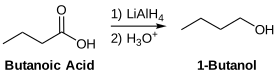
Hydride nucleophiles from lithium aluminum hydride (LiAlH4) can reduce carboxylic acids to 1o alcohols. Note that NaBH4 is not a strong enough reducing agent to convert carboxylic acids or esters to alcohols. Because the incoming nucleophile is an “H” the reaction first produces an aldehyde intermediate which available for further hydride additions. The aldehyde intermediate is difficult to isolate because it is more reactive than the original carboxylic acid. This reaction represents the first example in this chapter where a carboxylic acid derivative can undergo a double nucleophilic addition. In the mechanism of this reaction, a nucleophilic acyl substitution is followed by a nucleophilic addition allowing for two hydride nucleophiles being added to the electrophilic carbonyl carbon of a carboxylic acid.
General reaction
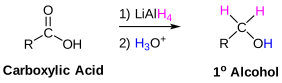
Predicting the product of a hydride reduction

Example
Possible Mechanism
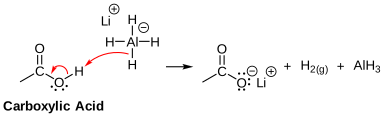
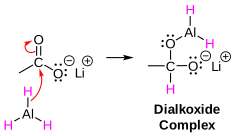
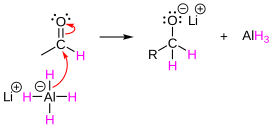
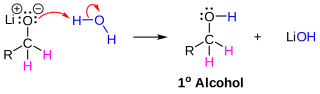
Although the mechanism of this reaction is not precisely known, much of it is understood. Initially, a hydride deprotonates the carboxylic acid to form a lithium carboxylate, hydrogen gas (H2), and aluminum hydride. Then a hydride nucleophile, from aluminum hydride, adds to the carbonyl carbon as part of a nucleophile acyl substitution. The resulting high-energy dianion intermediate forms a Lewis Acid/Base complex with aluminum, making one of the oxygens a good leaving group (the negative charge on the oxygen complexed to aluminum is not shown in step 2 below). The carbonyl bond is reformed along with the elimination of OAlH2 as a leaving group to form an aldehyde. A hydride nucleophile from another molecule of LiAlH4 adds to the re-formed carbonyl carbon as part of a nucleophilic addition. The resulting alkoxide intermediate is protonated during an acidic work-up to form the 1o alcohol product. Due to the formation of a dianion intermediate the reaction requires relatively high temperature and long reaction times.
1) Deprotonation
2) Nucleopilic attack by a hydride anion
3) Leaving group removal
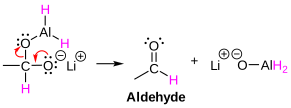
4) Nucleopilic attack by a hydride anion
5) Alkoxide protonation
Borane tetrahydrofuran complex
Solutions of a borane tetrahydrofuran complex (BH3-THF) rapidly reduce carboxylic acids at room temperature with often high yields. The borane tetrahydrofuran complex offers a safer and easier alternative to LiAlH4 reductions.
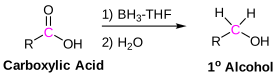
Example
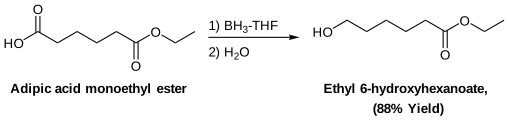
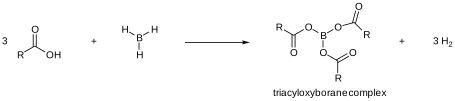
The acidic hydrogen of carboxylic acids allows them react faster with the borane tetrahydrofuran complex faster than any other functional group, allowing them to be selectively reduced in the presence of other carbonyls. In the first step of the reduction mechanism, which is rate determining, the acidic hydrogens of three carboxylic acids along with the three hydrogens from BH3 are rapidly removed to form hydrogen gas (H2) and a triacyloxyborane complex. A subsequent aqueous work-up converts the complex into a primary alcohol as shown in the general reaction above.
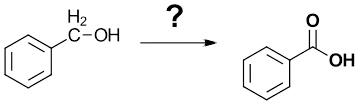
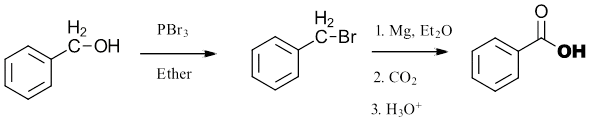
Show how the following transformation can be performed. Multiple steps may be required.
.png?revision=1&size=bestfit&width=324&height=95)
- Answer
-
.png?revision=1&size=bestfit&width=530&height=109)
Show how the following transformation can be performed. Multiple steps may be required.
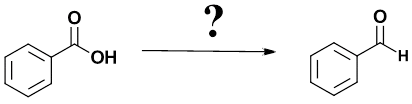.png?revision=1&size=bestfit&width=385&height=97)
- Answer
-
.png?revision=1)