

2.9: Periodic Trends
- Page ID
- 511449

\( \newcommand{\vecs}[1]{\overset { \scriptstyle \rightharpoonup} {\mathbf{#1}} } \)
\( \newcommand{\vecd}[1]{\overset{-\!-\!\rightharpoonup}{\vphantom{a}\smash {#1}}} \)
\( \newcommand{\dsum}{\displaystyle\sum\limits} \)
\( \newcommand{\dint}{\displaystyle\int\limits} \)
\( \newcommand{\dlim}{\displaystyle\lim\limits} \)
\( \newcommand{\id}{\mathrm{id}}\) \( \newcommand{\Span}{\mathrm{span}}\)
( \newcommand{\kernel}{\mathrm{null}\,}\) \( \newcommand{\range}{\mathrm{range}\,}\)
\( \newcommand{\RealPart}{\mathrm{Re}}\) \( \newcommand{\ImaginaryPart}{\mathrm{Im}}\)
\( \newcommand{\Argument}{\mathrm{Arg}}\) \( \newcommand{\norm}[1]{\| #1 \|}\)
\( \newcommand{\inner}[2]{\langle #1, #2 \rangle}\)
\( \newcommand{\Span}{\mathrm{span}}\)
\( \newcommand{\id}{\mathrm{id}}\)
\( \newcommand{\Span}{\mathrm{span}}\)
\( \newcommand{\kernel}{\mathrm{null}\,}\)
\( \newcommand{\range}{\mathrm{range}\,}\)
\( \newcommand{\RealPart}{\mathrm{Re}}\)
\( \newcommand{\ImaginaryPart}{\mathrm{Im}}\)
\( \newcommand{\Argument}{\mathrm{Arg}}\)
\( \newcommand{\norm}[1]{\| #1 \|}\)
\( \newcommand{\inner}[2]{\langle #1, #2 \rangle}\)
\( \newcommand{\Span}{\mathrm{span}}\) \( \newcommand{\AA}{\unicode[.8,0]{x212B}}\)
\( \newcommand{\vectorA}[1]{\vec{#1}} % arrow\)
\( \newcommand{\vectorAt}[1]{\vec{\text{#1}}} % arrow\)
\( \newcommand{\vectorB}[1]{\overset { \scriptstyle \rightharpoonup} {\mathbf{#1}} } \)
\( \newcommand{\vectorC}[1]{\textbf{#1}} \)
\( \newcommand{\vectorD}[1]{\overrightarrow{#1}} \)
\( \newcommand{\vectorDt}[1]{\overrightarrow{\text{#1}}} \)
\( \newcommand{\vectE}[1]{\overset{-\!-\!\rightharpoonup}{\vphantom{a}\smash{\mathbf {#1}}}} \)
\( \newcommand{\vecs}[1]{\overset { \scriptstyle \rightharpoonup} {\mathbf{#1}} } \)
\(\newcommand{\longvect}{\overrightarrow}\)
\( \newcommand{\vecd}[1]{\overset{-\!-\!\rightharpoonup}{\vphantom{a}\smash {#1}}} \)
\(\newcommand{\avec}{\mathbf a}\) \(\newcommand{\bvec}{\mathbf b}\) \(\newcommand{\cvec}{\mathbf c}\) \(\newcommand{\dvec}{\mathbf d}\) \(\newcommand{\dtil}{\widetilde{\mathbf d}}\) \(\newcommand{\evec}{\mathbf e}\) \(\newcommand{\fvec}{\mathbf f}\) \(\newcommand{\nvec}{\mathbf n}\) \(\newcommand{\pvec}{\mathbf p}\) \(\newcommand{\qvec}{\mathbf q}\) \(\newcommand{\svec}{\mathbf s}\) \(\newcommand{\tvec}{\mathbf t}\) \(\newcommand{\uvec}{\mathbf u}\) \(\newcommand{\vvec}{\mathbf v}\) \(\newcommand{\wvec}{\mathbf w}\) \(\newcommand{\xvec}{\mathbf x}\) \(\newcommand{\yvec}{\mathbf y}\) \(\newcommand{\zvec}{\mathbf z}\) \(\newcommand{\rvec}{\mathbf r}\) \(\newcommand{\mvec}{\mathbf m}\) \(\newcommand{\zerovec}{\mathbf 0}\) \(\newcommand{\onevec}{\mathbf 1}\) \(\newcommand{\real}{\mathbb R}\) \(\newcommand{\twovec}[2]{\left[\begin{array}{r}#1 \\ #2 \end{array}\right]}\) \(\newcommand{\ctwovec}[2]{\left[\begin{array}{c}#1 \\ #2 \end{array}\right]}\) \(\newcommand{\threevec}[3]{\left[\begin{array}{r}#1 \\ #2 \\ #3 \end{array}\right]}\) \(\newcommand{\cthreevec}[3]{\left[\begin{array}{c}#1 \\ #2 \\ #3 \end{array}\right]}\) \(\newcommand{\fourvec}[4]{\left[\begin{array}{r}#1 \\ #2 \\ #3 \\ #4 \end{array}\right]}\) \(\newcommand{\cfourvec}[4]{\left[\begin{array}{c}#1 \\ #2 \\ #3 \\ #4 \end{array}\right]}\) \(\newcommand{\fivevec}[5]{\left[\begin{array}{r}#1 \\ #2 \\ #3 \\ #4 \\ #5 \\ \end{array}\right]}\) \(\newcommand{\cfivevec}[5]{\left[\begin{array}{c}#1 \\ #2 \\ #3 \\ #4 \\ #5 \\ \end{array}\right]}\) \(\newcommand{\mattwo}[4]{\left[\begin{array}{rr}#1 \amp #2 \\ #3 \amp #4 \\ \end{array}\right]}\) \(\newcommand{\laspan}[1]{\text{Span}\{#1\}}\) \(\newcommand{\bcal}{\cal B}\) \(\newcommand{\ccal}{\cal C}\) \(\newcommand{\scal}{\cal S}\) \(\newcommand{\wcal}{\cal W}\) \(\newcommand{\ecal}{\cal E}\) \(\newcommand{\coords}[2]{\left\{#1\right\}_{#2}}\) \(\newcommand{\gray}[1]{\color{gray}{#1}}\) \(\newcommand{\lgray}[1]{\color{lightgray}{#1}}\) \(\newcommand{\rank}{\operatorname{rank}}\) \(\newcommand{\row}{\text{Row}}\) \(\newcommand{\col}{\text{Col}}\) \(\renewcommand{\row}{\text{Row}}\) \(\newcommand{\nul}{\text{Nul}}\) \(\newcommand{\var}{\text{Var}}\) \(\newcommand{\corr}{\text{corr}}\) \(\newcommand{\len}[1]{\left|#1\right|}\) \(\newcommand{\bbar}{\overline{\bvec}}\) \(\newcommand{\bhat}{\widehat{\bvec}}\) \(\newcommand{\bperp}{\bvec^\perp}\) \(\newcommand{\xhat}{\widehat{\xvec}}\) \(\newcommand{\vhat}{\widehat{\vvec}}\) \(\newcommand{\uhat}{\widehat{\uvec}}\) \(\newcommand{\what}{\widehat{\wvec}}\) \(\newcommand{\Sighat}{\widehat{\Sigma}}\) \(\newcommand{\lt}{<}\) \(\newcommand{\gt}{>}\) \(\newcommand{\amp}{&}\) \(\definecolor{fillinmathshade}{gray}{0.9}\)- Describe how some characteristics of elements relate to their positions on the periodic table.
Why do elements in a given group have similar properties?
The periodic table is organized on the basis of similarities in elemental properties, but what explains these similarities? It turns out that the shape of the periodic table reflects the filling of subshells with electrons, as shown in Figure \(\PageIndex{4}\). Starting with the first period and going from left to right, the table reproduces the order of filling of the electron subshells in atoms. Furthermore, elements in the same group share the same valence shell electron configuration. For example, all elements in the first column have a single s electron in their valence shells, so their electron configurations can be described as ns1 (where n represents the shell number). This last observation is crucial. Chemistry is largely the result of interactions between the valence electrons of different atoms. Thus, atoms that have the same valence shell electron configuration will have similar chemistry.

Using the variable n to represent the number of the valence electron shell, write the valence shell electron configuration for each group.
- the alkaline earth metals
- the column of elements headed by carbon
- Answer a
-
The alkaline earth metals are in the second column of the periodic table. This column corresponds to the s subshell being filled with 2 electrons. Therefore, the valence shell electron configuration is ns2.
- Answer b
-
The electron configuration of carbon is 1s22s22p2. Its valence shell electron configuration is 2s22p2. Every element in the same column should have a similar valence shell electron configuration, which we can represent as ns2np2.
Using the variable n to represent the number of the valence electron shell, write the valence shell electron configuration for each group.
- the halogens
- the column of elements headed by oxygen
- Answer a
-
The halogens are in the 17th column (or Group 7A) of the periodic table. This column corresponds to the p subshell being filled with 5 electrons. Therefore, the valence shell electron configuration is ns2np5.
- Answer b
-
The column headed by O is the 16th column (or Group 6A). This column corresponds to the p subshell being filled with 4 electrons. Therefore, the valence shell electron configuration is ns2np4.
Valence Electrons and Group Number
The number of valence electrons of an element can be determined by the periodic table group (vertical column) in which the element is categorized. With the exception of groups 3–12 (the transition metals), the units digit of the group number identifies how many valence electrons are associated with a neutral atom of an element listed under that particular column.
| Periodic table group | Valence electrons |
|---|---|
| Group 1 (I) (alkali metals) | 1 |
| Group 2 (II) (alkaline earth metals) | 2 |
| Group 13 (III) (boron group) | 3 |
| Group 14 (IV) (carbon group) | 4 |
| Group 15 (V) (pnictogens) | 5 |
| Group 16 (VI) (chalcogens) | 6 |
| Group 17 (VII) (halogens) | 7 |
| Group 18 (VIII or 0) (noble gases) | 8* |
* Except for helium, which has only two valence electrons.
Atomic Radius
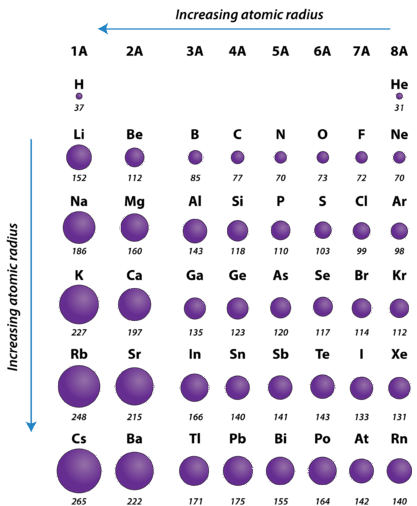
The periodic table is useful for understanding atomic properties that show periodic trends. One such property is the atomic radius (Figure \(\PageIndex{5}\)). The atomic radius is defined as one-half the distance between the nuclei of identical atoms that are bonded together. The units for atomic radii are picometers, equal to \(10^{-12}\) meters. As an example, the internuclear distance between the two hydrogen atoms in an \(\ce{H_2}\) molecule is measured to be \(74 \: \text{pm}\). Therefore, the atomic radius of a hydrogen atom is \(\frac{74}{2} = 37 \: \text{pm}\).
As mentioned earlier, the higher the shell number, the farther from the nucleus the electrons in that shell are likely to be. In other words, the size of an atom is generally determined by the number of the valence electron shell. Therefore, as we go down a column on the periodic table, the atomic radius increases. As we go across a period on the periodic table, however, electrons are being added to the same valence shell; meanwhile, more protons are being added to the nucleus, so the positive charge of the nucleus is increasing. The increasing positive charge attracts the electrons more strongly, pulling them closer to the nucleus. Consequently, as we go across a period, from left to right, the atomic radius decreases. These trends are seen clearly in Figure \(\PageIndex{5}\)
Using the periodic table (rather than Figure \(\PageIndex{5}\)), which atom is larger?
- N or Bi
- Mg or Cl
- Answer a
-
Bi is below N in Group 5A in the periodic table and has electrons in higher-numbered shells, hence we expect that Bi atoms are larger than N atoms.
- Answer b
-
Both Mg and Cl are in period 3 of the periodic table, but Cl lies farther to the right. Therefore we expect Mg atoms to be larger than Cl atoms.
Using the periodic table (rather than Figure \(\PageIndex{5}\)), which atom is larger?
- Li or F
- Na or K
- Answer a
-
Li and F are on the same period, but F lies farther to the right. Therefore, we expect Li to be larger than F atoms.
- Answer b
-
K lies below Na in Group 1A, hence has more electron shells, making it larger than Na.
Clinical chemistry is the area of chemistry concerned with the analysis of body fluids to determine the health status of the human body. Clinical chemists measure a variety of substances, ranging from simple elements such as sodium and potassium to complex molecules such as proteins and enzymes, in blood, urine, and other body fluids. The absence or presence, or abnormally low or high amounts, of a substance can be a sign of some disease or an indication of health. Many clinical chemists use sophisticated equipment and complex chemical reactions in their work, so they not only need to understand basic chemistry, but also be familiar with special instrumentation and how to interpret test results.
Key Takeaways
- The chemical elements are arranged in a chart called the periodic table.
- Some characteristics of the elements are related to their position on the periodic table.
- The number of valence electrons of an element can be determined by the group (vertical column) number in the Periodic Table. Elements with the same number of valence electrons have similar chemical properties.