

4.3: Compounds
- Page ID
- 538638

\( \newcommand{\vecs}[1]{\overset { \scriptstyle \rightharpoonup} {\mathbf{#1}} } \)
\( \newcommand{\vecd}[1]{\overset{-\!-\!\rightharpoonup}{\vphantom{a}\smash {#1}}} \)
\( \newcommand{\dsum}{\displaystyle\sum\limits} \)
\( \newcommand{\dint}{\displaystyle\int\limits} \)
\( \newcommand{\dlim}{\displaystyle\lim\limits} \)
\( \newcommand{\id}{\mathrm{id}}\) \( \newcommand{\Span}{\mathrm{span}}\)
( \newcommand{\kernel}{\mathrm{null}\,}\) \( \newcommand{\range}{\mathrm{range}\,}\)
\( \newcommand{\RealPart}{\mathrm{Re}}\) \( \newcommand{\ImaginaryPart}{\mathrm{Im}}\)
\( \newcommand{\Argument}{\mathrm{Arg}}\) \( \newcommand{\norm}[1]{\| #1 \|}\)
\( \newcommand{\inner}[2]{\langle #1, #2 \rangle}\)
\( \newcommand{\Span}{\mathrm{span}}\)
\( \newcommand{\id}{\mathrm{id}}\)
\( \newcommand{\Span}{\mathrm{span}}\)
\( \newcommand{\kernel}{\mathrm{null}\,}\)
\( \newcommand{\range}{\mathrm{range}\,}\)
\( \newcommand{\RealPart}{\mathrm{Re}}\)
\( \newcommand{\ImaginaryPart}{\mathrm{Im}}\)
\( \newcommand{\Argument}{\mathrm{Arg}}\)
\( \newcommand{\norm}[1]{\| #1 \|}\)
\( \newcommand{\inner}[2]{\langle #1, #2 \rangle}\)
\( \newcommand{\Span}{\mathrm{span}}\) \( \newcommand{\AA}{\unicode[.8,0]{x212B}}\)
\( \newcommand{\vectorA}[1]{\vec{#1}} % arrow\)
\( \newcommand{\vectorAt}[1]{\vec{\text{#1}}} % arrow\)
\( \newcommand{\vectorB}[1]{\overset { \scriptstyle \rightharpoonup} {\mathbf{#1}} } \)
\( \newcommand{\vectorC}[1]{\textbf{#1}} \)
\( \newcommand{\vectorD}[1]{\overrightarrow{#1}} \)
\( \newcommand{\vectorDt}[1]{\overrightarrow{\text{#1}}} \)
\( \newcommand{\vectE}[1]{\overset{-\!-\!\rightharpoonup}{\vphantom{a}\smash{\mathbf {#1}}}} \)
\( \newcommand{\vecs}[1]{\overset { \scriptstyle \rightharpoonup} {\mathbf{#1}} } \)
\(\newcommand{\longvect}{\overrightarrow}\)
\( \newcommand{\vecd}[1]{\overset{-\!-\!\rightharpoonup}{\vphantom{a}\smash {#1}}} \)
\(\newcommand{\ket}[1]{\left| #1 \right>}\)
\(\newcommand{\bra}[1]{\left< #1 \right|}\)
\(\newcommand{\braket}[2]{\left< #1 \vphantom{#2} \right| \left. #2 \vphantom{#1} \right>}\)
\(\newcommand{\braopket}[3]{\left< #1 \vphantom{#2}\vphantom{#3} \right| #2 \vphantom{#1}\vphantom{#3} \left| #3 \vphantom{#1}\vphantom{#2} \right>}\)
\(\newcommand{\qmvec}[1]{\mathbf{\vec{#1}}}\)
\(\newcommand{\op}[1]{\hat{\mathbf{#1}}}\)
\(\newcommand{\expect}[1]{\langle #1 \rangle}\)
\(\newcommand{\dfn}[1]{\emph{\textbf{#1}}}\)
A compound is a substance that contains two or more elements chemically combined in a fixed proportion. The elements carbon and hydrogen combine to form many different compounds. One of the simplest is called methane, in which there are always four times as many hydrogen particles as carbon particles. Methane is a pure substance because it always has the same composition. However, it is not an element because it can be broken down into simpler substances—carbon and hydrogen.
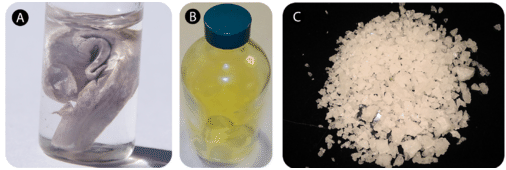
The properties of compounds are generally very different than the properties of the elements from which the compound is formed. Sodium is an extremely reactive soft metal that cannot be exposed to air or water. Chlorine is a deadly gas. The compound sodium chloride is a white solid which is essential for all living things (see below).
Chemical Formulas
A chemical formula is an expression that shows the elements in a compound and the relative proportions of those elements. Water is composed of hydrogen and oxygen in a 2:1 ratio. The chemical formula for water is \(\ce{H_2O}\). Sulfuric acid is one of the most widely produced chemicals in the United States and is composed of the elements hydrogen, sulfur, and oxygen. The chemical formula for sulfuric acid is \(\ce{H_2SO_4}\).
Certain groups of atoms are bonded together to form what is called a polyatomic ion that acts as a single unit. Polyatomic ions are discussed in greater detail later in this chapter. Polyatomic ions are enclosed in parenthesis followed by a subscript if more than one of the same ion exist in a chemical formula. The formula \(\ce{Ca3(PO4)2}\) represents a compound with the following:
3 Ca2+ ions + 2 PO43- ions
To count the total number of atoms for formulas with polyatomic ions enclosed in parenthesis, use the subscript as a multiplier for each atom or number of atoms.
Ca3(PO4)2
3 Ca + 2 x1 P + 2 x 4 O = 3 Ca atoms + 2 P atoms + 8 O atoms
Metals vs Non-Metals
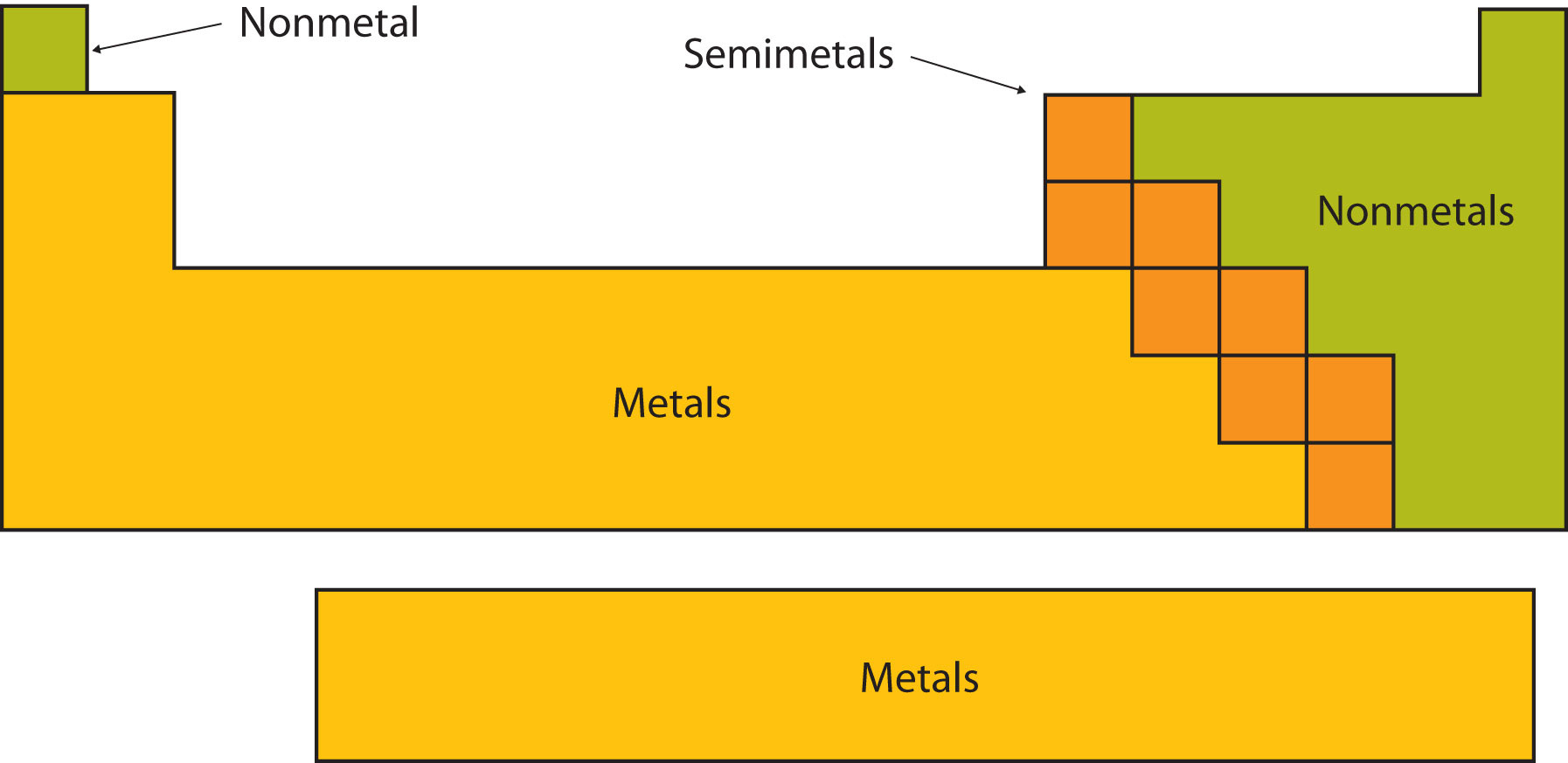
The first step in understanding different types of chemical compounds is to take a closer look at the elements on the periodic table.. Every element can be classified as either a metal, a nonmetal, or a metalloid (or semi metal), as shown in Figure \(\PageIndex{2}\).
- A metal is a substance that is shiny, typically (but not always) silvery in color, and an excellent conductor of electricity and heat. Metals are also malleable (they can be beaten into thin sheets) and ductile (they can be drawn into thin wires).
- A nonmetal is typically dull and a poor conductor of electricity and heat. Solid nonmetals are also very brittle. As shown in Figure \(\PageIndex{2}\), metals occupy the left three-fourths of the periodic table, while nonmetals (except for hydrogen) are clustered in the upper right-hand corner of the periodic table.
- The elements with properties intermediate between those of metals and nonmetals are called metalloids (or semi-metals). Elements adjacent to the bold line in the right-hand portion of the periodic table have semimetal properties.
Based on its position in the periodic table, classify each element below as metal, a nonmetal, or a metalloid.
- Se
- Mg
- Ge
Solution
- In Figure \(\PageIndex{1}\), selenium lies above and to the right of the diagonal line marking the boundary between metals and nonmetals, so it should be a nonmetal.
- Magnesium lies to the left of the diagonal line marking the boundary between metals and nonmetals, so it should be a metal.
- Germanium lies within the diagonal line marking the boundary between metals and nonmetals, so it should be a metalloid.
Based on its location in the periodic table, do you expect indium to be a nonmetal, a metal, or a metalloid?
- Answer
- Indium is a metal.
Types of Compounds
There are two types of compounds we will look at on the following pages- Ionic Compounds and Molecular Compounds.
- Ionic Compounds are those formed between a metal and a non-metal.
- Molecular Compounds are those formed between two or more non-metals.
Provide the classification (i.e. atomic element, molecular element, molecular compound, or ionic compound) of each substance.
- Fe
- PCl3
- LiBr
- P4
- oxygen gas (O₂)
Solution
- Fe (iron) is an element that is represented with no subscript, so it is an atomic element.
- PCl3 is made up of two nonmetals, so it is a molecular compound.
- LiBr is made up of lithium, a metal, and bromine, a nonmetal, so it is an ionic compound.
- P4 is a substance that is made up of four atoms of the same element, so it is a molecular element.
- The formula for oxygen gas is O2 so it is a molecular element.
Provide the classification (i.e. atomic element, molecular element, molecular compound, or ionic compound) of each substance.
- I2
- He
- H2O
- Al
- CuCl
- Answer a:
- molecular element
- Answer b:
- atomic element
- Answer c:
- molecular compound
- Answer d:
- atomic element
- Answer e:
- ionic compound
Contributions & Attributions
This page was constructed from content via the following contributor(s) and edited (topically or extensively) by the LibreTexts development team to meet platform style, presentation, and quality:
Henry Agnew (UC Davis)