

Odor Compounds in COVID-19 Induced Parosmia in Biology
- Page ID
- 418947
\( \newcommand{\vecs}[1]{\overset { \scriptstyle \rightharpoonup} {\mathbf{#1}} } \)
\( \newcommand{\vecd}[1]{\overset{-\!-\!\rightharpoonup}{\vphantom{a}\smash {#1}}} \)
\( \newcommand{\dsum}{\displaystyle\sum\limits} \)
\( \newcommand{\dint}{\displaystyle\int\limits} \)
\( \newcommand{\dlim}{\displaystyle\lim\limits} \)
\( \newcommand{\id}{\mathrm{id}}\) \( \newcommand{\Span}{\mathrm{span}}\)
( \newcommand{\kernel}{\mathrm{null}\,}\) \( \newcommand{\range}{\mathrm{range}\,}\)
\( \newcommand{\RealPart}{\mathrm{Re}}\) \( \newcommand{\ImaginaryPart}{\mathrm{Im}}\)
\( \newcommand{\Argument}{\mathrm{Arg}}\) \( \newcommand{\norm}[1]{\| #1 \|}\)
\( \newcommand{\inner}[2]{\langle #1, #2 \rangle}\)
\( \newcommand{\Span}{\mathrm{span}}\)
\( \newcommand{\id}{\mathrm{id}}\)
\( \newcommand{\Span}{\mathrm{span}}\)
\( \newcommand{\kernel}{\mathrm{null}\,}\)
\( \newcommand{\range}{\mathrm{range}\,}\)
\( \newcommand{\RealPart}{\mathrm{Re}}\)
\( \newcommand{\ImaginaryPart}{\mathrm{Im}}\)
\( \newcommand{\Argument}{\mathrm{Arg}}\)
\( \newcommand{\norm}[1]{\| #1 \|}\)
\( \newcommand{\inner}[2]{\langle #1, #2 \rangle}\)
\( \newcommand{\Span}{\mathrm{span}}\) \( \newcommand{\AA}{\unicode[.8,0]{x212B}}\)
\( \newcommand{\vectorA}[1]{\vec{#1}} % arrow\)
\( \newcommand{\vectorAt}[1]{\vec{\text{#1}}} % arrow\)
\( \newcommand{\vectorB}[1]{\overset { \scriptstyle \rightharpoonup} {\mathbf{#1}} } \)
\( \newcommand{\vectorC}[1]{\textbf{#1}} \)
\( \newcommand{\vectorD}[1]{\overrightarrow{#1}} \)
\( \newcommand{\vectorDt}[1]{\overrightarrow{\text{#1}}} \)
\( \newcommand{\vectE}[1]{\overset{-\!-\!\rightharpoonup}{\vphantom{a}\smash{\mathbf {#1}}}} \)
\( \newcommand{\vecs}[1]{\overset { \scriptstyle \rightharpoonup} {\mathbf{#1}} } \)
\(\newcommand{\longvect}{\overrightarrow}\)
\( \newcommand{\vecd}[1]{\overset{-\!-\!\rightharpoonup}{\vphantom{a}\smash {#1}}} \)
\(\newcommand{\avec}{\mathbf a}\) \(\newcommand{\bvec}{\mathbf b}\) \(\newcommand{\cvec}{\mathbf c}\) \(\newcommand{\dvec}{\mathbf d}\) \(\newcommand{\dtil}{\widetilde{\mathbf d}}\) \(\newcommand{\evec}{\mathbf e}\) \(\newcommand{\fvec}{\mathbf f}\) \(\newcommand{\nvec}{\mathbf n}\) \(\newcommand{\pvec}{\mathbf p}\) \(\newcommand{\qvec}{\mathbf q}\) \(\newcommand{\svec}{\mathbf s}\) \(\newcommand{\tvec}{\mathbf t}\) \(\newcommand{\uvec}{\mathbf u}\) \(\newcommand{\vvec}{\mathbf v}\) \(\newcommand{\wvec}{\mathbf w}\) \(\newcommand{\xvec}{\mathbf x}\) \(\newcommand{\yvec}{\mathbf y}\) \(\newcommand{\zvec}{\mathbf z}\) \(\newcommand{\rvec}{\mathbf r}\) \(\newcommand{\mvec}{\mathbf m}\) \(\newcommand{\zerovec}{\mathbf 0}\) \(\newcommand{\onevec}{\mathbf 1}\) \(\newcommand{\real}{\mathbb R}\) \(\newcommand{\twovec}[2]{\left[\begin{array}{r}#1 \\ #2 \end{array}\right]}\) \(\newcommand{\ctwovec}[2]{\left[\begin{array}{c}#1 \\ #2 \end{array}\right]}\) \(\newcommand{\threevec}[3]{\left[\begin{array}{r}#1 \\ #2 \\ #3 \end{array}\right]}\) \(\newcommand{\cthreevec}[3]{\left[\begin{array}{c}#1 \\ #2 \\ #3 \end{array}\right]}\) \(\newcommand{\fourvec}[4]{\left[\begin{array}{r}#1 \\ #2 \\ #3 \\ #4 \end{array}\right]}\) \(\newcommand{\cfourvec}[4]{\left[\begin{array}{c}#1 \\ #2 \\ #3 \\ #4 \end{array}\right]}\) \(\newcommand{\fivevec}[5]{\left[\begin{array}{r}#1 \\ #2 \\ #3 \\ #4 \\ #5 \\ \end{array}\right]}\) \(\newcommand{\cfivevec}[5]{\left[\begin{array}{c}#1 \\ #2 \\ #3 \\ #4 \\ #5 \\ \end{array}\right]}\) \(\newcommand{\mattwo}[4]{\left[\begin{array}{rr}#1 \amp #2 \\ #3 \amp #4 \\ \end{array}\right]}\) \(\newcommand{\laspan}[1]{\text{Span}\{#1\}}\) \(\newcommand{\bcal}{\cal B}\) \(\newcommand{\ccal}{\cal C}\) \(\newcommand{\scal}{\cal S}\) \(\newcommand{\wcal}{\cal W}\) \(\newcommand{\ecal}{\cal E}\) \(\newcommand{\coords}[2]{\left\{#1\right\}_{#2}}\) \(\newcommand{\gray}[1]{\color{gray}{#1}}\) \(\newcommand{\lgray}[1]{\color{lightgray}{#1}}\) \(\newcommand{\rank}{\operatorname{rank}}\) \(\newcommand{\row}{\text{Row}}\) \(\newcommand{\col}{\text{Col}}\) \(\renewcommand{\row}{\text{Row}}\) \(\newcommand{\nul}{\text{Nul}}\) \(\newcommand{\var}{\text{Var}}\) \(\newcommand{\corr}{\text{corr}}\) \(\newcommand{\len}[1]{\left|#1\right|}\) \(\newcommand{\bbar}{\overline{\bvec}}\) \(\newcommand{\bhat}{\widehat{\bvec}}\) \(\newcommand{\bperp}{\bvec^\perp}\) \(\newcommand{\xhat}{\widehat{\xvec}}\) \(\newcommand{\vhat}{\widehat{\vvec}}\) \(\newcommand{\uhat}{\widehat{\uvec}}\) \(\newcommand{\what}{\widehat{\wvec}}\) \(\newcommand{\Sighat}{\widehat{\Sigma}}\) \(\newcommand{\lt}{<}\) \(\newcommand{\gt}{>}\) \(\newcommand{\amp}{&}\) \(\definecolor{fillinmathshade}{gray}{0.9}\)This Exemplar will teach the following concept(s) from the ACS Examinations Institute General Chemistry ACCM:
- I. B. 2 The quantum model of the atom is capable of explaining many observations, and it organizes electrons into “orbitals”, which are wave functions that are identified using quantum numbers.
- II. E. A theoretical construct that describes chemical bonding utilizes the construction of molecular orbitals for the bond based on overlap of atomic orbitals on the constituent atoms.
- III. A. Atoms combine to form new compounds that have new properties based on structural and electronic features.
- III. B. 3. Using the VSEPR (valence shell electron-pair repulsion) model in conjunction with Lewis structures makes it possible to roughly predict many chemical structures.
- III. F. Reactions of molecules can often be understood in terms of subsets of atoms, called functional groups.
Background:
Our sense of smell is something that we tend to take for granted. For example, when passing by a landfill, we definitely don't wish to be able to smell at that moment! However, the ability to smell ties into many aspects of our life, such as fond memories and how we taste food. Even though this sense does not seem particularly important, losing it can be potentially detrimental. During the COVID-19 pandemic, millions of people began to experience a loss of this particular sense. This was a novel global health crisis for the international community, with medical, socioeconomic, and political implications. The virus particularly targeted the elderly, youth, and people with disabilities[1]. COVID-19, also known as SARS-CoV-2 is part of the coronavirus family, which is a virus characterized by crown-like surface proteins called spike (S) proteins. COVID-19 is spread through inhaled respiratory drops, making the ACE2 enzymes expressed in the lungs the primary site of COVID-19 infection[2].
A long-term consequence of COVID-19 is parosmia: a condition that changes the way a smell is perceived[3]. A patient can develop parosmia when their olfactory nerves become damaged during the recovery process from COVID-19[4]. As a patient recovers, their damaged nerves regenerate, but can become rewired during this process[5]. People with parosmia tend to have stronger olfactory distortions[6] with specific trigger foods that are associated with disgust, such as onions, meat, coffee, peanut butter, and eggs[8], which often involve Maillard reactions[7].

Scientifically accurate atomic model of the external structure of SARS-Cov-2. Each "ball" is an atom.[8]
Our paper presents and compares the different types of odor compounds that trigger long-term parosmia in patients who have recovered from COVID-19.

Molecular structures of common odor compounds that trigger patients with long-term, COVID-19-induced parosmia.[9]
Associated Chemistry:
Biomolecules
Biomolecules are compounds that maintain and reproduce life. Their backbone consists of carbon, which has the unique ability to develop strong bonds between itself and other nonmetals such as hydrogen, nitrogen, oxygen, sulfur, and the halogens. It uses this ability to form long chains or rings of carbon atoms that have many properties essential for living systems.[10]
Valence Bond Theory
There are two theories that describe how bonds between atoms are created in molecules: valence bond theory and hybridization. In valence bond theory, when valence orbitals between atoms overlap, covalent bonds form between electrons within the orbitals. The areas where these orbitals bonds overlap results in an increased overall electron density in that area compared to the individual orbitals, creating a higher probability of finding electrons between the nuclei. Valence bond theory uses the electrons in the outermost valence shell for bonding orbital overlaps [11].
The two different kinds of bonds that can form are Sigma (σ) and Pi (π) bonds. Sigma bonds are when the electron density between the two nuclei forms in a predominantly straight line. Pi orbitals are when the two, un-hybridized p-orbitals overlap. In electron configurations, the p electrons have stronger and shorter bonds than the s electrons [11].


1) 1sσ* antibonding molecular orbital in H2 with nodal plane. [6]
2) Two p-orbitals forming a π-bond. [13]
Hybridization
For orbitals to overlap, they must match each other's energy. Hybridization is how the bonding orbitals equalize their energies and bond lengths. Hybridization happens by the electrons filling up open orbital slots until the orbitals all reach a uniform energy level. Hybridization in molecules is identified by counting number of bonds or lone pairs to a central atom [11].
VSEPR Models
VSEPR Models, also known as valence-shell electron-pair repulsion model, uses number of bonds to central atom and lone pairs to determine three-dimensional arrangement of atoms in space. This is used to predict the structure of molecules and values of bond angles. Some limitations of VSEPR are that it doesn't information about bond lengths or if multiple bonds are present in the molecule. This model is rooted in the assumption that the electron pairs in bonds and lone pairs repel each other. Therefore, the electrons naturally move to the position that places the electron pairs as far away from each other as much as possible[14].
Application:
The COVID-19 pandemic, and its induced parosmia has brought heightened awareness to olfactory loss disorders. Many people suffering from loss or distorted sense of smell now have a larger network of support for a previously niche condition, due to the high-profile attention surrounding COVID-19, its symptoms, and long-term consequences[5]. Researchers have already begun to better understand the mechanisms behind parosmia and other post viral smell disorders. More work is being done into exploring how viruses impact sense of smell long after patients recover. Before, there was difficulty in understanding the causes behind olfactory sense loss disorders because there wasn’t enough data with enough people having the same virus simultaneously[5]. However, after the pandemic, more research is being done on the prevention and cures for post-viral smell disorders.
Here, we have the following molecules that are odor compounds that trigger long-term parosmia in patients recovering from COVID-19: 2-methyl-3-furanthiol (found in coffee), 2-ethyl-3,6-dimethylpyrazine (coffee), 2-ethyl-3-methoxypyrazine (chocolate), and 2-ethyl-3-(methylditihio)furan (meats). Given these molecules, compare their molecular orbital diagrams.
For the following examples, follow these steps to use WebMO (a software device):
- Open the WebMO app (free through the Apple App Store or Google Play) and click anywhere on the screen in the gray area. The default settings should show a gray ball appear where you touched.
- The P-Table text on the top contains the periodic table elements necessary to create the structures in the examples below.
- To optimize the structure, utilize the Cleanup menu at the top and select the following in order: hybridization, geometry, and finally comprehensive-mechanics.
- Click on the orbitals tab to navigate to the electrostatic potential tab.
A) 2-methyl-3-furanthiol: The molecular orbital structure for 2-methyl-3-furanthiol is generally nonpolar, with a negative polar site located at the S-H site and a positive polar site near the top of the cyclic ring of carbons. This molecule has the greatest dipole movement out of all of the odor compounds due to its strong polarity as shown in the electrostatic region diagram.

Solution
Step 1: Build the molecule including adding multiple bonds and editing charges before optimizing the structure.
Step 2: Optimize the structure using the directions above.
Step 3: Click on the orbitals tab and select electrostatic potential. This will give you the charge distribution on the surface of the molecule.
Step 4: Observe the negative (blue) and positive (red) polarities within the molecule and write an explanation regarding their presence in the structure.
Step 5: Compare the similarities and differences between the structures.
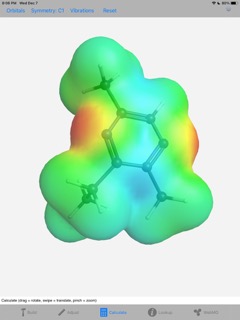
B) 2-ethyl-3,6-dimethylpyrazine: The molecular orbital structure for 2-ethyl-3,6-dimethylpyrazine is overall a nonpolar molecule. Two slightly positive sites are located at the ends of the benzene ring and do not have groups attached to them. This molecule does not have a particularly strong negative dipole, but there are two positive regions as indicated in red. Therefore, this molecule has a similar polarity to the remaining two structures, yet it is not as strong as the polarity noted in the first molecule.
Solution
Step 1: Build the molecule including adding multiple bonds and editing charges before optimizing the structure.
Step 2: Optimize the structure using the directions above.
Step 3: Click on the orbitals tab and select electrostatic potential. This will give you the charge distribution on the surface of the molecule.
Step 4: Observe the negative (blue) and positive (red) polarities within the molecule and write an explanation regarding their presence in the structure.
Step 5: Compare the similarities and differences between the structures.
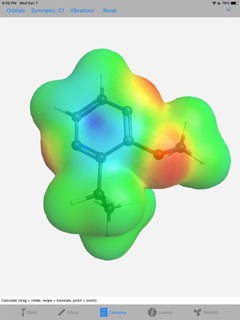
C) 2-ethyl-3-methoxypyrazine: The molecular orbital structure for 2-ethyl-3-methoxypyrazine is generally nonpolar, with positive sites located throughout the molecule. There is one negative site located near the benzene ring; however, it is not as prominent as the 2-methyl-3-furanthiol structure. Therefore, this molecule has a similar polarity to the second and final structures, yet it is not as strong as the polarity noted in the first molecule.
Solution
Step 1: Build the molecule including adding multiple bonds and editing charges before optimizing the structure.
Step 2: Optimize the structure using the directions above.
Step 3: Click on the orbitals tab and select electrostatic potential. This will give you the charge distribution on the surface of the molecule.
Step 4: Observe the negative (blue) and positive (red) polarities within the molecule and write an explanation regarding their presence in the structure.
Step 5: Compare the similarities and differences between the structures.
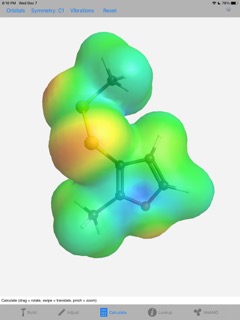
D) 2-ethyl-3-(methylditihio)furan: The molecular orbital structure for 2-ethyl-3-(methylditihio)furan is generally nonpolar, with no significant positive or negative sites throughout the molecule. They are very faintly shown through the electrostatic diagram, and there is a positive region located near the sulfur atom. Therefore, this molecule has a polarity slightly greater than the previous two molecules, yet not as strong as the first one in this example.
Solution
Step 1: Build the molecule including adding multiple bonds and editing charges before optimizing the structure.
Step 2: Optimize the structure using the directions above.
Step 3: Click on the orbitals tab and select electrostatic potential. This will give you the charge distribution on the surface of the molecule.
Step 4: Observe the negative (blue) and positive (red) polarities within the molecule and write an explanation regarding their presence in the structure.
Step 5: Compare the similarities and differences between the structures.
Write out the structures for 2-methyl-3-furanthiol, 2-ethyl-3,6-dimethylpyrazine, 2-ethyl-3-methoxypyrazine, and 2-ethyl-3-(methylditihio)furan and identify the different molecular geometries present in the carbon atoms. Note the hybridizations as well (sp, sp2, sp3).

Solution
A) 2-methyl-3-furanthiol
Step 1: Draw out the structure.
Step 2: Look at each carbon atom, noting how many bonds and atoms it is attached to.
Step 3: Based on how many bonds and atoms it is attached to, write the corresponding hybridization (either sp, sp2, or sp3).
Step 4: Looking at the bonds and checking for lone pairs, also write down the molecular geometry that goes with each carbon atom.
B) 2-ethyl-3,6-dimethylpyrazine
Step 1: Draw out the structure.
Step 2: Look at each carbon atom, noting how many bonds and atoms it is attached to.
Step 3: Based on how many bonds and atoms it is attached to, write the corresponding hybridization (either sp, sp2, or sp3).
Step 4: Looking at the bonds and checking for lone pairs, also write down the molecular geometry that goes with each carbon atom.
C) 2-ethyl-3-methoxypyrazine
Step 1: Draw out the structure.
Step 2: Look at each carbon atom, noting how many bonds and atoms it is attached to.
Step 3: Based on how many bonds and atoms it is attached to, write the corresponding hybridization (either sp, sp2, or sp3).
Step 4: Looking at the bonds and checking for lone pairs, also write down the molecular geometry that goes with each carbon atom.
D) 2-methyl-3-(methyldithio)furan
Step 1: Draw out the structure.
Step 2: Look at each carbon atom, noting how many bonds and atoms it is attached to.
Step 3: Based on how many bonds and atoms it is attached to, write the corresponding hybridization (either sp, sp2, or sp3).
Step 4: Looking at the bonds and checking for lone pairs, also write down the molecular geometry that goes with each carbon atom.
References:
(1) Everyone Included: Social Impact of COVID-19 | DISD. https://www.un.org/development/desa/...-covid-19.html (accessed 2022-12-07).
(2) COVID-19. Wikipedia; 2022.
(3) Bangert, B. HuffPost: Parosmia: The long COVID condition that makes everything taste or smell rotten. UC News. https://www.uc.edu/news/articles/202...ll-rotten.html (accessed 2022-12-07).
(4) Mechanism Revealed Behind Loss of Smell with COVID-19. NYU Langone News. https://nyulangone.org/news/mechanis...smell-covid-19 (accessed 2022-12-07).
(5) Parker, J. K.; Methven, L.; Pellegrino, R.; Smith, B. C.; Gane, S.; Kelly, C. E. Emerging Pattern of Post-COVID-19 Parosmia and Its Effect on Food Perception. Foods 2022, 11 (7), 967. https://doi.org/10.3390/foods11070967.
(6) Srinivasan, M. Taste Dysfunction and Long COVID-19. Frontiers in Cellular and Infection Microbiology 2021, 11.(11) Psoter, J. LibGuides: CHEM 110: Core Concepts in Context: Choosing a Topic. https://doi.org/10/topicselection.
(7) Everts, S. . https://cen.acs.org/articles/90/i40/...urns-100.html# (accessed 2022-12-07).
(8) Parker, J. K.; Kelly, C. E.; Gane, S. B. Insights into the Molecular Triggers of Parosmia Based on Gas Chromatography Olfactometry. Commun Med 2022, 2 (1), 1–8. https://doi.org/10.1038/s43856-022-00112-9.
(9) WebMO. https://www.webmo.net/ (accessed 2022-12-07).
(10) Zumdahl, S. S.; DeCoste, D. J. Chemical Principles, 8th ed.; Cengage Learning: Australia, 2017.
(11) Hybridization. https://chem.fsu.edu/chemlab/chm1045...idization.html (accessed 2022-12-07).
(12) Sigma Bond. Wikipedia; 2022.
(13) Pi Bond. Wikipedia; 2022.
(14) 9.2: The VSEPR Model. Chemistry LibreTexts. https://chem.libretexts.org/Bookshel...he_VSEPR_Model (accessed 2022-12-07).