

3.4: Standard Reduction Potentials
- Page ID
- 553792
\( \newcommand{\vecs}[1]{\overset { \scriptstyle \rightharpoonup} {\mathbf{#1}} } \)
\( \newcommand{\vecd}[1]{\overset{-\!-\!\rightharpoonup}{\vphantom{a}\smash {#1}}} \)
\( \newcommand{\dsum}{\displaystyle\sum\limits} \)
\( \newcommand{\dint}{\displaystyle\int\limits} \)
\( \newcommand{\dlim}{\displaystyle\lim\limits} \)
\( \newcommand{\id}{\mathrm{id}}\) \( \newcommand{\Span}{\mathrm{span}}\)
( \newcommand{\kernel}{\mathrm{null}\,}\) \( \newcommand{\range}{\mathrm{range}\,}\)
\( \newcommand{\RealPart}{\mathrm{Re}}\) \( \newcommand{\ImaginaryPart}{\mathrm{Im}}\)
\( \newcommand{\Argument}{\mathrm{Arg}}\) \( \newcommand{\norm}[1]{\| #1 \|}\)
\( \newcommand{\inner}[2]{\langle #1, #2 \rangle}\)
\( \newcommand{\Span}{\mathrm{span}}\)
\( \newcommand{\id}{\mathrm{id}}\)
\( \newcommand{\Span}{\mathrm{span}}\)
\( \newcommand{\kernel}{\mathrm{null}\,}\)
\( \newcommand{\range}{\mathrm{range}\,}\)
\( \newcommand{\RealPart}{\mathrm{Re}}\)
\( \newcommand{\ImaginaryPart}{\mathrm{Im}}\)
\( \newcommand{\Argument}{\mathrm{Arg}}\)
\( \newcommand{\norm}[1]{\| #1 \|}\)
\( \newcommand{\inner}[2]{\langle #1, #2 \rangle}\)
\( \newcommand{\Span}{\mathrm{span}}\) \( \newcommand{\AA}{\unicode[.8,0]{x212B}}\)
\( \newcommand{\vectorA}[1]{\vec{#1}} % arrow\)
\( \newcommand{\vectorAt}[1]{\vec{\text{#1}}} % arrow\)
\( \newcommand{\vectorB}[1]{\overset { \scriptstyle \rightharpoonup} {\mathbf{#1}} } \)
\( \newcommand{\vectorC}[1]{\textbf{#1}} \)
\( \newcommand{\vectorD}[1]{\overrightarrow{#1}} \)
\( \newcommand{\vectorDt}[1]{\overrightarrow{\text{#1}}} \)
\( \newcommand{\vectE}[1]{\overset{-\!-\!\rightharpoonup}{\vphantom{a}\smash{\mathbf {#1}}}} \)
\( \newcommand{\vecs}[1]{\overset { \scriptstyle \rightharpoonup} {\mathbf{#1}} } \)
\(\newcommand{\longvect}{\overrightarrow}\)
\( \newcommand{\vecd}[1]{\overset{-\!-\!\rightharpoonup}{\vphantom{a}\smash {#1}}} \)
\(\newcommand{\avec}{\mathbf a}\) \(\newcommand{\bvec}{\mathbf b}\) \(\newcommand{\cvec}{\mathbf c}\) \(\newcommand{\dvec}{\mathbf d}\) \(\newcommand{\dtil}{\widetilde{\mathbf d}}\) \(\newcommand{\evec}{\mathbf e}\) \(\newcommand{\fvec}{\mathbf f}\) \(\newcommand{\nvec}{\mathbf n}\) \(\newcommand{\pvec}{\mathbf p}\) \(\newcommand{\qvec}{\mathbf q}\) \(\newcommand{\svec}{\mathbf s}\) \(\newcommand{\tvec}{\mathbf t}\) \(\newcommand{\uvec}{\mathbf u}\) \(\newcommand{\vvec}{\mathbf v}\) \(\newcommand{\wvec}{\mathbf w}\) \(\newcommand{\xvec}{\mathbf x}\) \(\newcommand{\yvec}{\mathbf y}\) \(\newcommand{\zvec}{\mathbf z}\) \(\newcommand{\rvec}{\mathbf r}\) \(\newcommand{\mvec}{\mathbf m}\) \(\newcommand{\zerovec}{\mathbf 0}\) \(\newcommand{\onevec}{\mathbf 1}\) \(\newcommand{\real}{\mathbb R}\) \(\newcommand{\twovec}[2]{\left[\begin{array}{r}#1 \\ #2 \end{array}\right]}\) \(\newcommand{\ctwovec}[2]{\left[\begin{array}{c}#1 \\ #2 \end{array}\right]}\) \(\newcommand{\threevec}[3]{\left[\begin{array}{r}#1 \\ #2 \\ #3 \end{array}\right]}\) \(\newcommand{\cthreevec}[3]{\left[\begin{array}{c}#1 \\ #2 \\ #3 \end{array}\right]}\) \(\newcommand{\fourvec}[4]{\left[\begin{array}{r}#1 \\ #2 \\ #3 \\ #4 \end{array}\right]}\) \(\newcommand{\cfourvec}[4]{\left[\begin{array}{c}#1 \\ #2 \\ #3 \\ #4 \end{array}\right]}\) \(\newcommand{\fivevec}[5]{\left[\begin{array}{r}#1 \\ #2 \\ #3 \\ #4 \\ #5 \\ \end{array}\right]}\) \(\newcommand{\cfivevec}[5]{\left[\begin{array}{c}#1 \\ #2 \\ #3 \\ #4 \\ #5 \\ \end{array}\right]}\) \(\newcommand{\mattwo}[4]{\left[\begin{array}{rr}#1 \amp #2 \\ #3 \amp #4 \\ \end{array}\right]}\) \(\newcommand{\laspan}[1]{\text{Span}\{#1\}}\) \(\newcommand{\bcal}{\cal B}\) \(\newcommand{\ccal}{\cal C}\) \(\newcommand{\scal}{\cal S}\) \(\newcommand{\wcal}{\cal W}\) \(\newcommand{\ecal}{\cal E}\) \(\newcommand{\coords}[2]{\left\{#1\right\}_{#2}}\) \(\newcommand{\gray}[1]{\color{gray}{#1}}\) \(\newcommand{\lgray}[1]{\color{lightgray}{#1}}\) \(\newcommand{\rank}{\operatorname{rank}}\) \(\newcommand{\row}{\text{Row}}\) \(\newcommand{\col}{\text{Col}}\) \(\renewcommand{\row}{\text{Row}}\) \(\newcommand{\nul}{\text{Nul}}\) \(\newcommand{\var}{\text{Var}}\) \(\newcommand{\corr}{\text{corr}}\) \(\newcommand{\len}[1]{\left|#1\right|}\) \(\newcommand{\bbar}{\overline{\bvec}}\) \(\newcommand{\bhat}{\widehat{\bvec}}\) \(\newcommand{\bperp}{\bvec^\perp}\) \(\newcommand{\xhat}{\widehat{\xvec}}\) \(\newcommand{\vhat}{\widehat{\vvec}}\) \(\newcommand{\uhat}{\widehat{\uvec}}\) \(\newcommand{\what}{\widehat{\wvec}}\) \(\newcommand{\Sighat}{\widehat{\Sigma}}\) \(\newcommand{\lt}{<}\) \(\newcommand{\gt}{>}\) \(\newcommand{\amp}{&}\) \(\definecolor{fillinmathshade}{gray}{0.9}\)In redox reactions the thermodynamic driving force can be measured as the cell potential. The cell potential results from the difference in the electrical potentials for each electrode. Standard cell potential determined using the standard reduction cell potential and the standard oxidation cell potential. The standard reduction potential is a measure of the likelihood that a species will be reduced. Likewise, the standard oxidation potential is a measure of the likelihood that a species will be oxidized. The equations that relate these three potentials are shown below:
\[ E^o_{cell} = E^o_{reduction} \text{ of reaction at cathode} + E^o_{oxidation} \text{ of reaction at anode}\]
or alternatively
\[ E^o_{cell} = E^o_{reduction} \text{ of reaction at cathode} - E^o_{reduction} \text{ of reaction at anode}\]
The standard oxidation potential and the standard reduction potential are opposite in sign to each other for the same chemical species.
- Relation Between Standard Reduction Potential (SRP) and the Standard Oxidation Potential (SOP)
\[ E_0^o (SRP) = -E_0^o (SOP)\]
How the Standard Reduction Cell Potential is Experimentally Determined
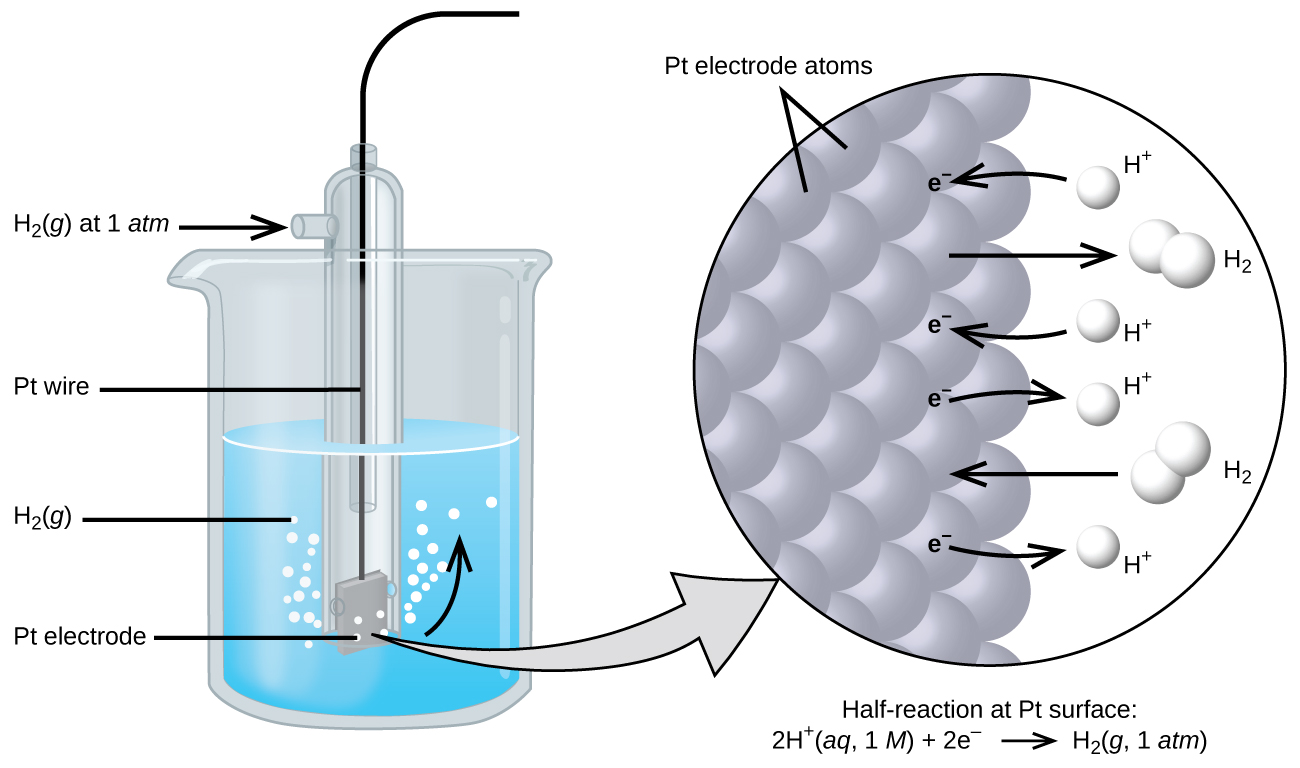
It is impossible to determine the electrical potential of a single electrode; therefore, we use a reference electrode. This means, we assign an electrode an electrical potential value of zero and then compare the electrical potential of other electrodes to it. The standard hydrogen electrode (SHE) is commonly used for assessing the potential of half-cells. The SHE consists of 1 atm of hydrogen gas bubbled through a 1 M HCl solution at 298 K. Platinum, which is chemically inert, is used as the electrode. The reduction half-reaction chosen as the reference is
\[\ce{2H+}(aq,\: 1\:M)+\ce{2e-}⇌\ce{H2}(g,\:1\: \ce{atm}) \hspace{20px} E°=\mathrm{0\: V} \nonumber \]
E° is the standard reduction potential. The superscript “°” on the E denotes standard conditions (1 bar or 1 atm for gases, 1 M for solutes). The voltage is defined as zero for all temperatures.
A galvanic cell consisting of a SHE and Cu2+/Cu half-cell can be used to determine the standard reduction potential for Cu2+ (Figure \(\PageIndex{2}\)). Electrons flow from the anode to the cathode. The reactions, which are reversible, are
\[\begin{align*}
&\textrm{Anode (oxidation): }\ce{H2}(g)⟶\ce{2H+}(aq) + \ce{2e-}\\
&\textrm{Cathode (reduction): }\ce{Cu^2+}(aq)+\ce{2e-}⟶\ce{Cu}(s)\\
&\overline{\textrm{Overall: }\ce{Cu^2+}(aq)+\ce{H2}(g)⟶\ce{2H+}(aq)+\ce{Cu}(s)}
\end{align*} \nonumber \]
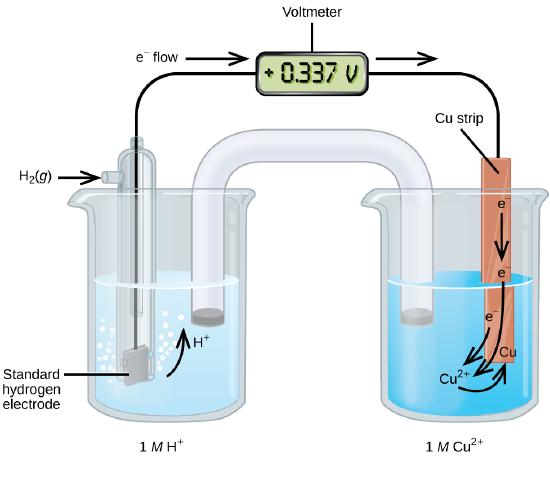
The standard reduction potential can be determined by subtracting the standard reduction potential for the reaction occurring at the anode from the standard reduction potential for the reaction occurring at the cathode. The minus sign is necessary because oxidation is the reverse of reduction.
\[E^\circ_\ce{cell}=E^\circ_\ce{cathode}−E^\circ_\ce{anode} \nonumber \]
\[\mathrm{+0.34\: V}=E^\circ_{\ce{Cu^2+/Cu}}−E^\circ_{\ce{H+/H2}}=E^\circ_{\ce{Cu^2+/Cu}}−0=E^\circ_{\ce{Cu^2+/Cu}} \nonumber \]
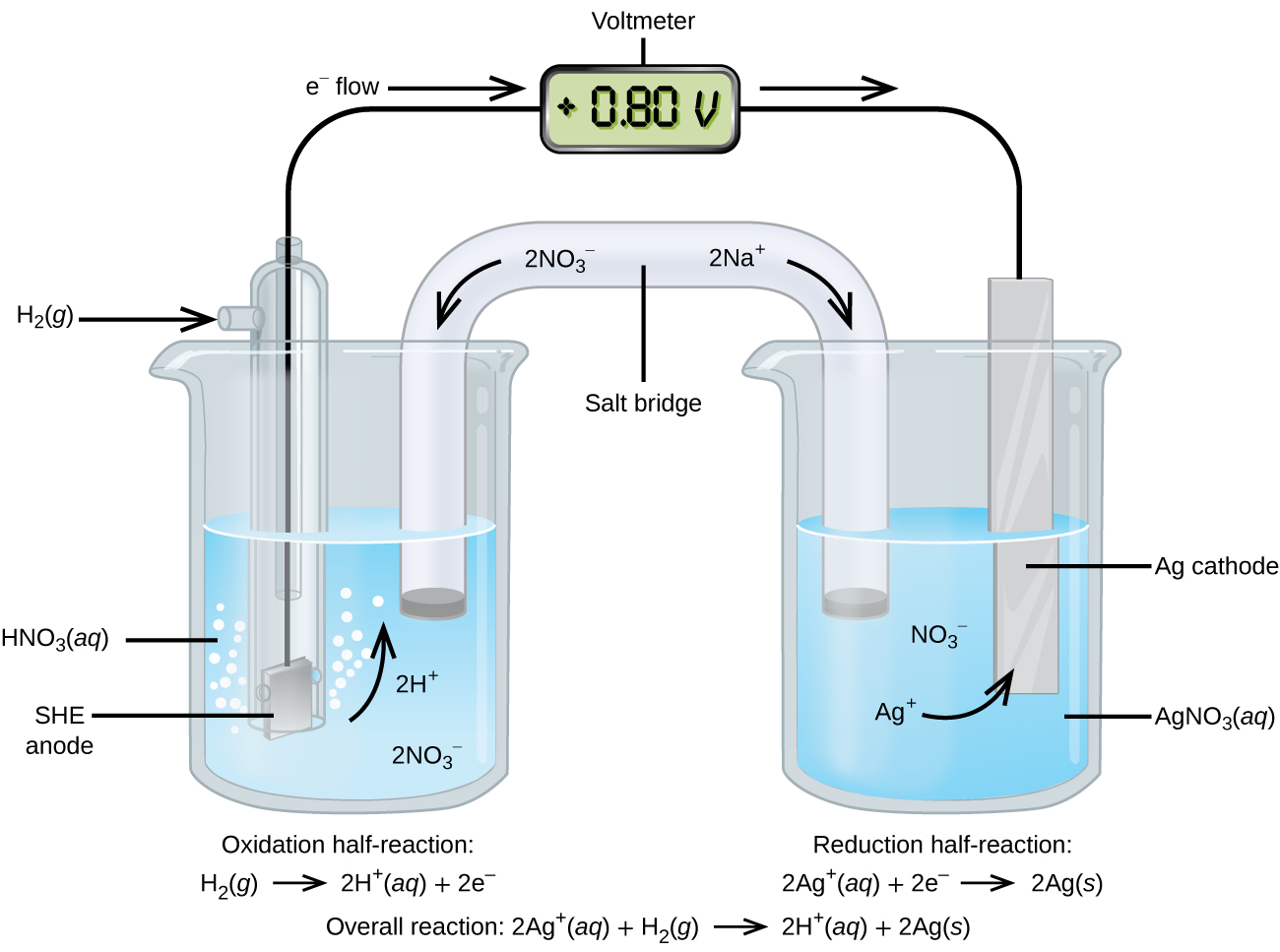
Using the SHE as a reference, other standard reduction potentials can be determined. Consider the cell shown in Figure \(\PageIndex{3}\), where the electrons flow from left to right, and the reactions are
\[\begin{align*}
&\textrm{anode (oxidation): }\ce{H2}(g)⟶\ce{2H+}(aq)+\ce{2e-}\\
&\textrm{cathode (reduction): }\ce{2Ag+}(aq)+\ce{2e-}⟶\ce{2Ag}(s)\\
&\overline{\textrm{overall: }\ce{2Ag+}(aq)+\ce{H2}(g)⟶\ce{2H+}(aq)+\ce{2Ag}(s)}
\end{align*} \nonumber \]
| Reduction Half-Reaction | Standard Reduction Potential (V) |
|---|---|
| F2(g)+2e- → 2F-(aq) | +2.87 |
| S2O82-(aq)+2e- → 2SO42-(aq) | +2.01 |
| O2(g)+4H+(aq)+4e- → 2H2O(l) | +1.23 |
| Br2(l)+2e- → 2Br-(aq) | +1.09 |
| Ag+(aq)+e- → Ag(s) | +0.80 |
| Fe3+(aq)+e- → Fe2+(aq) | +0.77 |
| I2(l) + 2e- → 2I-(aq) | +0.54 |
| Cu2+(aq)+2e- → Cu(s) | +0.34 |
| Sn4+(aq)+2e- → Sn2+(aq) | +0.15 |
| S(s)+2H+(aq)+2e- → H2S(g) | +0.14 |
| 2H+(aq)+2e- → H2(g) | 0.00 |
| Sn2+(aq)+2e- → Sn(g) | -0.14 |
| V3+(aq)+e- → V2+(aq) | -0.26 |
| Fe2+(aq)+2e- → Fe(s) | -0.44 |
| Cr3+(aq)+3e- → Cr(s) | -0.74 |
| Zn2+(aq)+2e- → Zn(s) | -0.76 |
| Mn2+(aq)+2e- → Mn(s) | -1.18 |
| Na+(aq)+e- → Na(s) | -2.71 |
| Li+(aq)+e- → Li(s) | -3.04 |
Problems
What is the standard cell potential for a galvanic cell that consists of Au3+/Au and Ni2+/Ni half-cells? Identify the oxidizing and reducing agents.
- Answer
-
Using Table \(\PageIndex{1}\), the reactions involved in the galvanic cell, both written as reductions, are
\[\ce{Au^3+}(aq)+\ce{3e-}⟶\ce{Au}(s) \hspace{20px} E^\circ_{\ce{Au^3+/Au}}=\mathrm{+1.498\: V} \nonumber \]
\[\ce{Ni^2+}(aq)+\ce{2e-}⟶\ce{Ni}(s) \hspace{20px} E^\circ_{\ce{Ni^2+/Ni}}=\mathrm{−0.257\: V} \nonumber \]
Galvanic cells have positive cell potentials, and all the reduction reactions are reversible. The reaction at the anode will be the half-reaction with the smaller or more negative standard reduction potential. Reversing the reaction at the anode (to show the oxidation) but not its standard reduction potential gives:
\[\begin{align*}
&\textrm{Anode (oxidation): }\ce{Ni}(s)⟶\ce{Ni^2+}(aq)+\ce{2e-} \hspace{20px} E^\circ_\ce{anode}=E^\circ_{\ce{Ni^2+/Ni}}=\mathrm{−0.257\: V}\\
&\textrm{Cathode (reduction): }\ce{Au^3+}(aq)+\ce{3e-}⟶\ce{Au}(s) \hspace{20px} E^\circ_\ce{cathode}=E^\circ_{\ce{Au^3+/Au}}=\mathrm{+1.498\: V}
\end{align*} \nonumber \]The least common factor is six, so the overall reaction is
\(\ce{3Ni}(s)+\ce{2Au^3+}(aq)⟶\ce{3Ni^2+}(aq)+\ce{2Au}(s)\)The reduction potentials are not scaled by the stoichiometric coefficients when calculating the cell potential, and the unmodified standard reduction potentials must be used.
\[E^\circ_\ce{cell}=E^\circ_\ce{cathode}−E^\circ_\ce{anode}=\mathrm{1.498\: V−(−0.257\: V)=1.755\: V} \nonumber \]
From the half-reactions, Ni is oxidized, so it is the reducing agent, and Au3+ is reduced, so it is the oxidizing agent.
A galvanic cell consists of a Mg electrode in 1 M Mg(NO3)2 solution and a Ag electrode in 1 M AgNO3 solution. Calculate the standard cell potential at 25 °C.
- Answer
-
\[\ce{Mg}(s)+\ce{2Ag+}(aq)⟶\ce{Mg^2+}(aq)+\ce{2Ag}(s) \hspace{20px} E^\circ_\ce{cell}=\mathrm{0.7996\: V−(−2.372\: V)=3.172\: V} \nonumber \]
True or False?
- Hydrogen has oxidation potentials of 0.
- The standard oxidation potential is not much like the standard reduction potential.
- The standard reduction cell potential and the standard oxidation cell potential can never be combined.
- Answer
-
- True
- False: the standard oxidation potential is much like the standard reduction potential
- False: The standard reduction cell potential and the standard oxidation cell potential can be combined to determine the overall cell potential
- What does the standard reduction potential measure?
- What are the differences between the standard reduction potential and standard oxidation potential, and how are the two related?
- What conditions must be met for a potential to be standard?
- When standard reduction potentials are measured, what are the potentials relative to?
- How is a standard reduction potential measured?
- Explain how the activity series is used.
- Explain how standard reduction potentials or standard oxidation potentials are applied.
- Draw and label a SHE.
- Answer
-
- Standard reduction potential measures the tendency for a given chemical species to be reduced.
- The standard oxidation potential measures the tendency for a given chemical species to be oxidized as opposed to be reduced. For the same chemical species the standard reduction potential and standard oxidation potential are opposite in sign.
- The cell must be at 298K, 1atm, and all solutions must be at 1M. Standard reduction potentials are measured with relativity to hydrogen which has be universally set to have a potential of zero.
- A standard reduction potential is measured using a galvanic cell which contains a SHE on one side and an unknown chemical half cell on the other side.
- The amount of charge that passes between the cells is measured using a voltmeter.
- The activity series is a list of standard reduction potentials in descending order of the tendency for chemical species to be reduced. Species at the top are more likely to be reduced while species at the bottom are more likely to be oxidized.
- Standard reduction and oxidation potentials can be applied to solve for the standard cell potential of two different non hydrogen species. Examples can be seen in Cell Potentials.
- See Figure (2).
Based on the activity series, which species will be oxidized and reduced: Zn2+ or H+.
- Answer
-
H+ is farther up on the activity series then Zn2+ so H+ is reduced while Zn2+ is oxidized.
The standard reduction potential of Fe3+ is +0.77V. What is its standard oxidation potential.
- Answer
-
The standard oxidation potential and standard reduction potential are always opposite in sign for the same species. The oxidation potential is -0.77V.