

Characteristic Reactions of Chromium Ions (Cr³⁺)
- Page ID
- 97267

\( \newcommand{\vecs}[1]{\overset { \scriptstyle \rightharpoonup} {\mathbf{#1}} } \)
\( \newcommand{\vecd}[1]{\overset{-\!-\!\rightharpoonup}{\vphantom{a}\smash {#1}}} \)
\( \newcommand{\dsum}{\displaystyle\sum\limits} \)
\( \newcommand{\dint}{\displaystyle\int\limits} \)
\( \newcommand{\dlim}{\displaystyle\lim\limits} \)
\( \newcommand{\id}{\mathrm{id}}\) \( \newcommand{\Span}{\mathrm{span}}\)
( \newcommand{\kernel}{\mathrm{null}\,}\) \( \newcommand{\range}{\mathrm{range}\,}\)
\( \newcommand{\RealPart}{\mathrm{Re}}\) \( \newcommand{\ImaginaryPart}{\mathrm{Im}}\)
\( \newcommand{\Argument}{\mathrm{Arg}}\) \( \newcommand{\norm}[1]{\| #1 \|}\)
\( \newcommand{\inner}[2]{\langle #1, #2 \rangle}\)
\( \newcommand{\Span}{\mathrm{span}}\)
\( \newcommand{\id}{\mathrm{id}}\)
\( \newcommand{\Span}{\mathrm{span}}\)
\( \newcommand{\kernel}{\mathrm{null}\,}\)
\( \newcommand{\range}{\mathrm{range}\,}\)
\( \newcommand{\RealPart}{\mathrm{Re}}\)
\( \newcommand{\ImaginaryPart}{\mathrm{Im}}\)
\( \newcommand{\Argument}{\mathrm{Arg}}\)
\( \newcommand{\norm}[1]{\| #1 \|}\)
\( \newcommand{\inner}[2]{\langle #1, #2 \rangle}\)
\( \newcommand{\Span}{\mathrm{span}}\) \( \newcommand{\AA}{\unicode[.8,0]{x212B}}\)
\( \newcommand{\vectorA}[1]{\vec{#1}} % arrow\)
\( \newcommand{\vectorAt}[1]{\vec{\text{#1}}} % arrow\)
\( \newcommand{\vectorB}[1]{\overset { \scriptstyle \rightharpoonup} {\mathbf{#1}} } \)
\( \newcommand{\vectorC}[1]{\textbf{#1}} \)
\( \newcommand{\vectorD}[1]{\overrightarrow{#1}} \)
\( \newcommand{\vectorDt}[1]{\overrightarrow{\text{#1}}} \)
\( \newcommand{\vectE}[1]{\overset{-\!-\!\rightharpoonup}{\vphantom{a}\smash{\mathbf {#1}}}} \)
\( \newcommand{\vecs}[1]{\overset { \scriptstyle \rightharpoonup} {\mathbf{#1}} } \)
\(\newcommand{\longvect}{\overrightarrow}\)
\( \newcommand{\vecd}[1]{\overset{-\!-\!\rightharpoonup}{\vphantom{a}\smash {#1}}} \)
\(\newcommand{\ket}[1]{\left| #1 \right>}\)
\(\newcommand{\bra}[1]{\left< #1 \right|}\)
\(\newcommand{\braket}[2]{\left< #1 \vphantom{#2} \right| \left. #2 \vphantom{#1} \right>}\)
\(\newcommand{\braopket}[3]{\left< #1 \vphantom{#2}\vphantom{#3} \right| #2 \vphantom{#1}\vphantom{#3} \left| #3 \vphantom{#1}\vphantom{#2} \right>}\)
\(\newcommand{\qmvec}[1]{\mathbf{\vec{#1}}}\)
\(\newcommand{\op}[1]{\hat{\mathbf{#1}}}\)
\(\newcommand{\expect}[1]{\langle #1 \rangle}\)
\(\newcommand{\dfn}[1]{\emph{\textbf{#1}}}\)
- Most common oxidation state: +3; +2 and +6 also exist. The +3 oxidation state is the most stable.
- M.P. 1857º
- B.P. 2672º
- Density 8.94 g/cm3
- Characteristics: Chromium is a silvery, rather brittle metal. Similar to aluminum, but exhibits several oxidation states.
Aqueous Ammonia
Ammonia reacts with chromium(III) ion to precipitate gray-green chromium(III) hydroxide:
\[\ce{Cr^{3+}(aq) + 3NH3(aq) + 3H2O(l) <=> Cr(OH)3(s) + 3NH4^{+}(aq)} \nonumber \]
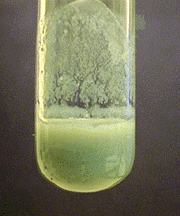
\(\ce{Cr(OH)3}\) dissolves only to a slight extent in excess ammonia. Boiling the solution causes the chromium(III) hydroxide to reprecipitate.
Sodium Hydroxide
Strong bases such as \(\ce{NaOH}\) also precipitate \(\ce{Cr(OH)3}\), but the precipitate dissolves in excess hydroxide.
\[\ce{Cr^{3+}(aq) + 3OH^{-}(aq) <=> Cr(OH)3(s)} \nonumber \]
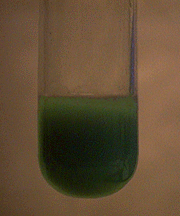
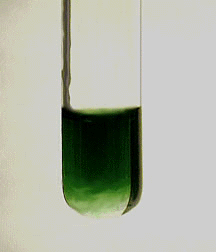
\[\ce{Cr(OH)3(s) + OH^{-}(aq) <=> Cr(OH)4^{-}(aq) (green) } \nonumber \]
Hydrogen Peroxide
In basic solution, hydrogen peroxide oxidizes \(\ce{Cr(III)}\) to \(\ce{Cr(VI)}\):
\[\ce{2Cr(OH)4^{-}(aq) + 3H2O2(aq) + 2OH^{-}(aq) -> 2CrO4^{2-}(aq) + 8H2O(l)} \nonumber \]
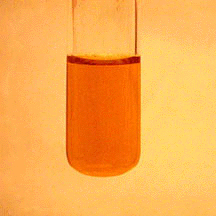
To confirm the oxidation, addition of \(\ce{Ba^{2+}}\) solutions precipitate the yellow chromate ion, \(\ce{CrO4^{2-}}\), as yellow barium chromate.
No Reaction
\(\ce{Cl^{-}}\), \(\ce{SO4^{2-}}\)