

8.7: Sequence Rules - The E,Z Designation
- Page ID
- 227094
\( \newcommand{\vecs}[1]{\overset { \scriptstyle \rightharpoonup} {\mathbf{#1}} } \)
\( \newcommand{\vecd}[1]{\overset{-\!-\!\rightharpoonup}{\vphantom{a}\smash {#1}}} \)
\( \newcommand{\dsum}{\displaystyle\sum\limits} \)
\( \newcommand{\dint}{\displaystyle\int\limits} \)
\( \newcommand{\dlim}{\displaystyle\lim\limits} \)
\( \newcommand{\id}{\mathrm{id}}\) \( \newcommand{\Span}{\mathrm{span}}\)
( \newcommand{\kernel}{\mathrm{null}\,}\) \( \newcommand{\range}{\mathrm{range}\,}\)
\( \newcommand{\RealPart}{\mathrm{Re}}\) \( \newcommand{\ImaginaryPart}{\mathrm{Im}}\)
\( \newcommand{\Argument}{\mathrm{Arg}}\) \( \newcommand{\norm}[1]{\| #1 \|}\)
\( \newcommand{\inner}[2]{\langle #1, #2 \rangle}\)
\( \newcommand{\Span}{\mathrm{span}}\)
\( \newcommand{\id}{\mathrm{id}}\)
\( \newcommand{\Span}{\mathrm{span}}\)
\( \newcommand{\kernel}{\mathrm{null}\,}\)
\( \newcommand{\range}{\mathrm{range}\,}\)
\( \newcommand{\RealPart}{\mathrm{Re}}\)
\( \newcommand{\ImaginaryPart}{\mathrm{Im}}\)
\( \newcommand{\Argument}{\mathrm{Arg}}\)
\( \newcommand{\norm}[1]{\| #1 \|}\)
\( \newcommand{\inner}[2]{\langle #1, #2 \rangle}\)
\( \newcommand{\Span}{\mathrm{span}}\) \( \newcommand{\AA}{\unicode[.8,0]{x212B}}\)
\( \newcommand{\vectorA}[1]{\vec{#1}} % arrow\)
\( \newcommand{\vectorAt}[1]{\vec{\text{#1}}} % arrow\)
\( \newcommand{\vectorB}[1]{\overset { \scriptstyle \rightharpoonup} {\mathbf{#1}} } \)
\( \newcommand{\vectorC}[1]{\textbf{#1}} \)
\( \newcommand{\vectorD}[1]{\overrightarrow{#1}} \)
\( \newcommand{\vectorDt}[1]{\overrightarrow{\text{#1}}} \)
\( \newcommand{\vectE}[1]{\overset{-\!-\!\rightharpoonup}{\vphantom{a}\smash{\mathbf {#1}}}} \)
\( \newcommand{\vecs}[1]{\overset { \scriptstyle \rightharpoonup} {\mathbf{#1}} } \)
\(\newcommand{\longvect}{\overrightarrow}\)
\( \newcommand{\vecd}[1]{\overset{-\!-\!\rightharpoonup}{\vphantom{a}\smash {#1}}} \)
\(\newcommand{\ket}[1]{\left| #1 \right>}\)
\(\newcommand{\bra}[1]{\left< #1 \right|}\)
\(\newcommand{\braket}[2]{\left< #1 \vphantom{#2} \right| \left. #2 \vphantom{#1} \right>}\)
\(\newcommand{\braopket}[3]{\left< #1 \vphantom{#2}\vphantom{#3} \right| #2 \vphantom{#1}\vphantom{#3} \left| #3 \vphantom{#1}\vphantom{#2} \right>}\)
\(\newcommand{\qmvec}[1]{\mathbf{\vec{#1}}}\)
\(\newcommand{\op}[1]{\hat{\mathbf{#1}}}\)
\(\newcommand{\expect}[1]{\langle #1 \rangle}\)
\(\newcommand{\dfn}[1]{\emph{\textbf{#1}}}\)
After completing this section, you should be able to
- illustrate, by means of a suitable example, the limitations of the terms cis and trans in naming isomeric alkenes.
- use the E/Z designation to describe the geometry of a given alkene structure.
- incorporate the E/Z designation into the IUPAC name of a given alkene.
- draw the correct Kekulé, condensed or shorthand structure of an alkene, given its E/Z designation plus other necessary information (e.g., molecular formula, IUPAC name).
Make certain that you can define, and use in context, the key term below.
- sequence rules (Cahn-Ingold-Prelog rules)
The limitations of the cis/trans system are illustrated in the examples given below.
- From your study of the IUPAC system, you should be able to identify this compound as 4-ethyl-3-methyl-3-heptene, but is it cis or trans?
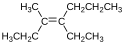
At first you might say cis, because it appears that two ethyl groups appear on the same side of the double bond. However, the correct answer is trans. The rule is that the designation cis or trans must correspond to the configuration of the longest carbon chain. Tracing out the seven-carbon chain in the compound shown above, you change sides as you pass through the double bond:
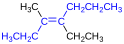
So, the full name for this compound is trans-4-ethyl-3methyl-3-heptene.
- The cis/trans system breaks down completely in a compound such as that shown below. The E/Z system, which is the subject of this section, is designed to accommodate such situations.

In cases where two or more double bonds are present, you must be prepared to assign an E or Z designation to each of the double bonds. For example:

Another use for these sequence rules will be part of the discussion of optical isomerism in Section 9.5.
E/Z nomenclature
When each carbon in a double bond is attached to a hydrogen and and a non-hydrogen substituent, the geometric isomers can be identified by using the cis-trans nomenclature discussed in the previous section. However, when a double bond is attached to three or four non-hydrogen substituents there are some examples where cis-trans nomenclature is ineffective in describing the substituents orientation in geometric isomers. In these situations the rigorous IUPAC system for naming alkene isomers, called the E/Z system, is used. The E/Z system analyzes the two substituents attached to each carbon in the double bond and assigns each either a high or low priority. If the higher priority group on both carbons in the double bond the same side the alkene is said to have a Z isomer (from German zusammen = together). You could think of Z as Zame Zide to help memorize it. If the higher priority group on opposite sides the alkene has an E isomer (from German entgegen = opposite).

Note, if both substituents an a double bond carbon are exactly the same there is no E/Z isomerizem is possible. Also, if E/Z isomerism is possible, interchanging the substituents attached on double-bond carbon converts one isomer to the other.
Substituent priority for the E,Z system is assigned using the Cahn–Ingold–Prelog (CIP) sequence rules. These are the same rules used to assign R/S configurations to chiral centers in Section 5.5. A brief overview of using CIP rules to determine alkene configuration is given here but CIP rules are discussed in greater detail in Section 5.5.
The priority rules are often called the Cahn-Ingold-Prelog (CIP) rules, after the chemists who developed the system
Rule 1: The "first point of difference" rule
First, determine the two substituents on each double-bond carbon separately. Rank these substituents based on the atom which directly attached to the double-bond carbon. The substituent whose atom has a higher atomic number takes precedence over the substituent whose atom has a lower atomic number.
Which is higher priority, by the CIP rules: a C with an O and 2 H attached to it or a C with three C? The first C has one atom of high priority but also two atoms of low priority. How do these "balance out"? Answering this requires a clear understanding of how the ranking is done. The simple answer is that the first point of difference is what matters; the O wins.

To illustrate this, consider the molecule at the left. Is the double bond here E or Z? At the left end of the double bond, Br > C. But the right end of the double bond requires a careful analysis.
At the right hand end, the first atom attached to the double bond is a C at each position. A tie, so we look at what is attached to this first C. For the upper C, it is CCC (since the triple bond counts three times). For the lower C, it is OHH -- listed in order from high priority atom to low. OHH is higher priority than CCC, because of the first atom in the list. That is, the O of the lower group beats the C of the upper group. In other words, the O is the highest priority atom of any in this comparison; thus the O "wins".
Therefore, the high priority groups are "up" on the left end (the -Br) and "down" on the right end (the -CH2-O-CH3). This means that the isomer shown is opposite = entgegen = E. And what is the name? The "name" is (E)-2-Bromo-3-(methoxymethyl)hex-2-en-4-yne.
Rule 2
If the first atom on both substituents are the identical, then proceed along both substituent chains until the first point of difference is determined.
Rule 3
Remember that atoms involved in multiple bonds are considered with a specific set of rules. These atoms are treated as if they have the same number of single-bond atoms as they have attached to multiply bonded atoms.
An easy example which shows the necessity of the E/Z system is the alkene, 1-bromo-2-chloro-2-fluoro-1-iodoethene, which has four different substituents attached to the double bond. The figure below shows that there are two distinctly different geometric isomers for this molecule neither of which can be named using the cis-trans system.

Consider the left hand structure. On the double bond carbon on the left, the two atoms attached to the double bond are Br and I. By the CIP priority rules, I is higher priority than Br (higher atomic number). Now look at carbon on the right. The attached atoms are Cl and F, with Cl having the higher atomic number and the higher priority.
When considering the relative positions of the higher priority groups, the higher priority group is "down" on the left double bond carbon and "down" at right double bond carbon. Since the two higher priority groups are both on the same side of the double bond ("down", in this case), they are zusammen = together. Therefore, this is the (Z) isomer. Similarly, the right hand structure is (E).

 cis-2-butene (Z)-2-butene |
 trans-2-butene (E)-2-butene |
The Figure above shows the two isomers of 2-butene. You should recognize them as cis and trans. Let's analyze them to see whether they are E or Z. Start with the left hand structure (the cis isomer). On C2 (the left end of the double bond), the two atoms attached to the double bond are C and H. By the CIP priority rules, C is higher priority than H (higher atomic number). Now look at C3 (the right end of the double bond). Similarly, the atoms are C and H, with C being higher priority. We see that the higher priority group is "down" at C2 and "down" at C3. Since the two priority groups are both on the same side of the double bond ("down", in this case), they are zusammen = together. Therefore, this is (Z)-2-butene.
Now look at the right hand structure (the trans isomer). In this case, the priority group is "down" on the left end of the double bond and "up" on the right end of the double bond. Since the two priority groups are on opposite sides of the double bond, they are entgegen = opposite. Therefore, this is (E)-2-butene.
E/Z will work – even when cis/trans fails
In simple cases, such as 2-butene, Z corresponds to cis and E to trans. However, that is not a rule. This section and the following one illustrate some idiosyncrasies that happen when you try to compare the two systems. The real advantage of the E/Z system is that it will always work. In contrast, the cis/trans system breaks down with many ambiguous cases.
The following figure shows two isomers of an alkene with four different groups on the double bond, 1-bromo-2-chloro-2-fluoro-1-iodoethene.
 (Z)-1-bromo-2-chloro-2-fluoro-1-iodoethene |
 (E)-1-bromo-2-chloro-2-fluoro-1-iodoethene |
It should be apparent that the two structures shown are distinct chemicals. However, it is impossible to name them as cis or trans. On the other hand, the E/Z system works fine... Consider the left hand structure. On C1 (the left end of the double bond), the two atoms attached to the double bond are Br and I. By the CIP priority rules, I is higher priority than Br (higher atomic number). Now look at C2. The atoms are Cl and F, with Cl being higher priority. We see that the higher priority group is "down" at C1 and "down" at C2. Since the two priority groups are both on the same side of the double bond ("down", in this case), they are zusammen = together. Therefore, this is the (Z) isomer. Similarly, the right hand structure is (E).
E/Z will work, but may not agree with cis/trans
Consider the molecule shown below. This is 2-bromo-2-butene -- ignoring the geometric isomerism for now. Cis or trans? This molecule is clearly cis. The two methyl groups are on the same side. More rigorously, the "parent chain" is cis.

E or Z? There is a methyl at each end of the double bond. On the left, the methyl is the high priority group -- because the other group is -H. On the right, the methyl is the low priority group -- because the other group is -Br. That is, the high priority groups are -CH3 (left) and -Br (right). Thus the two priority groups are on opposite sides = entgegen = E.
This example should convince you that cis and Z are not synonyms. Cis/trans and E/Z are determined by distinct criteria. There may seem to be a simple correspondence, but it is not a rule. Be sure to determine cis/trans or E/Z separately, as needed.
Multiple double bonds
If the compound contains more than one double bond, then each one is analyzed and declared to be E or Z.

The configuration at the left hand double bond is E; at the right hand double bond it is Z. Thus this compound is (1E,4Z)-1,5-dichloro-1,4-hexadiene.
The double-bond rule in determining priorities
Consider the compound below

This is 1-chloro-2-ethyl-1,3-butadiene -- ignoring, for the moment, the geometric isomerism. There is no geometric isomerism at the second double bond, at 3-4, because it has 2 H at its far end.
What about the first double bond, at 1-2? On the left hand end, there is H and Cl; Cl is higher priority (by atomic number). On the right hand end, there is -CH2-CH3 (an ethyl group) and -CH=CH2 (a vinyl or ethenyl group). Both of these groups have C as the first atom, so we have a tie so far and must look further. What is attached to this first C? For the ethyl group, the first C is attached to C, H, and H. For the ethenyl group, the first C is attached to a C twice, so we count it twice; therefore that C is attached to C, C, H. CCH is higher than CHH; therefore, the ethenyl group is higher priority. Since the priority groups, Cl and ethenyl, are on the same side of the double bond, this is the Z-isomer; the compound is (Z)-1-chloro-2-ethyl-1,3-butadiene.
The configuration about double bonds is undoubtedly best specified by the cis/trans notation when there is no ambiguity involved. Unfortunately, many compounds cannot be described adequately by the cis/trans system. Consider, for example, configurational isomers of 1-fluoro-1-chloro-2-bromo-2-iodo-ethene, 9 and 10. There is no obvious way in which the cis/trans system can be used:


A system that is easy to use and which is based on the sequence rules already described for the R,S system works as follows:
- An order of precedence is established for the two atoms or groups attached to each end of the double bond according to the sequence rules of Section 19-6. When these rules are applied to 1-fluoro- 1-chloro-2-bromo-2- iodoethene, the priority sequence is:
- at carbon atom 1, C1 > F
- at carbon atom 2, I > Br
- Examination of the two configurations shows that the two priority groups- one on each end- are either on the same side of the double bond or on opposite sides:
 priority groups on opposite sides (E) configuration |
 priority groups on same side (Z) configuration |
The Z isomer is designated as the isomer in which the top priority groups are on the same side (Z is taken from the German word zusammen- together). The E isomer has these groups on opposite sides (E, German for entgegen across). Two further examples show how the nomenclature is used:
 (Z)-1-chloro-1-butene |
 (1Z,3E)-1,3-butadiene-1,4-d2 |
Exercises
Which of the following sets has a higher ranking?
- -CH3 or -CH2Br
- -Br or -Cl
- -CH=CH2 or -CH=O
- Answer
-
a) -CH2Br
b) -Br
c) -CH=O
Place the following sets of substituents in each group in order of lowest priority (1st) to highest priority (4th)
- -CH(CH3)2, -CH2CH3, -C(CH3)3, -CH3
- -NH2, -F, -Br, -CH3
- -SH, -NH2, -F, -H
- Answer
-
a) (lowest priority) -CH3 < -CH2CH3 < -CH(CH3)2 < -C(CH3)3 (highest priority)
b) (lowest priority) -CH3 < -NH2 < -F < -Br (highest priority)
c) (lowest priority) -H < -NH2 < -F < -SH (highest priority)
Label the following alkenes as E, Z, or neither.

- Answer
-
The higher priority group is highlighted in red.

a) E
b) E
c) E
d) Z
e) neither (both isopropyls on the right have the same priority)
Name the following alkenes.
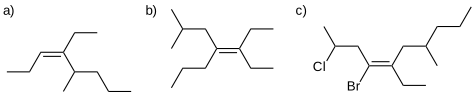
- Answer
-

The higher priority group is highlighted in red.
- (Z)-4-ethyl-5-methyloct-3-ene or (Z)-4-ethyl-5-methyl-3-octene
- 3-ethyl-6-methyl-4-propylhept-3-ene or 3-ethyl-6-methyl-4-propyl-3-heptene
- (E)-4-bromo-2-chloro-5-ethyl-7-methyldec-4-ene or (E)-4-bromo-2-chloro-5-ethyl-7-methyl-4-decene