

14.1.2: Dehydration Synthesis
- Page ID
- 491373

\( \newcommand{\vecs}[1]{\overset { \scriptstyle \rightharpoonup} {\mathbf{#1}} } \)
\( \newcommand{\vecd}[1]{\overset{-\!-\!\rightharpoonup}{\vphantom{a}\smash {#1}}} \)
\( \newcommand{\dsum}{\displaystyle\sum\limits} \)
\( \newcommand{\dint}{\displaystyle\int\limits} \)
\( \newcommand{\dlim}{\displaystyle\lim\limits} \)
\( \newcommand{\id}{\mathrm{id}}\) \( \newcommand{\Span}{\mathrm{span}}\)
( \newcommand{\kernel}{\mathrm{null}\,}\) \( \newcommand{\range}{\mathrm{range}\,}\)
\( \newcommand{\RealPart}{\mathrm{Re}}\) \( \newcommand{\ImaginaryPart}{\mathrm{Im}}\)
\( \newcommand{\Argument}{\mathrm{Arg}}\) \( \newcommand{\norm}[1]{\| #1 \|}\)
\( \newcommand{\inner}[2]{\langle #1, #2 \rangle}\)
\( \newcommand{\Span}{\mathrm{span}}\)
\( \newcommand{\id}{\mathrm{id}}\)
\( \newcommand{\Span}{\mathrm{span}}\)
\( \newcommand{\kernel}{\mathrm{null}\,}\)
\( \newcommand{\range}{\mathrm{range}\,}\)
\( \newcommand{\RealPart}{\mathrm{Re}}\)
\( \newcommand{\ImaginaryPart}{\mathrm{Im}}\)
\( \newcommand{\Argument}{\mathrm{Arg}}\)
\( \newcommand{\norm}[1]{\| #1 \|}\)
\( \newcommand{\inner}[2]{\langle #1, #2 \rangle}\)
\( \newcommand{\Span}{\mathrm{span}}\) \( \newcommand{\AA}{\unicode[.8,0]{x212B}}\)
\( \newcommand{\vectorA}[1]{\vec{#1}} % arrow\)
\( \newcommand{\vectorAt}[1]{\vec{\text{#1}}} % arrow\)
\( \newcommand{\vectorB}[1]{\overset { \scriptstyle \rightharpoonup} {\mathbf{#1}} } \)
\( \newcommand{\vectorC}[1]{\textbf{#1}} \)
\( \newcommand{\vectorD}[1]{\overrightarrow{#1}} \)
\( \newcommand{\vectorDt}[1]{\overrightarrow{\text{#1}}} \)
\( \newcommand{\vectE}[1]{\overset{-\!-\!\rightharpoonup}{\vphantom{a}\smash{\mathbf {#1}}}} \)
\( \newcommand{\vecs}[1]{\overset { \scriptstyle \rightharpoonup} {\mathbf{#1}} } \)
\(\newcommand{\longvect}{\overrightarrow}\)
\( \newcommand{\vecd}[1]{\overset{-\!-\!\rightharpoonup}{\vphantom{a}\smash {#1}}} \)
\(\newcommand{\avec}{\mathbf a}\) \(\newcommand{\bvec}{\mathbf b}\) \(\newcommand{\cvec}{\mathbf c}\) \(\newcommand{\dvec}{\mathbf d}\) \(\newcommand{\dtil}{\widetilde{\mathbf d}}\) \(\newcommand{\evec}{\mathbf e}\) \(\newcommand{\fvec}{\mathbf f}\) \(\newcommand{\nvec}{\mathbf n}\) \(\newcommand{\pvec}{\mathbf p}\) \(\newcommand{\qvec}{\mathbf q}\) \(\newcommand{\svec}{\mathbf s}\) \(\newcommand{\tvec}{\mathbf t}\) \(\newcommand{\uvec}{\mathbf u}\) \(\newcommand{\vvec}{\mathbf v}\) \(\newcommand{\wvec}{\mathbf w}\) \(\newcommand{\xvec}{\mathbf x}\) \(\newcommand{\yvec}{\mathbf y}\) \(\newcommand{\zvec}{\mathbf z}\) \(\newcommand{\rvec}{\mathbf r}\) \(\newcommand{\mvec}{\mathbf m}\) \(\newcommand{\zerovec}{\mathbf 0}\) \(\newcommand{\onevec}{\mathbf 1}\) \(\newcommand{\real}{\mathbb R}\) \(\newcommand{\twovec}[2]{\left[\begin{array}{r}#1 \\ #2 \end{array}\right]}\) \(\newcommand{\ctwovec}[2]{\left[\begin{array}{c}#1 \\ #2 \end{array}\right]}\) \(\newcommand{\threevec}[3]{\left[\begin{array}{r}#1 \\ #2 \\ #3 \end{array}\right]}\) \(\newcommand{\cthreevec}[3]{\left[\begin{array}{c}#1 \\ #2 \\ #3 \end{array}\right]}\) \(\newcommand{\fourvec}[4]{\left[\begin{array}{r}#1 \\ #2 \\ #3 \\ #4 \end{array}\right]}\) \(\newcommand{\cfourvec}[4]{\left[\begin{array}{c}#1 \\ #2 \\ #3 \\ #4 \end{array}\right]}\) \(\newcommand{\fivevec}[5]{\left[\begin{array}{r}#1 \\ #2 \\ #3 \\ #4 \\ #5 \\ \end{array}\right]}\) \(\newcommand{\cfivevec}[5]{\left[\begin{array}{c}#1 \\ #2 \\ #3 \\ #4 \\ #5 \\ \end{array}\right]}\) \(\newcommand{\mattwo}[4]{\left[\begin{array}{rr}#1 \amp #2 \\ #3 \amp #4 \\ \end{array}\right]}\) \(\newcommand{\laspan}[1]{\text{Span}\{#1\}}\) \(\newcommand{\bcal}{\cal B}\) \(\newcommand{\ccal}{\cal C}\) \(\newcommand{\scal}{\cal S}\) \(\newcommand{\wcal}{\cal W}\) \(\newcommand{\ecal}{\cal E}\) \(\newcommand{\coords}[2]{\left\{#1\right\}_{#2}}\) \(\newcommand{\gray}[1]{\color{gray}{#1}}\) \(\newcommand{\lgray}[1]{\color{lightgray}{#1}}\) \(\newcommand{\rank}{\operatorname{rank}}\) \(\newcommand{\row}{\text{Row}}\) \(\newcommand{\col}{\text{Col}}\) \(\renewcommand{\row}{\text{Row}}\) \(\newcommand{\nul}{\text{Nul}}\) \(\newcommand{\var}{\text{Var}}\) \(\newcommand{\corr}{\text{corr}}\) \(\newcommand{\len}[1]{\left|#1\right|}\) \(\newcommand{\bbar}{\overline{\bvec}}\) \(\newcommand{\bhat}{\widehat{\bvec}}\) \(\newcommand{\bperp}{\bvec^\perp}\) \(\newcommand{\xhat}{\widehat{\xvec}}\) \(\newcommand{\vhat}{\widehat{\vvec}}\) \(\newcommand{\uhat}{\widehat{\uvec}}\) \(\newcommand{\what}{\widehat{\wvec}}\) \(\newcommand{\Sighat}{\widehat{\Sigma}}\) \(\newcommand{\lt}{<}\) \(\newcommand{\gt}{>}\) \(\newcommand{\amp}{&}\) \(\definecolor{fillinmathshade}{gray}{0.9}\)- Explain dehydration (or condensation) reactions
Dehydration Synthesis
Most macromolecules are made from single subunits, or building blocks, called monomers. The monomers combine with each other via covalent bonds to form larger molecules known as polymers. In doing so, monomers release water molecules as byproducts. This type of reaction is known as dehydration synthesis, which means “to put together while losing water. ” It is also considered to be a condensation reaction since two molecules are condensed into one larger molecule with the loss of a smaller molecule (the water.)
In a dehydration synthesis reaction between two un-ionized monomers, such as monosaccharide sugars, the hydrogen of one monomer combines with the hydroxyl group of another monomer, releasing a molecule of water in the process. The removal of a hydrogen from one monomer and the removal of a hydroxyl group from the other monomer allows the monomers to share electrons and form a covalent bond. Thus, the monomers that are joined together are being dehydrated to allow for synthesis of a larger molecule.
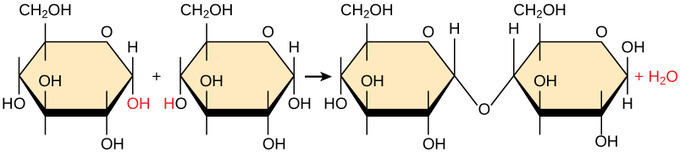 Figure \(\PageIndex{1}\): A dehydration synthesis reaction involving un-ionized moners..: In the dehydration synthesis reaction between two molecules of glucose, a hydroxyl group from the first glucose is combined with a hydrogen from the second glucose, creating a covalent bond that links the two monomeric sugars (monosaccharides) together to form the dissacharide maltose. In the process, a water molecule is formed.
When the monomers are ionized, such as is the case with amino acids in an aqueous environment like cytoplasm, two hydrogens from the positively-charged end of one monomer are combined with an oxygen from the negatively-charged end of another monomer, again forming water, which is released as a side-product, and again joining the two monomers with a covalent bond.
 Figure \(\PageIndex{1}\): A dehydration synthesis reaction involving ionized monomers.: In the dehydration synthesis reaction between two amino acids, with are ionized in aqueous environments like the cell, an oxygen from the first amino acid is combined with two hydrogens from the second amino acid, creating a covalent bond that links the two monomers together to form a dipeptide. In the process a water molecule is formed.
As additional monomers join via multiple dehydration synthesis reactions, the chain of repeating monomers begins to form a polymer. Different types of monomers can combine in many configurations, giving rise to a diverse group of macromolecules. Three of the four major classes of biological macromolecules (complex carbohydrates, nucleic acids, and proteins), are composed of monomers that join together via dehydration synthesis reactions. Complex carbohydrates are formed from monosaccharides, nucleic acids are formed from mononucleotides, and proteins are formed from amino acids.
There is great diversity in the manner by which monomers can combine to form polymers. For example, glucose monomers are the constituents of starch, glycogen, and cellulose. These three are polysaccharides, classified as carbohydrates, that have formed as a result of multiple dehydration synthesis reactions between glucose monomers. However, the manner by which glucose monomers join together, specifically locations of the covalent bonds between connected monomers and the orientation (stereochemistry) of the covalent bonds, results in these three different polysaccharides with varying properties and functions. In nucleic acids and proteins, the location and stereochemistry of the covalent linkages connecting the monomers do not vary from molecule to molecule, but instead the multiple kinds of monomers (five different monomers in nucleic acids, A, G, C, T, and U mononucleotides; 21 different amino acids monomers in proteins) are combined in a huge variety of sequences. Each protein or nucleic acid with a different sequence is a different molecule with different properties.
Key Points
- During dehydration synthesis, either the hydrogen of one monomer combines with the hydroxyl group of another monomer releasing a molecule of water, or two hydrogens from one monomer combine with one oxygen from the other monomer releasing a molecule of water.
- The monomers that are joined via dehydration synthesis reactions share electrons and form covalent bonds with each other.
- As additional monomers join via multiple dehydration synthesis reactions, this chain of repeating monomers begins to form a polymer.
- Complex carbohydrates, nucleic acids, and proteins are all examples of polymers that are formed by dehydration synthesis.
- Monomers like glucose can join together in different ways and produce a variety of polymers. Monomers like mononucleotides and amino acids join together in different sequences to produce a variety of polymers.
Key Terms
- covalent bond: A type of chemical bond where two atoms are connected to each other by the sharing of two or more electrons.
- monomer: A relatively small molecule which can be covalently bonded to other monomers to form a polymer.