

7.3: Functional groups
- Page ID
- 538685

\( \newcommand{\vecs}[1]{\overset { \scriptstyle \rightharpoonup} {\mathbf{#1}} } \)
\( \newcommand{\vecd}[1]{\overset{-\!-\!\rightharpoonup}{\vphantom{a}\smash {#1}}} \)
\( \newcommand{\dsum}{\displaystyle\sum\limits} \)
\( \newcommand{\dint}{\displaystyle\int\limits} \)
\( \newcommand{\dlim}{\displaystyle\lim\limits} \)
\( \newcommand{\id}{\mathrm{id}}\) \( \newcommand{\Span}{\mathrm{span}}\)
( \newcommand{\kernel}{\mathrm{null}\,}\) \( \newcommand{\range}{\mathrm{range}\,}\)
\( \newcommand{\RealPart}{\mathrm{Re}}\) \( \newcommand{\ImaginaryPart}{\mathrm{Im}}\)
\( \newcommand{\Argument}{\mathrm{Arg}}\) \( \newcommand{\norm}[1]{\| #1 \|}\)
\( \newcommand{\inner}[2]{\langle #1, #2 \rangle}\)
\( \newcommand{\Span}{\mathrm{span}}\)
\( \newcommand{\id}{\mathrm{id}}\)
\( \newcommand{\Span}{\mathrm{span}}\)
\( \newcommand{\kernel}{\mathrm{null}\,}\)
\( \newcommand{\range}{\mathrm{range}\,}\)
\( \newcommand{\RealPart}{\mathrm{Re}}\)
\( \newcommand{\ImaginaryPart}{\mathrm{Im}}\)
\( \newcommand{\Argument}{\mathrm{Arg}}\)
\( \newcommand{\norm}[1]{\| #1 \|}\)
\( \newcommand{\inner}[2]{\langle #1, #2 \rangle}\)
\( \newcommand{\Span}{\mathrm{span}}\) \( \newcommand{\AA}{\unicode[.8,0]{x212B}}\)
\( \newcommand{\vectorA}[1]{\vec{#1}} % arrow\)
\( \newcommand{\vectorAt}[1]{\vec{\text{#1}}} % arrow\)
\( \newcommand{\vectorB}[1]{\overset { \scriptstyle \rightharpoonup} {\mathbf{#1}} } \)
\( \newcommand{\vectorC}[1]{\textbf{#1}} \)
\( \newcommand{\vectorD}[1]{\overrightarrow{#1}} \)
\( \newcommand{\vectorDt}[1]{\overrightarrow{\text{#1}}} \)
\( \newcommand{\vectE}[1]{\overset{-\!-\!\rightharpoonup}{\vphantom{a}\smash{\mathbf {#1}}}} \)
\( \newcommand{\vecs}[1]{\overset { \scriptstyle \rightharpoonup} {\mathbf{#1}} } \)
\(\newcommand{\longvect}{\overrightarrow}\)
\( \newcommand{\vecd}[1]{\overset{-\!-\!\rightharpoonup}{\vphantom{a}\smash {#1}}} \)
\(\newcommand{\ket}[1]{\left| #1 \right>}\)
\(\newcommand{\bra}[1]{\left< #1 \right|}\)
\(\newcommand{\braket}[2]{\left< #1 \vphantom{#2} \right| \left. #2 \vphantom{#1} \right>}\)
\(\newcommand{\braopket}[3]{\left< #1 \vphantom{#2}\vphantom{#3} \right| #2 \vphantom{#1}\vphantom{#3} \left| #3 \vphantom{#1}\vphantom{#2} \right>}\)
\(\newcommand{\qmvec}[1]{\mathbf{\vec{#1}}}\)
\(\newcommand{\op}[1]{\hat{\mathbf{#1}}}\)
\(\newcommand{\expect}[1]{\langle #1 \rangle}\)
\(\newcommand{\dfn}[1]{\emph{\textbf{#1}}}\)
- Define organic functional group and recognize it in an organic compound.
What is a functional group?
A functional group is an atom or a group of atoms that imparts a characteristic set of physical and chemical properties to the compound.
For example, alkanes with no functional group are the least reactive classes of organic compounds. Alkanes have only \(\ce{C-C}\) and \(\ce{C-H}\) single bonds, which are nonpolar and strong bonds. Alkenes, alkynes, and aromatic compounds are relatively reactive classes of organic compounds because they have a \(\ce{C=C}\) bond, \(\ce{C≡C}\) bond, or a benzene ring as functional groups. Although alkenes, alkynes, and aromatic hydrocarbons are nonpolar, there is a partial negative (\(\delta^{-}\)) character in the \(\pi\)-bond region that attracts electrophilic reagents having \(\delta^{+}\) regions. Further, the \(\pi\)-bond is weaker than a \(\sigma\)-bond making it easier to break during chemical reactions.
Classification of organic compounds based on the functional groups
One primary class of organic compounds is hydrocarbons that contain only \(\ce{C's}\) and \(\ce{H's}\), listed in Table 1, and the others are organic compounds with heteroatom/s, in their functional group/s. Hydrocarbons have been introduced in the previous section. Other classes of organic compounds containing heteratom\s in their functional groups are described next.
The heteroatom/s in the functional group can be a single bonded, i.e., sp3-hybridized halogen, \(\ce{O}\), \(\ce{N}\), \(\ce{S}\), \(\ce{P}\), etc., listed in Table 2; a double bonded, i.e., sp2-hybridized \(\ce{O}\), \(\ce{N}\), \(\ce{S}\), \(\ce{P}\), etc., listed in Table 3; or a combination of these, listed in Table 4.
| Class name | Group name | General structural formula | General condensed formula | Prefix | Suffix | Example |
|---|---|---|---|---|---|---|
| Alkane | Alkyl | R | R | alkyl- | -ane |  |
| Alkene | Alkenyl |  |
\(\ce{R2C=CR2}\) | alkenyl- | -ene |  |
| Alkyne | Alkynyl |  |
\(\ce{RC≡CR2}\) | alkynyl- | -yne |  |
| Aromatic (benzene derivatives) | Phenyl |  |
\(\ce{R-C6H5}\) | phenyl- | -benzene |  |
| Haloalkane | Halo | \(\ce{R-X}\), i.e., \(\ce{R-F}\), \(\ce{R-Cl}\), \(\ce{R-Br}\), or \(\ce{R-I}\) | \(\ce{R-X}\) i.e., \(\ce{R-F}\), \(\ce{R-Cl}\), \(\ce{R-Br}\), or \(\ce{R-I}\) | halo- i.e., fluoro-, chloro-, bromo-, or iodo-) | - | \(\ce{CH3-CH2-Cl}\) (chloroethane) |
| Alcohol | Alcohol | \(\ce{R-OH}\) | \(\ce{ROH}\) | hydroxy- | -ol | \(\ce{CH3-CH2-OH}\) (ethanol) |
| Ether | Ether | \(\ce{R-O-R'}\) | \(\ce{ROR'}\) | Alkoxy | - | \(\ce{CH3-CH2-O-CH2-CH3}\) (ethoxyethane) |
| Amine | Amine |  |
\(\ce{R1R2R3N}\) | amino- | -amine |  |
| Aldehyde | Aldehyde |  |
\(\ce{RCHO}\) | oxo- | -al | 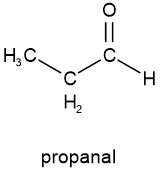 |
| Ketone | Ketone |  |
\(\ce{RCOR'}\) | oxo- | -one |  |
| Carboxylic acid | Carboxyl |  |
\(\ce{R-COOH}\) | carboxy- | oic acid |  |