5.2: Chemical Equations
- Page ID
- 538653

\( \newcommand{\vecs}[1]{\overset { \scriptstyle \rightharpoonup} {\mathbf{#1}} } \)
\( \newcommand{\vecd}[1]{\overset{-\!-\!\rightharpoonup}{\vphantom{a}\smash {#1}}} \)
\( \newcommand{\dsum}{\displaystyle\sum\limits} \)
\( \newcommand{\dint}{\displaystyle\int\limits} \)
\( \newcommand{\dlim}{\displaystyle\lim\limits} \)
\( \newcommand{\id}{\mathrm{id}}\) \( \newcommand{\Span}{\mathrm{span}}\)
( \newcommand{\kernel}{\mathrm{null}\,}\) \( \newcommand{\range}{\mathrm{range}\,}\)
\( \newcommand{\RealPart}{\mathrm{Re}}\) \( \newcommand{\ImaginaryPart}{\mathrm{Im}}\)
\( \newcommand{\Argument}{\mathrm{Arg}}\) \( \newcommand{\norm}[1]{\| #1 \|}\)
\( \newcommand{\inner}[2]{\langle #1, #2 \rangle}\)
\( \newcommand{\Span}{\mathrm{span}}\)
\( \newcommand{\id}{\mathrm{id}}\)
\( \newcommand{\Span}{\mathrm{span}}\)
\( \newcommand{\kernel}{\mathrm{null}\,}\)
\( \newcommand{\range}{\mathrm{range}\,}\)
\( \newcommand{\RealPart}{\mathrm{Re}}\)
\( \newcommand{\ImaginaryPart}{\mathrm{Im}}\)
\( \newcommand{\Argument}{\mathrm{Arg}}\)
\( \newcommand{\norm}[1]{\| #1 \|}\)
\( \newcommand{\inner}[2]{\langle #1, #2 \rangle}\)
\( \newcommand{\Span}{\mathrm{span}}\) \( \newcommand{\AA}{\unicode[.8,0]{x212B}}\)
\( \newcommand{\vectorA}[1]{\vec{#1}} % arrow\)
\( \newcommand{\vectorAt}[1]{\vec{\text{#1}}} % arrow\)
\( \newcommand{\vectorB}[1]{\overset { \scriptstyle \rightharpoonup} {\mathbf{#1}} } \)
\( \newcommand{\vectorC}[1]{\textbf{#1}} \)
\( \newcommand{\vectorD}[1]{\overrightarrow{#1}} \)
\( \newcommand{\vectorDt}[1]{\overrightarrow{\text{#1}}} \)
\( \newcommand{\vectE}[1]{\overset{-\!-\!\rightharpoonup}{\vphantom{a}\smash{\mathbf {#1}}}} \)
\( \newcommand{\vecs}[1]{\overset { \scriptstyle \rightharpoonup} {\mathbf{#1}} } \)
\(\newcommand{\longvect}{\overrightarrow}\)
\( \newcommand{\vecd}[1]{\overset{-\!-\!\rightharpoonup}{\vphantom{a}\smash {#1}}} \)
\(\newcommand{\ket}[1]{\left| #1 \right>}\)
\(\newcommand{\bra}[1]{\left< #1 \right|}\)
\(\newcommand{\braket}[2]{\left< #1 \vphantom{#2} \right| \left. #2 \vphantom{#1} \right>}\)
\(\newcommand{\braopket}[3]{\left< #1 \vphantom{#2}\vphantom{#3} \right| #2 \vphantom{#1}\vphantom{#3} \left| #3 \vphantom{#1}\vphantom{#2} \right>}\)
\(\newcommand{\qmvec}[1]{\mathbf{\vec{#1}}}\)
\(\newcommand{\op}[1]{\hat{\mathbf{#1}}}\)
\(\newcommand{\expect}[1]{\langle #1 \rangle}\)
\(\newcommand{\dfn}[1]{\emph{\textbf{#1}}}\)
- Learn to read chemical equations
What's for Dinner?
Various ways of recording recipes have developed over the centuries. The cookbook shown below was written by a woman who probably collected all her own recipes. Later, printed cookbooks became available. Today we can find recipes on a number of internet sites and can quickly search for information on how to cook anything we want. Reading a recipe sometimes requires we understand a few codes and symbols (like tsp and tbsp), but the information on what we start with and what we end up with is there.
Chemical equations are "recipes" that describe chemical reactions.
Word Equations
Chemical reactions are occurring all around us. Plants use sunlight to drive their photosynthetic process and produce energy. Cars and other vehicles burn gasoline in order to power their engines. Batteries use electrochemical reactions to produce energy and power many everyday devices. Many chemical reactions are going on within the human body as well, particularly during the digestion of food.
You can describe a chemical reaction by writing a sentence or word equation as shown below.
Chemical Reaction sentence: The primary component of natural gas, methane burns in the presence of gaseous oxygen (from air) to produce carbon dioxide gas and water vapor.
Word Equation: \[\text{Methane gas} + \text{oxygen gas} \rightarrow \text{carbon dioxide gas} + \text{water gas}\nonumber \]
Writing Chemical Equations
A Chemical Equation shows the same information in a more abbreviated/succinct form and includes the chemical formulas of the specific compounds in the reaction.
\[\ce{CH_4}(g) + \ce{2O_2}(g) \rightarrow \ce{CO_2}(g) + \ce{H_2O}(g)\nonumber \]
The left side of the equation describes the "Reactants" (ingredients) of the reaction, while the right side of the equation shows the "Products".
\[Reactants \rightarrow Products\]
The symbols in parentheses after each formula show the physical state of each chemical in the reaction: \(\left( s \right)\) for solid, \(\left( l \right)\) for liquid, \(\left( g \right)\) for gas, and \(\left( aq \right)\) for an aqueous (water-based) solution.
The numbers in front of the chemicals, called coefficients, indicate how many molecules of that compound are needed or produced in the reaction.
If no number is shown, it is assumed to be "1".
Balancing a chemical equation
When we "balance" a chemical equation, we start with the reactants and products, then add coefficients in to make sure there are the same number of atoms on each side of the equation. For example, the initial equation for burning hydrogen burns in oxygen and producing water would be:
\[\ce{H2 + O2 -> H2O}\nonumber\]
Note that hydrogen is written as H2 (not H) and oxygen as O2 (not O) because these reactants usually exist as molecules, not as atoms.
The next step is to add coefficients to balance atoms of each element on the two sides of the equation. For example, in the above equation hydrogen is balanced but oxygen is not. Balance oxygen by changing the coefficient of water from 1 to 2:
\[\ce{H2 + O2 -> 2H2O}\nonumber\]
Subscripts in the formulae can not be changed, as they are constant. For example, if O2 is changed to O in the above equation to balance the oxygen, it is incorrect as O2 is molecular oxygen which is a different chemical than atomic oxygen O.
The coefficient is a multiplier of each subscript in the formula, i.e., in 2H2O there are 2x2 = 4 hydrogen and 2x1 =2 oxygen. Now look for the other elements again: note that hydrogen atoms have changed to 4 on the right side. To balance hydrogen, change the coefficient of H2 from 1 to 2:
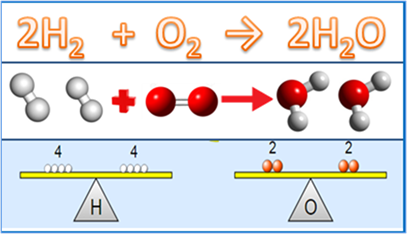
\[\ce{2H2 + O2 -> 2H2O}\nonumber\]
Check again: Now, the atoms of each element are the same on both sides, i.e., the equation is balanced, as illustrated in Fig. 4.3.3.