

11.3: Bases-Properties and Examples
- Page ID
- 521827

\( \newcommand{\vecs}[1]{\overset { \scriptstyle \rightharpoonup} {\mathbf{#1}} } \)
\( \newcommand{\vecd}[1]{\overset{-\!-\!\rightharpoonup}{\vphantom{a}\smash {#1}}} \)
\( \newcommand{\dsum}{\displaystyle\sum\limits} \)
\( \newcommand{\dint}{\displaystyle\int\limits} \)
\( \newcommand{\dlim}{\displaystyle\lim\limits} \)
\( \newcommand{\id}{\mathrm{id}}\) \( \newcommand{\Span}{\mathrm{span}}\)
( \newcommand{\kernel}{\mathrm{null}\,}\) \( \newcommand{\range}{\mathrm{range}\,}\)
\( \newcommand{\RealPart}{\mathrm{Re}}\) \( \newcommand{\ImaginaryPart}{\mathrm{Im}}\)
\( \newcommand{\Argument}{\mathrm{Arg}}\) \( \newcommand{\norm}[1]{\| #1 \|}\)
\( \newcommand{\inner}[2]{\langle #1, #2 \rangle}\)
\( \newcommand{\Span}{\mathrm{span}}\)
\( \newcommand{\id}{\mathrm{id}}\)
\( \newcommand{\Span}{\mathrm{span}}\)
\( \newcommand{\kernel}{\mathrm{null}\,}\)
\( \newcommand{\range}{\mathrm{range}\,}\)
\( \newcommand{\RealPart}{\mathrm{Re}}\)
\( \newcommand{\ImaginaryPart}{\mathrm{Im}}\)
\( \newcommand{\Argument}{\mathrm{Arg}}\)
\( \newcommand{\norm}[1]{\| #1 \|}\)
\( \newcommand{\inner}[2]{\langle #1, #2 \rangle}\)
\( \newcommand{\Span}{\mathrm{span}}\) \( \newcommand{\AA}{\unicode[.8,0]{x212B}}\)
\( \newcommand{\vectorA}[1]{\vec{#1}} % arrow\)
\( \newcommand{\vectorAt}[1]{\vec{\text{#1}}} % arrow\)
\( \newcommand{\vectorB}[1]{\overset { \scriptstyle \rightharpoonup} {\mathbf{#1}} } \)
\( \newcommand{\vectorC}[1]{\textbf{#1}} \)
\( \newcommand{\vectorD}[1]{\overrightarrow{#1}} \)
\( \newcommand{\vectorDt}[1]{\overrightarrow{\text{#1}}} \)
\( \newcommand{\vectE}[1]{\overset{-\!-\!\rightharpoonup}{\vphantom{a}\smash{\mathbf {#1}}}} \)
\( \newcommand{\vecs}[1]{\overset { \scriptstyle \rightharpoonup} {\mathbf{#1}} } \)
\(\newcommand{\longvect}{\overrightarrow}\)
\( \newcommand{\vecd}[1]{\overset{-\!-\!\rightharpoonup}{\vphantom{a}\smash {#1}}} \)
\(\newcommand{\avec}{\mathbf a}\) \(\newcommand{\bvec}{\mathbf b}\) \(\newcommand{\cvec}{\mathbf c}\) \(\newcommand{\dvec}{\mathbf d}\) \(\newcommand{\dtil}{\widetilde{\mathbf d}}\) \(\newcommand{\evec}{\mathbf e}\) \(\newcommand{\fvec}{\mathbf f}\) \(\newcommand{\nvec}{\mathbf n}\) \(\newcommand{\pvec}{\mathbf p}\) \(\newcommand{\qvec}{\mathbf q}\) \(\newcommand{\svec}{\mathbf s}\) \(\newcommand{\tvec}{\mathbf t}\) \(\newcommand{\uvec}{\mathbf u}\) \(\newcommand{\vvec}{\mathbf v}\) \(\newcommand{\wvec}{\mathbf w}\) \(\newcommand{\xvec}{\mathbf x}\) \(\newcommand{\yvec}{\mathbf y}\) \(\newcommand{\zvec}{\mathbf z}\) \(\newcommand{\rvec}{\mathbf r}\) \(\newcommand{\mvec}{\mathbf m}\) \(\newcommand{\zerovec}{\mathbf 0}\) \(\newcommand{\onevec}{\mathbf 1}\) \(\newcommand{\real}{\mathbb R}\) \(\newcommand{\twovec}[2]{\left[\begin{array}{r}#1 \\ #2 \end{array}\right]}\) \(\newcommand{\ctwovec}[2]{\left[\begin{array}{c}#1 \\ #2 \end{array}\right]}\) \(\newcommand{\threevec}[3]{\left[\begin{array}{r}#1 \\ #2 \\ #3 \end{array}\right]}\) \(\newcommand{\cthreevec}[3]{\left[\begin{array}{c}#1 \\ #2 \\ #3 \end{array}\right]}\) \(\newcommand{\fourvec}[4]{\left[\begin{array}{r}#1 \\ #2 \\ #3 \\ #4 \end{array}\right]}\) \(\newcommand{\cfourvec}[4]{\left[\begin{array}{c}#1 \\ #2 \\ #3 \\ #4 \end{array}\right]}\) \(\newcommand{\fivevec}[5]{\left[\begin{array}{r}#1 \\ #2 \\ #3 \\ #4 \\ #5 \\ \end{array}\right]}\) \(\newcommand{\cfivevec}[5]{\left[\begin{array}{c}#1 \\ #2 \\ #3 \\ #4 \\ #5 \\ \end{array}\right]}\) \(\newcommand{\mattwo}[4]{\left[\begin{array}{rr}#1 \amp #2 \\ #3 \amp #4 \\ \end{array}\right]}\) \(\newcommand{\laspan}[1]{\text{Span}\{#1\}}\) \(\newcommand{\bcal}{\cal B}\) \(\newcommand{\ccal}{\cal C}\) \(\newcommand{\scal}{\cal S}\) \(\newcommand{\wcal}{\cal W}\) \(\newcommand{\ecal}{\cal E}\) \(\newcommand{\coords}[2]{\left\{#1\right\}_{#2}}\) \(\newcommand{\gray}[1]{\color{gray}{#1}}\) \(\newcommand{\lgray}[1]{\color{lightgray}{#1}}\) \(\newcommand{\rank}{\operatorname{rank}}\) \(\newcommand{\row}{\text{Row}}\) \(\newcommand{\col}{\text{Col}}\) \(\renewcommand{\row}{\text{Row}}\) \(\newcommand{\nul}{\text{Nul}}\) \(\newcommand{\var}{\text{Var}}\) \(\newcommand{\corr}{\text{corr}}\) \(\newcommand{\len}[1]{\left|#1\right|}\) \(\newcommand{\bbar}{\overline{\bvec}}\) \(\newcommand{\bhat}{\widehat{\bvec}}\) \(\newcommand{\bperp}{\bvec^\perp}\) \(\newcommand{\xhat}{\widehat{\xvec}}\) \(\newcommand{\vhat}{\widehat{\vvec}}\) \(\newcommand{\uhat}{\widehat{\uvec}}\) \(\newcommand{\what}{\widehat{\wvec}}\) \(\newcommand{\Sighat}{\widehat{\Sigma}}\) \(\newcommand{\lt}{<}\) \(\newcommand{\gt}{>}\) \(\newcommand{\amp}{&}\) \(\definecolor{fillinmathshade}{gray}{0.9}\)Learning Objectives
- Examine properties and nomenclature of bases.
Perhaps you have eaten too much pizza and felt very uncomfortable hours later. This feeling is due to excess stomach acid being produced. The discomfort can be dealt with by taking an antacid. The base in the antacid will react with the \(\ce{HCl}\)(aq) in the stomach and neutralize it, taking care of that unpleasant feeling.
Properties of Bases
Bases have properties that mostly contrast with those of acids.
- Aqueous solutions of bases are also electrolytes. Bases can be either strong or weak, just as acids can.
- Bases often have a bitter taste and are found in foods less frequently than acids. Many bases, like soaps, are slippery to the touch.
- Bases also change the color of indicators. Litmus turns blue in the presence of a base while phenolphthalein turns pink. The indicator extracted from purple cabbage can qualitatively determine the pH of household chemicals. In basic solutions, the color of the indicator from the purple cabbage varies from bluish green to yellow.
- Bases react with acids to produce a salt and water.
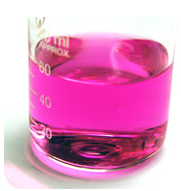
Bases are less common in foods. However, antacids are products which combat excess stomach acid, are comprised of bases such as magnesium hydroxide, or sodium hydrogen carbonate, or calcium carbonate. They are also present in many household cleaning products. Ammonia cleaner is a base. Sodium hydroxide is found in drain cleaner.
Base Strength
Strong Bases completely ionize in water, which can be represented with a single arrow:
\[ \ce{\displaystyle BOH (aq) \longrightarrow OH^{-}(aq) + B^{+} (aq) }\]
The base is represented as BOH. Once it dissociates the OH-, the conjugate base is represented with B+
Weak Bases: Unlike strong bases, which fully dissociate in water, weak bases only partially ionize. This partial ionization means that the nature of the base determines how much it dissociates. The concentrations of hydroxide ions (OH-) are always lower than the initial amount of base. The weak property of the acid is expressed with the double arrow in the dissociation equation.
\[ \ce{\displaystyle BOH (aq) \rightleftharpoons OH^{-}(aq) + B^{+} (aq) }\]
Here's a list of the strong bases and weak bases:
| Strong Bases (Hydroxides from Group 1A and 2A cations) | Weak Bases (a few examples) |
| Sodium hydroxide, NaOH | Ammonia, NH3 |
| Potassium hydroxide, KOH | Sodium carbonate, Na2CO3 |
| Magnesium hydroxide, Mg(OH)2 | Lithium nitrite, LiNO2 |
| Calcium hydroxide, Ca(OH)2 | Sodium chlorite, HClO2 |
Nomenclature and Formulae of Common Bases
Common bases are ionic compounds of polyatomic ions such as hydroxide (OH-), carbonate (CO32-) and bicarbonate (HCO3-) anions.
Group 1A cations such as sodium ion (Na+), potassium ion (K+), or lithium ion (Li+) combine with one hydroxide ion to form an ionic compound which functions as a base. Group 2A cations such as magnesium ion (Mg2+), calcium ion (Ca2+), or barium ion (Ba2+) combine with two hydroxide ions to form an ionic compound that is a base.
Lithium hydroxide LiOH; Potassium hydroxide KOH; Magnesium hydroxide Mg(OH)2; Barium hydroxide Ba(OH)2
The polyatomic anions (example: carbonate; except ClO3- and ClO4-) combines with two group 1A metal cations and one group 2A metal cation to form an ionic compound that functions as a base.
Lithium Carbonate Li2CO3; Sodium Carbonate Na2CO3; Calcium carbonate CaCO3; Magnesium Carbonate MgCO3
The polyatomic anion hydrogencarbonate also called the bicarbonate anion combines with one group 1A metal cations and two group 2A metal cation to form an ionic compound that functions as a base.
Sodium bicarbonate NaHCO3; Potassium bicarbonate KHCO3; Calcium bicarbonate Ca(HCO3)2; Magnesium bicarbonate Mg(HCO3)2
Various common bases and corresponding uses are given in Table \(\PageIndex{1}\).
|
Some Common Bases
|
Uses |
|---|---|
| sodium hydroxide, NaOH (lye or caustic soda) |
Used in the manufacture of soaps and detergents, and as the main ingredient in oven and drain cleaners. |
| potassium hydroxide, KOH (lye or caustic potash) |
Used in the production of liquid soaps and soft soaps. Used in alkaline batteries. |
| magnesium hydroxide, Mg(OH)2 (milk of magnesia) |
Used as an ingredient in laxatives, antacids, and deodorants. Also used in the neutralization of acidic wastewater. |
| calcium hydroxide, Ca(OH)2 (slaked lime) |
Used in the manufacture of cement and lime water. Also, added to neutralize acidic soil. |
| aluminum hydroxide | Used in water purification and as an ingredient in antacids. |
| ammonia, NH3 | Used as a building block for the synthesis of many pharmaceutical products and in many commercial cleaning products. Used in the manufacture of fertilizers. |
Sodium Hydroxide
Sodium hydroxide, also known as lye and caustic soda, is an inorganic compound with formula \(\ce{NaOH}\). It is a white solid ionic compound consisting of sodium cations \(\ce{Na^{+}}\) and hydroxide anions \(\ce{OH^{−}}\).

Dissolution of solid sodium hydroxide in water is a highly exothermic reaction
\[ \ce{ NaOH (s) \rightarrow Na^{+} (aq) + OH^{-} (aq)}\]
The resulting solution is usually colorless and odorless and feels slippery when it comes in contact with skin.
Potassium Hydroxide
Potassium hydroxide is an inorganic compound with the formula \(\ce{KOH}\), and is commonly called caustic potash. Along with sodium hydroxide (NaOH), this colorless solid is a prototypical strong base. It has many industrial and niche applications, most of which exploit its corrosive nature and its reactivity toward acids. Its dissolution in water is strongly exothermic.
\[ \ce{ KOH (s) \rightarrow K^{+} (aq) + OH^{-} (aq)}\]
Concentrated aqueous solutions are sometimes called potassium lyes.
Magnesium Hydroxide
Magnesium hydroxide is the inorganic compound with the chemical formula \(\ce{Mg(OH)2}\). Magnesium hydroxide is a common component of antacids, such as milk of magnesia, as well as laxatives.

It is a white solid with low solubility in water. Combining a solution of many magnesium salts with basic water induces precipitation of solid \(\ce{Mg(OH)2}\). However, a weak concentration of dissociated ions can be found in solution:
\[\ce{Mg(OH)2 (s) \rightleftharpoons Mg^{2+} (aq) + 2 OH^{−}(aq) }\]
Calcium Hydroxide
Calcium hydroxide (traditionally called slaked lime) is an inorganic compound with the chemical formula \(\ce{Ca(OH)2}\). It is a colorless crystal or white powder. It has many names, including hydrated lime, caustic lime, builders' lime, slaked lime, cal, or pickling lime. Calcium hydroxide is used in many applications, including food preparation. Limewater is the common name for a saturated solution of calcium hydroxide.
Calcium hydroxide is relatively insoluble in water, but is large enough that its solutions are basic according to the following reaction:
\[\ce{Ca(OH)2 (s) \rightleftharpoons Ca^{2+}(aq) + 2 OH^{−} (aq)}\]
Ammonia
Ammonia is a compound of nitrogen and hydrogen with the formula \(\ce{NH3}\) and is a colorless gas with a characteristic pungent smell. It is the active product of “smelling salts,” and can quickly revive the faint of heart and light of head. Although common in nature and in wide use, ammonia is both caustic and hazardous in its concentrated form.

In aqueous solution, ammonia acts as a base, acquiring hydrogen ions from \(\ce{H_2O}\) to yield ammonium and hydroxide ions:
\[ \ce{NH3 (g) + H2O (l) \rightleftharpoons NH4^{+} (aq) + OH^{-} (aq)}\]
Ammonia is also a building block for the synthesis of many pharmaceutical products and is used in many commercial cleaning products.
Summary
- A brief summary of the properties of bases was given.
- The properties of bases mostly contrast with those of acids.
Identify each acid or base as strong or weak.
- HCl
- Mg(OH)2
- C5H5N
Solution
- Because HCl is listed in Table \(\PageIndex{1}\), it is a strong acid.
- Because Mg(OH)2 is not listed in Table \(\PageIndex{1}\), it is a weak base.
- The nitrogen in C5H5N would act as a proton acceptor and therefore can be considered a base, but because it does not contain an OH compound, it cannot be considered a strong base; it is a weak base.
Identify each acid or base as strong or weak.
- \(\ce{RbOH}\)
- \(\ce{HNO_2}\)
- Answer a
- strong base
- Answer b
- weak acid