

10.8: Passive Transport - Osmosis
- Page ID
- 521816


\( \newcommand{\vecs}[1]{\overset { \scriptstyle \rightharpoonup} {\mathbf{#1}} } \)
\( \newcommand{\vecd}[1]{\overset{-\!-\!\rightharpoonup}{\vphantom{a}\smash {#1}}} \)
\( \newcommand{\dsum}{\displaystyle\sum\limits} \)
\( \newcommand{\dint}{\displaystyle\int\limits} \)
\( \newcommand{\dlim}{\displaystyle\lim\limits} \)
\( \newcommand{\id}{\mathrm{id}}\) \( \newcommand{\Span}{\mathrm{span}}\)
( \newcommand{\kernel}{\mathrm{null}\,}\) \( \newcommand{\range}{\mathrm{range}\,}\)
\( \newcommand{\RealPart}{\mathrm{Re}}\) \( \newcommand{\ImaginaryPart}{\mathrm{Im}}\)
\( \newcommand{\Argument}{\mathrm{Arg}}\) \( \newcommand{\norm}[1]{\| #1 \|}\)
\( \newcommand{\inner}[2]{\langle #1, #2 \rangle}\)
\( \newcommand{\Span}{\mathrm{span}}\)
\( \newcommand{\id}{\mathrm{id}}\)
\( \newcommand{\Span}{\mathrm{span}}\)
\( \newcommand{\kernel}{\mathrm{null}\,}\)
\( \newcommand{\range}{\mathrm{range}\,}\)
\( \newcommand{\RealPart}{\mathrm{Re}}\)
\( \newcommand{\ImaginaryPart}{\mathrm{Im}}\)
\( \newcommand{\Argument}{\mathrm{Arg}}\)
\( \newcommand{\norm}[1]{\| #1 \|}\)
\( \newcommand{\inner}[2]{\langle #1, #2 \rangle}\)
\( \newcommand{\Span}{\mathrm{span}}\) \( \newcommand{\AA}{\unicode[.8,0]{x212B}}\)
\( \newcommand{\vectorA}[1]{\vec{#1}} % arrow\)
\( \newcommand{\vectorAt}[1]{\vec{\text{#1}}} % arrow\)
\( \newcommand{\vectorB}[1]{\overset { \scriptstyle \rightharpoonup} {\mathbf{#1}} } \)
\( \newcommand{\vectorC}[1]{\textbf{#1}} \)
\( \newcommand{\vectorD}[1]{\overrightarrow{#1}} \)
\( \newcommand{\vectorDt}[1]{\overrightarrow{\text{#1}}} \)
\( \newcommand{\vectE}[1]{\overset{-\!-\!\rightharpoonup}{\vphantom{a}\smash{\mathbf {#1}}}} \)
\( \newcommand{\vecs}[1]{\overset { \scriptstyle \rightharpoonup} {\mathbf{#1}} } \)
\(\newcommand{\longvect}{\overrightarrow}\)
\( \newcommand{\vecd}[1]{\overset{-\!-\!\rightharpoonup}{\vphantom{a}\smash {#1}}} \)
\(\newcommand{\avec}{\mathbf a}\) \(\newcommand{\bvec}{\mathbf b}\) \(\newcommand{\cvec}{\mathbf c}\) \(\newcommand{\dvec}{\mathbf d}\) \(\newcommand{\dtil}{\widetilde{\mathbf d}}\) \(\newcommand{\evec}{\mathbf e}\) \(\newcommand{\fvec}{\mathbf f}\) \(\newcommand{\nvec}{\mathbf n}\) \(\newcommand{\pvec}{\mathbf p}\) \(\newcommand{\qvec}{\mathbf q}\) \(\newcommand{\svec}{\mathbf s}\) \(\newcommand{\tvec}{\mathbf t}\) \(\newcommand{\uvec}{\mathbf u}\) \(\newcommand{\vvec}{\mathbf v}\) \(\newcommand{\wvec}{\mathbf w}\) \(\newcommand{\xvec}{\mathbf x}\) \(\newcommand{\yvec}{\mathbf y}\) \(\newcommand{\zvec}{\mathbf z}\) \(\newcommand{\rvec}{\mathbf r}\) \(\newcommand{\mvec}{\mathbf m}\) \(\newcommand{\zerovec}{\mathbf 0}\) \(\newcommand{\onevec}{\mathbf 1}\) \(\newcommand{\real}{\mathbb R}\) \(\newcommand{\twovec}[2]{\left[\begin{array}{r}#1 \\ #2 \end{array}\right]}\) \(\newcommand{\ctwovec}[2]{\left[\begin{array}{c}#1 \\ #2 \end{array}\right]}\) \(\newcommand{\threevec}[3]{\left[\begin{array}{r}#1 \\ #2 \\ #3 \end{array}\right]}\) \(\newcommand{\cthreevec}[3]{\left[\begin{array}{c}#1 \\ #2 \\ #3 \end{array}\right]}\) \(\newcommand{\fourvec}[4]{\left[\begin{array}{r}#1 \\ #2 \\ #3 \\ #4 \end{array}\right]}\) \(\newcommand{\cfourvec}[4]{\left[\begin{array}{c}#1 \\ #2 \\ #3 \\ #4 \end{array}\right]}\) \(\newcommand{\fivevec}[5]{\left[\begin{array}{r}#1 \\ #2 \\ #3 \\ #4 \\ #5 \\ \end{array}\right]}\) \(\newcommand{\cfivevec}[5]{\left[\begin{array}{c}#1 \\ #2 \\ #3 \\ #4 \\ #5 \\ \end{array}\right]}\) \(\newcommand{\mattwo}[4]{\left[\begin{array}{rr}#1 \amp #2 \\ #3 \amp #4 \\ \end{array}\right]}\) \(\newcommand{\laspan}[1]{\text{Span}\{#1\}}\) \(\newcommand{\bcal}{\cal B}\) \(\newcommand{\ccal}{\cal C}\) \(\newcommand{\scal}{\cal S}\) \(\newcommand{\wcal}{\cal W}\) \(\newcommand{\ecal}{\cal E}\) \(\newcommand{\coords}[2]{\left\{#1\right\}_{#2}}\) \(\newcommand{\gray}[1]{\color{gray}{#1}}\) \(\newcommand{\lgray}[1]{\color{lightgray}{#1}}\) \(\newcommand{\rank}{\operatorname{rank}}\) \(\newcommand{\row}{\text{Row}}\) \(\newcommand{\col}{\text{Col}}\) \(\renewcommand{\row}{\text{Row}}\) \(\newcommand{\nul}{\text{Nul}}\) \(\newcommand{\var}{\text{Var}}\) \(\newcommand{\corr}{\text{corr}}\) \(\newcommand{\len}[1]{\left|#1\right|}\) \(\newcommand{\bbar}{\overline{\bvec}}\) \(\newcommand{\bhat}{\widehat{\bvec}}\) \(\newcommand{\bperp}{\bvec^\perp}\) \(\newcommand{\xhat}{\widehat{\xvec}}\) \(\newcommand{\vhat}{\widehat{\vvec}}\) \(\newcommand{\uhat}{\widehat{\uvec}}\) \(\newcommand{\what}{\widehat{\wvec}}\) \(\newcommand{\Sighat}{\widehat{\Sigma}}\) \(\newcommand{\lt}{<}\) \(\newcommand{\gt}{>}\) \(\newcommand{\amp}{&}\) \(\definecolor{fillinmathshade}{gray}{0.9}\)- Define osmosis and diffusion.
- Distinguish among hypotonic, hypertonic, and isotonic solutions and predict the behavior of blood cells in different solution types.
- Describe the process of osmosis and explain how the concentration gradient affects osmosis.
Osmosis and Semipermeable Membranes
Osmosis is the movement of water through a semipermeable membrane according to the concentration gradient of water across the membrane, which is inversely proportional to the concentration of solutes. Semipermeable membranes, also termed selectively permeable membranes or partially permeable membranes, allow certain molecules or ions to pass through by diffusion.
While diffusion transports materials across membranes and within cells, osmosis transports only water across a membrane. The semipermeable membrane limits the diffusion of solutes in the water. Not surprisingly, the aquaporin proteins that facilitate water movement play a large role in osmosis, most prominently in red blood cells and the membranes of kidney tubules.
Mechanism of Osmosis
Osmosis is a special case of diffusion. Water, like other substances, moves from an area of high concentration to one of low concentration. An obvious question is what makes water move at all? Imagine a beaker with a semipermeable membrane separating the two sides or halves. On both sides of the membrane the water level is the same, but there are different concentrations of a dissolved substance, or solute, that cannot cross the membrane (otherwise the concentrations on each side would be balanced by the solute crossing the membrane). If the volume of the solution on both sides of the membrane is the same but the concentrations of solute are different, then there are different amounts of water, the solvent, on either side of the membrane. If there is more solute in one area, then there is less water; if there is less solute in one area, then there must be more water.
To illustrate this, imagine two full glasses of water. One has a single teaspoon of sugar in it, whereas the second one contains one-quarter cup of sugar. If the total volume of the solutions in both cups is the same, which cup contains more water? Because the large amount of sugar in the second cup takes up much more space than the teaspoon of sugar in the first cup, the first cup has more water in it.

Returning to the beaker example, recall that it has a mixture of solutes on either side of the membrane. A principle of diffusion is that the molecules move around and will spread evenly throughout the medium if they can. However, only the material capable of passing through the membrane will diffuse through it. In this example, the solute cannot diffuse through the membrane, but the water can. Water has a concentration gradient in this system. Thus, water will diffuse down its concentration gradient, crossing the membrane to the side where it is less concentrated. This diffusion of water through the membrane—osmosis—will continue until the concentration gradient of water goes to zero or until the hydrostatic pressure of the water balances the osmotic pressure. In the beaker example, this means that the level of fluid in the side with a higher solute concentration will go up.
Osmosis in Blood Cells
Imagine you have a cup that has \(100 \: \text{mL}\) water, and you add \(15 \: \text{g}\) of table sugar to the water. The sugar dissolves and the mixture that is now in the cup is made up of a solute (the sugar) that is dissolved in the solvent (the water). The mixture of a solute in a solvent is called a solution.
Imagine now that you have a second cup with \(100 \: \text{mL}\) of water, and you add \(45 \: \text{g}\) of table sugar to the water. Just like the first cup, the sugar is the solute, and the water is the solvent. But now you have two mixtures of different solute concentrations. In comparing two solutions of unequal solute concentration, the solution with the higher solute concentration is hypertonic, and the solution with the lower solute concentration is hypotonic. Solutions of equal solute concentration are isotonic. The first sugar solution is hypotonic to the second solution. The second sugar solution is hypertonic to the first.
You now add the two solutions to a beaker that has been divided by a semipermeable membrane. A semipermeable membrane has pores that are too small for the sugar molecules to pass through, but are big enough for the water molecules to pass through. The hypertonic solution is on one side of the membrane and the hypotonic solution is on the other. The hypertonic solution has a lower water concentration than the hypotonic solution, so a concentration gradient of water now exists across the membrane. Water molecules will move from the side of higher water concentration to the side of lower concentration until both solutions are isotonic. At this point, equilibrium is reached.
Red blood cells behave the same way (see figure below). When red blood cells are in a hypertonic (higher concentration) solution, water flows out of the cell faster than it comes in. This results in crenation (shriveling) of the blood cell. On the other extreme, a red blood cell that is hypotonic (lower concentration outside the cell) will result in more water flowing into the cell than out. This results in swelling of the cell called hemolysis and potential (bursting) of the cell. In an isotonic solution, the flow of water in and out of the cell is happening at the same rate.
Two common isotonic solutions used in health care are 5.5 %(w/v) glucose solution and 0.95 %(w/v). In isotonic solutions the cells maintain their healthy state and do not undergo crenation or hemolysis.
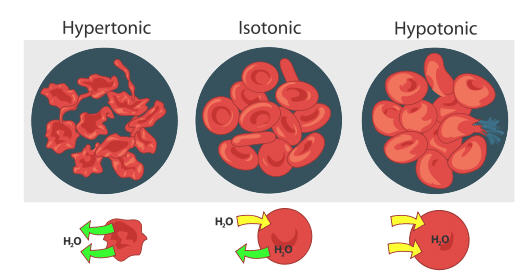
Osmosis is the diffusion of water molecules across a semipermeable membrane from an area of lower concentration of solute (i.e., higher concentration of water) to an area of higher concentration of solute (i.e., lower concentration of water). Water moves into and out of cells by osmosis.
- If a cell is in a hypertonic solution, the solution has a lower water concentration than the cell cytosol, and water moves out of the cell until both solutions are isotonic.
- Cells placed in a hypotonic solution will take in water across their membranes until both the external solution and the cytosol are isotonic.
A red blood cell will swell and undergo hemolysis (burst) when placed in a hypotonic solution. When placed in a hypertonic solution, a red blood cell will lose water and undergo crenation (shrivel). Animal cells tend to do best in an isotonic environment, where the flow of water in and out of the cell is occurring at equal rates.
Dialysis
As introduced in a previous section, osmosis is the process by which solvent particles can pass through a semipermeable membrane. Dialysis is similar to osmosis with the difference being that the pores in the semipermeable membranes are larger, thus allowing both solvent and small solute molecules to pass through. Larger solute particles, such as colloids and proteins, that cannot pass through the pores in the membrane are left behind. The size of the pores in the semipermeable membranes can be varied to allow for separation (or purification) of specific solute molecules from a solution based on their size. Biochemists and molecular biologists use dialysis to purify proteins from mixtures or to change the concentration of solute particles for different types of experiments,
The main function of the kidneys is to filter the blood to remove wastes and extra water, which are then expelled from the body as urine. Some diseases rob the kidneys of their ability to perform this function, causing a buildup of waste materials in the bloodstream. If a kidney transplant is not available or desirable, a procedure called dialysis can be used to remove waste materials and excess water from the blood.
In one form of dialysis, called hemodialysis, a patient’s blood is passed through a length of tubing that travels through an artificial kidney machine (also called a dialysis machine). A section of tubing composed of a semipermeable membrane is immersed in a solution of sterile water, glucose, amino acids, and certain electrolytes. The osmotic pressure of the blood forces waste molecules and excess water through the membrane into the sterile solution. Red and white blood cells are too large to pass through the membrane, so they remain in the blood. After being cleansed in this way, the blood is returned to the body.
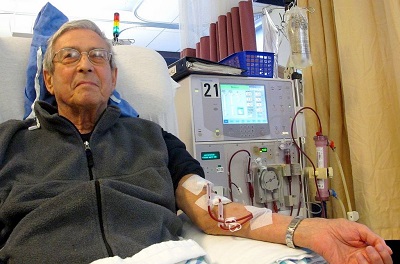
Dialysis is a continuous process, as the osmosis of waste materials and excess water takes time. Typically, 5–10 lb of waste-containing fluid is removed in each dialysis session, which can last 2–8 hours and must be performed several times a week. Although some patients have been on dialysis for 30 or more years, dialysis is always a temporary solution because waste materials are constantly building up in the bloodstream. A more permanent solution is a kidney transplant.
Cell walls are semipermeable membranes, so the osmotic pressures of the body’s fluids have important biological consequences. If solutions of different osmolarity exist on either side of the cells, solvent (water) may pass into or out of the cells, sometimes with disastrous results. Consider what happens if red blood cells are placed in a hypotonic solution, meaning a solution of lower osmolarity than the liquid inside the cells. The cells swell up as water enters them, disrupting cellular activity and eventually causing the cells to burst. This process is called hemolysis. If red blood cells are placed in a hypertonic solution, meaning one having a higher osmolarity than exists inside the cells, water leaves the cells to dilute the external solution, and the red blood cells shrivel and die. This process is called crenation. Only if red blood cells are placed in isotonic solutions that have the same osmolarity as exists inside the cells are they unaffected by negative effects of osmotic pressure. Glucose solutions of about 0.31 M, or sodium chloride solutions of about 0.16 M, are isotonic with blood plasma.
The concentration of an isotonic sodium chloride (NaCl) solution is only half that of an isotonic glucose (C6H12O6) solution because NaCl produces two ions when a formula unit dissolves, while molecular C6H12O6 produces only one particle when a formula unit dissolves. The osmolarities are therefore the same even though the concentrations of the two solutions are different.
Osmotic pressure explains why you should not drink seawater if you are abandoned in a life raft in the middle of the ocean. Its osmolarity is about three times higher than most bodily fluids. You would actually become thirstier as water from your cells was drawn out to dilute the salty ocean water you ingested. Our bodies do a better job coping with hypotonic solutions than with hypertonic ones. The excess water is collected by our kidneys and excreted.
Osmotic pressure effects are used in the food industry to make pickles from cucumbers and other vegetables and in brining meat to make corned beef. It is also a factor in the mechanism of getting water from the roots to the tops of trees!
A perfusionist is a medical technician trained to assist during any medical procedure in which a patient’s circulatory or breathing functions require support. The use of perfusionists has grown rapidly since the advent of open-heart surgery in 1953.
Most perfusionists work in operating rooms, where their main responsibility is to operate heart-lung machines. During many heart surgeries, the heart itself must be stopped. In these situations, a heart-lung machine keeps the patient alive by aerating the blood with oxygen and removing carbon dioxide. The perfusionist monitors both the machine and the status of the blood, notifying the surgeon and the anesthetist of any concerns and taking corrective action if the status of the blood becomes abnormal.
Despite the narrow parameters of their specialty, perfusionists must be highly trained. Certified perfusion education programs require a student to learn anatomy, physiology, pathology, chemistry, pharmacology, math, and physics. A college degree is usually required. Some perfusionists work with other external artificial organs, such as hemodialysis machines and artificial livers.
Key Points
- Osmosis occurs according to the concentration gradient of water across the membrane, which is inversely proportional to the concentration of solutes.
- Osmosis occurs until the concentration gradient of water goes to zero or until the hydrostatic pressure of the water balances the osmotic pressure.
- Osmosis occurs when there is a concentration gradient of a solute within a solution, but the membrane does not allow diffusion of the solute.
Key Terms
- solute: Any substance that is dissolved in a liquid solvent to create a solution
- osmosis: The net movement of solvent molecules from a region of high solvent potential to a region of lower solvent potential through a partially permeable membrane
- semipermeable membrane: A type of biological membrane that will allow certain molecules or ions to pass through it by diffusion and occasionally by specialized facilitated diffusion