

6.5: Measures of Concentration
- Page ID
- 538671

\( \newcommand{\vecs}[1]{\overset { \scriptstyle \rightharpoonup} {\mathbf{#1}} } \)
\( \newcommand{\vecd}[1]{\overset{-\!-\!\rightharpoonup}{\vphantom{a}\smash {#1}}} \)
\( \newcommand{\dsum}{\displaystyle\sum\limits} \)
\( \newcommand{\dint}{\displaystyle\int\limits} \)
\( \newcommand{\dlim}{\displaystyle\lim\limits} \)
\( \newcommand{\id}{\mathrm{id}}\) \( \newcommand{\Span}{\mathrm{span}}\)
( \newcommand{\kernel}{\mathrm{null}\,}\) \( \newcommand{\range}{\mathrm{range}\,}\)
\( \newcommand{\RealPart}{\mathrm{Re}}\) \( \newcommand{\ImaginaryPart}{\mathrm{Im}}\)
\( \newcommand{\Argument}{\mathrm{Arg}}\) \( \newcommand{\norm}[1]{\| #1 \|}\)
\( \newcommand{\inner}[2]{\langle #1, #2 \rangle}\)
\( \newcommand{\Span}{\mathrm{span}}\)
\( \newcommand{\id}{\mathrm{id}}\)
\( \newcommand{\Span}{\mathrm{span}}\)
\( \newcommand{\kernel}{\mathrm{null}\,}\)
\( \newcommand{\range}{\mathrm{range}\,}\)
\( \newcommand{\RealPart}{\mathrm{Re}}\)
\( \newcommand{\ImaginaryPart}{\mathrm{Im}}\)
\( \newcommand{\Argument}{\mathrm{Arg}}\)
\( \newcommand{\norm}[1]{\| #1 \|}\)
\( \newcommand{\inner}[2]{\langle #1, #2 \rangle}\)
\( \newcommand{\Span}{\mathrm{span}}\) \( \newcommand{\AA}{\unicode[.8,0]{x212B}}\)
\( \newcommand{\vectorA}[1]{\vec{#1}} % arrow\)
\( \newcommand{\vectorAt}[1]{\vec{\text{#1}}} % arrow\)
\( \newcommand{\vectorB}[1]{\overset { \scriptstyle \rightharpoonup} {\mathbf{#1}} } \)
\( \newcommand{\vectorC}[1]{\textbf{#1}} \)
\( \newcommand{\vectorD}[1]{\overrightarrow{#1}} \)
\( \newcommand{\vectorDt}[1]{\overrightarrow{\text{#1}}} \)
\( \newcommand{\vectE}[1]{\overset{-\!-\!\rightharpoonup}{\vphantom{a}\smash{\mathbf {#1}}}} \)
\( \newcommand{\vecs}[1]{\overset { \scriptstyle \rightharpoonup} {\mathbf{#1}} } \)
\(\newcommand{\longvect}{\overrightarrow}\)
\( \newcommand{\vecd}[1]{\overset{-\!-\!\rightharpoonup}{\vphantom{a}\smash {#1}}} \)
\(\newcommand{\ket}[1]{\left| #1 \right>}\)
\(\newcommand{\bra}[1]{\left< #1 \right|}\)
\(\newcommand{\braket}[2]{\left< #1 \vphantom{#2} \right| \left. #2 \vphantom{#1} \right>}\)
\(\newcommand{\braopket}[3]{\left< #1 \vphantom{#2}\vphantom{#3} \right| #2 \vphantom{#1}\vphantom{#3} \left| #3 \vphantom{#1}\vphantom{#2} \right>}\)
\(\newcommand{\qmvec}[1]{\mathbf{\vec{#1}}}\)
\(\newcommand{\op}[1]{\hat{\mathbf{#1}}}\)
\(\newcommand{\expect}[1]{\langle #1 \rangle}\)
\(\newcommand{\dfn}[1]{\emph{\textbf{#1}}}\)
- Understand what is meant by the term solution concentration.
To define a solution precisely, we need to state its concentration: how much solute is dissolved in a certain amount of solvent. Words such as dilute or concentrated are used to describe solutions that have a little or a lot of dissolved solute, respectively, but these are relative terms with meanings that depend on various factors.
Concentration is the measure of how much of a given substance is mixed with another substance. Solutions are said to be either dilute or concentrated. When we say that vinegar is \(5\%\) acetic acid in water, we are giving the concentration. If we said the mixture was \(10\%\) acetic acid, this would be more concentrated than the vinegar solution.
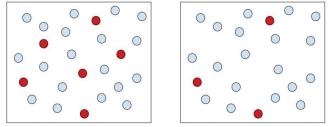
A concentrated solution is one in which there is a large amount of solute in a given amount of solvent. A dilute solution is one in which there is a small amount of solute in a given amount of solvent. A dilute solution is a concentrated solution that has been, in essence, watered down. Think of the frozen juice containers you buy in the grocery store. To make juice, you have to mix the frozen juice concentrate from inside these containers with three or four times the container size full of water. Therefore, you are diluting the concentrated juice. In terms of solute and solvent, the concentrated solution has a lot of solute versus the dilute solution that would have a smaller amount of solute.
The terms "concentrated" and "dilute" are too vague to be very useful to scientists. Some of the more useful ways of quantifying solution concentration will be shown below.
Quantitative Measures of Solution Concentration
Chemists use very many measures of concentration. They include Molarity, molality, normality, mass percent, parts per million, mole fraction, and more. In this section, we will focus only on those most commonly encountered in society outside of the chemistry classroom.
Percent Solutions
One way to describe the concentration of a solution is by the percent of a solute in the solvent. The percent can further be determined in one of two ways: (1) the ratio of the mass of the solute divided by the mass of the solution or (2) the ratio of the volume of the solute divided by the volume of the solution.
\[\text{Percent} = \frac{\text{solute}}{\text{total solution}} \times 100\%\nonumber \]
This can be calculated using masses of solute and solution, volumes, or a mixture of the two. To see how this works out, let's use the following solution information for a bottle of Cabernet Sauvignon. Alcoholic beverages are a solution made of mixing water (solvent) with ethanol (solute).

Mass Percent
One convenient way to express the concentration is by mass percent \(\left( \frac{\text{mass}}{\text{mass}} \right)\), which is the grams of solute per \(100 \: \text{g}\) of solution.
\[\text{Percent by mass} = \frac{\text{mass of solute}}{\text{mass of solution}} \times 100\%\nonumber \]
Using the above masses: \(83.6 \: \text{g}\) of ethanol (solute) was dissolved in \(642 \: \text{g}\) of water (solvent) for a total solution mass of \(726 \: \text{g}\). The percent by mass would be calculated by:
\[\text{Percent by mass} = \frac{83.6 \: \text{g ethanol}}{726 \: \text{g solution}} \times 100\% = 11.5\% \: \text{ethanol}\nonumber \]
Volume Percent
Another convenient way to express the concentration that is most often used for wine is by volume percent \(\left( \frac{\text{volume}}{\text{volume}} \right)\), which could be calculated as mL of solute per \(100 \: \text{mL}\) of solution.
\[\text{Percent by Volume} = \frac{\text{volume of solute}}{\text{volume of solution}} \times 100\%\nonumber \]
Using the above volumes: \(106 \: \text{mL}\) of ethanol (solute) was dissolved in \(644 \: \text{mL}\) of water (solvent) for a total solution volume of \(750 \: \text{mL}\). The percent by mass would be calculated by:
\[\text{Percent by volume} = \frac{106 \: \text{mL ethanol}}{750 \: \text{mL solution}} \times 100\% = 14.1\% \: \text{ethanol}\nonumber \]
Mass / Volume Percent
A final method of calculating percentages, which is very common dealing with environmental or drinking water contaminants (like lead or arsenic) is to take the ratio of the mass of solute to the volume of solution. For a percentage, this is calculated as follows. \(\left( \frac{\text{mass}}{\text{volume}} \right)\), which could be calculated as grams of solute per \(100 \: \text{mL}\) of solution.
\[\text{Percent Mass / Volume} = \frac{\text{mass of solute}}{\text{volume of solution}} \times 100\%\nonumber \]
Using the above quantities: \(83.6 \: \text{g}\) of ethanol (solute) was dissolved in \(644 \: \text{mL}\) of water (solvent) for a total solution volume of \(750 \: \text{mL}\). The percent by mass would be calculated by:
\[\text{Percent mass / volume} = \frac{83.6 \: \text{g ethanol}}{750 \: \text{mL solution}} \times 100\% = 11.1\%(m/v) \: \text{ethanol}\nonumber \]
Parts Per ...
Perhaps you have heard the terms "Parts Per Million" or "Parts Per Billion". These units are calculated exactly as above, but instead of the percentage, which multiplies by one hundred (100), the multiplier is one million (1,000,000) or one billion (1,000,000,000).
So, for parts Parts Per Million (ppm) by mass, it would look like this...
\[\text{ppm by mass} = \frac{\text{mass of solute}}{\text{mass of solution}} \times 1,000,000\nonumber \]
\[\text{ppm by mass} = \frac{83.6 \: \text{g ethanol}}{726 \: \text{g solution}} \times 1,000,000 = 115,000 \: \text{ppm ethanol}\nonumber \]
and for Parts Per Billion (ppb) by mass, it would look like this...
\[\text{ppb by mass} = \frac{\text{mass of solute}}{\text{mass of solution}} \times 1,000,000,000\nonumber \]
\[\text{ppb by mass} = \frac{83.6 \: \text{g ethanol}}{726 \: \text{g solution}} \times 1,000,000,000 = 115,000,000 \: \text{ppb ethanol}\nonumber \]
PPM and PPB look a little weird when used to calculate alcohol percentages in wine, but for things that we need to measure and control in extremely small quantities, these units can ve very helpful. For example, in the United States, the Maximum Contaminant Limit for some contaminants in drinking water are shown below.
Lead: 10 ppb (m/v)
Arsenic: 10 ppb (m/v)
Mercury: 2 ppb (m/v)
Nitrate: 10 ppm (m/v)
A 50.0 g NaCl is dissolved in 450. g of water to make a 500. g solution. What is the percentage of NaCl in the solution?
Solution
Given part = 50.0 g NaCl, and total = 500 g solution. Desired: %NaCl in the solution?
Formula: \(\text { Percentage }(\%)=\frac{\text { part }}{\text { Total }} \times 100 \text {. }\nonumber\)
Calculations: \(\text { Percentage }(\%)=\frac{50.0 \cancel{\mathrm{~g}}}{500 \cancel{\mathrm{~g}}} \times 100=10.0 ~\% \mathrm{NaCl}\)
Contributors and Attributions
Henry Agnew (UC Davis)