

5.4: Oxidation and Reduction
- Page ID
- 538662

\( \newcommand{\vecs}[1]{\overset { \scriptstyle \rightharpoonup} {\mathbf{#1}} } \)
\( \newcommand{\vecd}[1]{\overset{-\!-\!\rightharpoonup}{\vphantom{a}\smash {#1}}} \)
\( \newcommand{\dsum}{\displaystyle\sum\limits} \)
\( \newcommand{\dint}{\displaystyle\int\limits} \)
\( \newcommand{\dlim}{\displaystyle\lim\limits} \)
\( \newcommand{\id}{\mathrm{id}}\) \( \newcommand{\Span}{\mathrm{span}}\)
( \newcommand{\kernel}{\mathrm{null}\,}\) \( \newcommand{\range}{\mathrm{range}\,}\)
\( \newcommand{\RealPart}{\mathrm{Re}}\) \( \newcommand{\ImaginaryPart}{\mathrm{Im}}\)
\( \newcommand{\Argument}{\mathrm{Arg}}\) \( \newcommand{\norm}[1]{\| #1 \|}\)
\( \newcommand{\inner}[2]{\langle #1, #2 \rangle}\)
\( \newcommand{\Span}{\mathrm{span}}\)
\( \newcommand{\id}{\mathrm{id}}\)
\( \newcommand{\Span}{\mathrm{span}}\)
\( \newcommand{\kernel}{\mathrm{null}\,}\)
\( \newcommand{\range}{\mathrm{range}\,}\)
\( \newcommand{\RealPart}{\mathrm{Re}}\)
\( \newcommand{\ImaginaryPart}{\mathrm{Im}}\)
\( \newcommand{\Argument}{\mathrm{Arg}}\)
\( \newcommand{\norm}[1]{\| #1 \|}\)
\( \newcommand{\inner}[2]{\langle #1, #2 \rangle}\)
\( \newcommand{\Span}{\mathrm{span}}\) \( \newcommand{\AA}{\unicode[.8,0]{x212B}}\)
\( \newcommand{\vectorA}[1]{\vec{#1}} % arrow\)
\( \newcommand{\vectorAt}[1]{\vec{\text{#1}}} % arrow\)
\( \newcommand{\vectorB}[1]{\overset { \scriptstyle \rightharpoonup} {\mathbf{#1}} } \)
\( \newcommand{\vectorC}[1]{\textbf{#1}} \)
\( \newcommand{\vectorD}[1]{\overrightarrow{#1}} \)
\( \newcommand{\vectorDt}[1]{\overrightarrow{\text{#1}}} \)
\( \newcommand{\vectE}[1]{\overset{-\!-\!\rightharpoonup}{\vphantom{a}\smash{\mathbf {#1}}}} \)
\( \newcommand{\vecs}[1]{\overset { \scriptstyle \rightharpoonup} {\mathbf{#1}} } \)
\(\newcommand{\longvect}{\overrightarrow}\)
\( \newcommand{\vecd}[1]{\overset{-\!-\!\rightharpoonup}{\vphantom{a}\smash {#1}}} \)
\(\newcommand{\ket}[1]{\left| #1 \right>}\)
\(\newcommand{\bra}[1]{\left< #1 \right|}\)
\(\newcommand{\braket}[2]{\left< #1 \vphantom{#2} \right| \left. #2 \vphantom{#1} \right>}\)
\(\newcommand{\braopket}[3]{\left< #1 \vphantom{#2}\vphantom{#3} \right| #2 \vphantom{#1}\vphantom{#3} \left| #3 \vphantom{#1}\vphantom{#2} \right>}\)
\(\newcommand{\qmvec}[1]{\mathbf{\vec{#1}}}\)
\(\newcommand{\op}[1]{\hat{\mathbf{#1}}}\)
\(\newcommand{\expect}[1]{\langle #1 \rangle}\)
\(\newcommand{\dfn}[1]{\emph{\textbf{#1}}}\)
"Redox" is short for "oxidation and reduction", two complimentary types of chemical reactions. The term oxidation originally referred to substances combining with oxygen, as happens when an iron bar rusts or a campfire log burns. We often refer to these two examples as corrosion and combustion. Reduction originally referred to the process of converting metal ores to pure metals, a process that is accompanied by a reduction in the mass of the ore.
These two terms have broader meanings now. In all oxidation-reduction reactions, an exchange of electrons occurs—one substance loses electrons while another gains them. That is the key to understanding redox reactions. We'll define these terms below.
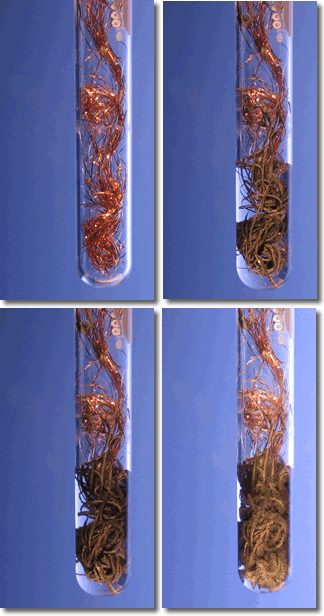
A simple demonstration of a redox reaction involves placing a solid piece of copper wire in a silver nitrate solution. Within minutes, the wire begins to look fuzzy or furry as small silver crystals begin to form on the wire. Meanwhile, the originally clear silver nitrate solution begins to take on a pale bluish tint (from the copper ions dissolving). Furthermore, if the crystals are shaken off of the wire, we see that the wire partially disintegrated.
The overall equation for our demonstration describes the events:
\[\ce{Cu(s) + 2AgNO3(aq) → Cu(NO3)2 (aq) + 2 Ag(s)}\]
When Ionic Compounds are dissolved in water, the compounds separate into their individual ions. Showing these compounds as separate ions (as they truly are) will allow us to see more details of what is happening. (Note: The "(aq)" after many of the substances indicates that it is "aqueous" or "dissolved in water".)
\[\ce{Cu(s) + 2Ag^{+}(aq) + 2NO^{-}3(aq) → Cu^{2+}(aq) + 2NO^{-}3(aq) + 2Ag(s)}\]
We can now see a bit more clearly what changes are occurring with this reaction.
Oxidation of Copper Metal to Make Copper Ions
Copper began as a neutral atom with no charge, but changed into an ion with a charge of +2. An atom becomes a positive ion by losing electrons:
\[\ce{Cu(s) → Cu^{2+}(aq) + 2e^{-}} \label{oxeq} \]
Notice that copper began as a solid, but is converted into aqueous ions—this is why the copper wire disintegrates. We say that copper was oxidized because it has lost electrons (i.e., electrons appear on the product side of the Equation \(\ref{oxeq}\)).
Reduction of Silver Ions to Make Silver Metal
Silver was converted from an ion with a charge of +1, Ag+, to a neutral atom, Ag. The only way an ion can undergo this change is to gain an electron:
\[\ce{Ag^{+}(aq) + e^{-} → Ag(s)} \label{redeq}\]
Notice that solid silver is formed—this is what causes the fuzzy appearance to begin appearing on the wire—solid silver crystals. Silver has gained electrons, it has been reduced (i.e., electrons appear on the reactant side of Equation \(\ref{redeq}\)).
The electrons that silver gained had to come from somewhere—they came from copper. Conversely, a substance such as copper can only lose electrons if there is something else that will take them up, the silver ions. One cannot occur without the other. This exchange of electrons is what defines an oxidation-reduction reaction.
Oxidation is the loss of electrons. (The element's charge is increased.)
Reduction is the gain of electrons. (The element's charge is reduced.)
You will be learning several new terms in this chapter and it is important that you learn them very quickly. You may find it useful to have some tricks to help you remember these terms, including the LEO/GER.
- LEO: Loss of Electrons is Oxidation.
- GER: Gain of Electrons is Reduction.

Combustion
Combustion is a special category of oxidation-reduction reactions where one of the reactants is oxygen (O₂). These reactions are so common because oxygen is a reactive molecules that is nearly always present on earth as it is one of the major components of earth's atomosphere.
The air around us is composed of atoms and molecules just like all other matter.
"Dry Air" contains approximately*:
78% Nitrogen (N₂)
21% Oxygen (O₂)
1% Argon (Ar)
0.04% Carbon Dioxide (CO₂)
* The amount of water (H₂O) vapor in air varies by location and time of day, but is generally between 1% and 4% of the total molecules in air. Because it varies throughout the day, it is excluded from the above percentages.
One of the most common and important types of combustion reactions is when molecular compounds containing carbon, hydrogen, and sometimes oxygen burn in air. An example of these reactions is shown described below. (The molecule CH₄ is the main component of natural gas.)
Generic Equation:
\[Hydrocarbon + Oxygen \rightarrow Carbon~Dioxide + Water\]
Reaction:
\[Natural~Gas + Oxygen \rightarrow Carbon~Dioxide + Water\]
Chemical Equation:
\[\mathrm{CH}_{4}(\mathrm{g})+\mathrm{2O}_{2}(\mathrm{g}) \rightarrow \mathrm{CO}_{2}(\mathrm{g})+\mathrm{2H}_{2} \mathrm{O}(\mathrm{g}) \]
The reaction that powers our bodies is very similar. It is controlled within our bodies systems, but it is still a reaction between sugars (like glucose, C₆H₁₂O₆) and oxygen from the air we breathe.
Reaction:
\[Glucose + Oxygen \rightarrow Carbon~Dioxide + Water\]
Chemical Equation:
\[\mathrm{C}_{6}{H}_{12}{O}_{6}({\mathrm{g}})+\mathrm{6O}_{2}(\mathrm{g}) \rightarrow \mathrm{6CO}_{2}(\mathrm{g})+\mathrm{6H}_{2} \mathrm{O}(\mathrm{g}) \]
What happens when something doesn't completely burn?
It is impossible to write a single chemical reaction to describe "incomplete combustion", but it is a very important topic.
In addition to the usual products of carbon dioxide and water, other compounds will form. These include
Carbon Monoxide (CO)
Hydrocarbon Fragments \(\ce{C_xH_yO_z}\) *
*These will often be reactive, incomplete molecules that react further in air to produce some of the worst components of smog. (More on this later.)