

The Harmful Consequences of Nuclear Disasters in Environmental and Green Chemistry
- Page ID
- 418910
\( \newcommand{\vecs}[1]{\overset { \scriptstyle \rightharpoonup} {\mathbf{#1}} } \)
\( \newcommand{\vecd}[1]{\overset{-\!-\!\rightharpoonup}{\vphantom{a}\smash {#1}}} \)
\( \newcommand{\dsum}{\displaystyle\sum\limits} \)
\( \newcommand{\dint}{\displaystyle\int\limits} \)
\( \newcommand{\dlim}{\displaystyle\lim\limits} \)
\( \newcommand{\id}{\mathrm{id}}\) \( \newcommand{\Span}{\mathrm{span}}\)
( \newcommand{\kernel}{\mathrm{null}\,}\) \( \newcommand{\range}{\mathrm{range}\,}\)
\( \newcommand{\RealPart}{\mathrm{Re}}\) \( \newcommand{\ImaginaryPart}{\mathrm{Im}}\)
\( \newcommand{\Argument}{\mathrm{Arg}}\) \( \newcommand{\norm}[1]{\| #1 \|}\)
\( \newcommand{\inner}[2]{\langle #1, #2 \rangle}\)
\( \newcommand{\Span}{\mathrm{span}}\)
\( \newcommand{\id}{\mathrm{id}}\)
\( \newcommand{\Span}{\mathrm{span}}\)
\( \newcommand{\kernel}{\mathrm{null}\,}\)
\( \newcommand{\range}{\mathrm{range}\,}\)
\( \newcommand{\RealPart}{\mathrm{Re}}\)
\( \newcommand{\ImaginaryPart}{\mathrm{Im}}\)
\( \newcommand{\Argument}{\mathrm{Arg}}\)
\( \newcommand{\norm}[1]{\| #1 \|}\)
\( \newcommand{\inner}[2]{\langle #1, #2 \rangle}\)
\( \newcommand{\Span}{\mathrm{span}}\) \( \newcommand{\AA}{\unicode[.8,0]{x212B}}\)
\( \newcommand{\vectorA}[1]{\vec{#1}} % arrow\)
\( \newcommand{\vectorAt}[1]{\vec{\text{#1}}} % arrow\)
\( \newcommand{\vectorB}[1]{\overset { \scriptstyle \rightharpoonup} {\mathbf{#1}} } \)
\( \newcommand{\vectorC}[1]{\textbf{#1}} \)
\( \newcommand{\vectorD}[1]{\overrightarrow{#1}} \)
\( \newcommand{\vectorDt}[1]{\overrightarrow{\text{#1}}} \)
\( \newcommand{\vectE}[1]{\overset{-\!-\!\rightharpoonup}{\vphantom{a}\smash{\mathbf {#1}}}} \)
\( \newcommand{\vecs}[1]{\overset { \scriptstyle \rightharpoonup} {\mathbf{#1}} } \)
\(\newcommand{\longvect}{\overrightarrow}\)
\( \newcommand{\vecd}[1]{\overset{-\!-\!\rightharpoonup}{\vphantom{a}\smash {#1}}} \)
\(\newcommand{\avec}{\mathbf a}\) \(\newcommand{\bvec}{\mathbf b}\) \(\newcommand{\cvec}{\mathbf c}\) \(\newcommand{\dvec}{\mathbf d}\) \(\newcommand{\dtil}{\widetilde{\mathbf d}}\) \(\newcommand{\evec}{\mathbf e}\) \(\newcommand{\fvec}{\mathbf f}\) \(\newcommand{\nvec}{\mathbf n}\) \(\newcommand{\pvec}{\mathbf p}\) \(\newcommand{\qvec}{\mathbf q}\) \(\newcommand{\svec}{\mathbf s}\) \(\newcommand{\tvec}{\mathbf t}\) \(\newcommand{\uvec}{\mathbf u}\) \(\newcommand{\vvec}{\mathbf v}\) \(\newcommand{\wvec}{\mathbf w}\) \(\newcommand{\xvec}{\mathbf x}\) \(\newcommand{\yvec}{\mathbf y}\) \(\newcommand{\zvec}{\mathbf z}\) \(\newcommand{\rvec}{\mathbf r}\) \(\newcommand{\mvec}{\mathbf m}\) \(\newcommand{\zerovec}{\mathbf 0}\) \(\newcommand{\onevec}{\mathbf 1}\) \(\newcommand{\real}{\mathbb R}\) \(\newcommand{\twovec}[2]{\left[\begin{array}{r}#1 \\ #2 \end{array}\right]}\) \(\newcommand{\ctwovec}[2]{\left[\begin{array}{c}#1 \\ #2 \end{array}\right]}\) \(\newcommand{\threevec}[3]{\left[\begin{array}{r}#1 \\ #2 \\ #3 \end{array}\right]}\) \(\newcommand{\cthreevec}[3]{\left[\begin{array}{c}#1 \\ #2 \\ #3 \end{array}\right]}\) \(\newcommand{\fourvec}[4]{\left[\begin{array}{r}#1 \\ #2 \\ #3 \\ #4 \end{array}\right]}\) \(\newcommand{\cfourvec}[4]{\left[\begin{array}{c}#1 \\ #2 \\ #3 \\ #4 \end{array}\right]}\) \(\newcommand{\fivevec}[5]{\left[\begin{array}{r}#1 \\ #2 \\ #3 \\ #4 \\ #5 \\ \end{array}\right]}\) \(\newcommand{\cfivevec}[5]{\left[\begin{array}{c}#1 \\ #2 \\ #3 \\ #4 \\ #5 \\ \end{array}\right]}\) \(\newcommand{\mattwo}[4]{\left[\begin{array}{rr}#1 \amp #2 \\ #3 \amp #4 \\ \end{array}\right]}\) \(\newcommand{\laspan}[1]{\text{Span}\{#1\}}\) \(\newcommand{\bcal}{\cal B}\) \(\newcommand{\ccal}{\cal C}\) \(\newcommand{\scal}{\cal S}\) \(\newcommand{\wcal}{\cal W}\) \(\newcommand{\ecal}{\cal E}\) \(\newcommand{\coords}[2]{\left\{#1\right\}_{#2}}\) \(\newcommand{\gray}[1]{\color{gray}{#1}}\) \(\newcommand{\lgray}[1]{\color{lightgray}{#1}}\) \(\newcommand{\rank}{\operatorname{rank}}\) \(\newcommand{\row}{\text{Row}}\) \(\newcommand{\col}{\text{Col}}\) \(\renewcommand{\row}{\text{Row}}\) \(\newcommand{\nul}{\text{Nul}}\) \(\newcommand{\var}{\text{Var}}\) \(\newcommand{\corr}{\text{corr}}\) \(\newcommand{\len}[1]{\left|#1\right|}\) \(\newcommand{\bbar}{\overline{\bvec}}\) \(\newcommand{\bhat}{\widehat{\bvec}}\) \(\newcommand{\bperp}{\bvec^\perp}\) \(\newcommand{\xhat}{\widehat{\xvec}}\) \(\newcommand{\vhat}{\widehat{\vvec}}\) \(\newcommand{\uhat}{\widehat{\uvec}}\) \(\newcommand{\what}{\widehat{\wvec}}\) \(\newcommand{\Sighat}{\widehat{\Sigma}}\) \(\newcommand{\lt}{<}\) \(\newcommand{\gt}{>}\) \(\newcommand{\amp}{&}\) \(\definecolor{fillinmathshade}{gray}{0.9}\)I. F. 2. a. Balancing nuclear reactions is based on the simultaneous conservation of both atomic and mass numbers.
I. F. 3. a. Radioactive half-lives are unique and may be used to identify what isotopes are present.
I. F. 3. b. Radioactivity may occur via alpha, beta, gamma or other decay events and the type of radioactivity observed is often an important component of identifying the decaying isotope.
VI. 1. I. a. Nuclear chemistry arises when there are changes in the nuclei of atoms.
VI. 1. I. c. Nuclear reactions give off radiation that may have biological effects
VII. B. 1. c. The kinetics of nuclear processes is first order and can be quantitatively treated, often by indicating the half-life of a nuclear reaction.
Introduction to Concept:
Nuclear reactors provide a large portion of the world’s energy and are considered a more sustainable way of generating energy than burning fossil fuel. Utilizing the power generated by fission, nuclear reactors produce large amounts of energy with little fuel, little waste, and no carbon footprint.\(^{1}\) It would seem that nuclear reactors are a clear solution to the question of clean energy; however, there is a significant drawback. Nuclear reactors are extremely hazardous because they produce radioactive waste that is dangerous to humans and the environment. Due to their long half-lives, the radioactive materials produced in the reactors remain radioactive for a long period of time, often exceeding 30 years. When disasters occur that release radioactive material into the outside environment, the effects can be catastrophic to environmental and public health.\(^{2}\)
Two of the major nuclear disasters in history are the Chernobyl accident that occurred in 1986 and the Fukushima Daiichi accident that occurred in 2011. The Chernobyl accident was caused by a power surge, resulting in an explosion of the reactor and building and releasing a large amount of radioactive material into the surroundings (See Figure 1 for a shocking aftermath of the explosion).\(^{3}\) The Fukushima accident was caused due to damage sustained by an earthquake and a series of tsunami waves. The earthquake, which hit first, disrupted the power supply to the reactors causing the emergency generators to kick in. Shortly after, tsunami waves hit the reactors flooding the emergency generators and thereby cutting off power to the cooling units for the reactor core. Eventually, the reactor cores could not endure the high heat and pressure, and they underwent nuclear meltdown which leaked radioactive materials into the environment.\(^{4}\)
Figure 1. Debris from Chernobyl

This picture shows the debris form the exploded reactor chamber. No wonder there was such a big leakage of radioactive materials!\(^{5}\)
Each accident released certain radionuclides into the atmosphere and surrounding environment. Table A below illustrates various isotopes released in both major nuclear accidents.\(^{6}\) The next part will delve into why radioactive materials such as radiocesiums are so harmful to living things.
Why should you learn this?:
Now that you have had an introduction to nuclear reactors and more specific examples of how they can go wrong, let's dive into the science behind them to understand why they can be so dangerous to the environment. This is a fascinating concept because it involves the principle concepts of nuclear chemistry as well as what happens when nuclear waste contaminates the environment and why exactly it is so harmful.
Radioactive Decay
What is Radioactive Decay?
Nuclear fission occurs when you split large nuclei into smaller ones. Nuclear reactors use radioactive isotopes in this fission process, and thus the nucleus of these isotopes are changed when undergoing the fission process. When "nuclear disasters" happen, a noxious byproduct is the release of these radioactive isotopes into the environment. As mentioned in the introduction and shown in Table A, there are a multitude of radioactive materials that nuclear accidents can release into the environment. What makes these isotopes so-called “radioactive” is that they decay, essentially transforming a more stable atom.\(^{7}\) Through this decay process, called a decay chain, they release different types of particles. The most common particles that are released are alpha (α), beta (β), and gamma (γ) particles.
Table A. Major Radioactive Elements from Fukushima/Daiichi and Chernobyl Nuclear Disasters (Data from Reference 7)
| H-3 (Tritium) | Sr-90 (Strontium 90) | I-131 (Iodine-131) | Cs-134 (Cesium-134) | Cs-137 (Cesium-137) | Pu-239 (Plutonium-239) | U-236 (Uranium-236) | |
| Types of Radiation | β | β | β, γ | β, γ | β, γ | α, γ | α, γ |
| Half-Life (years) | 12.3 | 29 | .02 | 2.1 | 30 | 24,000 | 23,400,000 |
U-236 was a radioactive isotope that was used in reactors in Fukushima and Daiichi that has an extremely long half-life. When this isotope was released through the meltdown, it continued its decay chain of reaching the most stable form.\(^{7}\) Since it has a long half-life, its first decay step to Th-232 takes a long amount of time, which is even still occurring today. Try writing out the decay equation for this first step of the decay chain to understand where the emission of the alpha particle comes from.
Write out the full decay equation for the decay of U-236 into Th-232 through the production of an alpha-particle.
Solution
Given: Starting element, final element, and type of radioactive decay
Strategy: Use alpha decay equation: \({ }_{Z}^{A} x \rightarrow{ }_{Z-2}^{A-4} x’+{ }_{2}^{4} \alpha\)
Answer: (Try it out yourself before giving this a look!)
\[{ }_{92}^{236} U \rightarrow{ }_{90}^{232} Th+{ }_{2}^{4} \alpha\nonumber\]
*Note that the law of conservation of mass does not apply for radioactive decay. The mass that is lost is expelled as energy – this is known as mass defect and follows the equation \(E=mc^2\).
Different types of Radioactive Decay
As mentioned above, there are different types of radioactive decay: alpha, beta, and gamma. Each of the decay types release radiation, but the nature of this radiation differs through the release of their different respective particles.\(^{8}\) As seen in the equations below, alpha and beta decay change the number of protons in an atom's nucleus while gamma decay results in the emission of a high-energy particle known as a gamma ray (γ). It is through this different particle emissions that each type of radiation gains its unique properties.
\[{ }_{Z}^{A} x \rightarrow{ }_{Z-2}^{A-4} x’+{ }_{2}^{4} \alpha\nonumber\]
\[{ }_{Z}^{A} x \rightarrow{ }_{Z+1}^{A} x’+{ }_{-1}^{0} \beta\nonumber\]
\[{ }_{Z}^{A} x \rightarrow{ }_{Z}^{A} x’+{ }_{0}^{0} \gamma\nonumber\]
Effect of Each Type of Decay:
The potential damage for each type of radioactive particle can be measured by two criteria: Ionizing and Penetration Power. Ionizing power is the ability of the particle to damage molecules by ionizing them (causing them to lose their electrons). Penetration Power is the ability of the particle to pass through different types of matter.\(^{8}\)
One major difference between the three types of radiation is their ionizing power. Alpha and Beta particles both have a high ionizing power, while Gamma radiation has a relatively low ionizing power, but can still cause damage to living tissue due to its high penetration power.\(^{9}\)
The penetration power of each type of radiation also differs. Alpha particles have a very low penetration power, and are easily stopped by a sheet of paper or a few centimeters of air. Beta particles have a slightly higher penetration power, but are still easily stopped by materials such as aluminum or wood. Gamma radiation has a high penetration power, and can pass through many materials, including concrete and steel.
Overall, alpha particles have the highest ionizing power and the lowest penetration power, while gamma radiation has the lowest ionizing power and the highest penetration power. Beta particles fall somewhere in between. Table B below compares the Penetrating Power, Ionizing Power, and Shielding of Alpha and Beta Particles, and Gamma Rays.\(^{10}\)
Table B. Comparison of the Penetrating Power, Ionizing Power, and Shielding of Alpha and Beta Particles, and Gamma Rays (Data from Reference 10)
| Particle | Symbol | Penetrating Power | Ionizing Power | Shielding |
| Alpha | α | Very Low | Very High | Paper Skin |
| Beta | β | Intermediate | Intermediate | Aluminum |
| Gamma | γ | Very High | Very low | 2 Inches lead |
How does it effect humans?
Now that we have covered the conceptual parts of radiation, let's end with the effects of radiation on human bodies. Radiation can affect humans both internally and externally. Alpha particles do not pose an external risk as they are unlikely to penetrate the body; however, if ingested through contaminated food or water, they are harmful due to their high ionizing power. Alpha particles inside the body can cause DNA mutations when colliding with cells leading to cancer. Beta particles have a higher penetration power and can pierce human skin causing "beta burns". Gamma particles have the highest penetration power and can go completely through the human body, damaging cells and DNA in the process. Generally, there is no one "worst" type of radiation – its severity depends on a multitude of factors including quantity of exposure, type of particle released, penetration power, and ionization power.\(^{11}\)
Another Variable: Half-Life and Decay Rates
In order to fully understand the effects of radiation, we must also consider some additional variables: decay rates and half-lives. An isotopes' decay rate and half-life can determine the amount of radiation one will receive per unit of time along with the amount that is present. \(^{12}\) In a nuclear reaction we often refer to an element's decay rates through first-order half-life, the period of time required for half for the concentration of the reaction to decrease by half its initial value \([A]_0\) to \(\dfrac{[A]_0}{2}\).\(^{12}\) We can use the first order half-life equation below to help calculate nuclear decay related problems. A key concept here is that each element can be identified by its own unique half-life regardless of any other factors. This means if we know the half-life (which are tabulated values), we can find the corresponding element.\(^{13}\) Now you might be wondering where the mathematical equation for half life comes from – see the derivation below to find out!
Start with the 1st Order Integrated Rate Law
\[[A]=[A]_0 e^{-k t}\nonumber\]
Rearrange equation
\[ln \frac{[A]_0}{[A]}=k t\nonumber\]
Substitute \([A_0]\) and \(\frac{\left[A_0\right]}{2}\) to show half-life
\[\ln \frac{\left[A_0\right]}{\frac{[A]_0}{[2]}}=k t_{\frac{1}{2}}\nonumber\]
Simplify
\[\ln 2=k t_{\frac{1}{2}}\nonumber\]
Substitute \(\ln 2\) ~ 0.693
\[t_{\frac{1}{2}} = \frac{0.693}{k}\nonumber\]
The math behind half-life can help us understand its relationship with exposure. What the above equation suggests is that when an element has a shorter half-life (Iodine-131, Cs-134, and Cs-137 from Table A 1), it decays faster (produces more products in the same amount of time) as opposed to an element with a longer half-life (i.e Pu-239 or U-236). Thus, isotopes with a short half (i.e Iodine-131 Table A) can have very high exposure rate in the days after an accident as they decay very rapidly. A way for scientist to detect radiation is through the use of a Geiger Counter (See Figure 2 Below).
Figure 2. Geiger Counter
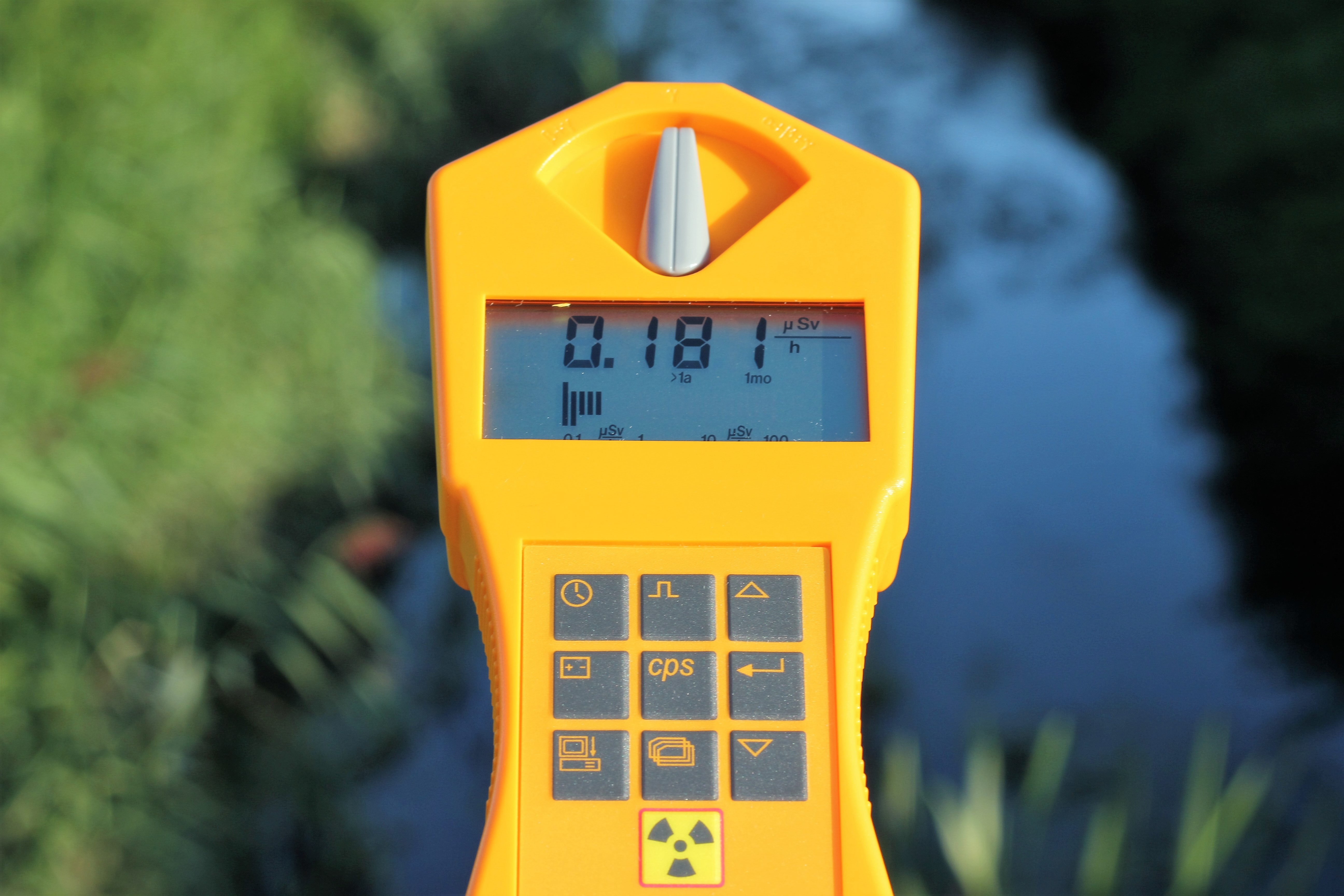
A Geiger Counter – used to measure radiation exposure.\(^{14}\)
An element with a longer half-life like Cesium-137 will be present in the environment for a long amount of time. In fact, much of the area around Chernobyl is still uninhabitable because of the presence of Cesium-137, which has a half-life of 30 years.\(^{15}\) To calculate the amount of radioactive material present to determine exposure, you can use the nuclear half-life equation by substituting a known half-life value. Try out problem 2 to calculate the amount of Cesium-137 that is still present today from the Chernobyl Disaster.
During the 1986 Chernobyl Disaster, 27 kg of Cesium-137 was released into the environment. Cesium-137 is a radioactive isotope with a half-life of 30 years. Calculate how much Cesium-137 remains in the environment at present. (Data adapted from Reference 15)
Solution
Given: Initial amount of Cesium-137, half life
Strategy:
First order half-life equation: \(t_{\frac{1}{2}} = \dfrac{0.693}{k}\)
1st order Integrated Rate Law: \([A]=[A]_0 e^{-k t}\)
Answer: (Try it out yourself before giving this a look!)
Use first order half-life equation to determine the k value:
30 years = \(\dfrac{0.693}{k}\) , k = 0.0231
Substitute into first order integrated rate law equation (Assuming 2022 as current year, see note below for different year):
\([A]=27 \mathrm{~kg} e^{(-0.0231)(36 \text { years* })}\) , A = 11.8 kg
* Note: This solution uses 2022 as the current year, for any years past that simply substitute the difference of your current year and Chernobyl's date (1986). I.e if the year is 2025 instead of 36 years we would substitute 39 years (2025-1986).
Conclusion:
Nuclear energy is a viable large-scale energy solution for countries worldwide due to its efficiency and lack of CO2 emissions. However, as demonstrated by the accidents at Chernobyl and Fukushima Daiichi, nuclear power plants pose severe threats to the world in the event that something goes wrong, whether it be human error or a natural disaster. In this section, you have gained an understanding of what elements are released in nuclear disasters, what types of radioactive particles they can release, and the relative effects of these particles in relation to their decay rates and exposure. Hopefully by learning about these topics you have gained an appreciation for the grave nature of the radioactive materials released in each accident and the acute impact of a radioactive fallout.
References:
(1) U.S. Energy Information Administration - EIA - Independent Statistics and Analysis. https://www.eia.gov/energyexplained/nuclear/nuclear-power-and-the-environment.php (accessed 2022-12-07).
(2) SITNFlash. Reconsidering the Risks of Nuclear Power. Science in the News. https://sitn.hms.harvard.edu/flash/2...nuclear-power/ (accessed 2022-12-07).
(3) Chernobyl | Chernobyl Accident | Chernobyl Disaster - World Nuclear Association. https://world-nuclear.org/informatio...-accident.aspx (accessed 2022-12-07).
(4) Fukushima Daiichi Accident - World Nuclear Association. https://world-nuclear.org/informatio...-accident.aspx (accessed 2022-12-07).
(5) Editors, H. com. Chernobyl. HISTORY. https://www.history.com/topics/1980s/chernobyl (accessed 2022-12-07).
(6) Tetsuji, I.; Gohei, H.; Satoru, E. Comparison of the Accident Process, Radioactivity Release and Ground Contamination between Chernobyl and Fukushima-1 . JRR 2015, 56 (suppl_1), i56–i61. https://doi.org/https://doi.org/10.1093/jrr/rrv074.
(7) US EPA, O. Radioactive Decay. https://www.epa.gov/radiation/radioactive-decay (accessed 2022-12-07).
(8) Yang, G.; Tazoe, H.; Hayano, K.; Okayama, K.; Yamada, M. Isotopic Compositions of 236U, 239Pu, and 240Pu in Soil Contaminated by the Fukushima Daiichi Nuclear Power Plant Accident. Sci Rep 2017, 7 (1), 13619. https://doi.org/10.1038/s41598-017-13998-6.
(9) Radioactive Materials Derived from Nuclear Accidents [MOE]. https://www.env.go.jp/en/chemi/rhm/b.../02-02-04.html (accessed 2022-12-07).
(10) 11.6: Penetrating Power of Radiation. Chemistry LibreTexts. https://chem.libretexts.org/Courses/...r_of_Radiation (accessed 2022-12-07).
(11) Kirschenbaum, J. Radioactive Materials Derived from Nuclear Accidents [MOE]. Teach the Earth Portal. https://www.eia.gov/energyexplained/nuclear/nuclear-power-and-the-environment.php (accessed 2022-12-07).
(12) Half-lives and Radioactive Decay [MOE]. https://www.env.go.jp/en/chemi/rhm/b.../01-02-07.html (accessed 2022-12-07).
(13) Half-Lives and Radioactive Decay Kinetics. https://saylordotorg.github.io/text_...ctive-dec.html (accessed 2022-12-07).
(14) Photo of Geiger Counter. https://pxhere.com/en/photo/1162734?..._source=pxhere. (accessed 2022-12-07).
(15) Chernobyl: Assessment of Radiological and Health Impacts (OECD Nuclear Energy Agency, 2002).
Vocabulary/Terms/Concepts:
Radioactive Decay, Alpha Decay, Beta Decay, Gamma Decay, Half-Life, Ionization Power, Penetration Power
Further Readings:
For further reading on evaluating the specific public health risks in relation to the Fukushima Daiichi disaster, refer to “A Public Health Perspective on the Fukushima Nuclear Disaster” by Tilman A. Ruff. Readers interested in comparing the Fukushima and the Chernobyl nuclear disasters should refer to “Comparison of the accident process, radioactivity release and ground contamination between Chernobyl and Fukushima” by Tesuji Imanaka et. al.”. To learn more about the long-term consequences of nuclear disasters by analyzing Chernobyl readers should consult “Long Term Consequences of the Chernobyl Radioactive Fallout: An Exploration of the Aggregate Data” by F. Marino and L. Nunziata.