

6.5: Molar Mass
- Page ID
- 472402
\( \newcommand{\vecs}[1]{\overset { \scriptstyle \rightharpoonup} {\mathbf{#1}} } \)
\( \newcommand{\vecd}[1]{\overset{-\!-\!\rightharpoonup}{\vphantom{a}\smash {#1}}} \)
\( \newcommand{\dsum}{\displaystyle\sum\limits} \)
\( \newcommand{\dint}{\displaystyle\int\limits} \)
\( \newcommand{\dlim}{\displaystyle\lim\limits} \)
\( \newcommand{\id}{\mathrm{id}}\) \( \newcommand{\Span}{\mathrm{span}}\)
( \newcommand{\kernel}{\mathrm{null}\,}\) \( \newcommand{\range}{\mathrm{range}\,}\)
\( \newcommand{\RealPart}{\mathrm{Re}}\) \( \newcommand{\ImaginaryPart}{\mathrm{Im}}\)
\( \newcommand{\Argument}{\mathrm{Arg}}\) \( \newcommand{\norm}[1]{\| #1 \|}\)
\( \newcommand{\inner}[2]{\langle #1, #2 \rangle}\)
\( \newcommand{\Span}{\mathrm{span}}\)
\( \newcommand{\id}{\mathrm{id}}\)
\( \newcommand{\Span}{\mathrm{span}}\)
\( \newcommand{\kernel}{\mathrm{null}\,}\)
\( \newcommand{\range}{\mathrm{range}\,}\)
\( \newcommand{\RealPart}{\mathrm{Re}}\)
\( \newcommand{\ImaginaryPart}{\mathrm{Im}}\)
\( \newcommand{\Argument}{\mathrm{Arg}}\)
\( \newcommand{\norm}[1]{\| #1 \|}\)
\( \newcommand{\inner}[2]{\langle #1, #2 \rangle}\)
\( \newcommand{\Span}{\mathrm{span}}\) \( \newcommand{\AA}{\unicode[.8,0]{x212B}}\)
\( \newcommand{\vectorA}[1]{\vec{#1}} % arrow\)
\( \newcommand{\vectorAt}[1]{\vec{\text{#1}}} % arrow\)
\( \newcommand{\vectorB}[1]{\overset { \scriptstyle \rightharpoonup} {\mathbf{#1}} } \)
\( \newcommand{\vectorC}[1]{\textbf{#1}} \)
\( \newcommand{\vectorD}[1]{\overrightarrow{#1}} \)
\( \newcommand{\vectorDt}[1]{\overrightarrow{\text{#1}}} \)
\( \newcommand{\vectE}[1]{\overset{-\!-\!\rightharpoonup}{\vphantom{a}\smash{\mathbf {#1}}}} \)
\( \newcommand{\vecs}[1]{\overset { \scriptstyle \rightharpoonup} {\mathbf{#1}} } \)
\(\newcommand{\longvect}{\overrightarrow}\)
\( \newcommand{\vecd}[1]{\overset{-\!-\!\rightharpoonup}{\vphantom{a}\smash {#1}}} \)
\(\newcommand{\avec}{\mathbf a}\) \(\newcommand{\bvec}{\mathbf b}\) \(\newcommand{\cvec}{\mathbf c}\) \(\newcommand{\dvec}{\mathbf d}\) \(\newcommand{\dtil}{\widetilde{\mathbf d}}\) \(\newcommand{\evec}{\mathbf e}\) \(\newcommand{\fvec}{\mathbf f}\) \(\newcommand{\nvec}{\mathbf n}\) \(\newcommand{\pvec}{\mathbf p}\) \(\newcommand{\qvec}{\mathbf q}\) \(\newcommand{\svec}{\mathbf s}\) \(\newcommand{\tvec}{\mathbf t}\) \(\newcommand{\uvec}{\mathbf u}\) \(\newcommand{\vvec}{\mathbf v}\) \(\newcommand{\wvec}{\mathbf w}\) \(\newcommand{\xvec}{\mathbf x}\) \(\newcommand{\yvec}{\mathbf y}\) \(\newcommand{\zvec}{\mathbf z}\) \(\newcommand{\rvec}{\mathbf r}\) \(\newcommand{\mvec}{\mathbf m}\) \(\newcommand{\zerovec}{\mathbf 0}\) \(\newcommand{\onevec}{\mathbf 1}\) \(\newcommand{\real}{\mathbb R}\) \(\newcommand{\twovec}[2]{\left[\begin{array}{r}#1 \\ #2 \end{array}\right]}\) \(\newcommand{\ctwovec}[2]{\left[\begin{array}{c}#1 \\ #2 \end{array}\right]}\) \(\newcommand{\threevec}[3]{\left[\begin{array}{r}#1 \\ #2 \\ #3 \end{array}\right]}\) \(\newcommand{\cthreevec}[3]{\left[\begin{array}{c}#1 \\ #2 \\ #3 \end{array}\right]}\) \(\newcommand{\fourvec}[4]{\left[\begin{array}{r}#1 \\ #2 \\ #3 \\ #4 \end{array}\right]}\) \(\newcommand{\cfourvec}[4]{\left[\begin{array}{c}#1 \\ #2 \\ #3 \\ #4 \end{array}\right]}\) \(\newcommand{\fivevec}[5]{\left[\begin{array}{r}#1 \\ #2 \\ #3 \\ #4 \\ #5 \\ \end{array}\right]}\) \(\newcommand{\cfivevec}[5]{\left[\begin{array}{c}#1 \\ #2 \\ #3 \\ #4 \\ #5 \\ \end{array}\right]}\) \(\newcommand{\mattwo}[4]{\left[\begin{array}{rr}#1 \amp #2 \\ #3 \amp #4 \\ \end{array}\right]}\) \(\newcommand{\laspan}[1]{\text{Span}\{#1\}}\) \(\newcommand{\bcal}{\cal B}\) \(\newcommand{\ccal}{\cal C}\) \(\newcommand{\scal}{\cal S}\) \(\newcommand{\wcal}{\cal W}\) \(\newcommand{\ecal}{\cal E}\) \(\newcommand{\coords}[2]{\left\{#1\right\}_{#2}}\) \(\newcommand{\gray}[1]{\color{gray}{#1}}\) \(\newcommand{\lgray}[1]{\color{lightgray}{#1}}\) \(\newcommand{\rank}{\operatorname{rank}}\) \(\newcommand{\row}{\text{Row}}\) \(\newcommand{\col}{\text{Col}}\) \(\renewcommand{\row}{\text{Row}}\) \(\newcommand{\nul}{\text{Nul}}\) \(\newcommand{\var}{\text{Var}}\) \(\newcommand{\corr}{\text{corr}}\) \(\newcommand{\len}[1]{\left|#1\right|}\) \(\newcommand{\bbar}{\overline{\bvec}}\) \(\newcommand{\bhat}{\widehat{\bvec}}\) \(\newcommand{\bperp}{\bvec^\perp}\) \(\newcommand{\xhat}{\widehat{\xvec}}\) \(\newcommand{\vhat}{\widehat{\vvec}}\) \(\newcommand{\uhat}{\widehat{\uvec}}\) \(\newcommand{\what}{\widehat{\wvec}}\) \(\newcommand{\Sighat}{\widehat{\Sigma}}\) \(\newcommand{\lt}{<}\) \(\newcommand{\gt}{>}\) \(\newcommand{\amp}{&}\) \(\definecolor{fillinmathshade}{gray}{0.9}\)- Define molar mass
- Use the periodic table to dentify the molar mass of elements
- Calcualte the molar mass of compounds
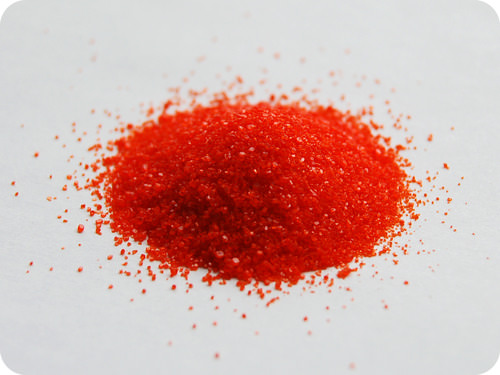
When performing a reaction, how do I know how much of each substance to use?
Chemical equations are like recipes that tell you how much of each reactant to use as ratios of numbers of moles. For example here is the reaction to make water:
\[\ce{O2 + 2H2 \rightarrow 2H2O }\]
From this equation we know we need two moles of hydrogen molecules for every one mole of oxygen molecules to make two moles of water molecules. If you know the relationship between moles and the number of grams in a mole, you can use a balance (scale) to measure out the needed amount of material. The relationship between moles and number of grams in a mole is called molar mass.
Molar Mass
Molar mass is defined as the mass of one mole of representative particles of a substance. Because of the way the atomic mass unit and mole were defined, the numbers on the periodic table that represent the average mass of an element are the same as the grams of a mole of that element.
For example, by looking at a periodic table, we can conclude that the mass of a mole of lithium is \(6.94 \: \text{g}\), the mass of a mole of zinc is \(65.38 \: \text{g}\), and the mass of a mole of gold is \(196.97 \: \text{g}\). (By the way, each of these quantities contains \(6.02 \times 10^{23}\) atoms of that particular element.)
The units for molar mass are grams per mole, or \(\text{g/mol}\). So we can also say that lithium weighs 6.94 grams per mole or \(6.94 \: \text{g/mol}\).
Molar Masses of Compounds
The molecular formula of the compound carbon dioxide is \(\ce{CO_2}\). One molecule of carbon dioxide consists of 1 atom of carbon and 2 atoms of oxygen. We can calculate the mass of one molecule of carbon dioxide by adding together the masses of 1 atom of carbon and 2 atoms of oxygen:
\[12.01 \: \text{amu} + 2 \left( 16.00 \: \text{amu} \right) = 44.01 \: \text{amu}\nonumber \]
We can also calculate the mass of a mole of the compound by adding together the molar masses of the elements in the compound.
\[12.01 \: \text{g/mol} + 2 \left( 16.00 \: \text{g/mol} \right) = 44.01 \: \text{g/mol}\nonumber \]
Stated another way, the molar mass of any compound is the mass in grams of one mole of that compound. One mole of carbon dioxide molecules has a mass of \(44.01 \: \text{g}\), while one mole of sodium sulfide formula units has a mass of \(78.04 \: \text{g}\). The molar masses are \(44.01 \: \text{g/mol}\) and \(78.04 \: \text{g/mol}\) respectively. In both cases, that is the mass of \(6.02 \times 10^{23}\) representative particles. The representative particle of \(\ce{CO_2}\) is the molecule, while for \(\ce{Na_2S}\) it is the formula unit.
Example \(\PageIndex{1}\): Molar Mass of a Compound
Calcium nitrate, \(\ce{Ca(NO_3)_2}\), is used as a component in fertilizer. Determine the molar mass of calcium nitrate.
Solution
Step 1: List the known and unknown quantities and plan the problem.
Known
- Formula \(= \ce{Ca(NO_3)_2}\)
- Molar mass \(\ce{Ca} = 40.08 \: \text{g/mol}\)
- Molar mass \(\ce{N} = 14.01 \: \text{g/mol}\)
- Molar mass \(\ce{O} = 16.00 \: \text{g/mol}\)
Unknown
- molar mass Ca(NO3)2
First we need to analyze the formula. Since the \(\ce{Ca}\) lacks a subscript, there is one \(\ce{Ca}\) atom per formula unit. The 2 outside the parentheses means that there are two nitrate ions per formula unit and each nitrate ion consists of one nitrogen atom and three oxygen atoms per formula unit. Thus, \(1 \: \text{mol}\) of calcium nitrate contains \(1 \: \text{mol}\) of \(\ce{Ca}\) atoms, \(2 \: \text{mol}\) of \(\ce{N}\) atoms, and \(6 \: \text{mol}\) of \(\ce{O}\) atoms.
Step 2: Calculate
Use the molar masses of each atom together with the number of atoms in the formula and add together.
\[1 \: \text{mol} \: \ce{Ca} \times \frac{40.08 \: \text{g} \: \ce{Ca}}{1 \: \text{mol} \: \ce{Ca}} = 40.08 \: \text{g} \: \ce{Ca}\nonumber \]
\[2 \: \text{mol} \: \ce{N} \times \frac{14.01 \: \text{g} \: \ce{N}}{1 \: \text{mol} \: \ce{N}} = 28.02 \: \text{g} \: \ce{N}\nonumber \]
\[6 \: \text{mol} \: \ce{O} \times \frac{16.00 \: \text{g} \: \ce{O}}{1 \: \text{mol} \: \ce{O}} = 96.00 \: \text{g} \: \ce{O}\nonumber \]
Molar mass of \(\ce{Ca(NO_3)_2} = 40.08 \: \text{g} + 28.02 \: \text{g} + 96.00 \: \text{g} = 164.10 \: \text{g/mol}\)
Practice
- What is the molar mass of Pb?
- Where do you find the molar mass of an element?
- How many moles of Cl are in one mole of the CaCl2?
- How many moles of H are in one mole of the compound (NH4)3PO4?
- Calculate the molar mass of CaCl2.