

5.8: Electronegativity and Bond Polarity
- Page ID
- 521757

\( \newcommand{\vecs}[1]{\overset { \scriptstyle \rightharpoonup} {\mathbf{#1}} } \)
\( \newcommand{\vecd}[1]{\overset{-\!-\!\rightharpoonup}{\vphantom{a}\smash {#1}}} \)
\( \newcommand{\dsum}{\displaystyle\sum\limits} \)
\( \newcommand{\dint}{\displaystyle\int\limits} \)
\( \newcommand{\dlim}{\displaystyle\lim\limits} \)
\( \newcommand{\id}{\mathrm{id}}\) \( \newcommand{\Span}{\mathrm{span}}\)
( \newcommand{\kernel}{\mathrm{null}\,}\) \( \newcommand{\range}{\mathrm{range}\,}\)
\( \newcommand{\RealPart}{\mathrm{Re}}\) \( \newcommand{\ImaginaryPart}{\mathrm{Im}}\)
\( \newcommand{\Argument}{\mathrm{Arg}}\) \( \newcommand{\norm}[1]{\| #1 \|}\)
\( \newcommand{\inner}[2]{\langle #1, #2 \rangle}\)
\( \newcommand{\Span}{\mathrm{span}}\)
\( \newcommand{\id}{\mathrm{id}}\)
\( \newcommand{\Span}{\mathrm{span}}\)
\( \newcommand{\kernel}{\mathrm{null}\,}\)
\( \newcommand{\range}{\mathrm{range}\,}\)
\( \newcommand{\RealPart}{\mathrm{Re}}\)
\( \newcommand{\ImaginaryPart}{\mathrm{Im}}\)
\( \newcommand{\Argument}{\mathrm{Arg}}\)
\( \newcommand{\norm}[1]{\| #1 \|}\)
\( \newcommand{\inner}[2]{\langle #1, #2 \rangle}\)
\( \newcommand{\Span}{\mathrm{span}}\) \( \newcommand{\AA}{\unicode[.8,0]{x212B}}\)
\( \newcommand{\vectorA}[1]{\vec{#1}} % arrow\)
\( \newcommand{\vectorAt}[1]{\vec{\text{#1}}} % arrow\)
\( \newcommand{\vectorB}[1]{\overset { \scriptstyle \rightharpoonup} {\mathbf{#1}} } \)
\( \newcommand{\vectorC}[1]{\textbf{#1}} \)
\( \newcommand{\vectorD}[1]{\overrightarrow{#1}} \)
\( \newcommand{\vectorDt}[1]{\overrightarrow{\text{#1}}} \)
\( \newcommand{\vectE}[1]{\overset{-\!-\!\rightharpoonup}{\vphantom{a}\smash{\mathbf {#1}}}} \)
\( \newcommand{\vecs}[1]{\overset { \scriptstyle \rightharpoonup} {\mathbf{#1}} } \)
\(\newcommand{\longvect}{\overrightarrow}\)
\( \newcommand{\vecd}[1]{\overset{-\!-\!\rightharpoonup}{\vphantom{a}\smash {#1}}} \)
\(\newcommand{\ket}[1]{\left| #1 \right>}\)
\(\newcommand{\bra}[1]{\left< #1 \right|}\)
\(\newcommand{\braket}[2]{\left< #1 \vphantom{#2} \right| \left. #2 \vphantom{#1} \right>}\)
\(\newcommand{\braopket}[3]{\left< #1 \vphantom{#2}\vphantom{#3} \right| #2 \vphantom{#1}\vphantom{#3} \left| #3 \vphantom{#1}\vphantom{#2} \right>}\)
\(\newcommand{\qmvec}[1]{\mathbf{\vec{#1}}}\)
\(\newcommand{\op}[1]{\hat{\mathbf{#1}}}\)
\(\newcommand{\expect}[1]{\langle #1 \rangle}\)
\(\newcommand{\dfn}[1]{\emph{\textbf{#1}}}\)
- Define electronegativity
- Determine the polarity of a covalent bond.
Electronegativity
The ability of an atom in a molecule to attract shared electrons is called electronegativity. When two atoms combine, the difference between their electronegativities is an indication of the type of bond that will form. If the difference between the electronegativities of the two atoms is small, neither atom can take the shared electrons completely away from the other atom, and the bond will be covalent. If the difference between the electronegativities is large, the more electronegative atom will take the bonding electrons completely away from the other atom (electron transfer will occur) and the bond will be ionic. This is why metals (low electronegativities) bonded with nonmetals (high electronegativities) typically produce ionic compounds.
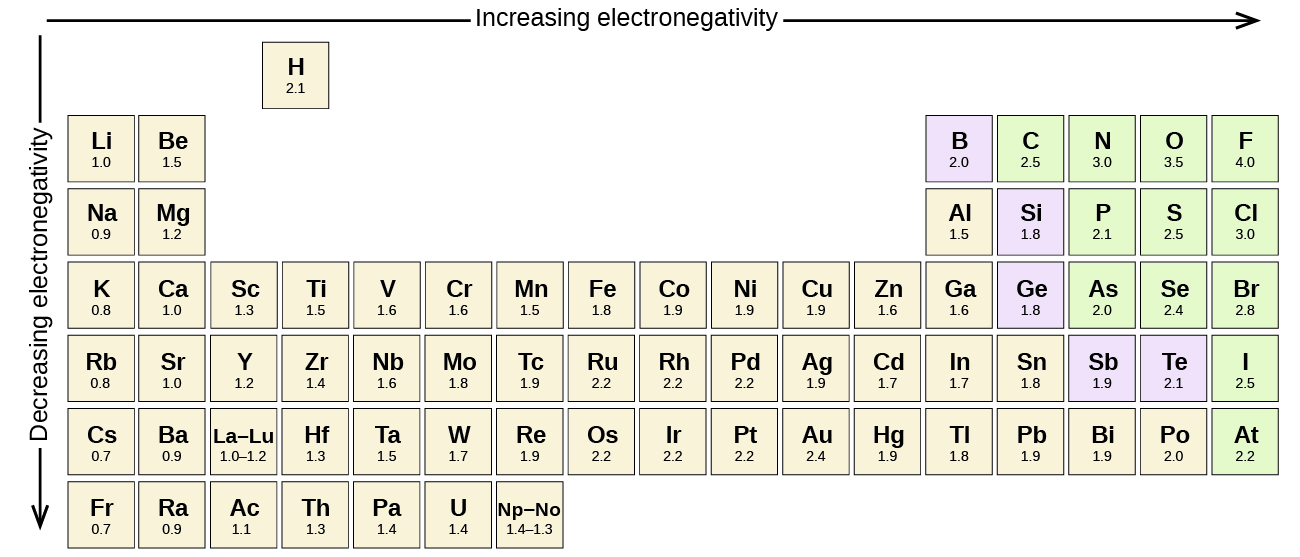
A bond may be so polar that an electron actually transfers from one atom to another, forming a true ionic bond. How do we judge the degree of polarity? Scientists have devised a scale called electronegativity, a scale for judging how much atoms of any element attract electrons. Electronegativity is a unitless number; the higher the number, the more an atom attracts electrons. A common scale for electronegativity is shown in Figure \(\PageIndex{1}\).
Bond Polarity
Although polarity is a continuum, marking divisions can help discuss bonds with similar characteristics. The polarity of a covalent bond can be classified by determining the difference in the electronegativities of the two atoms involved in the covalent bond, as summarized in the following table:
| Electronegativity Difference | Bond Type |
|---|---|
| 0–0.4 | nonpolar covalent |
| 0.5–1.5 | polar covalent |
| 1.6 - 1.9 | polar covalent if two nonmetals, ionic if a metal with a nonmetal |
| ≥ 2.0 | ionic |
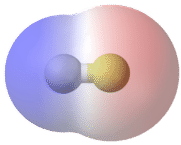
A covalent bond that has an equal sharing of electrons, as in H2, (Figure \(\PageIndex{2a}\)) is called a nonpolar covalent bond. A covalent bond that has an unequal sharing of electrons, as in Figure \(\PageIndex{2b}\), is called a polar covalent bond.

The distribution of electron density in a polar bond is uneven. It is greater around the atom that attracts the electrons more than the other. For example, the electrons in the H–Cl bond of a hydrogen chloride molecule spend more time near the chlorine atom than near the hydrogen atom. Note that the colored area around Cl in Figure \(\PageIndex{2b}\) is much larger than it is around H.
Nonpolar Covalent Bonds
A bond in which the electronegativity difference is less than 1.9 is considered to be mostly covalent in character. However, at this point we need to distinguish between two general types of covalent bonds. A nonpolar covalent bond is a covalent bond in which the bonding electrons are shared equally between the two atoms. In a nonpolar covalent bond, the distribution of electrical charge is balanced between the two atoms.

The two chlorine atoms share the pair of electrons in the single covalent bond equally, and the electron density surrounding the \(\ce{Cl_2}\) molecule is symmetrical. Also note that molecules in which the electronegativity difference is very small (<0.5) are also considered nonpolar covalent. An example would be a bond between chlorine and bromine (\(\Delta\)EN \(=3.0 - 2.8 = 0.2\)).
Polar Covalent Bonds
A bond in which the electronegativity difference between the atoms is between 0.5 and about 2.0 is called a polar covalent bond. A polar covalent bond is a covalent bond in which the atoms have an unequal attraction for electrons, and so the sharing is unequal. In a polar covalent bond, sometimes simply called a polar bond, the distribution of electrons around the molecule is no longer symmetrical.
An easy way to illustrate the electronegativity difference in a polar covalent bond is to use the Greek letter delta \(\left( \delta \right)\). This imbalance in electron density results in a buildup of partial negative charge (designated as δ−) on one side of the bond (Cl) and a partial positive charge (designated δ+) on the other side of the bond (H). This is seen in Figure \(\PageIndex{5a}\). The separation of charge in a polar covalent bond results in an electric dipole (two poles), represented by the arrow in the direction of greater electron density, Figure \(\PageIndex{5b}\). The direction of the arrow is pointed toward the δ− end while the + tail of the arrow indicates the δ+ end of the bond.

Electronegativity differences in bonding using Pauling scale. Using differences in electronegativity to classify bonds as covalent, polar covalent, or ionic.
Describe the electronegativity difference between each pair of atoms and the resulting polarity (or bond type).
- C and H
- H and H
- Na and Cl
- O and H
- Mg and Br
Solution
- Carbon has an electronegativity of 2.5, while the value for hydrogen is 2.1. The difference is 0.4, which is rather small. The C–H bond is therefore considered nonpolar.
- Both hydrogen atoms have the same electronegativity value—2.1. The difference is zero, so the bond is nonpolar.
- Sodium’s electronegativity is 0.9, while chlorine’s is 3.0. The difference of 2.1 is rather high, indicating that sodium and chlorine form an ionic compound.
- With 2.1 for hydrogen and 3.5 for oxygen, the electronegativity difference is 1.4. The bond is polar. The sharing of electrons between O and H is unequal, with the electrons more strongly drawn towards O.
- Mg has an electronegativity of 1.2, while the value for Br is 2.8, the electronegativity difference is 1.6. Based on the table, he bond is a polar bond, but remember that Mg is a metal, so for our purposes we consider the bond ionic.
Describe the electronegativity (EN) difference between each pair of atoms and the resulting polarity (or bond type).
- C and O
- K and Br
- N and N
- Cs and F
- Answer a:
-
The EN difference is 1.0 , hence polar. The sharing of electrons between C and O is unequal with the electrons more strongly drawn towards O.
- Answer b:
-
K (0.8) and Br (2.8). The EN difference is 2.0, and additionally, K is a metal; the bond is ionic.
- Answer c:
-
Identical atoms have zero EN difference, hence nonpolar.
- Answer d:
-
The EN difference is greater than 1.8, indicating it is ionic.
What is the polarity of each bond?
- Rb–F
- P–Cl
- Answer a
-
likely ionic
- Answer b
-
polar covalent
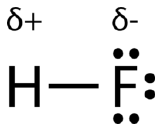
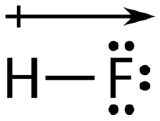
For the molecule HF:
a- Draw the Lewis structure
b- Illustrate the electronegativity difference using the Greek letter delta.
c- Using an arrow. Indicate the direction of greater electron density..
- Answer
-
a- and b-
 c-
Summary
- The type of bond (polar covalent,non polar covalent or ionic) between two atoms is determined by the differences in electronegativity.
- For atoms sharing a polar covalent bond, the atom with the greater electronegativity acquires a partial negative charge, while the atom with the lesser electronegativity acquires a partial positive charge.