

4.E: Ionic Bonding and Simple Ionic Compounds (Exercises)
- Page ID
- 521747

\( \newcommand{\vecs}[1]{\overset { \scriptstyle \rightharpoonup} {\mathbf{#1}} } \)
\( \newcommand{\vecd}[1]{\overset{-\!-\!\rightharpoonup}{\vphantom{a}\smash {#1}}} \)
\( \newcommand{\dsum}{\displaystyle\sum\limits} \)
\( \newcommand{\dint}{\displaystyle\int\limits} \)
\( \newcommand{\dlim}{\displaystyle\lim\limits} \)
\( \newcommand{\id}{\mathrm{id}}\) \( \newcommand{\Span}{\mathrm{span}}\)
( \newcommand{\kernel}{\mathrm{null}\,}\) \( \newcommand{\range}{\mathrm{range}\,}\)
\( \newcommand{\RealPart}{\mathrm{Re}}\) \( \newcommand{\ImaginaryPart}{\mathrm{Im}}\)
\( \newcommand{\Argument}{\mathrm{Arg}}\) \( \newcommand{\norm}[1]{\| #1 \|}\)
\( \newcommand{\inner}[2]{\langle #1, #2 \rangle}\)
\( \newcommand{\Span}{\mathrm{span}}\)
\( \newcommand{\id}{\mathrm{id}}\)
\( \newcommand{\Span}{\mathrm{span}}\)
\( \newcommand{\kernel}{\mathrm{null}\,}\)
\( \newcommand{\range}{\mathrm{range}\,}\)
\( \newcommand{\RealPart}{\mathrm{Re}}\)
\( \newcommand{\ImaginaryPart}{\mathrm{Im}}\)
\( \newcommand{\Argument}{\mathrm{Arg}}\)
\( \newcommand{\norm}[1]{\| #1 \|}\)
\( \newcommand{\inner}[2]{\langle #1, #2 \rangle}\)
\( \newcommand{\Span}{\mathrm{span}}\) \( \newcommand{\AA}{\unicode[.8,0]{x212B}}\)
\( \newcommand{\vectorA}[1]{\vec{#1}} % arrow\)
\( \newcommand{\vectorAt}[1]{\vec{\text{#1}}} % arrow\)
\( \newcommand{\vectorB}[1]{\overset { \scriptstyle \rightharpoonup} {\mathbf{#1}} } \)
\( \newcommand{\vectorC}[1]{\textbf{#1}} \)
\( \newcommand{\vectorD}[1]{\overrightarrow{#1}} \)
\( \newcommand{\vectorDt}[1]{\overrightarrow{\text{#1}}} \)
\( \newcommand{\vectE}[1]{\overset{-\!-\!\rightharpoonup}{\vphantom{a}\smash{\mathbf {#1}}}} \)
\( \newcommand{\vecs}[1]{\overset { \scriptstyle \rightharpoonup} {\mathbf{#1}} } \)
\(\newcommand{\longvect}{\overrightarrow}\)
\( \newcommand{\vecd}[1]{\overset{-\!-\!\rightharpoonup}{\vphantom{a}\smash {#1}}} \)
\(\newcommand{\ket}[1]{\left| #1 \right>}\)
\(\newcommand{\bra}[1]{\left< #1 \right|}\)
\(\newcommand{\braket}[2]{\left< #1 \vphantom{#2} \right| \left. #2 \vphantom{#1} \right>}\)
\(\newcommand{\braopket}[3]{\left< #1 \vphantom{#2}\vphantom{#3} \right| #2 \vphantom{#1}\vphantom{#3} \left| #3 \vphantom{#1}\vphantom{#2} \right>}\)
\(\newcommand{\qmvec}[1]{\mathbf{\vec{#1}}}\)
\(\newcommand{\op}[1]{\hat{\mathbf{#1}}}\)
\(\newcommand{\expect}[1]{\langle #1 \rangle}\)
\(\newcommand{\dfn}[1]{\emph{\textbf{#1}}}\)
Additional Exercises
Periodic Table
5. How are the elements organized into the periodic table?
6. Looking at the periodic table, where do the following elements appear?
the metals
the nonmetals
the halogens
the transition metals
the noble gases
7. Describe the trends in atomic radii as related to an element’s position on the periodic table.
8. Using the periodic table, which atom is larger? Explain.
N or Bi
Mg or Cl
Li or F
Na or K
9. a. A potassium atom has ____ core electrons and ____ valence electrons.
b. A silicon atom has ____ core electrons and ____ valence electrons.
c. How many total and valence electrons are in a neutral phosphorus atom?
d. How many total, valence, and core electrons are there in a neutral xenon atom?
Mole-Mass Conversions
1. How many moles are present in 100.0 g of Al?
2. How many moles are present in 25.5 g Na?
3. What is the mass of 8.603 mol of Fe metal?
4. What is the mass of 0.552 mol of Ag metal?
Exercises
- What are the two types of ions?
- Use Lewis diagrams to illustrate the formation of an ionic compound from a potassium atom and an iodine atom.
3. When the following atoms become ions, what charges do they acquire?
- Li
- S
- Ca
- F
4. Identify each as a cation, an anion, or neither.
- H+
- Cl−
- O2
- Ba2+
- CH4
- CS2
5. Identify each as a cation, an anion, or neither.
- NH3
- Br−
- H−
- Hg2+
- CCl4
- SO3
6. Using Lewis diagrams, show the electron transfer for the formation of LiF.
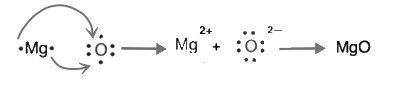
7. Using Lewis diagrams, show the electron transfer for the formation of MgO.
8. Using Lewis diagrams, show the electron transfer for the formation of Li2O.
9. Using Lewis diagrams, show the electron transfer for the formation of CaF2.
10. What characteristic charge do atoms in the first column of the periodic table have when they become ions?
11. What characteristic charge do atoms in the second column of the periodic table have when they become ions?
12. What characteristic charge do atoms in the third-to-last column of the periodic table have when they become ions?
13. What characteristic charge do atoms in the next-to-last column of the periodic table have when they become ions?
Answers
- Cations (positive charged) and anions (negative charged).

-
- 1+
- 2−
- 2+
- 1−
4.
- cation
- anion
- neither
- cation
- neither
- neither
5.
- neither
- anion
- anion
- cation
- neither
- neither
6.
7. 
8. 
9. 
10. 1+
11. 2+
12. 2−
13. 1−
----------------
- What information is contained in the formula of an ionic compound?
2. Why do the chemical formulas for some ionic compounds contain subscripts, while others do not?
3. Write the chemical formula for the ionic compound formed by each pair of ions.
- Mg2+ and I−
- Na+ and O2−
4. Write the chemical formula for the ionic compound formed by each pair of ions.
- Na+ and Br−
- Mg2+ and Br−
- Mg2+ and S2−
5. Write the chemical formula for the ionic compound formed by each pair of ions.
- K+ and Cl−
- Mg2+ and Cl−
- Mg2+ and Se2−
6. Write the chemical formula for the ionic compound formed by each pair of ions.
- Na+ and N3−
- Mg2+ and N3−
- Al3+ and S2−
7. Write the chemical formula for the ionic compound formed by each pair of ions.
- Li+ and N3−
- Mg2+ and P3−
- Li+ and P3−
8. Write the chemical formula for the ionic compound formed by each pair of ions.
- Fe3+ and Br−
- Fe2+ and Br−
- Au3+ and S2−
- Au+ and S2−
9. Write the chemical formula for the ionic compound formed by each pair of ions.
- Cr3+ and O2−
- Cr2+ and O2−
- Pb2+ and Cl−
- Pb4+ and Cl−
10. Write the chemical formula for the ionic compound formed by each pair of ions.
- Cr3+ and NO3−
- Fe2+ and PO43−
- Ca2+ and CrO42−
- Al3+ and OH−
11. Write the chemical formula for the ionic compound formed by each pair of ions.
- NH4+ and NO3−
- H+ and Cr2O72−
- Cu+ and CO32−
- Na+ and HCO3−
12. For each pair of elements, determine the charge for their ions and write the proper formula for the resulting ionic compound between them.
- Ba and S
- Cs and I
13. For each pair of elements, determine the charge for their ions and write the proper formula for the resulting ionic compound between them.
- K and S
- Sc and Br
14. Which compounds would you predict to be ionic?
- Li2O
- (NH4)2O
- CO2
- FeSO3
- C6H6
- C2H6O
15. Which compounds would you predict to be ionic?
- Ba(OH)2
- CH2O
- NH2CONH2
- (NH4)2CrO4
- C8H18
- NH3
16. Name the ionic compound formed by each pair of ions. Use both the Stock and common systems, where appropriate.
- Cr3+ and NO3−
- Fe2+ and PO43−
- Ca2+ and CrO42−
- Al3+ and OH−
17. Name the ionic compound formed by each pair of ions. Use both the Stock and common systems, where appropriate.
- NH4+ and NO3−
- K+ and Cr2O72−
- Cu+ and CO32−
- Na+ and HCO3−
18. Give two names for each compound.
- Al(HSO4)3
- Mg(HSO4)2
19. Give two names for each compound.
- Co(HCO3)2
- LiHCO3
20. Give the formula of each compound.
- chromium(III) oxide or chromic oxide
- chromium(II) oxide or chromous oxide
- lead(II) chloride or plumbous chloride
- lead(IV) chloride or plumbic chloride
- chromium(III) nitrate or chromic nitrate
- iron(II) phosphate or ferrous phosphate
- calcium chromate
- aluminum hydroxide
- ammonium nitrate
- copper(I) carbonate or cuprous carbonate
- sodium hydrogen carbonate or sodium bicarbonate
- aluminum hydrogen sulfate or aluminum bisulfate
- magnesium hydrogen sulfate or magnesium bisulfate
- cobalt hydrogen carbonate or cobalt bicarbonate
- lithium hydrogen carbonate or lithium bicarbonate
Answers
1. the ratio of each kind of ion in the compound
2. Sometimes more than one ion is needed to balance the charge on the other ion in an ionic compound.
3.
- MgI2
- Na2O
4.
- NaBr
- MgBr2
- MgS
5.
- KCl
- MgCl2
- MgSe
6.
- Na3N
- Mg3N2
- Al2S3
7.
- Li3N
- Mg3P2
- Li3P
8.
- FeBr3
- FeBr2
- Au2S3
- Au2S
9.
- Cr2O3
- CrO
- PbCl2
- PbCl4
10.
- Cr(NO3)3
- Fe3(PO4)2
- CaCrO4
- Al(OH)3
11.
- NH4NO3
- H2Cr2O7
- Cu2CO3
- NaHCO3
12.
- Ba2+, S2−, BaS
- Cs+, I−, CsI
13.
- K+, S2−, K2S
- Sc3+, Br−, ScBr3
14.
- ionic
- ionic
- not ionic
- ionic
- not ionic
- not ionic
15.
- ionic
- not ionic
- not ionic
- ionic
- not ionic
- not ionic
-------------------
- What number shell is the valence electron shell of a sodium atom? What number shell is the valence shell of a sodium ion? Explain the difference.
- What number shell is the valence electron shell of a bromine atom? What number shell is the valence shell of a bromide ion? Explain the difference between these answers and the answers to Exercise 1.
- What is the electron configuration of each ion?
- K+
- Mg2+
- F−
- S2−
- What is the electron configuration of each ion?
- Li+
- Ca2+
- Cl−
- O2−
-
- If a sodium atom were to lose two electrons, what would be the electron configuration of the resulting cation?
- Considering that electron shells are typically separated by large amounts of energy, use your answer to Exercise 5a to suggest why sodium atoms do not form a 2+ cation.
-
- If a chlorine atom were to gain two electrons, what would be the electron configuration of the resulting anion?
- Considering that electron shells are typically separated by large amounts of energy, use your answer to Exercise 6a to suggest why chlorine atoms do not form a 2− anion.
- Use Lewis diagrams and arrows to show the electron transfer that occurs during the formation of an ionic compound among Mg atoms and F atoms. (Hint: how many atoms of each will you need?)
- Use Lewis diagrams and arrows to show the electron transfer that occurs during the formation of an ionic compound among K atoms and O atoms. (Hint: how many atoms of each will you need?)
- Mercury forms two possible cations—Hg2+ and Hg22+, the second of which is actually a two-atom cation with a 2+ charge.
- Using common names, give the probable names of these ions.
- What are the chemical formulas of the ionic compounds these ions make with the oxide ion, O2−?
- The uranyl ion (UO22+) is a common water-soluble form of uranium. What is the chemical formula of the ionic compound uranyl nitrate? What is the chemical formula of the ionic compound uranyl phosphate?
- The formal chemical name of the mineral strengite is iron(III) phosphate dihydrate. What is the chemical formula of strengite? What is the formula mass of strengite?
- What is the formula mass of MgSO4·7H2O?
- What is the formula mass of CaSO4·½H2O?
- What mass does 20 formula units of NaCl have?
- What mass does 75 formula units of K2SO4 have?
- If an atomic mass unit equals 1.66 × 10⁻²⁴ g, what is the mass in grams of one formula unit of NaCl?
- If an atomic mass unit equals 1.66 × 10⁻²⁴ g, what is the mass in grams of 5.00 × 10²² formula units of NaOH?
- If an atomic mass unit equals 1.66 × 10⁻²⁴ g, what is the mass in grams of 3.96 × 10²³ formula units of (NH4)2SO4?
- Both tin and lead acquire 2+ or 4+ charges when they become ions. Use the periodic table to explain why this should not surprise you.
- Which ion would you expect to be larger in size—In3+ or Tl3+? Explain.
- Which ion would you expect to be smaller in size—I− or Br−? Explain.
- Which ion with a 2+ charge has the following electron configuration? 1s22s22p6
- Which ion with a 3− charge has the following electron configuration? 1s22s22p6
Answers
- For sodium, the valence shell is the third shell; for the sodium ion, the valence shell is the second shell because it has lost all its third shell electrons.
- The valence shell for both bromine atom and bromide ion is n=4. This is because the valence shell of bromine atom can accommodate one more electron.
-
- 1s22s22p63s23p6
- 1s22s22p6
- 1s22s22p6
- 1s22s22p63s23p6
-
- 1s2
- 1s22s22p63s23p6
- 1s22s22p63s23p6
- 1s22s22p6
-
- 1s22s22p5
- It probably requires too much energy to form.
- 1. 1s22s22p63s23p64s1
2. Gaining the second electron would probably require too much energy.
7.

8.

9. 1. mercuric and mercurous, respectively
2. HgO and Hg2O, respectively
10. uranyl nitrate UO2(NO3)2 and uranyl phosphate (UO2)3(PO4)2
11. FePO4·2H2O; 186.86 u
12. 246.51 u
13. 145.16 u
14. 1,169 u
15. 13,070 u
16. 9.701 x 10⁻²³ g
17. 3.32 g
18. 86.9 g
19. Both tin and lead have two p electrons and two s electrons in their valence shells.
20. Tl3+ is larger because it is found lower on the periodic table
21. Br− because it is higher up on the periodic table
22. Mg2+
23. N3−
6.1: The Mole
Concept Review Exercise
- What is a mole?
Answer
- A mole is 6.022 × 10²³ things.
Exercises
- How many dozens are in 1 mol? Express your answer in proper scientific notation.
- A gross is a dozen dozen, or 144 things. How many gross are in 1 mol? Express your answer in proper scientific notation.
- How many moles of each type of atom are in 1.0 mol of C6H12O6?
- How many moles of each type of atom are in 1.0 mol of K2Cr2O7?
- How many moles of each type of atom are in 2.58 mol of Na2SO4?
- How many moles of each type of atom are in 0.683 mol of C34H32FeN4O4? (This is the formula of heme, a component of hemoglobin.)
- How many molecules are in 16.8 mol of H2O?
- How many formula units are in 0.778 mol of iron(III) nitrate?
- A sample of gold contains 7.02 × 1024 atoms. How many moles of gold is this?
- A flask of mercury contains 3.77 × 10²² atoms. How many moles of mercury are in the flask?
- An intravenous solution of normal saline may contain 1.72 mol of sodium chloride (NaCl). How many sodium and chlorine atoms are present in the solution?
- A lethal dose of arsenic is 1.00 × 10²¹ atoms. How many moles of arsenic is this?
Answers
- 5.018 × 10²² dozens
2. 4.18 x 10²¹ grosses
- 6.0 mol of C atoms, 12.0 mol of H atoms, and 6.0 mol of O atoms
4. 2.0 mol of K atoms, 2.0 mol of Cr atoms, and 7.0 mol of O atoms
- 5.16 mol of Na atoms, 2.58 mol of S atoms, and 10.32 mol of O atoms
6. 23.2 mol of C atoms, 21.9 mol of H atoms, 0.683 mol of Fe, 2.73 mol of N and 2.73 mol of O atoms
- 1.012 × 1025 molecules
8. 4.69 x 10²³ formula units
9. 11.7 mol
10. 0.0626 mol
11. 1.04 × 1024 Na atoms and 1.04 × 1024 Cl atoms
12. 0.00166 mol
Concept Review Exercises
- How are molar masses of the elements determined?
- How are molar masses of compounds determined?
Answers
- Molar masses of the elements are the same numeric value as the masses of a single atom in atomic mass units but in units of grams instead.
- Molar masses of compounds are calculated by adding the molar masses of their atoms.
Exercises
- What is the molar mass of Si? What is the molar mass of U?
- What is the molar mass of Mn? What is the molar mass of Mg?
- What is the molar mass of FeCl2? What is the molar mass of FeCl3?
- What is the molar mass of C6H6? What is the molar mass of C6H5CH3?
- What is the molar mass of (NH4)2S? What is the molar mass of Ca(OH)2?
- What is the molar mass of (NH4)3PO4? What is the molar mass of Sr(HCO3)2?
- Aspirin (C9H8O4) is an analgesic (painkiller) and antipyretic (fever reducer). What is the molar mass of aspirin?
- Ibuprofen (C13H18O2) is an analgesic (painkiller). What is the molar mass of ibuprofen?
- Morphine (C17H19NO3) is a narcotic painkiller. What is the mass of 1 mol of morphine?
- Heroin (C21H23NO5) is a narcotic drug that is a derivative of morphine. What is the mass of 1 mol of heroin?
Answers
1. 28.09 g/mol; 238.0 g/mol
2. 54.94 g/mol; 24.31 g/mol
3. 126.75 g/mol; 162.20 g/mol
4. 78.12 g/mol; 92.15 g/mol
5. 68.16 g/mol; 74.10 g/mol
6. 149.12 g/mol; 209.64 g/mol
7. 180.17 g/mol
8. 206.31 g/mol
9. 285.37 g
10. 369.45 g
Concept Review Exercises
- What relationship is needed to perform mole-mass conversions?
- What information determines which conversion factor is used in a mole-mass conversion?
Answers
- The atomic or molar mass is needed for a mole-mass conversion.
- The unit of the initial quantity determines which conversion factor is used.
Exercises
- What is the mass of 8.603 mol of Fe metal?
- What is the mass of 0.552 mol of Ag metal?
- What is the mass of 6.24 × 10⁴ mol of Cl2 gas?
- What is the mass of 0.661 mol of O2 gas?
- What is the mass of 20.77 mol of CaCO3?
- What is the mass of 9.02 × 10⁻³ mol of the hormone epinephrine (C9H13NO3)?
- How many moles are present in 977.4 g of NaHCO3?
- How many moles of erythromycin (C37H67NO13), a widely used antibiotic, are in 1.00 × 10³ g of the substance?
- Cortisone (C21H28O5) is a synthetic steroid that is used as an anti-inflammatory drug. How many moles of cortisone are present in one 10.0 mg tablet?
- Recent research suggests that the daily ingestion of 85 mg of aspirin (also known as acetylsalicylic acid, C9H8O4) will reduce a person’s risk of heart disease. How many moles of aspirin is that?
Answers
- 480.5 g
2. 59.6 g
3. 4.42 × 10⁶ g
4. 21.2 g
5. 2,079 g
6. 1.65 g
7. 11.63 mol
8. 1.36 mol
9. 2.77 × 10⁻⁵ mol
10. 4.7 x 10⁻⁴ mol
Additional Exercises
- If the average male has a body mass of 70 kg, of which 60% is water, how many moles of water are in an average male?
- If the average female is 60.0 kg and contains 0.00174% iron, how many moles of iron are in an average female?
- How many moles of each element are present in 2.67 mol of each compound?
- HCl
- H2SO4
- Al(NO3)3
- Ga2(SO4)3
- How many moles of each element are present in 0.00445 mol of each compound?
- HCl
- H2SO4
- Al2(CO3)3
- Ga2(SO4)3
- What is the mass of one hydrogen atom in grams? What is the mass of one oxygen atom in grams? Do these masses have a 1:16 ratio, as expected?
- What is the mass of one sodium atom in grams?
- If 6.63 × 10⁻⁶ mol of a compound has a mass of 2.151 mg, what is the molar mass of the compound?
- Hemoglobin (molar mass is approximately 64,000 g/mol) is the major component of red blood cells that transports oxygen and carbon dioxide in the body. How many moles are in 0.034 g of hemoglobin?
Answers
- 2,330 mol
2. 0.0187 mol
-
- 2.67 mol of H and 2.67 mol of Cl
- 5.34 mol of H, 2.67 mol of S, and 10.68 mol of O
- 2.67 mol of Al, 8.01 mol of N, and 24.03 mol of O
- 5.34 mol of Ga, 8.01 mol of S, and 32.04 mol of O
4.
- 0.00445 mol of H and 0.00445 mol of Cl
- 0.00890 mol of H, 0.00445 mol of S, and 0.0178 mol of O
- 0.00890 mol of Al, 0.0134 mol of C, and 0.0401 mol of O
- 0.00890 mol of Ga, 0.0134 mol of S, and 0.0534 mol of O
5. H = 1.68 × 10⁻²⁴ g and O = 2.66 × 10⁻²³ g; yes, they are in a 1:16 ratio.
6. 3.819 x 10⁻²³ g
7. 324 g/mol
8. 5.3 x 10⁻⁷ mol