

1.29: Quiz 6A
- Page ID
- 19335
\( \newcommand{\vecs}[1]{\overset { \scriptstyle \rightharpoonup} {\mathbf{#1}} } \)
\( \newcommand{\vecd}[1]{\overset{-\!-\!\rightharpoonup}{\vphantom{a}\smash {#1}}} \)
\( \newcommand{\dsum}{\displaystyle\sum\limits} \)
\( \newcommand{\dint}{\displaystyle\int\limits} \)
\( \newcommand{\dlim}{\displaystyle\lim\limits} \)
\( \newcommand{\id}{\mathrm{id}}\) \( \newcommand{\Span}{\mathrm{span}}\)
( \newcommand{\kernel}{\mathrm{null}\,}\) \( \newcommand{\range}{\mathrm{range}\,}\)
\( \newcommand{\RealPart}{\mathrm{Re}}\) \( \newcommand{\ImaginaryPart}{\mathrm{Im}}\)
\( \newcommand{\Argument}{\mathrm{Arg}}\) \( \newcommand{\norm}[1]{\| #1 \|}\)
\( \newcommand{\inner}[2]{\langle #1, #2 \rangle}\)
\( \newcommand{\Span}{\mathrm{span}}\)
\( \newcommand{\id}{\mathrm{id}}\)
\( \newcommand{\Span}{\mathrm{span}}\)
\( \newcommand{\kernel}{\mathrm{null}\,}\)
\( \newcommand{\range}{\mathrm{range}\,}\)
\( \newcommand{\RealPart}{\mathrm{Re}}\)
\( \newcommand{\ImaginaryPart}{\mathrm{Im}}\)
\( \newcommand{\Argument}{\mathrm{Arg}}\)
\( \newcommand{\norm}[1]{\| #1 \|}\)
\( \newcommand{\inner}[2]{\langle #1, #2 \rangle}\)
\( \newcommand{\Span}{\mathrm{span}}\) \( \newcommand{\AA}{\unicode[.8,0]{x212B}}\)
\( \newcommand{\vectorA}[1]{\vec{#1}} % arrow\)
\( \newcommand{\vectorAt}[1]{\vec{\text{#1}}} % arrow\)
\( \newcommand{\vectorB}[1]{\overset { \scriptstyle \rightharpoonup} {\mathbf{#1}} } \)
\( \newcommand{\vectorC}[1]{\textbf{#1}} \)
\( \newcommand{\vectorD}[1]{\overrightarrow{#1}} \)
\( \newcommand{\vectorDt}[1]{\overrightarrow{\text{#1}}} \)
\( \newcommand{\vectE}[1]{\overset{-\!-\!\rightharpoonup}{\vphantom{a}\smash{\mathbf {#1}}}} \)
\( \newcommand{\vecs}[1]{\overset { \scriptstyle \rightharpoonup} {\mathbf{#1}} } \)
\(\newcommand{\longvect}{\overrightarrow}\)
\( \newcommand{\vecd}[1]{\overset{-\!-\!\rightharpoonup}{\vphantom{a}\smash {#1}}} \)
\(\newcommand{\ket}[1]{\left| #1 \right>}\)
\(\newcommand{\bra}[1]{\left< #1 \right|}\)
\(\newcommand{\braket}[2]{\left< #1 \vphantom{#2} \right| \left. #2 \vphantom{#1} \right>}\)
\(\newcommand{\braopket}[3]{\left< #1 \vphantom{#2}\vphantom{#3} \right| #2 \vphantom{#1}\vphantom{#3} \left| #3 \vphantom{#1}\vphantom{#2} \right>}\)
\(\newcommand{\qmvec}[1]{\mathbf{\vec{#1}}}\)
\(\newcommand{\op}[1]{\hat{\mathbf{#1}}}\)
\(\newcommand{\expect}[1]{\langle #1 \rangle}\)
\(\newcommand{\dfn}[1]{\emph{\textbf{#1}}}\)
- Clearly indicate true (T) or false (F) for the following statements (2 pts each):
| _____ | Enantiomers of a compound will have different boiling points. |
| _____ | A chiral catalyst or enzyme can be used to synthesize a single enantiomer product. |
| _____ | A primary carbon is less sterically hindered than a tertiary carbon, which explains why a primary alkyl halide reacts faster than a tertiary alkyl halide in an SN2 reaction. |
- (2 pts each) Multiple Choice/fill-in-the-box (choose the best answer from the options given):
 Which of the following reactions will give a racemic product?
- An achiral Rh metal complex for the hydrogenation reaction of an alkene
- A reaction with the enzymes in Bakerʼs yeast
- An enzyme that only recognizes a trans alkene substrate
- A chiral Rh metal complex for the hydrogenation reaction of an alkene
- What is the chemical reason for the controversy regarding the use of methyl iodide as an agricultural fumigant?
- Methyl iodide is a racemic molecule and one enantiomer has toxic side-effects.
- Methyl iodide catalyzes the hydrolysis reaction of DNA, making it toxic.
- Methyl iodide is an electrophile that will alkylate DNA, making it toxic.
- Methyl iodide makes strawberries taste bad.
- Stereoisomers with an asymmetric carbon center and non-superimposable mirror images are:
- cis/trans isomers
- enantiomers
- constitutional isomers
- end-of-the-quarter isomers
- regioisomers
- A 50:50 mixture of two enantiomers is called a ____________
- memorial day mixture
- cis/trans mixture
- mirror image
- constitutional mixture
- racemic mixture
- (2 pts) What carbon building block does nature use to synthesize the following product(s)?

-
- (6 pts) How many asymmetric carbon centers does each of the following molecules have?

- (6 pts) Indicate for the following pairs of compounds whether they are identical, constitutional isomers, or enantiomers. (put your answer in the box provided – you may use an answer more than once, or not at all)
-



-
- (2 pts) Provide a brief definition indicating what factors make a molecule a good nucleophile.
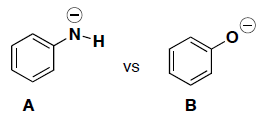
- (4 pts) Circle which molecule is a better nucleophile and briefly explain your answer.
-
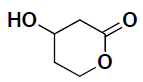
- (5 pts) Identify the asymmetric carbon center in the molecule shown below and then draw a perspective structure for each enantiomer.
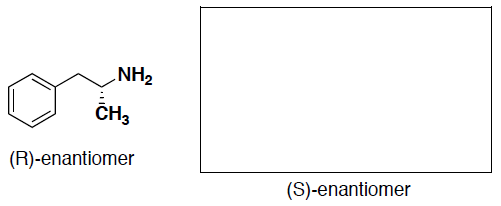
- (3 pts) The (R)-enantiomer of an amine molecule is shown below. Draw the perspective structure for the (S)-enantiomer (ie, the other enantiomer) in the box provided.
- (5 pts) Identify the asymmetric carbon center in the molecule shown below and then draw a perspective structure for each enantiomer.
- Extra Practice:
- (4 pts) Draw the racemic mixture (both enantiomers) that result upon hydrogenation of the following alkene with an achiral catalyst.
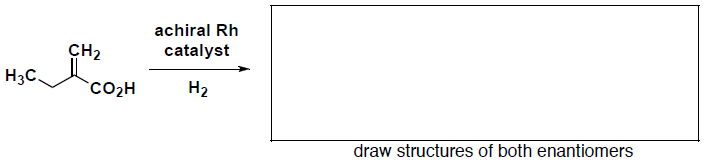
- (2 pts) How would you expect the reaction to be different if a chiral Rh catalyst is used?