

1.4: Quiz 1A Key
- Page ID
- 18944
\( \newcommand{\vecs}[1]{\overset { \scriptstyle \rightharpoonup} {\mathbf{#1}} } \)
\( \newcommand{\vecd}[1]{\overset{-\!-\!\rightharpoonup}{\vphantom{a}\smash {#1}}} \)
\( \newcommand{\dsum}{\displaystyle\sum\limits} \)
\( \newcommand{\dint}{\displaystyle\int\limits} \)
\( \newcommand{\dlim}{\displaystyle\lim\limits} \)
\( \newcommand{\id}{\mathrm{id}}\) \( \newcommand{\Span}{\mathrm{span}}\)
( \newcommand{\kernel}{\mathrm{null}\,}\) \( \newcommand{\range}{\mathrm{range}\,}\)
\( \newcommand{\RealPart}{\mathrm{Re}}\) \( \newcommand{\ImaginaryPart}{\mathrm{Im}}\)
\( \newcommand{\Argument}{\mathrm{Arg}}\) \( \newcommand{\norm}[1]{\| #1 \|}\)
\( \newcommand{\inner}[2]{\langle #1, #2 \rangle}\)
\( \newcommand{\Span}{\mathrm{span}}\)
\( \newcommand{\id}{\mathrm{id}}\)
\( \newcommand{\Span}{\mathrm{span}}\)
\( \newcommand{\kernel}{\mathrm{null}\,}\)
\( \newcommand{\range}{\mathrm{range}\,}\)
\( \newcommand{\RealPart}{\mathrm{Re}}\)
\( \newcommand{\ImaginaryPart}{\mathrm{Im}}\)
\( \newcommand{\Argument}{\mathrm{Arg}}\)
\( \newcommand{\norm}[1]{\| #1 \|}\)
\( \newcommand{\inner}[2]{\langle #1, #2 \rangle}\)
\( \newcommand{\Span}{\mathrm{span}}\) \( \newcommand{\AA}{\unicode[.8,0]{x212B}}\)
\( \newcommand{\vectorA}[1]{\vec{#1}} % arrow\)
\( \newcommand{\vectorAt}[1]{\vec{\text{#1}}} % arrow\)
\( \newcommand{\vectorB}[1]{\overset { \scriptstyle \rightharpoonup} {\mathbf{#1}} } \)
\( \newcommand{\vectorC}[1]{\textbf{#1}} \)
\( \newcommand{\vectorD}[1]{\overrightarrow{#1}} \)
\( \newcommand{\vectorDt}[1]{\overrightarrow{\text{#1}}} \)
\( \newcommand{\vectE}[1]{\overset{-\!-\!\rightharpoonup}{\vphantom{a}\smash{\mathbf {#1}}}} \)
\( \newcommand{\vecs}[1]{\overset { \scriptstyle \rightharpoonup} {\mathbf{#1}} } \)
\(\newcommand{\longvect}{\overrightarrow}\)
\( \newcommand{\vecd}[1]{\overset{-\!-\!\rightharpoonup}{\vphantom{a}\smash {#1}}} \)
\(\newcommand{\ket}[1]{\left| #1 \right>}\)
\(\newcommand{\bra}[1]{\left< #1 \right|}\)
\(\newcommand{\braket}[2]{\left< #1 \vphantom{#2} \right| \left. #2 \vphantom{#1} \right>}\)
\(\newcommand{\braopket}[3]{\left< #1 \vphantom{#2}\vphantom{#3} \right| #2 \vphantom{#1}\vphantom{#3} \left| #3 \vphantom{#1}\vphantom{#2} \right>}\)
\(\newcommand{\qmvec}[1]{\mathbf{\vec{#1}}}\)
\(\newcommand{\op}[1]{\hat{\mathbf{#1}}}\)
\(\newcommand{\expect}[1]{\langle #1 \rangle}\)
\(\newcommand{\dfn}[1]{\emph{\textbf{#1}}}\)
-
- Please indicate true (T) or false (F) for the following statements based on lecture materials (2 pts each):
| __F__ | Based on the number of valence electrons, a carbon atom can have either three, four or five bonds. |
| __F__ | If a carbon atom is sp2 hybridized, then the bond angles will be 180˚. |
| __T__ | LiCl contains an ionic bond. |
- For each of the following condensed structures, indicate how many lone pairs each molecule has. (1 pt each, put your numerical answer in the box provided)
| CH3CH2OH | CH3Cl | HONH2 | CH3CH2CH3 | |||
 |  |  |  |
- (3 pts each) Draw a Lewis structure for the following species (including any lone pairs):
| a) H2CO | b) [CH3NH3]+ | |
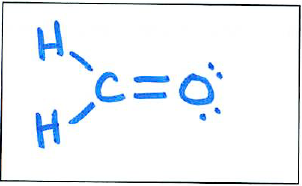 |  |
-
- (2 pts) Covalent bonds may be polar or nonpolar. What property of the atoms forming a given bond determines this?
electronegativity
- Give an example for each of the following bond types (2 pts each):
(Note: your answer does not need to be a valid Lewis structure, you can just show two atoms in a bond.)
- (2 pts) Covalent bonds may be polar or nonpolar. What property of the atoms forming a given bond determines this?
| non-polar covalent bond | polar covalent bond | |
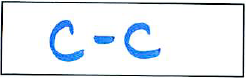 |  | |
| F-F H-H based on the lecture notes and page 8 of the textbook, | C-F C-Cl C-Br C-O F-H O-H N-H |
-
- (4 pts) Briefly explain why a carbon atom cannot have more than 4 bonds?
Carbon has 4 valence electrons and 4 orbitals that can each accept an electron to make 4 bonds (2 e- each). More than 4 bonds would violate the octet rule because all orbitals are full.
- (4 pts) Draw a structure of a molecule that has an sp-hybridized carbon that is directly attached to an sp2-hybridized carbon and clearly label these two carbon atoms with the hybridization. (Note: Your molecule can have any atoms in addition to these two carbon atoms. There are several possible answers, but make sure that your answer is a valid structure showing any hydrogens or lone pairs for full credit.)
- (4 pts) Briefly explain why a carbon atom cannot have more than 4 bonds?

- Multiple choice (2 pts each, put your letter answer in the box provided)
What is the approximate value of the Br-C-Br bond angles in carbon tetrabromide, CBr4?
 90˚
- 109˚
- 120˚
- 180˚
Which of the following describes a carbon-carbon triple bond?
 three pi bonds
- one sigma bond and one pi bond
- two sigma bonds and one pi bond
- one sigma bond and two pi bonds
-
- For the following molecule, give the hybridization of the indicated atom.
(2 pts each, put your answer in the box provided)
- For the following molecule, give the hybridization of the indicated atom.

- (2 pts each) What are the formal charges on the indicated nitrogen and oxygen atoms in the molecule shown below?
