

8.6 Molecular Geometries
- Page ID
- 169774
\( \newcommand{\vecs}[1]{\overset { \scriptstyle \rightharpoonup} {\mathbf{#1}} } \)
\( \newcommand{\vecd}[1]{\overset{-\!-\!\rightharpoonup}{\vphantom{a}\smash {#1}}} \)
\( \newcommand{\dsum}{\displaystyle\sum\limits} \)
\( \newcommand{\dint}{\displaystyle\int\limits} \)
\( \newcommand{\dlim}{\displaystyle\lim\limits} \)
\( \newcommand{\id}{\mathrm{id}}\) \( \newcommand{\Span}{\mathrm{span}}\)
( \newcommand{\kernel}{\mathrm{null}\,}\) \( \newcommand{\range}{\mathrm{range}\,}\)
\( \newcommand{\RealPart}{\mathrm{Re}}\) \( \newcommand{\ImaginaryPart}{\mathrm{Im}}\)
\( \newcommand{\Argument}{\mathrm{Arg}}\) \( \newcommand{\norm}[1]{\| #1 \|}\)
\( \newcommand{\inner}[2]{\langle #1, #2 \rangle}\)
\( \newcommand{\Span}{\mathrm{span}}\)
\( \newcommand{\id}{\mathrm{id}}\)
\( \newcommand{\Span}{\mathrm{span}}\)
\( \newcommand{\kernel}{\mathrm{null}\,}\)
\( \newcommand{\range}{\mathrm{range}\,}\)
\( \newcommand{\RealPart}{\mathrm{Re}}\)
\( \newcommand{\ImaginaryPart}{\mathrm{Im}}\)
\( \newcommand{\Argument}{\mathrm{Arg}}\)
\( \newcommand{\norm}[1]{\| #1 \|}\)
\( \newcommand{\inner}[2]{\langle #1, #2 \rangle}\)
\( \newcommand{\Span}{\mathrm{span}}\) \( \newcommand{\AA}{\unicode[.8,0]{x212B}}\)
\( \newcommand{\vectorA}[1]{\vec{#1}} % arrow\)
\( \newcommand{\vectorAt}[1]{\vec{\text{#1}}} % arrow\)
\( \newcommand{\vectorB}[1]{\overset { \scriptstyle \rightharpoonup} {\mathbf{#1}} } \)
\( \newcommand{\vectorC}[1]{\textbf{#1}} \)
\( \newcommand{\vectorD}[1]{\overrightarrow{#1}} \)
\( \newcommand{\vectorDt}[1]{\overrightarrow{\text{#1}}} \)
\( \newcommand{\vectE}[1]{\overset{-\!-\!\rightharpoonup}{\vphantom{a}\smash{\mathbf {#1}}}} \)
\( \newcommand{\vecs}[1]{\overset { \scriptstyle \rightharpoonup} {\mathbf{#1}} } \)
\(\newcommand{\longvect}{\overrightarrow}\)
\( \newcommand{\vecd}[1]{\overset{-\!-\!\rightharpoonup}{\vphantom{a}\smash {#1}}} \)
\(\newcommand{\ket}[1]{\left| #1 \right>}\)
\(\newcommand{\bra}[1]{\left< #1 \right|}\)
\(\newcommand{\braket}[2]{\left< #1 \vphantom{#2} \right| \left. #2 \vphantom{#1} \right>}\)
\(\newcommand{\braopket}[3]{\left< #1 \vphantom{#2}\vphantom{#3} \right| #2 \vphantom{#1}\vphantom{#3} \left| #3 \vphantom{#1}\vphantom{#2} \right>}\)
\(\newcommand{\qmvec}[1]{\mathbf{\vec{#1}}}\)
\(\newcommand{\op}[1]{\hat{\mathbf{#1}}}\)
\(\newcommand{\expect}[1]{\langle #1 \rangle}\)
\(\newcommand{\dfn}[1]{\emph{\textbf{#1}}}\)
Molecular Geometry
Exercise \(\PageIndex{1}\)
What is the molecular geometry around an atom in a molecule or ion which is surrounded by zero lone pairs of electrons and four single bonds.
- Answer
-
tetrahedral
Exercise \(\PageIndex{2}\)
What is the electron-pair geometry around an atom in a molecule or ion which is surrounded by two lone pairs of electrons and three single bonds.
- Answer
-
trigonal bipyramidal
Exercise \(\PageIndex{3}\)
The molecular geometry of a molecule whose central atom has four single bonds and one lone pair of electrons is ________.
- Answer
-
trigonal-bipyramidal
Exercise \(\PageIndex{4}\)
What is the bond angle in a trigonal planar molecule or ion?
- Answer
-
120°
VSEPR
Exercise \(\PageIndex{5}\)
What is the molecular geometry around the nitrogen atom as per the valence shell electron-pair repulsion (VSEPR) theory??
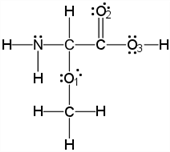
- Answer
-
trigonal pyramidal
Exercise \(\PageIndex{6}\)
What is the molecular geometry around carbon atom C1?
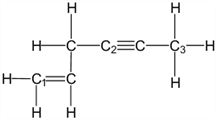
- Answer
-
trigonal planar
Exercise \(\PageIndex{7}\)
Use VSEPR theory to predict the electron-pair geometry and the molecular geometry of nitrogen trichloride, NCl3.
- The electron-pair geometry is linear, the molecular geometry is linear.
- The electron-pair geometry is trigonal-planar, the molecular geometry is trigonal-planar.
- The electron-pair geometry is trigonal-planar, the molecular geometry is bent.
- The electron-pair geometry is tetrahedral, the molecular geometry is tetrahedral.
- The electron-pair geometry is tetrahedral, the molecular geometry is trigonal-pyramidal.
- Answer
-
e. The electron-pair geometry is tetrahedral, the molecular geometry is trigonal-pyramidal.
Exercise \(\PageIndex{8}\)
Use VSEPR theory to predict the electron-pair geometry and the molecular geometry of boron tribromide, BBr3.
- The electron-pair geometry is trigonal-pyramidal, the molecular geometry is trigonal-pyramidal.
- The electron-pair geometry is trigonal-planar, the molecular geometry is trigonal-planar.
- The electron-pair geometry is trigonal-planar, the molecular geometry is bent.
- The electron-pair geometry is tetrahedral, the molecular geometry is trigonal-pyramidal.
- The electron-pair geometry is trigonal-pyramidal, the molecular geometry is t-shaped.
- Answer
-
b. The electron-pair geometry is trigonal-planar, the molecular geometry is trigonal-planar.
Bond Angles
Exercise \(\PageIndex{9}\)
Based on electron-pair geometries, which of the following molecules has the smallest bond angle between any two adjacent atoms?
a. CH4 b. H2O c. BH3 d. PH3 e. SF6
- Answer
-
e. SF6
Exercise \(\PageIndex{10}\)
What are the approximate H−N−H bond angles in NH4+?
- Answer
-
109.5°
Exercise \(\PageIndex{11}\)
What is the O−C−N bond angle in OCN–?
- Answer
-
180°
Exercise \(\PageIndex{12}\)
What are the approximate F−Br−F bond angles in BrF5?
- Answer
-
90° and 180°
Exercise \(\PageIndex{13}\)
In PCl5, the Cl−P−Cl bond angle between an axial and an equatorial chlorine atom is ________ degrees.
- Answer
-
90
Exercise \(\PageIndex{14}\)
Place the following molecules in order from smallest to largest H−N−H bond angles: NH4+, NH3, and NH2–.
- NH4+ < NH3 < NH2–
- NH4+ < NH2– < NH3
- NH2– < NH3 < NH4+
- NH2– < NH4+ < NH3
- NH3 < NH2– < NH4+
- Answer
-
c. NH2– < NH3 < NH4+