

8.2: Covalent Bonding and Lewis Structures
- Page ID
- 169770
\( \newcommand{\vecs}[1]{\overset { \scriptstyle \rightharpoonup} {\mathbf{#1}} } \)
\( \newcommand{\vecd}[1]{\overset{-\!-\!\rightharpoonup}{\vphantom{a}\smash {#1}}} \)
\( \newcommand{\dsum}{\displaystyle\sum\limits} \)
\( \newcommand{\dint}{\displaystyle\int\limits} \)
\( \newcommand{\dlim}{\displaystyle\lim\limits} \)
\( \newcommand{\id}{\mathrm{id}}\) \( \newcommand{\Span}{\mathrm{span}}\)
( \newcommand{\kernel}{\mathrm{null}\,}\) \( \newcommand{\range}{\mathrm{range}\,}\)
\( \newcommand{\RealPart}{\mathrm{Re}}\) \( \newcommand{\ImaginaryPart}{\mathrm{Im}}\)
\( \newcommand{\Argument}{\mathrm{Arg}}\) \( \newcommand{\norm}[1]{\| #1 \|}\)
\( \newcommand{\inner}[2]{\langle #1, #2 \rangle}\)
\( \newcommand{\Span}{\mathrm{span}}\)
\( \newcommand{\id}{\mathrm{id}}\)
\( \newcommand{\Span}{\mathrm{span}}\)
\( \newcommand{\kernel}{\mathrm{null}\,}\)
\( \newcommand{\range}{\mathrm{range}\,}\)
\( \newcommand{\RealPart}{\mathrm{Re}}\)
\( \newcommand{\ImaginaryPart}{\mathrm{Im}}\)
\( \newcommand{\Argument}{\mathrm{Arg}}\)
\( \newcommand{\norm}[1]{\| #1 \|}\)
\( \newcommand{\inner}[2]{\langle #1, #2 \rangle}\)
\( \newcommand{\Span}{\mathrm{span}}\) \( \newcommand{\AA}{\unicode[.8,0]{x212B}}\)
\( \newcommand{\vectorA}[1]{\vec{#1}} % arrow\)
\( \newcommand{\vectorAt}[1]{\vec{\text{#1}}} % arrow\)
\( \newcommand{\vectorB}[1]{\overset { \scriptstyle \rightharpoonup} {\mathbf{#1}} } \)
\( \newcommand{\vectorC}[1]{\textbf{#1}} \)
\( \newcommand{\vectorD}[1]{\overrightarrow{#1}} \)
\( \newcommand{\vectorDt}[1]{\overrightarrow{\text{#1}}} \)
\( \newcommand{\vectE}[1]{\overset{-\!-\!\rightharpoonup}{\vphantom{a}\smash{\mathbf {#1}}}} \)
\( \newcommand{\vecs}[1]{\overset { \scriptstyle \rightharpoonup} {\mathbf{#1}} } \)
\(\newcommand{\longvect}{\overrightarrow}\)
\( \newcommand{\vecd}[1]{\overset{-\!-\!\rightharpoonup}{\vphantom{a}\smash {#1}}} \)
\(\newcommand{\ket}[1]{\left| #1 \right>}\)
\(\newcommand{\bra}[1]{\left< #1 \right|}\)
\(\newcommand{\braket}[2]{\left< #1 \vphantom{#2} \right| \left. #2 \vphantom{#1} \right>}\)
\(\newcommand{\braopket}[3]{\left< #1 \vphantom{#2}\vphantom{#3} \right| #2 \vphantom{#1}\vphantom{#3} \left| #3 \vphantom{#1}\vphantom{#2} \right>}\)
\(\newcommand{\qmvec}[1]{\mathbf{\vec{#1}}}\)
\(\newcommand{\op}[1]{\hat{\mathbf{#1}}}\)
\(\newcommand{\expect}[1]{\langle #1 \rangle}\)
\(\newcommand{\dfn}[1]{\emph{\textbf{#1}}}\)
Exercise \(\PageIndex{1}\)
Name each molecule.
- What homonuclear diatomic molecule(s) have single bonds? That is, both atoms are the same element (A-A or B-B, not A-B)
- What homonuclear diatomic molecule(s) have double bonds?
- What homonuclear diatomic molecule(s) have triple bonds?
- How many electrons are in the valence shell of nitrogen?
- Answer a
-
H2, F2, Cl2, Br2, I2
- Answer b
-
O2
- Answer c
-
N2
- Answer d
-
5
Exercise \(\PageIndex{2}\)
- What is the octet rule?
- What atom can never have an octet, and why?
- What group of the periodic table forms stable molecules with 6 electrons in its valence shell?
- Atoms of what periods can not have an expanded octet?
- Answer a
-
Atoms in a molecule tend to have 8 electrons that reside in 4 orbitals. These may be lone pairs (localized on the atom) or bonding pairs (shared with another nucleous)
- Answer b
-
Hydrogen, as there is only one orbital in its valence shell, the 1s orbital
- Answer c
-
Group IIIA
- Answer d
-
the first and second period, as there are no d orbitals. The first period only has a 1s orbital, while the second has 2s and three 2p
Exercise \(\PageIndex{3}\)
- How many electrons are in a double bond?
- How many electrons are in a triple bond?
- What group of the periodic table forms stable molecules with 6 electrons in its valence shell?
- Carbon and sulfur are in group IVA and both have 4 valence electrons in their valence shell. Why can sulfur have an expanded octet, but carbon can not?
- Answer a
-
4
- Answer b
-
6
- Answer c
-
Group IIIA
- Answer d
-
Carbon is in the second period and so there are only 4 orbitals in the valence shell (2s and three 2p) and thus it can only have 8 electrons, while sulfur is in the third period and has 8 orbitals (one 3s, threee 3p and five 3d), and so it can hold more electrons and have an expanded octet.
Exercise \(\PageIndex{1}\)
Which of the following statements is/are CORRECT?
- Chemical reactions result in the gain, loss, or rearrangement of valence electrons.
- For main group elements, the number of valence electrons equals eight minus the element’s group number.
- Core electrons are not involved in bonding or in chemical reactions.
a. 1 only b. 2 only c. 3 only d. 1 and 3 e. 1, 2, and 3
- Answer
-
d. 1 and 3
Exercise \(\PageIndex{2}\)
The given representation of an atom is called the _____.

- a Lewis dot structure.
- an ion.
- a structural formula.
- an electrostatic potential map.
- an ionic bond.
- Answer
-
a. a Lewis dot structure.
Exercise \(\PageIndex{3}\)
In the Lewis formula for sulfur dioxide, SO2, the number of lone pairs of electrons around the sulfur atom is
- Answer
-
1.
Exercise \(\PageIndex{4}\)
What is the total number of electrons (both lone and bond pairs) in the Lewis structure of SO42-?
- Answer
-
32
Exercise \(\PageIndex{5}\)
How many valence electrons are present in the Lewis formula for the chlorite ion, Cl2–?
- Answer
-
20
Exercise \(\PageIndex{6}\)
Which of the following molecules or ions are isoelectronic: SO3, NF3, NO3–, CO32–?
- Answer
-
SO3, NO3– and CO32–
Exercise \(\PageIndex{7}\)
Which of the following has a Lewis structure similar to OCS?
a. NH2− b. O3 c. CO2 d. SO2 e. ClO2−
- Answer
-
c. CO2
Exercise \(\PageIndex{8}\)
The correct Lewis structure for Cl2CO is (the 2 Cl's and the O are bound to the C and not to each other):
a. 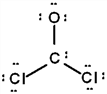 b.
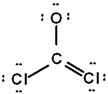 c.
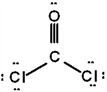 d.
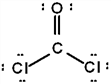 e. None of these
- Answer
-
d.
Exercise \(\PageIndex{9}\)
Which of the following is the Lewis electron dot structure for carbon monoxide?
a.  b.
 c.
 d.
 e.

- Answer
-
a.
Exercise \(\PageIndex{10}\)
Which of the following will often have a Lewis dot structure with 6 electrons in the valence orbital?
B, Be, Al, Mg, C, S, Cl
- Answer
-
B and Al
Exercise \(\PageIndex{10}\)
Which of the following will often have a Lewis dot structure with 4 electrons in the valence orbital?
B, Be, Al, Mg, C, S, Cl
- Answer
-
Be, Mg
Exercise \(\PageIndex{10}\)
Which of the following will often have a Lewis dot structure with 12 electrons in the valence orbital?
B, Be, Al, Mg, C, S, Cl
- Answer
-
S
Exercise \(\PageIndex{10}\)
Which of the following will often have a Lewis dot structure with 10 electrons in the valence orbital?
B, Be, Al, Mg, C, P, S
- Answer
-
P