3.1: Elements, Compounds, Pure Substances, and Mixtures
- Page ID
- 540946

\( \newcommand{\vecs}[1]{\overset { \scriptstyle \rightharpoonup} {\mathbf{#1}} } \)
\( \newcommand{\vecd}[1]{\overset{-\!-\!\rightharpoonup}{\vphantom{a}\smash {#1}}} \)
\( \newcommand{\dsum}{\displaystyle\sum\limits} \)
\( \newcommand{\dint}{\displaystyle\int\limits} \)
\( \newcommand{\dlim}{\displaystyle\lim\limits} \)
\( \newcommand{\id}{\mathrm{id}}\) \( \newcommand{\Span}{\mathrm{span}}\)
( \newcommand{\kernel}{\mathrm{null}\,}\) \( \newcommand{\range}{\mathrm{range}\,}\)
\( \newcommand{\RealPart}{\mathrm{Re}}\) \( \newcommand{\ImaginaryPart}{\mathrm{Im}}\)
\( \newcommand{\Argument}{\mathrm{Arg}}\) \( \newcommand{\norm}[1]{\| #1 \|}\)
\( \newcommand{\inner}[2]{\langle #1, #2 \rangle}\)
\( \newcommand{\Span}{\mathrm{span}}\)
\( \newcommand{\id}{\mathrm{id}}\)
\( \newcommand{\Span}{\mathrm{span}}\)
\( \newcommand{\kernel}{\mathrm{null}\,}\)
\( \newcommand{\range}{\mathrm{range}\,}\)
\( \newcommand{\RealPart}{\mathrm{Re}}\)
\( \newcommand{\ImaginaryPart}{\mathrm{Im}}\)
\( \newcommand{\Argument}{\mathrm{Arg}}\)
\( \newcommand{\norm}[1]{\| #1 \|}\)
\( \newcommand{\inner}[2]{\langle #1, #2 \rangle}\)
\( \newcommand{\Span}{\mathrm{span}}\) \( \newcommand{\AA}{\unicode[.8,0]{x212B}}\)
\( \newcommand{\vectorA}[1]{\vec{#1}} % arrow\)
\( \newcommand{\vectorAt}[1]{\vec{\text{#1}}} % arrow\)
\( \newcommand{\vectorB}[1]{\overset { \scriptstyle \rightharpoonup} {\mathbf{#1}} } \)
\( \newcommand{\vectorC}[1]{\textbf{#1}} \)
\( \newcommand{\vectorD}[1]{\overrightarrow{#1}} \)
\( \newcommand{\vectorDt}[1]{\overrightarrow{\text{#1}}} \)
\( \newcommand{\vectE}[1]{\overset{-\!-\!\rightharpoonup}{\vphantom{a}\smash{\mathbf {#1}}}} \)
\( \newcommand{\vecs}[1]{\overset { \scriptstyle \rightharpoonup} {\mathbf{#1}} } \)
\(\newcommand{\longvect}{\overrightarrow}\)
\( \newcommand{\vecd}[1]{\overset{-\!-\!\rightharpoonup}{\vphantom{a}\smash {#1}}} \)
\(\newcommand{\ket}[1]{\left| #1 \right>}\)
\(\newcommand{\bra}[1]{\left< #1 \right|}\)
\(\newcommand{\braket}[2]{\left< #1 \vphantom{#2} \right| \left. #2 \vphantom{#1} \right>}\)
\(\newcommand{\braopket}[3]{\left< #1 \vphantom{#2}\vphantom{#3} \right| #2 \vphantom{#1}\vphantom{#3} \left| #3 \vphantom{#1}\vphantom{#2} \right>}\)
\(\newcommand{\qmvec}[1]{\mathbf{\vec{#1}}}\)
\(\newcommand{\op}[1]{\hat{\mathbf{#1}}}\)
\(\newcommand{\expect}[1]{\langle #1 \rangle}\)
\(\newcommand{\dfn}[1]{\emph{\textbf{#1}}}\)
- Define matter, element, molecule, compound, molecule, mixture, homogeneous and heterogeneous mixtures.
- Be able to write and interpret symbols of elements, molecules, and compounds.
What is the matter?
Matter is anything that has mass and occupies space.
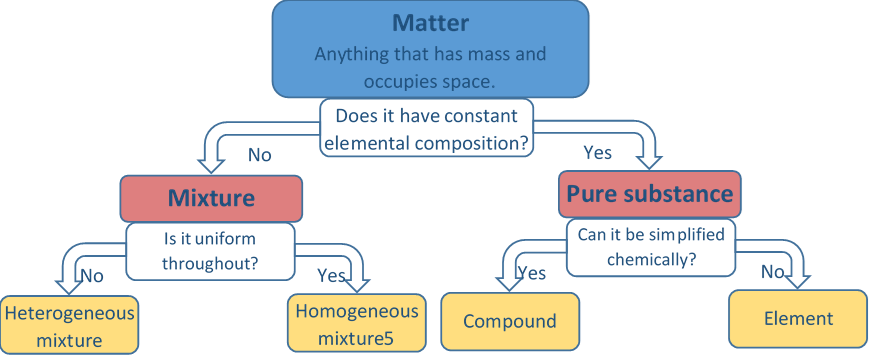
Matter is a natural material that makes up the universe. The matter comprises tiny particles called atoms held together by forces called bonds. The matter is classified as pure if it has a constant and a non-variable composition of the type of atoms. Pure matter is either an element or a compound.
Element
An element is pure matter that is composed of only one type of atom
For example, carbon, shown in Fig. 3.1.1, is an element. Elements can not convert to simpler matter by physical or chemical methods. There are around a hundred different elements known at this time. For example, hydrogen, oxygen, carbon, nitrogen, sodium, chlorine, iron, cobalt, gold, and silver are a few elements.
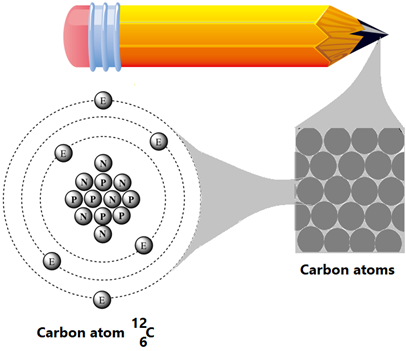
Symbol of an element
Symbols represent elements, the first alphabet of their English or non-English name, written in capital letters. For example, C for carbon, O for oxygen, and H for hydrogen. Usually, another alphabet is also chosen from the element's name and written as a small letter, e.g., He for helium, Co for cobalt. Some element symbols are derived from non-English names, e.g., Fe for iron is from its Latin name Ferrum, and Au for gold is from its Latin name Aurum.
Two consecutive capital letters do not represent an element; they may combine two elements.
CO is not a symbol of an element; it is a pure matter, a combination of carbon and oxygen bonded together in a 1:1 atom ratio.
Molecule
A molecule is a group of two or more atoms held together by forces called chemical bonds. The molecule is the smallest particle of matter that can exist freely. A single atom of some elements can exist freely and is also considered a molecule. For example, He, O2, P4, and S8 are examples of elements having molecules composed of one, two, four, and eight atoms of the same element, respectively, as illustrated in Fig. 3.1.2. Although metal elements exist as a vast number of atoms bonded together by a special type of bond called metallic bonds, their symbol is that of a single atom, e.g., Fe for iron and Au for gold.

Compound
A compound is a pure matter composed of atoms of two or more different elements in a constant whole-number ratio held together by chemical bonds.
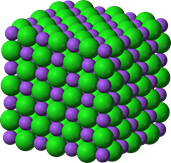
The symbol of a compound is a combination of its constituent elements with a subscript to the right of the element symbol representing the whole number ratio of the atoms of the element in the compound. For example, H2O symbolizes a compound called water composed of hydrogen (H) and oxygen (O) atoms in a 2:1 ratio. Similarly, NaCl symbolizes a table salt compound composed of sodium (Na) and chlorine (Cl) atoms in a 1:1 ratio. If the symbol of a compound also represents a molecule of the compound, it is called a molecular formula. For example, H2O is a molecule formula of water. On the other hand, table salt is another class of compound composed of a vast number of atoms of its constituent elements arranged in a specific arrangement in 3D space called a crystal lattice, as illustrated in Fig. 1.1.3. When the compound symbol does not represent a molecule, it only means the simple whole-number ratio of the constituent elements; it is called the formula unit. For example, NaCl is a chemical formula of a compound called table salt.

A chemical compound always contains the number of atoms of its component elements in a constant ratio, or the ratio of masses of the constituent elements is a constant in a given compound.
Pure matter, i.e., elements or compounds, has a fixed proportion of atoms of element/s independent of the source or method of their preparation. It is also called a chemical or a substance. The atoms in a compound are held together by attractive forces called chemical bonds. Constituent elements in a compound can be separated only by breaking chemical bonds and making new chemical bonds which is a chemical reaction.
Mixture
Two or more pure substances mixed such that ratio of the constituents is variable is called a mixture.
For example, table salt can be mixed with water, but the salt (NaCl) to water (H2O) can be varied to give less salty or more salty water in a mixture. A mixture in which the components are thoroughly mixed, and the composition is constant throughout a given sample, is a homogeneous mixture or a solution. For example, table salt dissolved in water is an example of a homogeneous mixture or a solution. Other homogeneous mixtures include sugar dissolved in water; the air, a mixture of nitrogen, oxygen, carbon dioxide, and other gases; and metal alloys like brass, a mix of copper and zinc metals, etc.


It is a heterogeneous mixture if the constituents are not thoroughly mixed and the composition varies within different regions of a given sample. For example, sulfur (S) powder mixed with iron (Fe) filling is a heterogeneous mixture shown in Fig. 3.1.4. Other examples of heterogeneous mixtures include smoke which is a mixture of air and carbon particles; smog which is a mixture of liquid water droplets suspended in air; and orange juice which is a mixture of sugar, water, fiber particles, etc. Fig. 3.1.5 illustrates the classification of the matter described above.