

3.2: Discussion
- Page ID
- 478289

\( \newcommand{\vecs}[1]{\overset { \scriptstyle \rightharpoonup} {\mathbf{#1}} } \)
\( \newcommand{\vecd}[1]{\overset{-\!-\!\rightharpoonup}{\vphantom{a}\smash {#1}}} \)
\( \newcommand{\dsum}{\displaystyle\sum\limits} \)
\( \newcommand{\dint}{\displaystyle\int\limits} \)
\( \newcommand{\dlim}{\displaystyle\lim\limits} \)
\( \newcommand{\id}{\mathrm{id}}\) \( \newcommand{\Span}{\mathrm{span}}\)
( \newcommand{\kernel}{\mathrm{null}\,}\) \( \newcommand{\range}{\mathrm{range}\,}\)
\( \newcommand{\RealPart}{\mathrm{Re}}\) \( \newcommand{\ImaginaryPart}{\mathrm{Im}}\)
\( \newcommand{\Argument}{\mathrm{Arg}}\) \( \newcommand{\norm}[1]{\| #1 \|}\)
\( \newcommand{\inner}[2]{\langle #1, #2 \rangle}\)
\( \newcommand{\Span}{\mathrm{span}}\)
\( \newcommand{\id}{\mathrm{id}}\)
\( \newcommand{\Span}{\mathrm{span}}\)
\( \newcommand{\kernel}{\mathrm{null}\,}\)
\( \newcommand{\range}{\mathrm{range}\,}\)
\( \newcommand{\RealPart}{\mathrm{Re}}\)
\( \newcommand{\ImaginaryPart}{\mathrm{Im}}\)
\( \newcommand{\Argument}{\mathrm{Arg}}\)
\( \newcommand{\norm}[1]{\| #1 \|}\)
\( \newcommand{\inner}[2]{\langle #1, #2 \rangle}\)
\( \newcommand{\Span}{\mathrm{span}}\) \( \newcommand{\AA}{\unicode[.8,0]{x212B}}\)
\( \newcommand{\vectorA}[1]{\vec{#1}} % arrow\)
\( \newcommand{\vectorAt}[1]{\vec{\text{#1}}} % arrow\)
\( \newcommand{\vectorB}[1]{\overset { \scriptstyle \rightharpoonup} {\mathbf{#1}} } \)
\( \newcommand{\vectorC}[1]{\textbf{#1}} \)
\( \newcommand{\vectorD}[1]{\overrightarrow{#1}} \)
\( \newcommand{\vectorDt}[1]{\overrightarrow{\text{#1}}} \)
\( \newcommand{\vectE}[1]{\overset{-\!-\!\rightharpoonup}{\vphantom{a}\smash{\mathbf {#1}}}} \)
\( \newcommand{\vecs}[1]{\overset { \scriptstyle \rightharpoonup} {\mathbf{#1}} } \)
\(\newcommand{\longvect}{\overrightarrow}\)
\( \newcommand{\vecd}[1]{\overset{-\!-\!\rightharpoonup}{\vphantom{a}\smash {#1}}} \)
\(\newcommand{\ket}[1]{\left| #1 \right>}\)
\(\newcommand{\bra}[1]{\left< #1 \right|}\)
\(\newcommand{\braket}[2]{\left< #1 \vphantom{#2} \right| \left. #2 \vphantom{#1} \right>}\)
\(\newcommand{\braopket}[3]{\left< #1 \vphantom{#2}\vphantom{#3} \right| #2 \vphantom{#1}\vphantom{#3} \left| #3 \vphantom{#1}\vphantom{#2} \right>}\)
\(\newcommand{\qmvec}[1]{\mathbf{\vec{#1}}}\)
\(\newcommand{\op}[1]{\hat{\mathbf{#1}}}\)
\(\newcommand{\expect}[1]{\langle #1 \rangle}\)
\(\newcommand{\dfn}[1]{\emph{\textbf{#1}}}\)
Electronegativity
Electronegativity is the power of an atom to attract bonding pairs of electrons towards itself, when it is a part of a compound. Refer to the electronegativity chart to see the trends among the elements.
Electronegativity chart

Bond Polarity
Electrons shared by two atoms are influenced by the positively charged nuclei of both atoms. For like atoms, these forces are equal. For example, in diatomic molecules such as H2 or Cl2, the bonded atoms have exactly the same electronegativity and hence the bond formed is a nonpolar covalent bond. Unlike atoms exert unequal attractions for their shared electrons and form polar covalent bonds
When the differences in electronegativity are less than 0.5, the bond is considered nonpolar.
Differences in electronegativity that ranges from 0.5 to 1.9 result in polar covalent bond.
When it is greater than 1.9 the bond is ionic.
Electronegativity is used to determine the direction of the bond polarity, which can be indicated in the line bond formula by labeling the more electronegative atom with a δ- and the less electronegative atom with a δ+. δ implies partial charge.

Overall Polarity
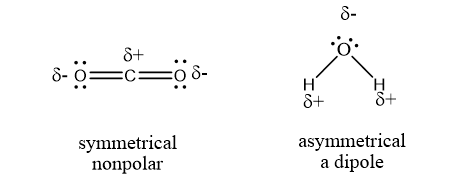
When there are two polar bonds within a molecule as in CO2 the polar effect of these bonds around a central atom can be cancelled if they are arranged symmetrically. On the other hand, if the arrangement of the polar bonds is asymmetrical, as in the bent water molecule, H2O, the resulting molecule has a definite positive end and oppositely charged negative end, and the molecule is called a dipole. In water the H atoms have a partial positive charge δ+, and the O atom has a partial negative charge, δ-. The water molecule is overall polar.
Intermolecular Forces
Molecules interact with one another through intermolecular forces (IMF’s) also known as noncovalent interactions. Polar molecules or polar parts of a molecule interact with one another through hydrogen bond or dipole-dipole forces. A hydrogen bond in an organic compound or a biological molecule is due to the interaction of a nitrogen or oxygen atom with a hydrogen atom that is covalently bonded to a different nitrogen or oxygen atom. Dipole-dipole forces takes place between polar molecules or polar parts of a molecule by orienting δ+ end to δ- end. Hydrogen bond is a special type of dipole-dipole interaction.

Nonpolar molecules or nonpolar parts of a molecule interact with one another through London forces. This force results from continuous movement of electrons in a molecule.