

12.5: The Pressure-Volume Law
- Page ID
- 435132

\( \newcommand{\vecs}[1]{\overset { \scriptstyle \rightharpoonup} {\mathbf{#1}} } \)
\( \newcommand{\vecd}[1]{\overset{-\!-\!\rightharpoonup}{\vphantom{a}\smash {#1}}} \)
\( \newcommand{\dsum}{\displaystyle\sum\limits} \)
\( \newcommand{\dint}{\displaystyle\int\limits} \)
\( \newcommand{\dlim}{\displaystyle\lim\limits} \)
\( \newcommand{\id}{\mathrm{id}}\) \( \newcommand{\Span}{\mathrm{span}}\)
( \newcommand{\kernel}{\mathrm{null}\,}\) \( \newcommand{\range}{\mathrm{range}\,}\)
\( \newcommand{\RealPart}{\mathrm{Re}}\) \( \newcommand{\ImaginaryPart}{\mathrm{Im}}\)
\( \newcommand{\Argument}{\mathrm{Arg}}\) \( \newcommand{\norm}[1]{\| #1 \|}\)
\( \newcommand{\inner}[2]{\langle #1, #2 \rangle}\)
\( \newcommand{\Span}{\mathrm{span}}\)
\( \newcommand{\id}{\mathrm{id}}\)
\( \newcommand{\Span}{\mathrm{span}}\)
\( \newcommand{\kernel}{\mathrm{null}\,}\)
\( \newcommand{\range}{\mathrm{range}\,}\)
\( \newcommand{\RealPart}{\mathrm{Re}}\)
\( \newcommand{\ImaginaryPart}{\mathrm{Im}}\)
\( \newcommand{\Argument}{\mathrm{Arg}}\)
\( \newcommand{\norm}[1]{\| #1 \|}\)
\( \newcommand{\inner}[2]{\langle #1, #2 \rangle}\)
\( \newcommand{\Span}{\mathrm{span}}\) \( \newcommand{\AA}{\unicode[.8,0]{x212B}}\)
\( \newcommand{\vectorA}[1]{\vec{#1}} % arrow\)
\( \newcommand{\vectorAt}[1]{\vec{\text{#1}}} % arrow\)
\( \newcommand{\vectorB}[1]{\overset { \scriptstyle \rightharpoonup} {\mathbf{#1}} } \)
\( \newcommand{\vectorC}[1]{\textbf{#1}} \)
\( \newcommand{\vectorD}[1]{\overrightarrow{#1}} \)
\( \newcommand{\vectorDt}[1]{\overrightarrow{\text{#1}}} \)
\( \newcommand{\vectE}[1]{\overset{-\!-\!\rightharpoonup}{\vphantom{a}\smash{\mathbf {#1}}}} \)
\( \newcommand{\vecs}[1]{\overset { \scriptstyle \rightharpoonup} {\mathbf{#1}} } \)
\(\newcommand{\longvect}{\overrightarrow}\)
\( \newcommand{\vecd}[1]{\overset{-\!-\!\rightharpoonup}{\vphantom{a}\smash {#1}}} \)
\(\newcommand{\ket}[1]{\left| #1 \right>}\)
\(\newcommand{\bra}[1]{\left< #1 \right|}\)
\(\newcommand{\braket}[2]{\left< #1 \vphantom{#2} \right| \left. #2 \vphantom{#1} \right>}\)
\(\newcommand{\braopket}[3]{\left< #1 \vphantom{#2}\vphantom{#3} \right| #2 \vphantom{#1}\vphantom{#3} \left| #3 \vphantom{#1}\vphantom{#2} \right>}\)
\(\newcommand{\qmvec}[1]{\mathbf{\vec{#1}}}\)
\(\newcommand{\op}[1]{\hat{\mathbf{#1}}}\)
\(\newcommand{\expect}[1]{\langle #1 \rangle}\)
\(\newcommand{\dfn}[1]{\emph{\textbf{#1}}}\)
- Understand the relationship between pressure and volume of a gas.
Pressure-Volume Relationship
Consider a gas in a cylinder with a piston pushing it down as illustrated in Fig. 12.5.1. The temperature and amount of gas is kept constant. Objects are placed on the piston to change the pressure or volume of the gas in the cylinder. Increasing the pressure on the piston, e.g., by adding more weight to it, causes the piston to move down, reducing the gas volume. The gas molecules have less distance to travel before striking the piston surface which increases the collision frequency and causes the gas pressure to increase.
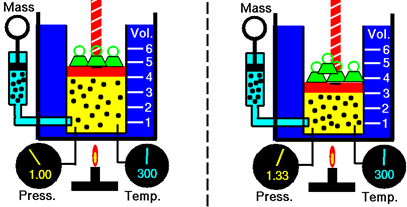
When a change in one parameter causes a change in another, the parameters are related. When an increase in one parameter causes a decrease in another, the two are inversely proportional to each other. Robert Boyle studied the quantitative relationship between the volume and pressure of the gas, keeping the quantity of gas and the temperature constant. The research concluded in a law called Boyle’s law, which states that:
The volume of a gas is inversely proportional to the pressure of the gas provided the temperature and the amount of the gas remain constant.
The mathematical form of Boyle’s law is: \[V \propto \frac{1}{P}\nonumber\], or \[V=\frac{\mathrm{k}}{P}\nonumber\], or \[PV=\mathrm{k}\nonumber\], where k is a constant. Since the product PV is a constant, it implies that: \[P_{1} V_{1}=P_{2} V_{2}={k}\nonumber\], i.e., a product of initial pressure (P1) and initial volume (V1) is equal to the product of final pressure (P2) and final volume (V2) of gas provided the quantity of the gas and temperature does not change.
The pressure of a 1.32 L sample of SO2 gas at 0.532 atm is increased to 1.231 atm. Calculate the new volume of the gas if the temperature and the quantity of the gas remain the same?
Solution
Given: P1 = 0.532 atm, P2 = 1.231 atm, V1 = 1.32 L V2 = ?
Formula: \(P_{1} V_{1}=P_{2} V_{2}={k}\), rearrange to isolate the desired variable: \(V_{2}=\frac{P_{1} V_{1}}{P_{2}}\).
Plug in the values in the rearranged formula and calculate: \(V_{2}=\frac{0.532 \mathrm{~atm} \times 1.32 \mathrm{~L}}{1.231 \mathrm{~atm}}=0.570 \mathrm{~L}\)
An oxygen tank holds 20.0 L of oxygen at a pressure of 10.0 atm. What is the final pressure when the gas is released and occupies a volume of 200. L?
Solution
Given: V1 = 20.0 L, V2 = 200. L, P1 = 10.0 atm P2 = ?
Formula: \(P_{1} V_{1}=P_{2} V_{2}={k}\), rearrange to isolate the desired variable: \(P_{2}=\frac{P_{1} V_{1}}{V_{2}}\).
Plug in the values in the rearranged formula and calculate: \(P_{2}=\frac{10.0 \mathrm{~atm} \times 20.0 \mathrm{~L}}{200. \mathrm{~L}}=1.00 \mathrm{~atm}\).
Applications
Respiration: Inhalation and Exhalation
Respiration is important for survival. Boyle’s law explains the mechanism of respiration. Lungs are elastic structures like balloons placed in the thoracic cavity, as illustrated in Fig. 12.5.2. The diaphragm muscle makes a flexible floor and ribs surround the cavity.

The inhalation or the inspiration process starts when the diaphragm moves down, expanding the thoracic cavity. Volume increases, the air pressure decreases inside the thoracic cavity and the atmospheric air flows into the lungs until the pressure in the lungs is equal to the outside pressure.
The exhalation or the expiration process starts when the diaphragm moves upwards, contracting the thoracic cavity. Volume decreases and the air pressure increases inside the thoracic cavity that pumps the air out of the lungs into the atmosphere.
Diving
When a person dives into the water, at 10 meters in depth, the pressure increases two-fold. Recall the relationship between altitude and atmospheric pressure. As altitude decreases, atmospheric pressure increases. The lungs behave like elastic balloons contracts by a factor of two. To avoid stress on the lungs, the diver requires decompression stops, to allow the lungs to adjust to the increase in atmospheric pressure.
Summary
The pressure of a gas is inversely proportional to the volume provided the temperature and amount of gas are constant.