

6.4: Nucleophilic substitution unimolecular (SN1) reactions
- Page ID
- 548510

\( \newcommand{\vecs}[1]{\overset { \scriptstyle \rightharpoonup} {\mathbf{#1}} } \)
\( \newcommand{\vecd}[1]{\overset{-\!-\!\rightharpoonup}{\vphantom{a}\smash {#1}}} \)
\( \newcommand{\dsum}{\displaystyle\sum\limits} \)
\( \newcommand{\dint}{\displaystyle\int\limits} \)
\( \newcommand{\dlim}{\displaystyle\lim\limits} \)
\( \newcommand{\id}{\mathrm{id}}\) \( \newcommand{\Span}{\mathrm{span}}\)
( \newcommand{\kernel}{\mathrm{null}\,}\) \( \newcommand{\range}{\mathrm{range}\,}\)
\( \newcommand{\RealPart}{\mathrm{Re}}\) \( \newcommand{\ImaginaryPart}{\mathrm{Im}}\)
\( \newcommand{\Argument}{\mathrm{Arg}}\) \( \newcommand{\norm}[1]{\| #1 \|}\)
\( \newcommand{\inner}[2]{\langle #1, #2 \rangle}\)
\( \newcommand{\Span}{\mathrm{span}}\)
\( \newcommand{\id}{\mathrm{id}}\)
\( \newcommand{\Span}{\mathrm{span}}\)
\( \newcommand{\kernel}{\mathrm{null}\,}\)
\( \newcommand{\range}{\mathrm{range}\,}\)
\( \newcommand{\RealPart}{\mathrm{Re}}\)
\( \newcommand{\ImaginaryPart}{\mathrm{Im}}\)
\( \newcommand{\Argument}{\mathrm{Arg}}\)
\( \newcommand{\norm}[1]{\| #1 \|}\)
\( \newcommand{\inner}[2]{\langle #1, #2 \rangle}\)
\( \newcommand{\Span}{\mathrm{span}}\) \( \newcommand{\AA}{\unicode[.8,0]{x212B}}\)
\( \newcommand{\vectorA}[1]{\vec{#1}} % arrow\)
\( \newcommand{\vectorAt}[1]{\vec{\text{#1}}} % arrow\)
\( \newcommand{\vectorB}[1]{\overset { \scriptstyle \rightharpoonup} {\mathbf{#1}} } \)
\( \newcommand{\vectorC}[1]{\textbf{#1}} \)
\( \newcommand{\vectorD}[1]{\overrightarrow{#1}} \)
\( \newcommand{\vectorDt}[1]{\overrightarrow{\text{#1}}} \)
\( \newcommand{\vectE}[1]{\overset{-\!-\!\rightharpoonup}{\vphantom{a}\smash{\mathbf {#1}}}} \)
\( \newcommand{\vecs}[1]{\overset { \scriptstyle \rightharpoonup} {\mathbf{#1}} } \)
\(\newcommand{\longvect}{\overrightarrow}\)
\( \newcommand{\vecd}[1]{\overset{-\!-\!\rightharpoonup}{\vphantom{a}\smash {#1}}} \)
\(\newcommand{\ket}[1]{\left| #1 \right>}\)
\(\newcommand{\bra}[1]{\left< #1 \right|}\)
\(\newcommand{\braket}[2]{\left< #1 \vphantom{#2} \right| \left. #2 \vphantom{#1} \right>}\)
\(\newcommand{\braopket}[3]{\left< #1 \vphantom{#2}\vphantom{#3} \right| #2 \vphantom{#1}\vphantom{#3} \left| #3 \vphantom{#1}\vphantom{#2} \right>}\)
\(\newcommand{\qmvec}[1]{\mathbf{\vec{#1}}}\)
\(\newcommand{\op}[1]{\hat{\mathbf{#1}}}\)
\(\newcommand{\expect}[1]{\langle #1 \rangle}\)
\(\newcommand{\dfn}[1]{\emph{\textbf{#1}}}\)
\(\newcommand{\avec}{\mathbf a}\) \(\newcommand{\bvec}{\mathbf b}\) \(\newcommand{\cvec}{\mathbf c}\) \(\newcommand{\dvec}{\mathbf d}\) \(\newcommand{\dtil}{\widetilde{\mathbf d}}\) \(\newcommand{\evec}{\mathbf e}\) \(\newcommand{\fvec}{\mathbf f}\) \(\newcommand{\nvec}{\mathbf n}\) \(\newcommand{\pvec}{\mathbf p}\) \(\newcommand{\qvec}{\mathbf q}\) \(\newcommand{\svec}{\mathbf s}\) \(\newcommand{\tvec}{\mathbf t}\) \(\newcommand{\uvec}{\mathbf u}\) \(\newcommand{\vvec}{\mathbf v}\) \(\newcommand{\wvec}{\mathbf w}\) \(\newcommand{\xvec}{\mathbf x}\) \(\newcommand{\yvec}{\mathbf y}\) \(\newcommand{\zvec}{\mathbf z}\) \(\newcommand{\rvec}{\mathbf r}\) \(\newcommand{\mvec}{\mathbf m}\) \(\newcommand{\zerovec}{\mathbf 0}\) \(\newcommand{\onevec}{\mathbf 1}\) \(\newcommand{\real}{\mathbb R}\) \(\newcommand{\twovec}[2]{\left[\begin{array}{r}#1 \\ #2 \end{array}\right]}\) \(\newcommand{\ctwovec}[2]{\left[\begin{array}{c}#1 \\ #2 \end{array}\right]}\) \(\newcommand{\threevec}[3]{\left[\begin{array}{r}#1 \\ #2 \\ #3 \end{array}\right]}\) \(\newcommand{\cthreevec}[3]{\left[\begin{array}{c}#1 \\ #2 \\ #3 \end{array}\right]}\) \(\newcommand{\fourvec}[4]{\left[\begin{array}{r}#1 \\ #2 \\ #3 \\ #4 \end{array}\right]}\) \(\newcommand{\cfourvec}[4]{\left[\begin{array}{c}#1 \\ #2 \\ #3 \\ #4 \end{array}\right]}\) \(\newcommand{\fivevec}[5]{\left[\begin{array}{r}#1 \\ #2 \\ #3 \\ #4 \\ #5 \\ \end{array}\right]}\) \(\newcommand{\cfivevec}[5]{\left[\begin{array}{c}#1 \\ #2 \\ #3 \\ #4 \\ #5 \\ \end{array}\right]}\) \(\newcommand{\mattwo}[4]{\left[\begin{array}{rr}#1 \amp #2 \\ #3 \amp #4 \\ \end{array}\right]}\) \(\newcommand{\laspan}[1]{\text{Span}\{#1\}}\) \(\newcommand{\bcal}{\cal B}\) \(\newcommand{\ccal}{\cal C}\) \(\newcommand{\scal}{\cal S}\) \(\newcommand{\wcal}{\cal W}\) \(\newcommand{\ecal}{\cal E}\) \(\newcommand{\coords}[2]{\left\{#1\right\}_{#2}}\) \(\newcommand{\gray}[1]{\color{gray}{#1}}\) \(\newcommand{\lgray}[1]{\color{lightgray}{#1}}\) \(\newcommand{\rank}{\operatorname{rank}}\) \(\newcommand{\row}{\text{Row}}\) \(\newcommand{\col}{\text{Col}}\) \(\renewcommand{\row}{\text{Row}}\) \(\newcommand{\nul}{\text{Nul}}\) \(\newcommand{\var}{\text{Var}}\) \(\newcommand{\corr}{\text{corr}}\) \(\newcommand{\len}[1]{\left|#1\right|}\) \(\newcommand{\bbar}{\overline{\bvec}}\) \(\newcommand{\bhat}{\widehat{\bvec}}\) \(\newcommand{\bperp}{\bvec^\perp}\) \(\newcommand{\xhat}{\widehat{\xvec}}\) \(\newcommand{\vhat}{\widehat{\vvec}}\) \(\newcommand{\uhat}{\widehat{\uvec}}\) \(\newcommand{\what}{\widehat{\wvec}}\) \(\newcommand{\Sighat}{\widehat{\Sigma}}\) \(\newcommand{\lt}{<}\) \(\newcommand{\gt}{>}\) \(\newcommand{\amp}{&}\) \(\definecolor{fillinmathshade}{gray}{0.9}\)
Mechanism and kinetics of \(S_{N}1\) reaction
Ionic compounds like \(\ce{Na^{+}Cl^{-}}\) dissociate into ions in polar protic solvents like \(\ce{H2O}\). This happens because ion-dipole interaction between the ions and the solvent molecules overcomes the ion-ion interaction. Polar covalent-bonded compounds like \(\ce{\overset{\delta{+}}{H-}\overset{\delta{-}}{Br}}\) also dissociate in polar protic solvents by the same mechanism. Polar organic compounds like \(\ce{\overset{\delta{+}}{H3C-}\overset{\delta{-}}{Br}}\) have less tendency to dissociate into ions. However, if the substrate is tertiary like \(\ce{(H3C)3\overset{\!\!\!\!\delta{+}}{C-}\overset{\delta{-}}{Br}}\), the effect of steric crowding on \(\alpha\ce{\overset{\!\!\!\!\delta{+}}{C-}}\) and the ion-dipole interaciton in the polar protic solvent together are strong enough to dissociate some polar organic molecules into ions, as in 1st step of the mechanism shown in Figure \(\PageIndex{1}\).

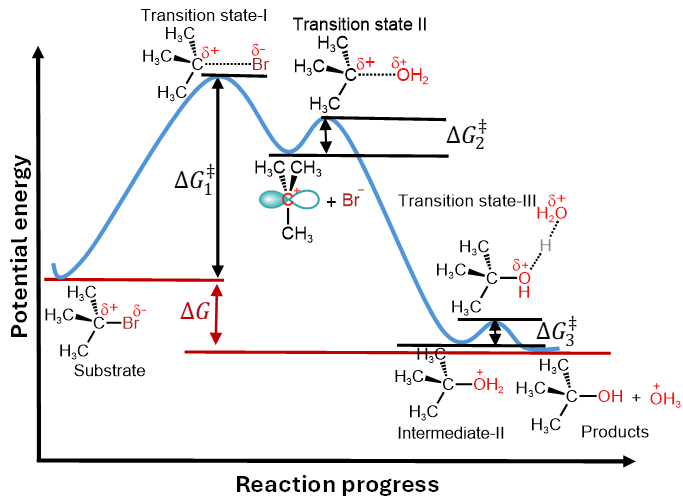
The carbocation produced in step 1, e.g., \(\ce{(H3C)3C^{+}}\) in this case, is a strong electrophile that may reform a bond with the leaving group and revert to the reactant, or it may react with any nucleophile in the medium. Water \(\ce{H2O}\) is a weak nucleophile, but it forms a new bond with the carbocation because the latter is a strong electrophile. This is step 2 of this series of reactions, which is significantly faster than step 1. Therefore, the overall rate of the reaction is determined by the rate of step 1, which is also called the rate-determining step. The product of step 2 is a strong acid that is deprotonated by solvent molecules through a fast acid-base reaction in step 3. Overall results of this sequence of reactions are that an incoming nucleophile substitutes an outgoing nucleophile (leaving group), in which the overall rate is determined by the first step, which is unimolecular, as shown in the equation below.
\[\text{Step 1: }\color{red}\ce{\underset{substrate}{ (CH3)3\overset{\delta +}{C}\color{blue}-\overset{\delta -}{Br}}} \color{black}\ce{ <=>[\color{green} Slow]} \color{red}\ce{\underset{intermediate-I}{(CH3)3\overset{+}{C}} \color{black}+ \color{blue}\ce{\underset{leaving group}{Br^{-}}}}\nonumber\]
\[\text{Step 2: }\color{blue}\ce{\underset{nucleophile}{H2O}} \color{black}+ \color{red}\ce{\underset{electrophile\backslash intermediate-I}{ (CH3)3\overset{+}{C}}} \color{black}\ce{ <=>[\color{green} Fast]} \color{red}\ce{\underset{intermediate-II}{ (CH3)3{C}\color{blue}-\overset{+}{O}H2}}\nonumber\]
\[\text{Step 3: }\ce{\color{red}{\underset{acid\backslash intermediate-II}{(CH3)3{C}-\overset{+}{O}H2}} \color{black}{+} \color{blue}{\underset{base}{H2O}} \overset{\color{green}Fast}{<=>} \color{red}{\underset{product\backslash conjugate base}{(CH3)3-OH}} \color{black}{+} \color{blue}\underset{conjugate acid}{\color{blue}H3\overset{+}{O}}}\nonumber\]
\[\text{Overall reaction: }\ce{\color{red}\ce{\underset{substrate}{ (CH3)3\overset{\delta +}{C}\color{blue}-\overset{\delta -}{Br}}} \color{black}{+} \color{blue}{\underset{nulceophile/solvent}{\ce{2H2O}}} \color{black}{<=>} \color{red}{\underset{product}{(CH3)3-OH}} \color{black}{+} \color{blue}\underset{leaving group}{\color{blue}\!\!Br^{-}} + \underset{conjugate acid of solvent}{H3\overset{+}{O}}}\nonumber\]
The mechanism based on this sequence of reactions is called an \(S_{N}1\), where \(S\) stands for substitution, \(_{N}\) for nucleophilic, and \(1\) for unimolecular because the rate-determining step (step 1) is unimolecular.
The kinetics of the slowest step 1, which is also the kinetics of the overall reaction, is unimolecular, i.e., \[Rate = k[substrate]\], where \(k\) is the rate constant and \([substrate]\) is the molar concentration of the substrate. Doubling the concentration of the substrate will double the reaction rate, but doubling the concentration of the nucleophile will not affect the overall reaction rate.
In summary, an \(S_{N}1\) reaction occurs through a series of two or more elementary reactions: 1) the leaving group leaves by heterolytic bond cleavage in the first rate-determining step, 2) the nucleophile donates a lone pair of electrons to make a new bond with the electrophile. Step 2 may be followed by an acid-base reaction. First-order kinetics of the rate-determining step is also the overall kinetics, i.e., the overall rate of an \(S_{N}1\) reaction is directly proportional to the molar concentration of the substrate and independent of the concentration of the nucleophile.
Energy diagram of an \(S_{N}1\) reaction
Figure \(\PageIndex{2}\) illustrates energy diagram of an example \(S_{N}1\) reaction. The first step is an exergonic reaction in which bond-breaking occurs between the electrophilic carbon and the leaving group. Reactants transition to transition state-I with an energy of activation \(\Delta G_{1}^{\ddagger}\) higher than the other elementary step in the series. Therefore, step 1 is the slowest rate-determining step in \(S_{N}1\) reactions. The transition state forms a carbocation and a leaving-group anion. The carbocations are short-lived reactive species, as they are strong electrophiles. They react fast in Step 2, even if the nucleophile is weak, like solvent molecules \(\ce{H2O}\) in this case. Activation of Step 2 is exergonic, with \(\Delta G_{2}^{\ddagger}\) significantly smaller than \(\Delta G_{1}^{\ddagger}\) because it involves overlap between the empty orbital of the carbocation and the filled orbital of the nucleophile bearing a lone pair. Usually the electrophilic center is a neutral atom in \(S _ {N}1\) reactions that becomes a cation after donating electrons. Any proton on the cation is strongly acidic and removed by any base in the medium by a fast acid-base proton removal step 3. The product of step 3 is usually a stable neutral molecule like tert-butanol in this example.

Racemization of chiral electrophilic centers in \(S_{N}1\) reactions

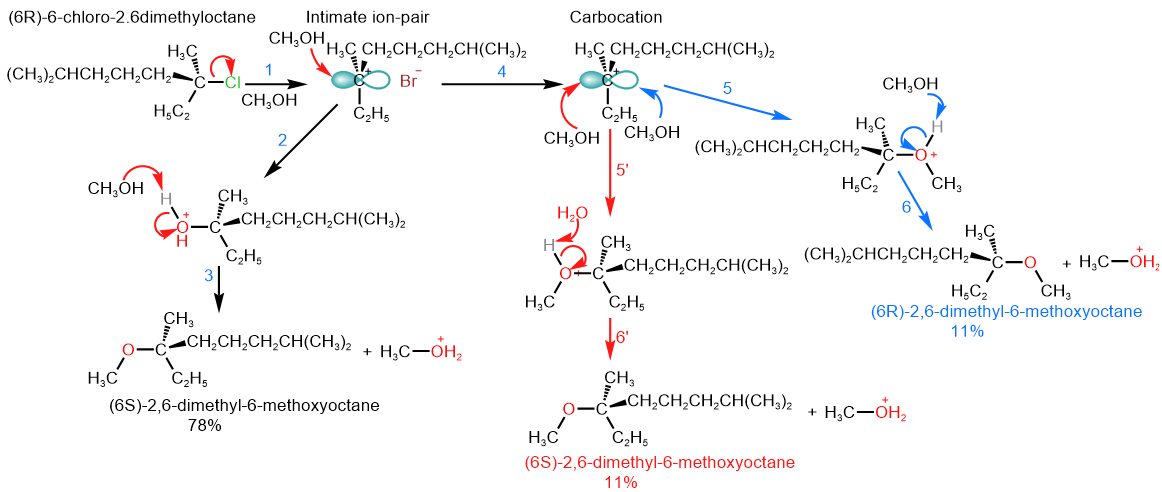
 If the electrophilic center in an \(S _ {N} 1 \) reaction is a chiral center, it loses chirality when it changes hybridization from \(sp^3\) in the substrate to \(sp^2\) in the carbocation intermediate, as shown in Figure \(\PageIndex{1}\). It is expected that the nucleophile will have equal probability of attacking from either face of the carbocation, resulting in complete racemization of the new chiral center formed, as illustrated in the simulations on the right (Moriac87, CC BY-SA 3.0, via Wikimedia Commons). In reality, the racemization is observed in the products of \(S _ {N} 1 \) reactions but almost always less than 100%. It is explained by the fact that when the bond with the leaving group breaks, the intermediates are a cation and an anion that remain associated for some time due to electrostatic attraction. This pair of associated cation-anion is called an intimate ion-pair, as illustrated in Figure \(\PageIndex{3}\). The carbocation starts reacting while it is in an intimate ion-pair, but the nucleophile can attack only from the side opposite to the leaving group, resulting in inversion of configuration, as shown by the sequence of step 2 and step 3 in Figure \(\PageIndex{3}\). The side of the leaving group is blocked for the incoming nucleophile due to steric hindrance and electrostatic repulsion from the leaving group anion. Ultimately, the leaving group departs, leaving the carbocation unhindered, i.e., step 4 in Figure \(\PageIndex{3}\). The nucleophile attacks the carbocation from either side with equal probability from this point onward, resulting in complete racemization of the product. This is illustrated by the sequences of steps 5 & 6 and steps 5' & 6' in Figure \(\PageIndex{3}\) occurring at equal rates.

The ratio of inversion to racemization in \(S_{N}1\) reactions varies from nearly 100% inversion to nearly 100% racemization, depending on the multifactors, like the substrate, the nucleophile, the solvent, and the rest of the experimental conditions. For example, in solvolysis of (3S)-3-chloro-3-methylpentane in water, there is 20% inversion and 80% racemization as shown in Figure \(\PageIndex{3}\), while in solvolysis of (6R)-6-chloro-2,6-dimethyloctane in methanol, there is 78% inversion and 22% racemization, as shown in Figure \(\PageIndex{4}\). This can be explained based on the difference in solvent polarity in these two examples. Methanol (\(\varepsilon\) 25) is less polar than water (\(\varepsilon\) 78). Therefore, methanol is less able to stabilize the carbocation, leaving it in a more reactive state that reacts 78% before the intimate ion-pair breaks, compared to 20% reaction at this stage in water.
Factors affecting \(S_{N}1\) reactions
The factors that affect \(S_{N}2\) reactions also affect \(S_{N}1\) reactions but often differently, as described in the following sections. These factors include the effect of i) the substrate, ii) the leaving group, iii) the nucleophile, and iv) the solvent.
Effect of the substrate on \(S_{N}1\) reactions
Stability of carbocation -effect of substitution
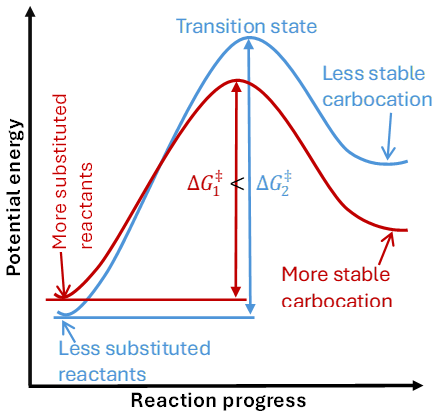 The rate-determining step of \(S_{N}1\) reactions is exergonic; the transition state resembles the carbocation more than the reactants. Therefore, any factor that stabilizes the carbocation also stabilizes the transition state, lowering activation energy and resulting in a faster reaction, as illustrated by the energy diagram in the figure on the right (Copyright: Public domain).
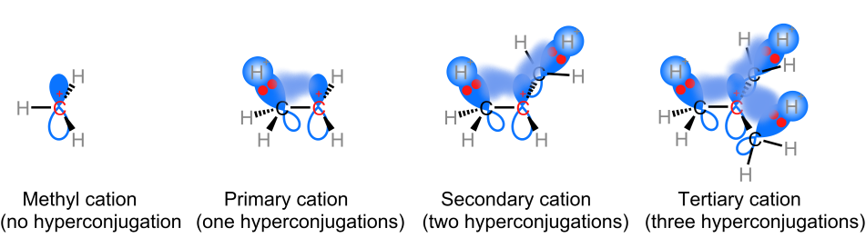
 Alkyl substituents stabilize the carbocation by hyperconjugation, as illustrated in Figure \(\PageIndex{5}\). Therefore, the more substituted the electrophilic center, the more stable the carbocation, the more stable the transition state, and the faster the reaction. Therefore, tertiary substrates react fastest in \(S_{N}1\) reactions, secondary do react but slower, and primary and methyl substrates do not react under \(S_{N}1\) conditions. The figure on the left margin explains this trend of substrate structure on \(S_{N}1\) reactions with the help of examples of hydrolysis of methyl bromide (\(\ce{CH3-Br}\), primary ethyl bromide (\(\ce{CH3CH2-Br}\), secondary isopropyl bromide (\(\ce{(CH3)2CH-Br}\), and tert-butyl bromide (\(\ce{(CH3)3C-Br}\), based on the data taken from ref. Organic Chemistry: Structure and Function by K. P. C. Vollhardt and N. E. Schore (published in 2010) (Copyright; Public domain).
Stability of carbocation -effect of hybridization
Vinylic and aromatic substrates with the leaving group on an \(sp^2\)-hybridized electrophilic center do not react by \(S_{N}1\) mechanism because \((sp^{2}-p)\sigma\)-bond is stronger than \((sp^{3}-p)\sigma\)-bond. Acetylenic substrates with leaving group on \(sp\)-hybridized electrophilic center do not react by \(S_{N}1\) mechanism for the same reason, i.e., \((sp-p)\sigma\)-bond > \((sp^{2}-p)\sigma\)-bond > \((sp^{3}-p)\sigma\)-bond. Consequently, a carbocation on an \(sp\) atom is less stable than on \(sp^2\), which is less stable than on \(sp^3\).
Stability of carbocation -effect of resonance
Resonance stabilizes the carbocation more than hyperconjugation. Therefore, allylic and benzylic substrates react faster than the corresponding aliphatic substrates.
Figure \(\PageIndex{6}\) illustrates the order of stability of carbocations, which is the same order of reactivity of these substrates in \(S_{N}1\) reactions. Acetylic, vinylic, aromatic, methyl, and primary substrates do not react by the \(S_{N}1\) mechanism, while secondary, tertiary, allylic, and benzylic substrates react at rates following the same trend as the carbocation stability shown in Figure \(\PageIndex{6}\).

Effect of the leaving group on \(S_{N}1\) reactions
The leaving group leaves the substrate in the rate-determining step of the \(S_{N}1\) reaction. Therefore, substrates with a better leaving group react faster, following the same trends as in \(S_{N}2\) reactions described earlier.
The higher the \(pK_b\) of the leaving group, the faster it leaves.
\(pK_b\) of a leaving group \(\ce{L^-}\) and \(pK_a\) of its conjugate acid \(\ce{HL}\) are related by the following relationship: \(pK_{a}(\ce{L^-}) + pK_{b}(\ce{HL}) = 14\). It is easier to compare the acidity of the conjugate acids of the leaving groups in terms of their \(pK_a\) values. Table \(\PageIndex{4}\) shows that leaving groups that are conjugate bases of acids having \(pK_{a}\le 0\) are excellent leaving groups. Table \(\PageIndex{5}\) shows that leaving groups that are conjugate bases of acids having \(pK_{a}\) 10 to 1 are moderate leaving groups; \(pK_{a}\) 11 to 20 are poor leaving groups; and \(pK_{a} > 20\) are extremely-poor leaving groups.
Effect of the nucleophile on \(S_{N}1\) reactions
Since the nucleophile is not involved in the first rate-determining step, the rate of \(S_{N}1\) reactions is independent of the nature of the nucleophile. Therefore, often weak neutral nucleophiles, usually neutral solvent molecules, are employed in \(S_{N}1\) reactions. The nucleophile attacks the carbocation intermediate in the second step, called the product-determining step. If there is only one nucleophile in the medium, it determines the product, but if there are more than one, there is a competition. Usually the stronger nucleophile determiens the product. For example, water is the nucleophile in the hydrolysis of tert-butyl chloride that produces tert-butanol, but when some calcium formate \(\ce{Ca(HCOO^{-})2}\) is dissolved in the water, the product will be tert-butyl formate, as shown below. This is because formate \(\ce{HCOO^-}\) is thousands of times more reactive nucleophile than \(\ce{H2O}\).
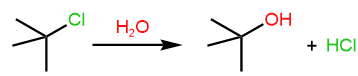 Hydrolysis of tert-butyl chloride in water by \(S_{N}1\) mechanism

Esterification of tert-butyl chloride in water contaning \(\ce{Ca(HCOO^{-})2}\) dissolved in it by \(S_{N}1\) mechanism
Effect of the solvent on \(S_{N}1\) reactions
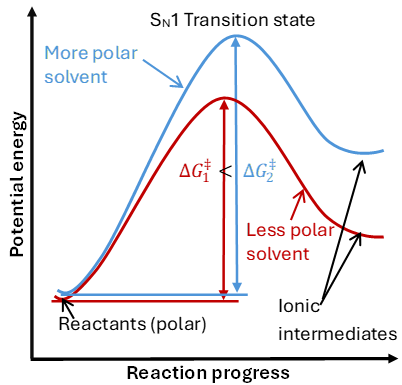 Most of the reagents and reactants in nucleophilic substitution reactions are polar substances that need a polar solvent to dissolve them for the reaction to occur. \(S_{N}1\) reactions usually begin with polar neutral reagents that convert into an ionic product, carbocation, and leaving group anion in the rate-determining endergonic step. The transition state resembles the ionic products. More polar and more hydrogen-bonding solvents better solvate the ionic transition state, lowering the activation energy, as illustrated in the energy diagram in the figure on the right (Copyright; Public domain). Non-polar solvents do not stabilize ions, and aprotic solvents do not stabilize anions effectively. Therefore, polar protic solvents that stabilize both cation and anion by ion-dipole and hydrogen bonding are suitable for \(S_{N}1\) reactions. Polarity of the solvent is quantified by its dielectric constant (\(\varepsilon\)). The more polar the solvent, the faster the \(S{N}1\) reaction, as shown in Figure \(\PageIndex{7}\).
If the nucleophile is a solvent molecule, the reaction is called solvolysis. A solvolysis reaction in water \(\ce{H2O}\) is also called hydrolysis; in methanol (\ce{CH3OH}\) methanolysis, in ethanol \(\ce{CH3CH2OH}\) ethanolysis, etc., as shown by the reaction equations below.


Although water is the best solvent for \(S_{N}1\) reactions, most substrates are not fully soluble in it. Therefore, a compromise between solubility and rate of reaction is made by employing a mixture of water + water-miscible organic solvent. In a solvent mixture, the dielectric constant is best represented as a weighted average, as shown by the experimental points for ethanol, water 40% to ethanol 60%, water 20% to ethanol in Figure \(\PageIndex{7}\). In an ethanol + water mixture, both ethanol \(\ce{CH3CH2OH}\) and water \(\ce{H2O}\) are nucleophiles, but the major product is the hydrolysis product because \(\ce{H2O}\) is a better nucleophile than \(\ce{CH3CH2OH}\). The same is true in other mixtures like acetone + water, acetic acid + water mixture, etc. However, since the mixture has a lower dielectric constant, the reaction rate is significantly lower than in pure water, as shown in the following example comparing hydrolysis in a 90% acetone + 10% water mixture with 100% water.

Carbocation rearrangement in \(S_{N}1\) reactions
Another proof that the \(S_{N}1\) reaction goes through a carbocation intermediate comes from carbocation rearrangement reactions. For example, hydrolysis of (2)-2-bromo-3-methylbutane, shown below, is expected to produce enantiomers of 3-methylbutan-2-ol by a regular \(S_{N}1\) mechanism. However, more than 90% of the product is 2-methylbutan-2-ol. This is explained by carbocation rearrangement of the carbocation intermediate happening before the nucleophilic addition of \(\ce{H2O}\).

The mechanism of the carbocation rearrangement during hydrolysis of (2S)-2-bromo-3-methylbutane is illustrated in Figure \(\PageIndex{8}\). Departure of the leaving group leaves behind a secondary carbocation, which is stabilized by hyperconjugation by one of the \(\sigma\)-bonds of the neighboring carbon. This hyperconjugation transitions into a three-membered cyclic transition state that ends up in the swap of the cation and the hydride \(\ce{H:^-}\) between neighboring carbons -a process called a 1,2-hydride shift, as shown in step 2 below. The nucleophile \(\ce{H2O}\) then attacks the rearranged carbocation, leading to the rearranged product.

The driving force for the carbocation rearrangement is the stability -a less stable carbocation converts into a more stable carbocation. A tertiary carbocation is more stable than a secondary, and the secondary is more stable than a primary, as shown in Figure \(\PageIndex{9}\). When the rearranged carbocation is more stable than the initial carbocation, rearrangement usually happens faster than the nucleophilic addition to the carbocation. Therefore, the rearranged product is usually the major product in these cases, as in the case of hydrolysis of 2-bromo-3-methylbutane.

In the hydrolysis of 2-bromo-3-methylbutane, a 1,2-hydride shift occurs, although the neighboring carbon bears two methyl groups and one hydride. 1,2-Methyl shift and 1,2-alkyl shift can also happen. For example, during hydrolysis of 2-bromo-3,3-dimethylbutane, there is no hydride to shift, so the carbocation rearranges by 1,2-methyl shift, as shown in Figure \(\PageIndex{10}\). Generally, a 1,2-hydride shift is preferred over a 1,2-methyl shift, and a 1,2-methyl shift is preferred over a 1,2-alkyl shift of other bulky alkyl groups.

Primary substrates usually do not undergo \(S_{N}1\) reactions because the primary carbocation is too unstable, resulting in prohibitively high activation energy during its formation. However, if a primary carbocation can rearrange into a more stable tertiary carbocation, the reaction occurs by departure of the leaving group in a concerted fashion with the 1,2-alkyl shift, forming a tertiary carbocation, without forming an unstable primary carbocation. This is illustrated in Figure \(\PageIndex{11}\) with the help of hydrolysis of 1-bromo-2,2-dimethylpropane, commonly known as neopentyl bromide. Only the rearranged product is formed in this case.
