

6.2: Neuclophilic substitution bimolecular (SN2) reactions
- Page ID
- 548509

\( \newcommand{\vecs}[1]{\overset { \scriptstyle \rightharpoonup} {\mathbf{#1}} } \)
\( \newcommand{\vecd}[1]{\overset{-\!-\!\rightharpoonup}{\vphantom{a}\smash {#1}}} \)
\( \newcommand{\dsum}{\displaystyle\sum\limits} \)
\( \newcommand{\dint}{\displaystyle\int\limits} \)
\( \newcommand{\dlim}{\displaystyle\lim\limits} \)
\( \newcommand{\id}{\mathrm{id}}\) \( \newcommand{\Span}{\mathrm{span}}\)
( \newcommand{\kernel}{\mathrm{null}\,}\) \( \newcommand{\range}{\mathrm{range}\,}\)
\( \newcommand{\RealPart}{\mathrm{Re}}\) \( \newcommand{\ImaginaryPart}{\mathrm{Im}}\)
\( \newcommand{\Argument}{\mathrm{Arg}}\) \( \newcommand{\norm}[1]{\| #1 \|}\)
\( \newcommand{\inner}[2]{\langle #1, #2 \rangle}\)
\( \newcommand{\Span}{\mathrm{span}}\)
\( \newcommand{\id}{\mathrm{id}}\)
\( \newcommand{\Span}{\mathrm{span}}\)
\( \newcommand{\kernel}{\mathrm{null}\,}\)
\( \newcommand{\range}{\mathrm{range}\,}\)
\( \newcommand{\RealPart}{\mathrm{Re}}\)
\( \newcommand{\ImaginaryPart}{\mathrm{Im}}\)
\( \newcommand{\Argument}{\mathrm{Arg}}\)
\( \newcommand{\norm}[1]{\| #1 \|}\)
\( \newcommand{\inner}[2]{\langle #1, #2 \rangle}\)
\( \newcommand{\Span}{\mathrm{span}}\) \( \newcommand{\AA}{\unicode[.8,0]{x212B}}\)
\( \newcommand{\vectorA}[1]{\vec{#1}} % arrow\)
\( \newcommand{\vectorAt}[1]{\vec{\text{#1}}} % arrow\)
\( \newcommand{\vectorB}[1]{\overset { \scriptstyle \rightharpoonup} {\mathbf{#1}} } \)
\( \newcommand{\vectorC}[1]{\textbf{#1}} \)
\( \newcommand{\vectorD}[1]{\overrightarrow{#1}} \)
\( \newcommand{\vectorDt}[1]{\overrightarrow{\text{#1}}} \)
\( \newcommand{\vectE}[1]{\overset{-\!-\!\rightharpoonup}{\vphantom{a}\smash{\mathbf {#1}}}} \)
\( \newcommand{\vecs}[1]{\overset { \scriptstyle \rightharpoonup} {\mathbf{#1}} } \)
\(\newcommand{\longvect}{\overrightarrow}\)
\( \newcommand{\vecd}[1]{\overset{-\!-\!\rightharpoonup}{\vphantom{a}\smash {#1}}} \)
\(\newcommand{\ket}[1]{\left| #1 \right>}\)
\(\newcommand{\bra}[1]{\left< #1 \right|}\)
\(\newcommand{\braket}[2]{\left< #1 \vphantom{#2} \right| \left. #2 \vphantom{#1} \right>}\)
\(\newcommand{\braopket}[3]{\left< #1 \vphantom{#2}\vphantom{#3} \right| #2 \vphantom{#1}\vphantom{#3} \left| #3 \vphantom{#1}\vphantom{#2} \right>}\)
\(\newcommand{\qmvec}[1]{\mathbf{\vec{#1}}}\)
\(\newcommand{\op}[1]{\hat{\mathbf{#1}}}\)
\(\newcommand{\expect}[1]{\langle #1 \rangle}\)
\(\newcommand{\dfn}[1]{\emph{\textbf{#1}}}\)
\(\newcommand{\avec}{\mathbf a}\) \(\newcommand{\bvec}{\mathbf b}\) \(\newcommand{\cvec}{\mathbf c}\) \(\newcommand{\dvec}{\mathbf d}\) \(\newcommand{\dtil}{\widetilde{\mathbf d}}\) \(\newcommand{\evec}{\mathbf e}\) \(\newcommand{\fvec}{\mathbf f}\) \(\newcommand{\nvec}{\mathbf n}\) \(\newcommand{\pvec}{\mathbf p}\) \(\newcommand{\qvec}{\mathbf q}\) \(\newcommand{\svec}{\mathbf s}\) \(\newcommand{\tvec}{\mathbf t}\) \(\newcommand{\uvec}{\mathbf u}\) \(\newcommand{\vvec}{\mathbf v}\) \(\newcommand{\wvec}{\mathbf w}\) \(\newcommand{\xvec}{\mathbf x}\) \(\newcommand{\yvec}{\mathbf y}\) \(\newcommand{\zvec}{\mathbf z}\) \(\newcommand{\rvec}{\mathbf r}\) \(\newcommand{\mvec}{\mathbf m}\) \(\newcommand{\zerovec}{\mathbf 0}\) \(\newcommand{\onevec}{\mathbf 1}\) \(\newcommand{\real}{\mathbb R}\) \(\newcommand{\twovec}[2]{\left[\begin{array}{r}#1 \\ #2 \end{array}\right]}\) \(\newcommand{\ctwovec}[2]{\left[\begin{array}{c}#1 \\ #2 \end{array}\right]}\) \(\newcommand{\threevec}[3]{\left[\begin{array}{r}#1 \\ #2 \\ #3 \end{array}\right]}\) \(\newcommand{\cthreevec}[3]{\left[\begin{array}{c}#1 \\ #2 \\ #3 \end{array}\right]}\) \(\newcommand{\fourvec}[4]{\left[\begin{array}{r}#1 \\ #2 \\ #3 \\ #4 \end{array}\right]}\) \(\newcommand{\cfourvec}[4]{\left[\begin{array}{c}#1 \\ #2 \\ #3 \\ #4 \end{array}\right]}\) \(\newcommand{\fivevec}[5]{\left[\begin{array}{r}#1 \\ #2 \\ #3 \\ #4 \\ #5 \\ \end{array}\right]}\) \(\newcommand{\cfivevec}[5]{\left[\begin{array}{c}#1 \\ #2 \\ #3 \\ #4 \\ #5 \\ \end{array}\right]}\) \(\newcommand{\mattwo}[4]{\left[\begin{array}{rr}#1 \amp #2 \\ #3 \amp #4 \\ \end{array}\right]}\) \(\newcommand{\laspan}[1]{\text{Span}\{#1\}}\) \(\newcommand{\bcal}{\cal B}\) \(\newcommand{\ccal}{\cal C}\) \(\newcommand{\scal}{\cal S}\) \(\newcommand{\wcal}{\cal W}\) \(\newcommand{\ecal}{\cal E}\) \(\newcommand{\coords}[2]{\left\{#1\right\}_{#2}}\) \(\newcommand{\gray}[1]{\color{gray}{#1}}\) \(\newcommand{\lgray}[1]{\color{lightgray}{#1}}\) \(\newcommand{\rank}{\operatorname{rank}}\) \(\newcommand{\row}{\text{Row}}\) \(\newcommand{\col}{\text{Col}}\) \(\renewcommand{\row}{\text{Row}}\) \(\newcommand{\nul}{\text{Nul}}\) \(\newcommand{\var}{\text{Var}}\) \(\newcommand{\corr}{\text{corr}}\) \(\newcommand{\len}[1]{\left|#1\right|}\) \(\newcommand{\bbar}{\overline{\bvec}}\) \(\newcommand{\bhat}{\widehat{\bvec}}\) \(\newcommand{\bperp}{\bvec^\perp}\) \(\newcommand{\xhat}{\widehat{\xvec}}\) \(\newcommand{\vhat}{\widehat{\vvec}}\) \(\newcommand{\uhat}{\widehat{\uvec}}\) \(\newcommand{\what}{\widehat{\wvec}}\) \(\newcommand{\Sighat}{\widehat{\Sigma}}\) \(\newcommand{\lt}{<}\) \(\newcommand{\gt}{>}\) \(\newcommand{\amp}{&}\) \(\definecolor{fillinmathshade}{gray}{0.9}\)
Mechanism and rate law of an \(S_{N}2\) reaction
An \(S_{N}2\) mechanism is a single-step bimolecular reaction involving single transition state, in which a nucleophile donates electrons to electrophilic center of the substrate making a new \(\sigma\)-bond, and, simultaneously, the electrophilic center breaks bond with the leaving group, in which leaving group retains both the bonding electron, as illustrated in the example below.

Rate law of an \(S_{N}2\) reaction is bimolecular, \(S_{N}2\), i.e., \[Rate = k[substrate][nucleophile]\], which is first-order with respect to substrate, first-order with respect to nucleophile, and second-order overall.
Direction of approach of the nucleophile to the substrate in an \(S_{N}2\) reaction

An \(S_{N}2\) reaction is successful only when the nucleophile approaches the substrate from the opposite side of the leaving group, as illustrated in the figure on the right margin (Copyright: public domain) for the reaction between \(\ce{^{-}OH}\) and \(\ce{CH3-Cl}\).
The orientation is dictated by two factors.
- Electrostatic factor: the nucleophile and the leaving group are both partially negative, and the electrophilic center is partially positive. Maximum attraction between opposite charges and minimum repulsion between similar charges occur when the nucleophile approaches the electrophilic center from the side opposite the leaving group.
- Shape of the lowest unoccupied molecular orbital (LUMO) of the substrate: minimum repulsion from the leaving group and maximum constructive overlap between the nucleophile's donor orbital and the substrate's LUMO can occur only if the nucleophile approaches from the side opposite the leaving group.
Inversion of configuraiton during \(S_{N}2\) reactions
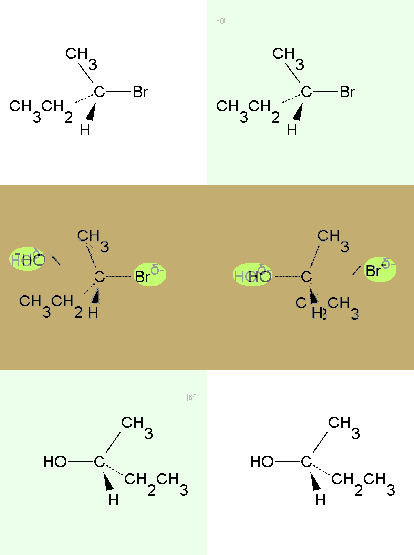
In \(S_{N}2\) reactions, as the nucleophile approaches the electrophilic center from the side opposite to the leaving group, it faces steric strain from three substituents other than the leaving group. To relieve some of the steric strain, the electrophilic center re-hybridizes from \(sp^3\) in the substrate to \(sp^2\) in the transition state. The three substituents are at the corners of a triangle, and the incoming nucleophile and the leaving groups are perpendicular to the plane of the triangle, resulting in a trigonal-bipyramidal geometry around the electrophilic center, as illustrated in the example below. As the leaving group departs, the electrophilic center re-hybridizes from \(sp^2\) in the transition state to \(sp^3\) in the product, with the three substituents pointing away from the incoming nucleophile. As a consequence of the flipping of substituents from one direction in the substrate to the opposite in the product, the configuration around the electrophilic center is inverted.

If the relative priority of the incoming nucleophile and the leaving group is the same, the R-configuration of the electrophilic center in the substrate becomes the S-configuration in the product, as shown in the above example. Similarly, the S-configuration inverts to the R-configuration, as shown in the simulation example below (Copyright: Kus2014, CC BY-SA 3.0, via Wikimedia Commons).

- Chemical reactions that show different reactivity toward isomeric substrates are called stereoselective reactions. Similarly, reactions that produce one isomer exclusively or preferentially over the others are also stereoselective.
- Reactions that are selective on both ends, i.e., starting with one isomer in the reactants produce one isomer, and beginning with the other isomer in the reactants produce another isomer selectively in the product, are called stereospecific reactions.
- If the electrophilic center is a chirality center, \(S_{N}2\) reactions are stereospecific, resulting in inversion of the configuration at the electrophilic center.
Nucleophile donates an electron pair to make a new \(\sigma\)-bond with the electrophilic center, leaving with a share of one bonding electron in the product. The leaving group shares one bonding electron with the substrate and departs with both bonding electrons of the broken bond. Consequently,
- in \(S_{N}2\) reaction, if the incoming nucleophile is an anion, it becomes neutral (or may be \(\delta-\)) in the product, as in the first example above, and
- if the incoming nucleophile is neutral, it becomes a cation in the product, as in the second example above. Similarly,
- if the leaving group in \(S_{N}2\) reaction is neutral (or may be \(\delta-\)), it leaves as an anion, as in the two examples above, and
- if the leaving group is a cation, it leaves as a neutral species, as in the example shown below.

Energy diagram for an \(S_{N}2\) reaction
When two balls collide, they deform each other upon impact, going into a high-energy state. Then they bounce off, releasing the potential energy. Similarly, when nucleophile and substrate collide in an \(S_{N}2\) reaction, they go into a high potential energy transition state, as illustrated in Figure \(\PageIndex{1}\). The transition state has five bonds on the electrophilic carbon, instead of four in its stable state, with one bond forming to the incoming nucleophile and one bond breaking to the leaving group. The transition state is at the maxima of the energy diagram. The transition state releases its extra potential energy by either falling to reactants or to the products, both of which are relatively stable at the well of the energy diagram.

The difference of energy between the reactants and the transition state is the activation energy \(\Delta G^{\ddagger}\).
The lower the \(\Delta G^{\ddagger}\), the faster the reaction.
The factors that affect \(\Delta G^{\ddagger}\), and, consequently, affect the rate of \(S_{N}2\) reactions include: the nature of the substrate, the nature of the leaving group, the nature of the nucleophile, and the solvent in which both the substrate and the nucleophile are dissolved. Their effects usually fall under one of the following four categories.
- Factors that destabilize the transition state more than the reactants and products cause an increase in the activation energy, as illustrated in Figure \(\PageIndex{2}\) a).
- Factors that destabilize the reactants and products more than the transition state cause a decrease in the activation energy, as illustrated in Figure \(\PageIndex{2}\) b).
- Factors that destabilize reactants more than the transition state cause a decrease in the activation energy, as illustrated in Figure \(\PageIndex{2}\) c).
- Factors that destabilize products more than the transition state cause an increase in the activation energy, as illustrated in Figure \(\PageIndex{2}\) d).
Note: the effects of stabilization are the opposite of those of the corresponding destabilization.
 a)
 b)
 c)
 d)
Factors affecting \(S_{N}2\) reactions
Since both the substrate and the nucleophile are in the rate law of \(S_{N}2\) reactions and reacting while they are dissolved in a suitable solvent, the rate of \(S_{N}2\) reactions is affected by i) the nature of the substrate, ii) the nature of the leaving group, iii) the nature of the nucleophile, and iv) the nature of the solvent. These factors are described in the following sections.
The substrate
Steric hindrance of bulky substituents at \(\alpha\ce{C}\) and \(\beta \ce{C}\)
Bulky substituents on the electrophilic center (\(\alpha \ce{C}\)) cause steric strain to the nucleophile. The steric strain raises the potential energy of the transition state, increasing activation energy, as illustrated in Figure \(\PageIndex{2}\) a). Consequently, the rate of reaction decreases, as shown in Figure \(\PageIndex{3}\). Methyl substrate with only small hydrogen substituents reacts fastest in \(S_{N}2\) reactions, primary with only one bulky alkyl substituent at (\(\alpha \ce{C}\) reacts slower then methyl, secondary with two bulky alkyl substituents reacts slower than primary, and tertiary with three bulky alkyl substituents completely blocks the side of electrophilic center from where nucleophile approaches. Therefore, tertiary substrates do not undergo \(S_{N}2\) reactions.
The reactivity order for \(S_{N}2\) reactions with respect to \(\alpha - \ce{C}\) is the following: methyl > primary > secondary > tertiary.
 Figure \(\PageIndex{3}\): Effect of substituents of substrates at \(\alpha \ce{C}\) and at \(\beta \ce{C}\) on the relative rates in \(S_{N}2\) reactions. Models illustrate how the alkyl substituents block the side of the electrophilic center opposite the leaving group, preventing nucleophilic attack. Note: the rates are approximate averages compared to the rate of isopropylbromide, assigned relative rate 1. (Copyright; Public domain)
The bulky substituents at \(\beta \ce{C}\) also slow down \(S_{N}2\) reactions, though less so than at \(\alpha \ce{C}\), as shown in Figure \(\PageIndex{3}\). Like tertiary \(\alpha \ce{C}\), three bulky substituents at \(\beta \ce{C}\) also block the approach of nucleophile and, consequently, prohibit \(S_{N}2\) reactions.
Effect of hybridization of \(\alpha \ce{C}\)
 \(S_{N}2\) reactions can occur only on methyl, primary, and some secondary \(sp^{3} \ce{C}\). Tertiary \(\alpha\ce{C}\) and tertiary \(\beta\ce{C}\) have the site of approach of nucleophile blocked by bulky substituents and do not undergo \(S_{N}2\) reactions. Similarly, \(sp^{2}\) \(\alpha\ce{C}\) of aromatic \(\ce{C6H5-X}\), vinylic (\(\ce{R2C=CR-X}\) substrates, and \(sp\) \(\alpha \ce{C}\) of acetylenic (\(\ce{RC\equiv C-X}\)) substrates, have the site of approach of the nucleophile blocked by \(\pi\)-bonding electron cloud and do not undergo \(S_{N}2\). The \(\pi\)-bond is an electron-rich region that repels negative or \(\delta -\) nucleophiles. The \(\pi\)-electron cloud blocks the nucleophiles' approach to the \(sp^{2}\) and \(sp\)-\(\alpha\ce{C}\) by steric as well as by electronic repulsion, as illustrated in the figure on the right margin (Copyright: Public domain).
Substrate having \(sp^{2}\) and \(sp\)-\(\alpha\ce{C}\), i.e., aromatic, vinylic, and acetylenic substrates, and those with tertiary \(\alpha\ce{C}\) or tertiary \(\beta\ce{C}\) do not undergo \(S_{N}2\) reactions.
Electronic effects on allylic and benzylic \(\alpha \ce{C}\)
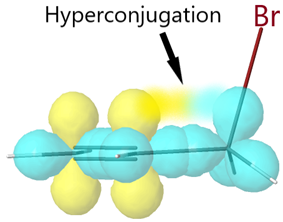 The \(\ce{C-X}\) bond of an allylic (\(\ce{R2C=CR-CR2-X}\)) or benzylic (\(\ce{C6H5-CR2-X}\)) substrate is in hyperconjugation with \(p\)-orbital of \(\beta \ce{C}\), as illustrated in the figure on the right margin (Copyright: Public domain). The \(\alpha \ce{C}\) re-hybridizes from \(sp^3\) in the substrate to \(sp^2\) in the transition state, resulting in the hyperconjugation in the substrate being replaced by resonance that stabilizes the transition state stronger than hyperconjugation stabilizes the substrate. Consequently, the activation energy is reduced, as illustrated in Figure 6.2.2 a). A lower activation energy increases the reaction rate. For example, 3-bromoprop-1-ene (\(\ce{H2C=CH-CH2-Br}\), illustrated in the figure on the right margin, reacts about a hundred times faster than 1-bromopropane (\(\ce{CH3-CH2-CH2-Br}\)) in \(S_{N}2\) reactions. The same is true for benzylic substrates.
Allylic and benzylic substrates react faster in \(S_{N}2\) reactions than equivalent alkyl substrates due to resonance stabilization of the transition state.
The leaving group
The leaving group \(\ce{X}\) in the substrate \(\ce{R3C-X}\) has many roles in \(S_{N}2\) reactions, including the following.
- Breaks the \(\ce{C-X}\) bond during the reaction: the weaker the bond, the faster the reaction.
- Polarizes the \(\ce{C-X}\) bond; the more polar the bond, the better the electrophile, the faster the reaction.
- Stabilizes the transition state; the more polarizable the \(\ce{X}\), the better it overlaps with the electrophilic center in the transition state, the faster the reaction.
- Stabilizes the electrons it receives after the heterolytic bond breakage; the more stable the product, the lower the activation energy, the faster the reaction.
The above factors collectively determine the leaving propensity of the leaving group. The leaving propensity is categorized qualitatively as excellent, moderate, poor, or extremely poor. A leaving group heterolytically breaks the bond with the electrophile and becomes the same as the corresponding conjugate base that heterolytically breaks the bond with the proton.
Leaving propensity of a leaving group can be predicted from its basicity: the higher the \(pK_b\), the weaker the base, the faster it leaves.
This is because the weaker bases are more stable and do not tend to donate their lone pair. The basicity of \(\ce{X^-}\) increases from top to bottom in a group of the periodic table, e.g. the trend of \(pK_b\) of halide ions is:
\(\underbrace{\text{Leaving group}}_{pK_b}\) = \(\underbrace{\ce{F^-}}_{\sim 11}\) < \(\underbrace{\ce{Cl^-}}_{\sim 20}\) < \(\underbrace{\ce{Br^-}}_{\sim 23}\) < \(\underbrace{\ce{I^-}}_{\sim 24}\)
, which is the same order of the rates of their reactions as leaving groups. For example, the rate of these leaving groups relative to that of \(\ce{F^-}\) assigned a value of 1 are:
\(\underbrace{\text{Leaving group}}_{\text{Relative rate as a leaving group}}\) = \(\underbrace{\ce{F^-}}_{1}\) < \(\underbrace{\ce{Br^-}}_{200}\) < \(\underbrace{\ce{Cl^-}}_{10,000}\) < \(\underbrace{\ce{I^-}}_{30,000}\)
\(\ce{F^-}\) is an extremely poor leaving group, while \(\ce{Cl^-}\), \(\ce{Br^-}\), and \(\ce{I^-}\) are excellent leaving groups and often act as leaving groups in nucleophilic substitution reactions.
The basicity of the conjugate base atoms of the same row in a periodic table decreases from left to right in the row. For example, the order of \(pK_b\) of second row elements is:
\(\underbrace{\text{Leaving group}}_{pK_b}\) = \(\underbrace{\ce{R3C^-}}_{\sim -40}\) < \(\underbrace{\ce{R2N^-}}_{\sim -24}\) < \(\underbrace{\ce{RO^-}}_{\sim -2}\) < \(\underbrace{\ce{F^-}}_{\sim 11}\)
, which is save order of the leaving propensity of these groups. All of these are poor or extremely poor leaving groups and very rarely act as leaving groups in in nucleophilic substitution reactions.
It is easier to compare the acidity of the conjugate acids of the leaving groups in terms of their \(pK_a\) values. The \(pK_b\) of a leaving group \(\ce{L^-}\) and \(pK_a\) of its conjugate acid \(\ce{HL}\) are related by the following relationship: \(pK_{a}(\ce{L^-}) + pK_{b}(\ce{HL}) = 14\). Table \(\PageIndex{4}\) shows that leaving groups that are conjugate bases of acids having \(pK_{a}\le 0\) are excellent leaving groups. Table \(\PageIndex{5}\) shows that leaving groups that are conjugate bases of acids having \(pK_{a}\) 10 to 1 are moderate leaving groups; \(pK_{a}\) 11 to 20 are poor leaving groups; and \(pK_{a} > 20\) are extremely-poor leaving groups. This is because a higher \(pK_{a}\) of the conjugated acid means the conjugate base is more stable. It makes the product more stable and the energy of activation lower when the more stable conjugate base is the leaving group, as in the energy diagram \(pK_{a}\) d).
| Name of acid | Hydroiodic acid | Hydrobromic acid | Hydrochloric acid | Sulfonates | Hydronium ion |
|---|---|---|---|---|---|
| \(pK_a\) | -10 | -9 | -6 | -3 | 0 |
| Acid | \(\ce{\color{red}H\color{black}I}\) | \(\ce{\color{red}H\color{black}Br}\) | \(\ce{\color{red}H\color{black}Cl}\) |
\(\ce{R-\!\!\!\!{\overset{\overset{\Huge\;{\ce{O}}}|\!\!|\enspace}{\underset{\underset{\Huge\enspace\!{\ce{O}}}|\!\!|\enspace}{\ce{S}\!}}}\!\!\!-O\color{red}H}\) |
\(\ce{\color{red}H3\color{black}\overset{+}{O}}\) |
| Conjugate base | \(\ce{I^-}\) | \(\ce{Br^-}\) | \(\ce{Cl^-}\) |
\(\ce{R-\!\!\!\!{\overset{\overset{\Huge\;{\ce{O}}}|\!\!|\enspace}{\underset{\underset{\Huge\enspace\!{\ce{O}}}|\!\!|\enspace}{\ce{S}\!}}}\!\!\!-\overset{-}{O}}\) |
\(\ce{H2O}\) |
| Name | Hydrofluoric acid | Carboxylic acids | Ammonium ions | Water | Alcohols | Amines | Hydrogen | Alkane |
|---|---|---|---|---|---|---|---|---|
| \(pK_a\) | 3.2 | ~5 | ~10 | 14 | ~16 | ~36 | ~40 | ~50 |
| Acid | \(\ce{\color{red}H\color{black}F}\) | \(\ce{R-\!\!{\overset{\overset{\Huge\enspace\!{\ce{O}}}|\!\!|\enspace}{\ce{C}}}\!\!-O\color{red}H}\) | \(\ce{R3\overset{+}{N}\color{red}H}\) | \(\ce{\color{red}H2\color{black}O}\) | \(\ce{RO\color{red}H}\) | \(\ce{R2N\color{red}H}\) | \(\ce{H-\color{red}H}\) | \(\ce{R-CH2-\color{red}H}\) |
| Conjugate base |
\(\ce{F^-}\) |
\(\ce{R-\!\!{\overset{\overset{\Huge\enspace\!{\ce{O}}}|\!\!|\enspace}{\ce{C}}}\!\!-\overset{-}{O}}\) | \(\ce{R3N}\) | \(\ce{^{-}OH}\) | \(\ce{RO^-}\) | \(\ce{R2N^-}\) | \(\ce{H^-}\) | \(\ce{R-\overset{-}{C}H2}\) |
| Category as a leaving group |
Extremely-poor (Exception) |
Moderate | Poor | Extremely-poor | ||||
The correlation between the leaving propensity of a leaving group in \(S_{N}2\) reactions and their basicity is qualitative, not quantitative, and there are exceptions. This is because basicity is related to one factor, "stabilization of the electrons it receives after the heterolytic bond breakage." Other factors that influence the propensity to leave include bond strength, bond polarity, and polarizability. Further, the basicity is a thermodynamic property that relates to the stability of the conjugate base product, while leaving propensity is a kinetic property that relates to the stability of the transition state, and, consequently, the energy of activation. For example, \(\ce{HF}\) is a weak acid with \(pK_a\) 3.2 and its conjugate base \(\ce{F^-}\) is predicted to be a moderate leaving group. Still, it is practically an extremely poor leaving group because \(\ce{C-F}\) bond is a stronger bond (~440 kJ/mol) than other halogens (\(\ce{C-Cl}\) ~330 kJ/mol, \(\ce{C-Br}\) ~280 kJ/mol, and \(\ce{C-I}\) ~240 kJ/mol). Another exception is sulfonates, e.g., para-methyltoluenesulfonate, commonly referred to as tosylate (\(\ce{TosO^-}\)) is less basic than \(\ce{Cl^-}\), \(\ce{Br^-}\), and \(\ce{I^-}\). So, it is predicted to be less reactive as a sleaving group than \(\ce{Cl^-}\), \(\ce{Br^-}\), and \(\ce{I^-}\). Practically, \(\ce{TosO^-}\) is two times more reactive than \(\ce{I^-}\).
The tosylate ion is resonance-stabilized, distributing its negative charge over three oxygen atoms, as shown below (Note: the first three structures are resonance contributors, and the fourth is a resonance hybrid).

Resonance of the neutral tosylate esters is less intense due to charge separation. Still, it makes the substrate more electrophilic, withdrawing electrons from the electrophilic center than an alcohol or ether group, due to the contribution of two charge-separated resonance contributors, placing \(\Delta +\) charge on the oxygen bonded to the electrophilic center, as shown below (Note: the first three structures are resonance contributors and the fourth is a resonance hybrid).

This enhancement of electrophilicity of the substrate, in combination with the resonance stabilization of the conjugate base, most likely makes the tosylate group a better leaving group than what is predicted from the stabilization of the conjugate base alone.
Some poor leaving groups can be easily modified to moderate or excellent leaving groups. For example, \(\ce{H2O}\) with \(pK_a\) 14 is a weak acid and its conjugate base \(\ce{^{-}OH}\) is a poor leaving groups from alcohols \(\ce{R-OH}\). But, \(\ce{H3\overset{+}{O}}\) with \(pK_a\) 0 is a strong acid and its conjugate base \(\ce{H2O}\) is a good leaving group, e.g., from protonated alcohols \(\ce{R-\overset{+}{O}H2}\). Similarly, \(\ce{R-O^-}\) is a poor leaving group from ethers \(\ce{R'-O-R}\), but its protonated form \(\ce{R-OH}\) is a good leaving group from protonated ethers \(\ce{R'-\overset{+}{\underset{\Large H}{O}}-R}\). Similarly, alcohols can be easily converted into alkyl halides or sulfonate esters, which bear excellent leaving groups. These conversions of poor leaving groups into excellent leaving groups will be described in later chapters, where reactions of alcohols, amines, and ethers are discussed.
The nucleophile
Nucleophile is a reagent that forms a bond with a substrate (also referred to as an electrophile) by donating both bonding electrons, as illustrated in this \(S_{N}2\) reaction
\[ \color{blue}\ce{\underset{nucleophile}{HO^{-}}} \color{black}+ \color{red}\ce{\underset{electrophile/substrate}{ H3\overset{\delta +}{C}-\overset{\delta -}{Br}}} \color{black}\ce{ ->[\textit{k}]} \color{blue}\ce{\underset{product}{H\overset{\delta -}{O}\color{red}-\overset{\delta +}{C}H3} \color{black}+ \color{red}\ce{\underset{leaving group}{Br^{-}}}}\]
, where \(k\) is the reaction rate constant. Nucleophilicity is the relative reactivity of nucleophiles, measured by their rate constants for bond formation to a common substrate, usually to a carbon atom in the substrate, as illustrated in Figure \(\PageIndex{6}\).

Since nucleophilicity is dependent on multiple factors and varies from substrate to substrate, it is usually described qualitatively by categorizing nucleophiles as "very weak", "weak", "fair or moderate", "good", or "very good" nucleophile, as illustrated in Figure \(\PageIndex{6}\). Water \(\ce{H2\overset{\LARGE{\cdot\cdot}}{O}\!:}\) and alcohols \(\ce{R\overset{\LARGE{\cdot\cdot}}{\underset{\LARGE\cdot\cdot}{O}}H}\) with neutral oxygen as attacking atom are weak nucleophiles, while their anionic forms, hydroxyl ion \(\ce{^{-}\!\!:\!\overset{\LARGE{\cdot\cdot}}{\underset{\LARGE\cdot\cdot}{O}}H}\) and alkoxy ion \(\ce{R\overset{\LARGE{\cdot\cdot}}{\underset{\LARGE\cdot\cdot}{O}}\!:\!\!^{-}}\) are good nucleophiles. Amines with a nitrogen atom less electronegative than oxygen are fair nucleophiles, whereas their corresponding anionic amide forms are very good nucleophiles. Carbon and hydrogen atoms in neutral form do not have lone pair and are not nucleophiles, but these are less electronegative than nitrogen and their anionic forms, e.g.\(\ce{^{-}\!\!:\!\!CH3}\) and \(\ce{H\!\!:\!\!^{-}}\) are very good nucleophiles. Thiols \(\ce{R\overset{\LARGE{\cdot\cdot}}{\underset{\LARGE\cdot\cdot}{S}}H}\) and sulfides \(\ce{R\overset{\LARGE{\cdot\cdot}}{\underset{\LARGE\cdot\cdot}{S}}R}\) with larger \(\ce{S}\) atom of 3rd row are fair nucleophiles, while their anionic forms \(\ce{R\overset{\LARGE{\cdot\cdot}}{\underset{\LARGE\cdot\cdot}{S}}\!:\!\!^{-}}\) is very good nucleophile. Nucleophilicity of halogens increases down the group as the electronegativity decreases and atomic size increases. \(\ce{:\!\overset{\LARGE{\cdot\cdot}}{\underset{\LARGE\cdot\cdot}{F}}\!:\!\!^{-}}\) is at the border line between weak and fair and seldom used as a nucleophile, while \(\ce{:\!\overset{\LARGE{\cdot\cdot}}{\underset{\LARGE\cdot\cdot}{Cl}}\!:\!\!^{-}}\) is fair, \(\ce{:\!\overset{\LARGE{\cdot\cdot}}{\underset{\LARGE\cdot\cdot}{Br}}\!:\!\!^{-}}\) is good, and \(\ce{:\!\overset{\LARGE{\cdot\cdot}}{\underset{\LARGE\cdot\cdot}{I}}\!:\!\!^{-}}\) is very good nucleophile. Phosphines \(\ce{R3P\!\!:}\) with phosphorous attacking atom, which is larger and less electronegative than \(\ce{N}\) in this group, are very good nucleophiles. Nucleophilic centers on small species with no bulky groups hindering the direction of their attack, like \(\ce{^{-}\!\!:\!\overset{\LARGE\cdot\cdot}{N}=\overset{+}{N}=\overset{\LARGE\cdot\cdot}{N}\!\!:\!\!^{-}}\) and \(\ce{RC#C\!:\!\!^{-}}\) are also good nucleophiles.  Example relative rates with \(\ce{CH3Br}\) in \(\ce{CH3OH}\) at \(20^\circ\text{C}\), are shown in the figure on the right (Ref: based on the data taken from: https://sites.science.oregonstate.ed...ophilicity.htm, Copyright; Public domain).
Since basicity is easily quantified and data tables of basicity are commonly available for many species, nucleophilicity is usually predicted from the basicity of the same species. This is because both nucleophiles and bases are electron donors in chemical reactions. However, there are several exceptions because nucleophilicity is a kinetic property measured by relative rate constants, while basicity is a thermodynamic property measured by relative equilibrium constants, as in this example:
\[ \color{blue}\ce{\underset{base}{H3N:}} \color{black}+ \color{red}\ce{\underset{Lewis acid}{ BF3}} \color{black}\ce{ <=>[K_{eq}]} \color{blue}\ce{\underset{Lewis acid-base adduct}{H3\overset{\delta +}{N}\color{red}-\overset{\delta -}{B}F3} }\]
, where \(K_{eq}\) is equilibrium constant. Major factors affecting nucleophilicity and their comparison with the corresponding effects on basicity are described below.
Factors affecting nucleophilicity
- For nucleophiles with the same attacking atom,
- the anionic form (conjugate base) is always significantly more nucleophilic than the neutral form (conjugate acid). For example, \(\ce{^{-}OH}\) is about million times more nucleophilic than \(\ce{H2O}\), i.e., \(\ce{^{-}OH}\) > \(\ce{H2O}\). This is true for other related species, e.g., \(\ce{RO^{-}}\) > \(\ce{ROH}\), and for other attacking atoms, e.g., \(\ce{^{-}NH2}\) > \(\ce{NH3}\). This is in predictable based on their basicity, e.g., \(\ce{^{-}OH}\) (\(pK_{b}\) = ~0) is a significantly stronger base than \(\ce{H2O}\) (\(pK_{b}\) = ~14).
- For nucleophiles with the same attacking atom, the full anion is more nucleophilic than the one from which part of the negative charge is withdrawn by resonance, e.g., \(\ce{CH3O^{-}}\) is about a hyndred times more nucleophilic than a resonance-stabilized \(\ce{CH3COO^{-}}\), i.e.,
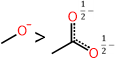 . This is predictable from thier basicity, e.g., \(\ce{CH3O^{-}}\) (\(pK_{b}\) = ~-1.5) is a significantly stronger base than \(\ce{CH3COO^{-}}\) (\(pK_{b}\) = ~9.24).
- Within the same row of the periodic table, nucleophilicity decreases from left to right as electronegativity increases, because the valence electrons are held more tightly, making the atom less polarizable, e.g., \(\ce{^{-}CH3}\) > \(\ce{^{-}NH2}\) > \(\ce{^{-}OH}\) > \(\ce{F^{-}}\). This trend is predictable form their basicity, e.g., \(\ce{^{-}CH3}\) (\(pK_{b}\) = ~-39) > \(\ce{^{-}NH2}\) (\(pK_{b}\) = ~-24) > \(\ce{^{-}OH}\) (\(pK_{b}\) = ~0) > \(\ce{F^{-}}\) (\(pK_{b}\) = ~10.8).
- Within the same group of the periodic table, nucleophilicity increases from top to bottom as electronegativity decreases and the distance of valence electrons from the nucleus increases, making the atom more polarizable, e.g., nucleophilicity: \(\overrightarrow{\ce{F^{-}} < \ce{Cl^{-}} < \ce{Br^{-}} < \ce{I^{-}}}\). This is explained by two factors: i) polarizability that allows larger atoms to make more bonding between the nucleophile and the electrophilic center, and ii) solvation layer that is more tightly held around the more dense charge of smaller atoms, as illustrated in Figure \(\PageIndex{7}\). This trend is opposite to basicity, which decreases from top to bottom in a group, e.g., basicity: \(\overleftarrow{\ce{F^{-}} (pK_{b} = ~10.8)> \ce{Cl^{-}} (pK_{b} = ~21 > \ce{Br^{-}} (pK_{b} = ~23)> \ce{I^{-}} (pK_{b} = ~24)}\). This discrepancy is explained based on two factors, i) the hydrogen atom of acids uses a smaller \(1s\) orbital, which makes better bonding with electron donor orbitals of smaller atoms at the top of a group, and ii) hydrogen being smaller and more dense charge without bulky groups around is not much affected by the steric effects of the solvation layer.

- For nucleophiles with the same attacking atom,
- bulky groups on the attacking atom make it less nucleophilic than predicted from their basicity. For example, methoxy ion \(\ce{CH3O^{-}}\) (\(pK_{b}\) = ~-1.5) is less basic but more nucleophilic (a good nucleophilie) than tert-butoxy ion \(\ce{(CH3)3CO^{-}}\) (\(pK_{b}\) = ~-4) which is more basic but a weak nucleophile. This is because three small \(\ce{-H}\) in \(\ce{CH3O^{-}}\) are replaced with bulky \(\ce{-CH3}\) groups in \(\ce{(CH3)3CO^{-}}\). The bulky groups hinder the approach of the electrophilic center to the nucleophilic center of the reacting partner. Basicity is not much affected by bulky groups on the reagent because it attacks a smaller, more exposed \(\ce{H}\) atom with no bulky groups in the way, unlike at an electrophilic center.
- Small nucleophilic reagents, with a bullet-like shape and few or no bulky groups that hinder their approach to the electrophilic center, are usually better nucleophiles than their basicity would predict. For example, cyanide ion \(\ce{^{-}\!\!:\!\!C#N\!\!:}\) (\(pK_{b}\) = ~4.7) and azide ion \(\ce{^{-}\!\!:\!\overset{\LARGE\cdot\cdot}{N}=\overset{+}{N}=\overset{\LARGE\cdot\cdot}{N}\!\!:\!\!^{-}}\) (\(pK_{b}\) = ~9.26) are weak bases but good nucleophiles.
The presence or absence of bulky groups on the same attacking atom can change its role from a nucleophile attacking predominantly an electrophilic center to a base attacking an acidic proton of the same substrate in a chemical reaction. For example, the methoxy ion reacts with 1-bromobutane, attacking ~90% at the electrophilic center and only ~10% at the acidic proton, whereas bulky tert-butoxide attacks ~90% at the acidic proton and only ~10% at the electrophilic center of the same substrate, as shown in Figure \(\PageIndex{8}\).

The Solvent
An electrophile and a nucleophile must find each other to react. For this purpose, they are usually dissolved in a suitable solvent. Solvents are classified as polar or nonpolar based on their dielectric constant, which measures a solvent's ability to reduce the electrical forces between charged particles dissolved in it. A solvent with a dielectric constant of 15 or greater is polar; less than 5 is nonpolar; and between 5 and 15 is borderline, called moderately polar. Polar solvents are also classified as polar protic or polar aprotic, as described below and listed in Table \(\PageIndex{9}\).
- Polar protic solvent are hydrogen-bond donor having \(\ce{H}\) attached to highly electronegative \(\ce{O}\) or \(\ce{N}\) atom, e.g., water \(\ce{H2O}\), \(\ce{NH3}\), methanol \(\ce{CH3-OH}\), etc.
- Polar aprotic have polar groups but they are not hydrogen-bond donor, i.e., they do not have \(\ce{H}\) attached to highly electronegative \(\ce{O}\) or \(\ce{N}\) atom, e.g., acetone \(\ce{(CH3)2\overset{\delta{+}}{C}{=}\overset{\delta{-}}{O}}\) and dimethylsulfoxide \(\ce{(CH3)2\overset{\delta{+}}{S}{=}\overset{\delta{-}}{O}}\).
| Solvent | Structure | Dielectric constant | classification |
| Water | \(\ce{\color{red}H\color{black}-O-\color{red}H}\) | 78 | Polar protic |
| Formic acid | \(\ce{H-\!\!{\overset{\overset{\Huge\enspace\!\!{\ce{O}}}|\!\!|\enspace}{\ce{C}}}\!\!-O\color{red}H}\) | 59 | Polar protic |
| Methanol | \(\ce{CH3O\color{red}H}\) | 33 | Polar protic |
| Ethanol | \(\ce{CH3CH2O\color{red}H}\) | 24 | Polar protic |
| Acetic acid | \(\ce{CH3-\!\!{\overset{\overset{\Huge\enspace\!\!{\ce{O}}}|\!\!|\enspace}{\ce{C}}}\!\!-O\color{red}H}\) | 6 | Moderately polar protic |
| Dimethyl sulfoxide (DMSO) | \(\ce{CH3-\!\!{\overset{\overset{\Huge\enspace\!\!{\ce{O}}}|\!\!|\enspace}{\ce{S}}}\!\!-CH3}\) | 49 | Polar aprotic |
| Acetonitrile | \(\ce{CH3C#N}\) | 38 | Polar aprotic |
| N, N-dimethylformamide (DMF) | \(\ce{H-\!\!{\overset{\overset{\Huge\enspace\!\!{\ce{O}}}|\!\!|\enspace}{\ce{C}}}\!\!-N(CH3)2}\) | 37 | Polar aprotic |
| Nitromethane | \(\ce{CH3NO2}\) | 36 | Polar aprotic |
| Acetone | \(\ce{CH3-\!\!{\overset{\overset{\Huge\enspace\!\!{\ce{O}}}|\!\!|\enspace}{\ce{C}}}\!\!-CH3}\) | 21 | Polar aprotic |
| Dichloromethane | \(\ce{CH2Cl2}\) | 9.1 | Moderately polar aprotic |
| Diethyl ether | \(\ce{CH3CH2OCH2CH3}\) | 4.3 | Nonpolar |
| Toluene | \(\ce{C6H5-CH3}\) | 2.3 | Nonpolar |
| Hexane | \(\ce{CH3CH2CH2CH2CH2CH3}\) | 1.9 | Nonpolar |
It is well known that "like dissolves like": ionic and polar substances dissolve in polar solvents, and nonpolar substances dissolve in nonpolar solvents. Nucleophiles and electrophiles are either ionic or polar substances. The ion-dipole and dipole-dipole interactions, along with nature's tendency to disperse particles, are usually strong enough to overcome ionic bonds, dissociate compounds into ions, and disperse them almost uniformly in polar solvents, as illustrated in Figure \(\PageIndex{10}\).
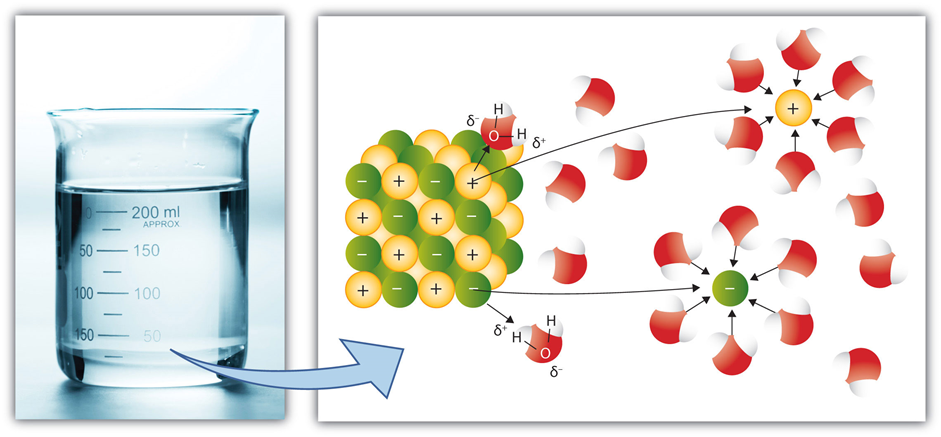
 Polar protic solvents dissolve ionic compounds by ion-dipole interactions, forming a layer of solvent around the cation and anion, called the solvation layer. It reduces the potential energy of the dissolved ion through stabilizing interactions. The nucleophile in the reactant and the leaving group in the product of an \(S_{N}2\) reaction are usually anions that are stabilized, thereby increasing the energy of activation, as illustrated in the figure on the right. In particular, the nucleophile becomes less nucleophilic because the solvent layer slows it down and because of the energy required to strip off the solvent layer before the reaction. The solvation layer is held more tightly by a small, dense charge than by a larger, less dense charge, which explains why nucleophilicity increases down the group in polar protic solvents. Therefore, less polar solvents are better for \(S_{N}2\) reactions, as long as they can dissolve sufficient concentrations of the reagents.
Nucleophiles are more reactive in aprotic solvents. Aprotic solvents dissolve ionic compounds via ion-dipole interactions with the cation, leaving the anion (i.e., the nucleophile) almost free in a more reactive, higher-energy state. This is because the \(\delta{-}\) pole of aprotic solvents is more exposed to interact with cations, while their \(\delta{+}\) pole is usually surrounded by bulky groups preventing anions from approaching it, as illustrated in Figure \(\PageIndex{11}\). This explains why nucleophiles are more reactive in aprotic solvents. The nuclephilic trend in a group of periodict table is \(\overrightarrow{\ce{F^{-}} < \ce{Cl^{-}} < \ce{Br^{-}} < \ce{I^{-}}}\) in polar protic solvent, but reverses to \(\overleftarrow{\ce{F^{-}} > \ce{Cl^{-}} > \ce{Br^{-}} > \ce{I^{-}}}\) in aprotic solvent. This is because the solvation-layer effect, which contradicts the basicity trend, dominates in polar protic solvents but diminishes in aprotic solvents.
Polar aprotic solvents are suitable for SN2 reactions because the nucleophiles are in a more energetic form due to a reduced or absent solvation layer.

Although \(S_{N}2\) reactions can occur in polar protic solvents, polar aprotic solvents are a better choice, as is evident from the data in Table \(\PageIndex{12}\). Another example, proving that the use of polar aprotic solvents makes \(S_{N}2 \) reactions easier and more useful, is the comparison of the following two reactions.
\[\ce{CH3CH2CH2CH2CH2CH2-Br + NaCN ->[\color{red}Solvent: Methanol + Water][\color{red} Condition: Heat, 20 hours] \underset{\color{blue}71\%}{\color{black}CH3CH2CH2CH2CH2CH2-N3} + NaBr}\nonumber\]
\[\ce{CH3CH2CH2CH2CH2CH2-Cl + NaCN ->[\color{red}Solvent: Dimethyl sulfoxide][\color{red} Condition: Heat, 20 minutes] \underset{\color{blue}91\%}{\color{black}CH3CH2CH2CH2CH2CH2-N3} + NaBr}\nonumber\]
In this case, replacing polar protic methanol + water solvent with polar aprotic dimethyl sulfoxide solvent in the \(S_{N}2\) re-action, the reaction time reduced from 20 hours to 20 minutes, product yield improved from 71% to 91%, and the good leaving but expensive \(\ce{-Br}\) could be replaced with not so good leaving but cheaper \(\ce{-Cl}\) group in the sustrate.
| Solvent | Structure | Dielectric constant | Solvent classification | Relative rate |
| Water | \(\ce{\color{red}H\color{black}-O-\color{red}H}\) | 78 | Polar protic | 1 |
| Methanol | \(\ce{CH3O\color{red}H}\) | 33 | Polar protic | 7 |
| Dimethyl sulfoxide (DMSO) | \(\ce{CH3-\!\!{\overset{\overset{\Huge\enspace\!\!{\ce{O}}}|\!\!|\enspace}{\ce{S}}}\!\!-CH3}\) | 49 | Polar aprotic | 1,300 |
| Acetonitrile | \(\ce{CH3C#N}\) | 38 | Polar aprotic | 5,000 |
| N, N-dimethylformamide (DMF) | \(\ce{H-\!\!{\overset{\overset{\Huge\enspace\!\!{\ce{O}}}|\!\!|\enspace}{\ce{C}}}\!\!-N(CH3)2}\) | 37 | Polar aprotic | 2,800 |