

6.1: Alkyl halides
- Page ID
- 548508

\( \newcommand{\vecs}[1]{\overset { \scriptstyle \rightharpoonup} {\mathbf{#1}} } \)
\( \newcommand{\vecd}[1]{\overset{-\!-\!\rightharpoonup}{\vphantom{a}\smash {#1}}} \)
\( \newcommand{\dsum}{\displaystyle\sum\limits} \)
\( \newcommand{\dint}{\displaystyle\int\limits} \)
\( \newcommand{\dlim}{\displaystyle\lim\limits} \)
\( \newcommand{\id}{\mathrm{id}}\) \( \newcommand{\Span}{\mathrm{span}}\)
( \newcommand{\kernel}{\mathrm{null}\,}\) \( \newcommand{\range}{\mathrm{range}\,}\)
\( \newcommand{\RealPart}{\mathrm{Re}}\) \( \newcommand{\ImaginaryPart}{\mathrm{Im}}\)
\( \newcommand{\Argument}{\mathrm{Arg}}\) \( \newcommand{\norm}[1]{\| #1 \|}\)
\( \newcommand{\inner}[2]{\langle #1, #2 \rangle}\)
\( \newcommand{\Span}{\mathrm{span}}\)
\( \newcommand{\id}{\mathrm{id}}\)
\( \newcommand{\Span}{\mathrm{span}}\)
\( \newcommand{\kernel}{\mathrm{null}\,}\)
\( \newcommand{\range}{\mathrm{range}\,}\)
\( \newcommand{\RealPart}{\mathrm{Re}}\)
\( \newcommand{\ImaginaryPart}{\mathrm{Im}}\)
\( \newcommand{\Argument}{\mathrm{Arg}}\)
\( \newcommand{\norm}[1]{\| #1 \|}\)
\( \newcommand{\inner}[2]{\langle #1, #2 \rangle}\)
\( \newcommand{\Span}{\mathrm{span}}\) \( \newcommand{\AA}{\unicode[.8,0]{x212B}}\)
\( \newcommand{\vectorA}[1]{\vec{#1}} % arrow\)
\( \newcommand{\vectorAt}[1]{\vec{\text{#1}}} % arrow\)
\( \newcommand{\vectorB}[1]{\overset { \scriptstyle \rightharpoonup} {\mathbf{#1}} } \)
\( \newcommand{\vectorC}[1]{\textbf{#1}} \)
\( \newcommand{\vectorD}[1]{\overrightarrow{#1}} \)
\( \newcommand{\vectorDt}[1]{\overrightarrow{\text{#1}}} \)
\( \newcommand{\vectE}[1]{\overset{-\!-\!\rightharpoonup}{\vphantom{a}\smash{\mathbf {#1}}}} \)
\( \newcommand{\vecs}[1]{\overset { \scriptstyle \rightharpoonup} {\mathbf{#1}} } \)
\(\newcommand{\longvect}{\overrightarrow}\)
\( \newcommand{\vecd}[1]{\overset{-\!-\!\rightharpoonup}{\vphantom{a}\smash {#1}}} \)
\(\newcommand{\ket}[1]{\left| #1 \right>}\)
\(\newcommand{\bra}[1]{\left< #1 \right|}\)
\(\newcommand{\braket}[2]{\left< #1 \vphantom{#2} \right| \left. #2 \vphantom{#1} \right>}\)
\(\newcommand{\braopket}[3]{\left< #1 \vphantom{#2}\vphantom{#3} \right| #2 \vphantom{#1}\vphantom{#3} \left| #3 \vphantom{#1}\vphantom{#2} \right>}\)
\(\newcommand{\qmvec}[1]{\mathbf{\vec{#1}}}\)
\(\newcommand{\op}[1]{\hat{\mathbf{#1}}}\)
\(\newcommand{\expect}[1]{\langle #1 \rangle}\)
\(\newcommand{\dfn}[1]{\emph{\textbf{#1}}}\)
\(\newcommand{\avec}{\mathbf a}\) \(\newcommand{\bvec}{\mathbf b}\) \(\newcommand{\cvec}{\mathbf c}\) \(\newcommand{\dvec}{\mathbf d}\) \(\newcommand{\dtil}{\widetilde{\mathbf d}}\) \(\newcommand{\evec}{\mathbf e}\) \(\newcommand{\fvec}{\mathbf f}\) \(\newcommand{\nvec}{\mathbf n}\) \(\newcommand{\pvec}{\mathbf p}\) \(\newcommand{\qvec}{\mathbf q}\) \(\newcommand{\svec}{\mathbf s}\) \(\newcommand{\tvec}{\mathbf t}\) \(\newcommand{\uvec}{\mathbf u}\) \(\newcommand{\vvec}{\mathbf v}\) \(\newcommand{\wvec}{\mathbf w}\) \(\newcommand{\xvec}{\mathbf x}\) \(\newcommand{\yvec}{\mathbf y}\) \(\newcommand{\zvec}{\mathbf z}\) \(\newcommand{\rvec}{\mathbf r}\) \(\newcommand{\mvec}{\mathbf m}\) \(\newcommand{\zerovec}{\mathbf 0}\) \(\newcommand{\onevec}{\mathbf 1}\) \(\newcommand{\real}{\mathbb R}\) \(\newcommand{\twovec}[2]{\left[\begin{array}{r}#1 \\ #2 \end{array}\right]}\) \(\newcommand{\ctwovec}[2]{\left[\begin{array}{c}#1 \\ #2 \end{array}\right]}\) \(\newcommand{\threevec}[3]{\left[\begin{array}{r}#1 \\ #2 \\ #3 \end{array}\right]}\) \(\newcommand{\cthreevec}[3]{\left[\begin{array}{c}#1 \\ #2 \\ #3 \end{array}\right]}\) \(\newcommand{\fourvec}[4]{\left[\begin{array}{r}#1 \\ #2 \\ #3 \\ #4 \end{array}\right]}\) \(\newcommand{\cfourvec}[4]{\left[\begin{array}{c}#1 \\ #2 \\ #3 \\ #4 \end{array}\right]}\) \(\newcommand{\fivevec}[5]{\left[\begin{array}{r}#1 \\ #2 \\ #3 \\ #4 \\ #5 \\ \end{array}\right]}\) \(\newcommand{\cfivevec}[5]{\left[\begin{array}{c}#1 \\ #2 \\ #3 \\ #4 \\ #5 \\ \end{array}\right]}\) \(\newcommand{\mattwo}[4]{\left[\begin{array}{rr}#1 \amp #2 \\ #3 \amp #4 \\ \end{array}\right]}\) \(\newcommand{\laspan}[1]{\text{Span}\{#1\}}\) \(\newcommand{\bcal}{\cal B}\) \(\newcommand{\ccal}{\cal C}\) \(\newcommand{\scal}{\cal S}\) \(\newcommand{\wcal}{\cal W}\) \(\newcommand{\ecal}{\cal E}\) \(\newcommand{\coords}[2]{\left\{#1\right\}_{#2}}\) \(\newcommand{\gray}[1]{\color{gray}{#1}}\) \(\newcommand{\lgray}[1]{\color{lightgray}{#1}}\) \(\newcommand{\rank}{\operatorname{rank}}\) \(\newcommand{\row}{\text{Row}}\) \(\newcommand{\col}{\text{Col}}\) \(\renewcommand{\row}{\text{Row}}\) \(\newcommand{\nul}{\text{Nul}}\) \(\newcommand{\var}{\text{Var}}\) \(\newcommand{\corr}{\text{corr}}\) \(\newcommand{\len}[1]{\left|#1\right|}\) \(\newcommand{\bbar}{\overline{\bvec}}\) \(\newcommand{\bhat}{\widehat{\bvec}}\) \(\newcommand{\bperp}{\bvec^\perp}\) \(\newcommand{\xhat}{\widehat{\xvec}}\) \(\newcommand{\vhat}{\widehat{\vvec}}\) \(\newcommand{\uhat}{\widehat{\uvec}}\) \(\newcommand{\what}{\widehat{\wvec}}\) \(\newcommand{\Sighat}{\widehat{\Sigma}}\) \(\newcommand{\lt}{<}\) \(\newcommand{\gt}{>}\) \(\newcommand{\amp}{&}\) \(\definecolor{fillinmathshade}{gray}{0.9}\)
Alkyl halide functional group
Organic compounds containing an alkyl group bonded to a halogen, i.e., \(\ce{R-X}\), where \(\ce{X}\) is \(\ce{F}\), \(\ce{Cl}\), \(\ce{Br}\), or \(\ce{I}\), are called alkyl halides. The halogen, i.e., \(\ce{-X}\) part is the functional group bonded to the alkyl group \(\ce{R}\) by a polar covalent bond, i.e., (\(\ce{(R)3\overset{\delta{+}}{C}{-}\overset{\delta{-}}{X}}\)).
Classification of alkyl halides
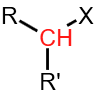
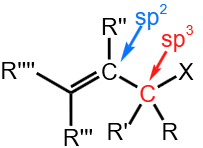
Alkyl halides are classified as methyl, primary, secondary, or tertiary, depending on whether the \(\ce{C}\) bearing halogen is methyl, primary, secondary, or tertiary, as illustrated in the Table \(\PageIndex{1}\). The \(\ce{C}\) in alkyl halides is \(sp^3\) hybridized. Their subclasses include allylic and benzylic, in which \(sp^3\)-\(\ce{C}\) bearing halogen is also bonded to an \(sp^2\)-\(\ce{C}\) of an alkene or an aromatic ring, respectively. Vinyl halides, alkynyl halides, and aryl halides are related to alkyl halides in which \(\ce{C}\) bearing halogen is \(sp^2\)-hybridized \(\ce{C}\) of alkene, \(sp\)-hybridized \(\ce{C}\) of alkyne, and \(sp^2\)-hybridized \(\ce{C}\) of an aromatic ring, respectively, as illustrated in the table below.
|
Structure (R is an alkyl group or \(\ce{H}\) |
 |
 |
 |
 |
 |
 |
 |
 |
 |
|---|---|---|---|---|---|---|---|---|---|
| Class of alkyl halide | Methyl | Primary | Secondary | Tertiary | Allylic | Benzylic | Vinyl | Alkynyl | aryl |
Bond length, strength, and polarity of alkyl halide group
Halogens belong to group 17 of the periodic table, which have seven valence electrons, represented as seven dots in Lewis dot structure, e.g., \(\ce{\LARGE :\!\normalsize \overset{\Huge{\cdot\cdot}}{\underset{\Huge{\cdot\cdot}}{Br}}{\LARGE\cdot}}\). Halogens in an organic compound are usually in \(sp^3\)-hybridized with zero formal charge, one covalent bond, and three lone pairs, e.g., \(\ce{CH3-\overset{\Huge{\cdot\cdot}}{\underset{\Huge{\cdot\cdot}}{Br}}{\LARGE :}}\). The radius of halogens increases down the group in the following order from smallest to largest: \(\ce{F < Cl < Br < I}\). Consequently, \(\ce{C-X}\) bond length increases in the same order, i.e., \(\ce{C-F < C-Cl < C-Br < C-I}\), as illustrated in the figure below.
 Hydrogen fluoride (\(\ce{CH3-F}\))
Bond length: 138 pm
Bond dissociation energy: 482 kJ/mol
Dipole moment: 1.82 D
 Hydrogen chloride (\(\ce{CH3-Cl}\))
Bond length: 178 pm
Bond dissociation energy: 350 kJ/mol
Dipole moment: 1.94 D
 Hydrogen bromide (\(\ce{CH3-Br}\))
Bond length: 194 pm
Bond dissociation energy: 302 kJ/mol
Dipole moment: 1.79 D
 Hydrogen iodide (\(\ce{CH3-I}\))
Bond length: 214
Bond dissociation energy: 241 kJ/mol
Dipole moment: 1.64 D
Bond strength, represented by bond dissociation energy, decreases as the bond length increases in the following order: \(\ce{C-F > C-Cl > C-Br > C-I}\). Recall that the overlap of atomic orbitals making bonds is maximum when the overlapping orbitals are comparable in size, and the overlap becomes less and less as their sizes differ more and more. \(\ce{C}\) and \(\ce{F}\) use \(2p\) orbitals, which are comparable in size, resulting in maximum overlap. While \(\ce{Cl}\),\(\ce{Br}\), and \(\ce{l}\), use \(3p\), \(4p\), and \(5p\) orbitals, respectively, which are larger than \(2p\) orbital of \(\ce{C}\) and overlap less resulting in weaker bonds.
Alkyl halides are polar functional groups, and the dipole moment does not vary much from halogen to halogen. Recall that dipole moment \(\mu\) is a product of the magnitude or charge \(Q\) times the distance \(d\) between the centers of positive and negative charges on a dipole, given by the formula: \(\mu = Q\times d\). Electronegativity decreases down the group in the order: \(\ce{F}\) 4.0 > \(\ce{Cl}\) 3.2 > \(\ce{Br}\) 3.0 > and \(\ce{l}\) 2.7, but the bond length increases counteracting it, which explains why the dipole moment does not vary much. Also, keep in mind that the molecular dipole moment is a vector sum of individual dipole moments in the molecule that also takes into account the dipole moments associated with the lone pair of electrons in \(sp^3\)-orbitals of halogens.
Physical properties of alkyl halides
Boiling points
Van der Walls radius of halogens increases down the group in the following order: \(\ce{F}\) 147 pm < \(\ce{Cl}\) 175 pm < \(\ce{Br}\) 185 pm < and \(\ce{l}\) 198 pm, which are larger than that of hydrogen \(\ce{H}\) 120 pm. Therefore, when a \(\ce{-H}\) of an alkane is replaced with a halogen \(\ce{-X}\), the surface area of the molecule increases, increasing London dispersion forces. The larger the halogen replacing hydrogen, the higher the boiling point, which can be observed in each row of \(\PageIndex{2}\). Further, a non-polar \(\ce{C-H}\) bond is replaced with a polar (\(\ce{\overset{\delta{+}}{C}{-}\overset{\delta{-}}{X}}\)) that adds dipole-dipole interactions that is also responsible for the increase in the overall intermolecular forces reflecting in an increase in the boiling points.
|
\(\ce{R-X}\), \(X\rightarrow\) \(R- \downarrow\) |
H |
F |
Cl |
Br |
I |
|
Methyl (\(\ce{CH3{-}}\)) |
-161 |
-78 |
-24 |
4 |
43 |
|
Ethyl (\(\ce{CH3CH2{-}}\)) |
-89 |
-37 |
13 |
38 |
72 |
|
Propyl (\(\ce{CH3(CH2)2{-}}\)) |
-45 |
3 |
46 |
71 |
102 |
|
Isopropyl (\(\ce{(CH3)2CH{-}}\)) |
-45 |
-11 |
35 |
60 |
89 |
|
Butyl (\(\ce{CH3(CH2)3{-}}\)) |
0 |
32 |
77 |
100 |
130 |
|
sec-Butyl (\(\ce{CH3CH2CH(CH3){-}}\)) |
0 |
25 |
67 |
90 |
119 |
|
Isobutyl (\(\ce{(CH3)2CHCH2{-}}\)) |
-12 |
16 |
68 |
91 |
120 |
|
tert-Butyl (\(\ce{(CH3)3C{-}}\)) |
-12 |
12 |
51 |
72 |
98 |
|
Pentyl (\(\ce{CH3(CH2)4{-}}\)) |
36 |
63 |
108 |
129 |
157 |
|
Hexyl (\(\ce{CH3(CH2)5{-}}\)) |
69 |
92 |
134 |
155 |
181 |
For the same halogen, the bigger the alkyl group, the higher the boiling point as observed in going down the column in Table \(\PageIndex{2}\). Among the isomers of alkyl halides, the more branched the alkyl groups, the lower the boiling point, which can be observed by comparing propyl halide with isopropyl halides and also by comparing butyl halides with sec-butyl, isobutyl, and tert-butyl halides in Table \(\PageIndex{2}\).
Densities
Replacing an \(\ce{-H}\) of an alkane with a halogen increases the density of the compound, as shown in Table \(\PageIndex{3}\). Although the Van der Waals radius rises in the order: \(\ce{H}\) < \(\ce{F}\) < \(\ce{Cl}\) < \(\ce{Br}\) < \(\ce{l}\), the increase in atomic weight is more, increasing the densities in the following order: \(\ce{R-H}\) < \(\ce{R-F}\) < \(\ce{R-Cl}\) < \(\ce{R-Br}\) < \(\ce{R-l}\). Alkyl fluorides and alkyl chlorides are less dense than water (1 g/ml), but alkyl bromides and alkyl iodides are denser than water. Monochloroalkanes are less dense than water, e.g., \(\ce{CH3Cl}\) is 0.92 g/ml, but dichloroalkane and higher are more dense than water, e.g., \(\ce{CH2Cl2}\) is 1.34 g/ml, \(\ce{CHCl3}\) is 1.50 g/ml, and \(\ce{CCl4}\) is 1.60 g/ml.
|
\(\ce{R-X}\), \(X\rightarrow\) \(R- \downarrow\) |
H |
F |
Cl |
Br |
I |
|
Methyl (\(\ce{CH3{-}}\)) |
- |
- |
0.92 |
1.68 |
2.26 |
|
Ethyl (\(\ce{CH3CH2{-}}\)) |
- |
0.72 |
0.90 |
1.46 |
1.94 |
|
Propyl (\(\ce{CH3(CH2)2{-}}\)) |
- |
0.80 |
0.89 |
1.35 |
1.75 |
|
Isopropyl (\(\ce{(CH3)2CH{-}}\)) |
- |
- |
0.86 |
1.31 |
1.70 |
|
Butyl (\(\ce{CH3(CH2)3{-}}\)) |
- |
0.78 |
0.89 |
1.28 |
1.62 |
|
tert-Butyl (\(\ce{(CH3)3C{-}}\)) |
- |
- |
0.84 |
1.23 |
1.54 |
|
Pentyl (\(\ce{CH3(CH2)4{-}}\)) |
0.626 |
.79 |
0.88 |
1.22 |
1.51 |
|
Hexyl (\(\ce{CH3(CH2)5{-}}\)) |
0.661 |
0.80 |
0.88 |
1.18 |
1.44 |
Solubilities
Alkyl halides are insoluble in water and soluble in organic solvents. This is based on the like dissolves like principle. Alkyl halides and organic solvents have similar intermolecular forces, making them miscible. Water is a hydrogen-bonding solvent, while alkyl halides do not hydrogen-bond with the hydrophobic alkyl chain, making them immiscible in water. Such organic solvents, which are immiscible with water, are used in liquid-liquid extraction processes with water and the organic solvent combination. Unlike most organic solvents, which are less dense than water and form an upper layer when added to water, alkyl halides like dichloromethane (\(\ce{CH2Cl2}\)) that are denser than water, make a bottom layer when added to water.
Reaction mechanisms of alkyl halides
Terminology related to alkyl halide reactions
Rearrangement of atoms within a substance or between substances is a chemical reaction. It involves making and/or breaking chemical bonds. Major classes of organic reactions are based on heterolytic bond making and/or breaking of polar covalent bonds. In alkyl halides, the polar covalent bond between carbon and a halogen \(\ce{R3\overset{\delta +}{C}-\overset{\delta -}{X}}\) is the center of their chemical reactivity.
- The species whose transformation is under observation during a chemical reaction is called the substrate.
- A small species that detaches from the substrate during a chemical reaction is called a leaving group.
For example, alkyl halide is a substrate and halide \(\ce{Br^{-}}\) that splits off from the substrate, receiving both the bonding electrons of the bond broken, is the leaving group in the reaction 6.1.1 shown below.
\[\color{red}\ce{\underset{substrate}{ (CH3)3\overset{\delta +}{C}\color{blue}-\overset{\delta -}{Br}}} \color{black}\ce{ ->[\color{green} Slow]} \color{red}\ce{\underset{intermediate}{(CH3)3\overset{+}{C}} \color{black}+ \color{blue}\ce{\underset{leaving group}{Br^{-}}}}\]
\[ \underline{\color{blue}\ce{\underset{nucleophile}{H2O}} \color{black}+ \color{red}\ce{\underset{electrophile}{ (CH3)3\overset{+}{C}}} \color{black}\ce{ ->[\color{green} Fast]} \color{red}\ce{\underset{product}{ (CH3)3{C}\color{blue}-\overset{+}{O}H2}}}\]
\[ \text{Overall\, reaction:}\color{blue}\ce{\underset{nucleophile}{H2O}} \color{black}+ \color{red}\ce{\underset{electrophile/substrate}{ (CH3)3\overset{\delta +}{C}-\color{blue}\overset{\delta -}{Br}}} \color{black}\ce{ ->} \color{red}\ce{\underset{product}{(CH3)3\color{blue}-\overset{+}{O}H2} \color{black}+ \color{blue}\ce{\underset{leaving group}{Br^{-}}}}\]
Atoms of every element usually have a specific set of covalent bonds and lone pairs in stable organic molecules. For example, carbon has four covalent bonds and zero lone pairs, nitrogen has three covalent bonds and one lone pair, oxygen has two covalent bonds and two lone pairs, halogens have one covalent bond and three lone pairs, and hydrogen has one covalent bond and zero lone pairs. Heterolytic bond breaking reduces covalent bonds, making the fragments reactive species that tend to form new covalent bonds. The species that loses a bonding electron during heterolytic bond breaking typically receives an electron pair from a donor species, forming a new covalent bond. For example, carbocation (\(\ce{(CH3)3\overset{+}{C}}\)) has an empty \(p\)-orbital in which it can accept one of the lone pairs from oxygen of water (\(\ce{H2O}\)) in reaction 6.1.2, making a new covalent bond.
- A species capable of receiving an electron pair to make a new covalent bond is called an electrophile.
- A positively charged atom in an electrophile, with a suitable orbital to accept a pair of electrons from a donor to form a new covalent bond, is called an electrophilic center.
- A species capable of donating a pair of electrons to an electrophile to make a new covalent bond is called a nucleophile. Nucleophiles usually bear a partial or complete negative charge and a \(\pi\)-bond or lone pair that they can donate to make a new covalent bond.
 For example, carbocation (\(\ce{(CH3)3\overset{+}{C}}\)) is an electrophile and its carbon bearing positive charge (\(\ce{\overset{+}{C}}\)) and an empty \(p\)-orbital is its electrophilic center, as illustrated in the figure on the righ margin. Water (\(\ce{\overset{\delta +}{H}-\overset{\delta -}{\overset{\Huge{\cdot\cdot}}{\underset{\Huge{\cdot\cdot}}{O}}}-\overset{\delta +}{H}}\) is a nucleophile donating a lone pair on oxygen to make a new covalent bond.
Species that are formed in one reaction and consumed in another in a sequence of reactions are called intermediates.
For example, carbocation (\(\ce{(CH3)3\overset{+}{C}}\)) is an intermediate formed in reaction 6.1.1 and consumed in reaction 6.1.2.
A reaction that occurs in a single step and passes from reactants to products through a single transition state is an elementary reaction.
For example, reactions 6.1.1 and 6.1.2 are elementary reactions. The rate law of an elementary reaction can be written directly from its stoichiometric coefficients; i.e., the rate of an elementary reaction is directly proportional to the product of the molar concentrations of the reactants, each raised to the power equal to its stoichiometric coefficient in the equation. For example, the rate of reaction 6.1.1 is: \[Rate = k_{1}[\ce{(CH3)3\overset{\delta +}{C}-\overset{\delta -}{Br}}]\], where \(k_{1}\) is the rate constant and \([\ce{(CH3)3\overset{\delta +}{C}-\overset{\delta -}{Br}}]\) is the molar concentration of the substrate. Similarly the rate of reaction 6.1.2 is: \[Rate = k_{2}[\ce{(CH3)3\overset{+}{C}}][\ce{H2O}]\], where \(k_{2}\) is the rate constant and \([substance]\) is the molar concentration of the substance in the square brackets.
A series of elementary reactions in which the product of one reaction is an intermediate of the subsequent reaction is called a stepwise reaction or a reaction sequence
For example, reactions 6.1.1 and 6.1.2 together are a reaction sequence.
Chemical reaction equations can be combined, like algebraic equations, to yield an overall reaction equation.
For example, the addition of equation 6.1.1. and 6.1.2 yield an overall equation of this reaction sequence.
The first step (6.1.1) is slow, and the second (6.1.2) is fast.
The slowest step in a sequence of reactions is the rate-determining step.
For example, step 6.1.1 is the rete-determining step of the sequence of reactions 6.1.1 and 6.1.2.
Nucleophilic substitution reactions
As with the algebraic addition of equations, the addition of elementary steps, e.g., the addition of chemical equations 6.1.1 and 6.1.2, yields the overall equation 6.1.3 for the reaction. In the overall reaction 6.1.3, a nucleophile (\(\ce{H2O}\) adds to the electrophilic part of the substrate and leaving group, which is a potential nucleophile, breaks away from the substrate.
Heterolytic reactions in which a nucleophile adds to the electrophilic part of the substrate and the leaving group, i.e., a potential nucleophile, departs from the electrophile, are called nucleophilic substitution reactions.
For example, the sequence of reactions 6.1.1 and 6.1.2, which together form reaction 6.1.3, is a nucleophilic substitution reaction. Kinetics of the slowest step (6.1.1), which is also the kinetic of the overall reaction (6.1.2) is unimolecular, i.e., \[Rate = k[substrate]\], where \(k\) is the rate constant and \([substrate]\) is the molar concentration of the substrate. Doubling the concentration of the substrate will double the reaction rate, but doubling the concentration of the nucleophile will not affect the overall reaction rate.
Nucleophilic substitution occurring in a sequence of two or more elementary steps with overall first-order kinetics is termed \(\mathbf{S_{N}1}\), where \(S\) stands for "substitution", \(_N\) for "nucleophilic", and \(1\) for "unimolecular kinetics".
The sequence of reactions 6.1.1 and 6.1.2, which add up to reaction 6.1.3, is an example of an \(S_{N}1\) mechanism. \(S_{N}1\) mechanism may have more than two elementary steps. Particularly, acid-base elementary steps often add to the two basic elementary steps of the mechanism. For example, the product of reaction 6.1.2 is a protonated alcohol (\(\ce{(CH3)3{C}-\overset{+}{O}H2}\)) which is a strong acid and undergoes the following fast acid-base reaction.
\[\ce{\color{red}{\underset{acid}{(CH3)3{C}-\overset{+}{O}H2}} \color{black}{+} \color{blue}{\underset{base}{:\!B}} \color{black}{->} \color{red}{\underset{conjugate base}{(CH3)3-OH}} \color{black}{+} \color{blue}\underset{conjugate acid}{ \color{red} H \color{blue}\!\!-\overset{+}{B}}}\]
, where \(\:B\) is any base in the medium, which may be a solvent molecule or the leaving group. Addition of step 6.1.5 to the sequence of 6.1.1 and 6.1.2 makes this \(S_{N}1\) mechanism, a sequence of three steps converting an alkyl halide substrate to an alcohol product, through two intermediates: first is carbocation (\(\ce{(CH3)3\overset{+}{C}}\)) formed in step 6.1.1 and consumed in step 6.1.2, and second is protonated alcohol (\(\ce{(CH3)3{C}-\overset{+}{O}H2}\)) formed in step 6.1.2 and consumed in step 6.1.5, as shown below.
\(\color{red}\ce{\underset{substrate}{ (CH3)3\overset{\delta +}{C}\color{blue}-\overset{\delta -}{Br}}} \color{black}\ce{ ->[\color{green} Slow]} \color{red}\ce{\underset{intermediate-I}{(CH3)3\overset{+}{C}} \color{black}+ \color{blue}\ce{\underset{leaving group}{Br^{-}}}}\)
\(\color{blue}\ce{\underset{nucleophile}{H2O}} \color{black}+ \color{red}\ce{\underset{electrophile\backslash intermediate-I}{ (CH3)3\overset{+}{C}}} \color{black}\ce{ ->[\color{green} Fast]} \color{red}\ce{\underset{intermediate-II}{ (CH3)3{C}\color{blue}-\overset{+}{O}H2}}\)
\(\ce{\color{red}{\underset{acid\backslash intermediate-II}{(CH3)3{C}-\overset{+}{O}H2}} \color{black}{+} \color{blue}{\underset{base}{:\!B}} \ce{ ->[\color{green} Fast]} \color{red}{\underset{product\backslash conjugate base}{(CH3)3-OH}} \color{black}{+} \color{blue}\underset{conjugate acid}{ \color{red} H \color{blue}\!\!-\overset{+}{B}}}\)
The nucleophilic substitution mechanism can occur in a single step or in multiple steps, depending on the conditions. The following is an example of a single-step nucleophilic substitution in which the incoming nucleophile forms a bond and, simultaneously, the leaving group breaks the bond to the substrate in a concerted manner.
\[ \color{blue}\ce{\underset{nucleophile}{HO^{-}}} \color{black}+ \color{red}\ce{\underset{electrophile/substrate}{ H3\overset{\delta +}{C}-\overset{\delta -}{Br}}} \color{black}\ce{ ->} \color{blue}\ce{\underset{product}{H\overset{\delta -}{O}\color{red}-\overset{\delta +}{C}H3} \color{black}+ \color{red}\ce{\underset{leaving group}{Br^{-}}}}\]
The kinetics of reaction 6.1.6 is bimolecular: unimolecular with respect to substrate and unimolecular with respect to nucleophile, i.e., \[Rate = k[substrate][nucleophile]\], where \(k\) is the rate constant, \([substrate]\) is the molar concentration of the substrate and \([nucleophile]\) is the molar concentration of the nucleophile. Doubling the concentration of either the substrate or the nucleophile doubles the rate, and doubling the concentrations of both the substrate and the nucleophile increases the rate by a factor of 4.
Nucleophilic substitution occurring in a single step, often with second-order (bimolecular) kinetics, is termed \(\mathbf{S_{N}2}\), where \(S\) stands for "substitution", \(_N\) for "nucleophilic", and \(s\) for "bimolecular kinetics".
Reaction 6.1.6 is an example of \(S_{N}2\) mechanism.
Nucleophilic substitution reactions are beneficial in organic synthesis. For example, alkyl halides are derived from alkanes by free radical reactions and converted to several other classes of organic compounds by \(S_{N}2\) mechanism, e.g., to:
an alcohol: \(\ce{CH3CH2Br + OH^{-} -> CH3CH2OH + Br^{-}}\),
a thiol: \(\ce{CH3CH2Br + HS^{-} -> CH3CH2SH + Br^{-}}\),
an ether: \(\ce{CH3CH2Br + CH3CH2O^{-} -> CH3CH2OCH2CH3 + Br^{-}}\),
a thioether: \(\ce{CH3CH2Br + CH3CH2S^{-} -> CH3CH2SCH2CH3 + Br^{-}}\),
an amine: \(\ce{CH3CH2Br + ^{-}NH2 -> CH3CH2NH2 + Br^{-}}\),
a nitrile: \(\ce{CH3CH2Br + ^{-}C≡N -> CH3CH2C≡N + Br^{-}}\), and
and an alkyne: \(\ce{CH3CH2Br + ^{-}C≡CCH3 -> CH3CH2C≡CCH3 + Br^{-}}\).
Nucleophilic substitution reactions are not limited to alkyl halides, but they also apply to other functional groups containing single polar covalent bonds. For example, protonated alcohols, protonated ethers, amines, and sulfonium ions undergo \(S_{N}1\) or \(S_{N}2\) reactions, yielding different products, as shown in examples below.
\(\ce{(CH3)3C-OH + HBr <=> (CH3)3C-\overset{+}{O}H2 + Br^{-} ->[\Delta] (CH3)3C-Br + H2O}\nonumber\) by SN1 mechanism
\(\ce{(CH3)2CH-OH + HBr <=> (CH3)2CH-\overset{+}{O}H2 + Br^{-} ->[\Delta] (CH3)2CH-Br + H2O}\nonumber\) by SN1 mechanism
\(\ce{CH3CH2-OH + HBr <=> CH3CH2-\overset{+}{O}H2 + Br^{-} ->[\Delta] CH3CH2-Br + H2O}\nonumber\) by SN2 mechanism
\(\ce{(CH3)3C-O-C(CH3)3 + HBr <=> (CH3)3C-\overset{+}{O}HC(CH3)3 + Br^{-} ->[\Delta] (CH3)3C-Br + (CH3)3C-OH}\nonumber\) by SN1 mechanism
\(\ce{CH3CH2-O-CH3 + HBr <=> CH3CH2-\overset{+}{O}HCH3 + Br^{-} ->[\Delta] CH3CH2-OH + CH3-Br}\nonumber\) by SN2 mechanism
\(\ce{CH3CH2-Br + CH3-NH2 -> CH3CH2-\overset{+}{N}H2-CH2CH3 + Br^{-}}\) an SN2 reaction
\(\ce{HO^{-} + (CH3)2\overset{+}{S}-CH3 -> CH3-OH + (CH3)2S}\) an SN2 reaction
Factors affecting \(S_{N}1\) and \(S_{N}2\) reactions are described in this chapter with the help of the reactions of alkyl halides.
Acid-base reactions vs. nucleophilic substitution reactions
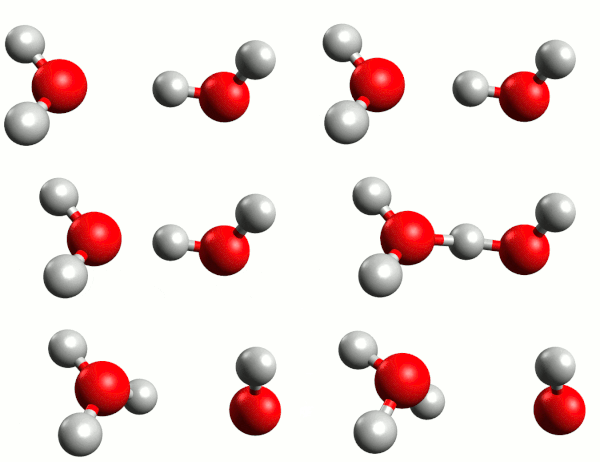 The majority of organic reactions occur through polar mechanisms, in which heterolytic bond-making and/or breaking involve polar covalent bonds. One primary class of polar reactions is acid-base reactions, e.g., the reaction of \(\ce{HBr}\) acid with \(\ce{OH^-}\) base shown below and reaction of \(\ce{H2O}\) acid with \(\ce{HO^{-}}\) base illustrated in the figure on the right margin (copyright: Manuel Almagro Rivas, CC BY-SA 4.0, via Wikimedia Commons).
\( \color{blue}\ce{\underset{base}{HO^{-}}} \color{black}+ \color{red}\ce{\underset{acid}{ \overset{\delta +}{H}-\overset{\delta -}{Br}}} \color{black}\ce{ ->} \color{blue}\ce{\underset{conjugate\;acid}{H\overset{\delta -}{O}\color{red}-\overset{\delta +}{H}} \color{black}+ \color{red}\ce{\underset{conjugate\;base}{Br^{-}}}}\)
Acid-base reactions are heterolytic reactions in which a \(\ce{\overset{\delta +}{H}}\) on a polar covalent bond receives an electron pair from a base, making a new \(\sigma\)-bond, and the conjugate base receives both electrons of the bond broken.
Acid-base reactions are proton exchange reactions, i.e., a proton substitutes for a base.
Nucleophilic substitutions are heterolytic reactions in which an electrophile, i.e., a positive or a partially positive atom other than a proton, receives an electron pair from an electron donor, called a nucleophile, making a new \(\sigma\)-bond, and leaving group retains both electrons of the bond broken, potentially becoming another nucleophile.
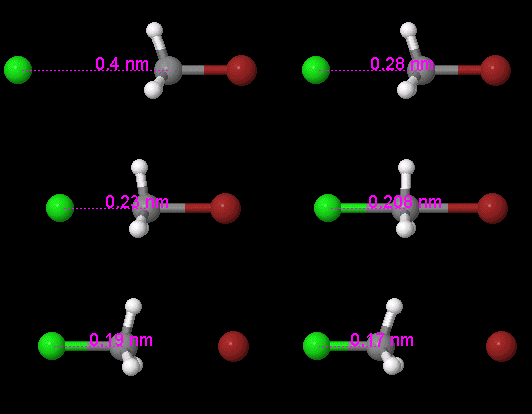 For example, simulation on the right margin shows the substitution of a green nucleophile, e.g., \(\ce{\color{green}Cl^{-}}\), with a red one, e.g., \(\ce{\color{red}Br^{-}}\), on an electrophile, e.g., carbon in \(\ce{H3\overset{\delta +}{C}-\overset{\delta -}{Br}}\), as in the following chemical reaction (copyright: CC0, via Wikimedia Commons.)
\( \color{green}\ce{\underset{nucleophile}{Cl^{-}}} \color{black}+ \ce{\underset{electrophile/substrate}{ H3\overset{\delta +}{C}-\color{red}\overset{\delta -}{Br}}} \color{black}\ce{ ->} \color{green}\ce{\underset{product}{\overset{\delta -}{Cl}\color{black}-\overset{\delta +}{C}H3} \color{black}+ \color{red}\ce{\underset{leaving group}{Br^{-}}}}\)
The terms base and nucleophile appear to be the same. Similarly, conjugate base and leaving group appear to be the same. An acid refers to an electron-deficient hydrogen atom. In contrast, an electrophile refers to an electron-deficient atom other than hydrogen, but a Lewis acid is also an electron-deficient atom that can be other than hydrogen. Therefore, acid and electrophile appear to be the same. In reality, these terms have different meanings.
Acid-base reactions are fast, and the discussion focuses on the thermodynamic aspects, namely the ratio of products to reactants after equilibrium has been established. Quantitative measure of acidity is \(pK_{a}\) and of basicity is \(pk_{b}\), which are equal to negative log of the corresponding equilibrium constants \(K_{a}\), and \(K_{b}\), respectively. It also relates to the relative stability of the reactants and the products; the more stable the products relative to the reactants, the larger the equilibrium constant. Nucleophilic substitution reactions, on the other hand, are slow, and the discussion focuses on kinetic aspects of the nucleophile and the electrophile: the faster a nucleophile reacts with a reference electrophile, the stronger the nucleophile. The rate of a reaction is determined by the energy of activation: the lower the energy of activation, the faster the reaction. Therefore, the factors affecting nucleophilic substitution reactions are discussed in terms of their effects on the corresponding activation energies.
Acidity of protons of alkyl halides
The carbons of alkyl halides and protons on them are designated as \(\alpha\), \(\beta\), \(\gamma\), etc., which refer to their location relative to the functional group. The carbon bearing the functional halide group is designated \(\alpha\)-\(\ce{C}\), the carbon two bond away from halide atom is \(\beta\)-\(\ce{C}\), three bonds away is \(\gamma\)-\(\ce{C}\), four bonds away is \(\delta\)-\(\ce{C}\), and so on, as illustrated in Figure \(\PageIndex{4}\) a). The hydrogen on an \(\alpha\)-\(\ce{C}\) are designed as \(\alpha\)-\(\ce{H}\), those on \(\beta\)-\(\ce{C}\) are \(\beta\)-\(\ce{H}\), and so on. These locants are also used for other classes of organic compounds containing a single polar covalently bonded functional group, such as alcohols and amines. However, for a carbonyl group (\(\ce{C=O}\) containing double bonded functional group, the carbon bearing oxygen is called carbonyl-\(\ce{C}\), carbon one bond away from the carbonyl-\(\ce{C}\) is designated \(\alpha\)-\(\ce{C}\), two bonds away is \(\beta\)-\(\ce{C}\), and so on, as shown in Figure \(\PageIndex{4}\) b).
 a) 1-Chlorobutane
 b) 3-Pentanone
 c) Propane
The \(\ce{C-H}\) bonds of alkanes, e.g., of propane in Figure \(\PageIndex{4}\) c), are non-polar. Further, the electronegativity of \(\ce{C}\) is low and does not stabilize a negative charge on it in its conjugate base. Therefore protons on \(\ce{C}\) of alkanes are not acidic with \(pK_{a}\) ~50. The \(\alpha\)-\(\ce{C-H}\) bonds of alkyl halide are slightly polar due to the inductive effect of the halogen atom. Therefore \(\alpha\)-\(\ce{C-H}\) of alkyl halides are expected to be slightly acidic, but their acidity is not strong enough to interfere in their reactions. The inductive effect reduces with distance. Therefore \(\beta\)-\(\ce{C-H}\) of alkyl halides are expected to be significantly less acidic than their \(\alpha\)-\(\ce{C-H}\). Contrary to this prediction, \(\beta\)-\(\ce{C-H}\) of alkyl halides are significantly acidic. To understand it, recall the acidity of \(\alpha\)-\(\ce{C-H}\) of carbonyl compounds. The \(\alpha\)-\(\ce{C-H}\) of carbonyl compounds are significantly acidic due to the resonance stabilization of the negative charge of the conjugate base on oxygen, as shown below.

, where \(\ce{:B}\) is a base. The \(pK_{a}\) of \(\alpha\)-\(\ce{C-H}\) of carbonyl compounds is ~20, which is ~\(10^{30}\) times larger than \(pK_{a}\) ~\(10^{50}\) of alkane \(\ce{C-H}\). Similarly, when a base removes a \(\beta\)-\(\ce{C-H}\) of alkyl halides, the the \(\sigma\)-bonding electrons convert into a \(\pi\)-bond between \(\alpha\)-\(\ce{C}\) and \(\beta\)-\(\ce{C}\), and \(\ce{C-X}\) bond breaks heterolytically, where the halide leaving group retains both the \(\sigma\)-bonding electrons.

Reactions in which small groups are lost from the substrate are called elimination reactions.
Elimination reactions in which two groups are lost from two adjacent centers (1,2-elimination), leaving behind a \(\pi\)-bond between the two centers, are called \(\beta\)-elimination reactions.
The above acid-base reaction of alkyl halide is an example of a \(\beta\)-elimination reaction. Retention of the negative charge of the conjugate base on an electronegative halide leaving group makes the \(\beta\)-\(\ce{C-H}\) of alkyl halides significantly acidic. Therefore, \(\beta\)-elimination reactions often compete with their nucleophilic substitution reactions.
\(\beta\)-Elimination reactions
The \(\beta\)-elimination reactions occur through three primary mechanisms, which differ in the timing of the departure of the proton relative to the departure of the halide from the substrate. In the case of single-step \(\beta\)-elimination shown below, \(\beta\)-\(\ce{H}\) and halide leaving group (\(\ce{Br^{-}}\)) leave simultaneously.

The kinetics of this single-step reaction, involving two molecular entities, is bimolecular, i.e., \[Rate = k[substrate][base]\], where \(k\) is the rate constant, \([substrate]\) is the molar concentration of the substrate, and \([base]\) is the molar concentration of the base.
\(\beta\)-elimination reactions in which \(\beta\)-\(\ce{H}\) and leaving group leave simultaneously from a substrate are called \(\mathbf E2\) reactions, where \(E\) stands for elimination and \(2\) refers to the bimolecular kinetics of the reaction.
Under some conditions, the leaving group leaves in a slow step followed by removal of \(\beta\)-\(\ce{H}\) in the second fast step, as shown in the example below.

The kinetics of the first step are unimolecular, i.e., \[Rate = k[substrate]\], where \(k\) is the rate constant and \([substrate]\) is the molar concentration of the substrate. Since the first step is rate-determining, the kinetics of the overall reaction are also those of the first step.
\(\beta\)-elimination reactions in which leaving group leaves first in a rate-determining step following by removal of \(\beta\)-\(\ce{H}\) by base in a fast step are called \(\mathbf E1\) reactions, where \(E\) stands for elimination and \(1\) refers to the unimolecular kinetics of the reaction.
Note that the first step, i.e., the rate-determining step, is common for \(E1\) and \(S_{N}1\) mechanisms for the same substrate. Therefore, \(E1\) and \(S_{N}1\) reactions often occur together, yielding a mixture of \(E1\) product and \(S_{N}1\) product.
In some conditions, a proton is removed by a base, resulting in a conjugate base intermediate. The anionic lone pair of the conjugate base then establishes a \(\pi\)-bond between \(\alpha\)- and \(\beta\)-carbons, pushing the leaving group out in the second slow and rate-determining step, as shown in an example below.

The kinetics of the second rate-determining step are unimolecular because only one molecular entity, i.e., the conjugate base intermediate, is involved in it.
\(\beta\)-elimination reactions in which the proton leaves first by a fast acid-base reaction, followed by elimination of the leaving group from the conjugate-base intermediate in a slow and rate-determining second step, are called \(\mathbf E1cB\) reactions, where \(E\) stands for elimination, \(1\) refers to the unimolecular kinetics of the rate-determining step, and \(cB\) refers to the conjugate base.
Alkyl halides do not usually undergo \(E1cB\) because halides, like chloro (\(\ce{-Cl}\)), bromo (\(\ce{-Br}\)), and iodo (\(\ce{-l}\)) are good leaving groups that leave either before or along with the proton, i.e., by \(E1\) or by \(E2\) mechanism. \(E1cB\) requires a poor leaving group, like \(\ce{^{-}OH}\) or \(\ce{^{-}OR}\), which requires a push from an anionic lone pair as in a conjugate base. Further, \(E1cB\) require protons to be sufficiently acidic, e.g., those \(\alpha\) to an electron-withdrawing group like a carbonyl (\(\ce{C=O}\) group. Therefore, \(E1cB\) is not common in laboratory reactions. However, alcohol (\(\ce{-OH}\)) and carbonyl (\(\ce{C=O}\) groups are very common in biochemicals. Consequently, \(E1cB\) is common in biochemical reactions.
Details of the \(E1\) and \(E2\) mechanisms are described later in this chapter.