

5.5: Selectivity in halogenation of alkanes
- Page ID
- 540750
\( \newcommand{\vecs}[1]{\overset { \scriptstyle \rightharpoonup} {\mathbf{#1}} } \)
\( \newcommand{\vecd}[1]{\overset{-\!-\!\rightharpoonup}{\vphantom{a}\smash {#1}}} \)
\( \newcommand{\dsum}{\displaystyle\sum\limits} \)
\( \newcommand{\dint}{\displaystyle\int\limits} \)
\( \newcommand{\dlim}{\displaystyle\lim\limits} \)
\( \newcommand{\id}{\mathrm{id}}\) \( \newcommand{\Span}{\mathrm{span}}\)
( \newcommand{\kernel}{\mathrm{null}\,}\) \( \newcommand{\range}{\mathrm{range}\,}\)
\( \newcommand{\RealPart}{\mathrm{Re}}\) \( \newcommand{\ImaginaryPart}{\mathrm{Im}}\)
\( \newcommand{\Argument}{\mathrm{Arg}}\) \( \newcommand{\norm}[1]{\| #1 \|}\)
\( \newcommand{\inner}[2]{\langle #1, #2 \rangle}\)
\( \newcommand{\Span}{\mathrm{span}}\)
\( \newcommand{\id}{\mathrm{id}}\)
\( \newcommand{\Span}{\mathrm{span}}\)
\( \newcommand{\kernel}{\mathrm{null}\,}\)
\( \newcommand{\range}{\mathrm{range}\,}\)
\( \newcommand{\RealPart}{\mathrm{Re}}\)
\( \newcommand{\ImaginaryPart}{\mathrm{Im}}\)
\( \newcommand{\Argument}{\mathrm{Arg}}\)
\( \newcommand{\norm}[1]{\| #1 \|}\)
\( \newcommand{\inner}[2]{\langle #1, #2 \rangle}\)
\( \newcommand{\Span}{\mathrm{span}}\) \( \newcommand{\AA}{\unicode[.8,0]{x212B}}\)
\( \newcommand{\vectorA}[1]{\vec{#1}} % arrow\)
\( \newcommand{\vectorAt}[1]{\vec{\text{#1}}} % arrow\)
\( \newcommand{\vectorB}[1]{\overset { \scriptstyle \rightharpoonup} {\mathbf{#1}} } \)
\( \newcommand{\vectorC}[1]{\textbf{#1}} \)
\( \newcommand{\vectorD}[1]{\overrightarrow{#1}} \)
\( \newcommand{\vectorDt}[1]{\overrightarrow{\text{#1}}} \)
\( \newcommand{\vectE}[1]{\overset{-\!-\!\rightharpoonup}{\vphantom{a}\smash{\mathbf {#1}}}} \)
\( \newcommand{\vecs}[1]{\overset { \scriptstyle \rightharpoonup} {\mathbf{#1}} } \)
\(\newcommand{\longvect}{\overrightarrow}\)
\( \newcommand{\vecd}[1]{\overset{-\!-\!\rightharpoonup}{\vphantom{a}\smash {#1}}} \)
\(\newcommand{\ket}[1]{\left| #1 \right>}\)
\(\newcommand{\bra}[1]{\left< #1 \right|}\)
\(\newcommand{\braket}[2]{\left< #1 \vphantom{#2} \right| \left. #2 \vphantom{#1} \right>}\)
\(\newcommand{\braopket}[3]{\left< #1 \vphantom{#2}\vphantom{#3} \right| #2 \vphantom{#1}\vphantom{#3} \left| #3 \vphantom{#1}\vphantom{#2} \right>}\)
\(\newcommand{\qmvec}[1]{\mathbf{\vec{#1}}}\)
\(\newcommand{\op}[1]{\hat{\mathbf{#1}}}\)
\(\newcommand{\expect}[1]{\langle #1 \rangle}\)
\(\newcommand{\dfn}[1]{\emph{\textbf{#1}}}\)
\(\newcommand{\avec}{\mathbf a}\) \(\newcommand{\bvec}{\mathbf b}\) \(\newcommand{\cvec}{\mathbf c}\) \(\newcommand{\dvec}{\mathbf d}\) \(\newcommand{\dtil}{\widetilde{\mathbf d}}\) \(\newcommand{\evec}{\mathbf e}\) \(\newcommand{\fvec}{\mathbf f}\) \(\newcommand{\nvec}{\mathbf n}\) \(\newcommand{\pvec}{\mathbf p}\) \(\newcommand{\qvec}{\mathbf q}\) \(\newcommand{\svec}{\mathbf s}\) \(\newcommand{\tvec}{\mathbf t}\) \(\newcommand{\uvec}{\mathbf u}\) \(\newcommand{\vvec}{\mathbf v}\) \(\newcommand{\wvec}{\mathbf w}\) \(\newcommand{\xvec}{\mathbf x}\) \(\newcommand{\yvec}{\mathbf y}\) \(\newcommand{\zvec}{\mathbf z}\) \(\newcommand{\rvec}{\mathbf r}\) \(\newcommand{\mvec}{\mathbf m}\) \(\newcommand{\zerovec}{\mathbf 0}\) \(\newcommand{\onevec}{\mathbf 1}\) \(\newcommand{\real}{\mathbb R}\) \(\newcommand{\twovec}[2]{\left[\begin{array}{r}#1 \\ #2 \end{array}\right]}\) \(\newcommand{\ctwovec}[2]{\left[\begin{array}{c}#1 \\ #2 \end{array}\right]}\) \(\newcommand{\threevec}[3]{\left[\begin{array}{r}#1 \\ #2 \\ #3 \end{array}\right]}\) \(\newcommand{\cthreevec}[3]{\left[\begin{array}{c}#1 \\ #2 \\ #3 \end{array}\right]}\) \(\newcommand{\fourvec}[4]{\left[\begin{array}{r}#1 \\ #2 \\ #3 \\ #4 \end{array}\right]}\) \(\newcommand{\cfourvec}[4]{\left[\begin{array}{c}#1 \\ #2 \\ #3 \\ #4 \end{array}\right]}\) \(\newcommand{\fivevec}[5]{\left[\begin{array}{r}#1 \\ #2 \\ #3 \\ #4 \\ #5 \\ \end{array}\right]}\) \(\newcommand{\cfivevec}[5]{\left[\begin{array}{c}#1 \\ #2 \\ #3 \\ #4 \\ #5 \\ \end{array}\right]}\) \(\newcommand{\mattwo}[4]{\left[\begin{array}{rr}#1 \amp #2 \\ #3 \amp #4 \\ \end{array}\right]}\) \(\newcommand{\laspan}[1]{\text{Span}\{#1\}}\) \(\newcommand{\bcal}{\cal B}\) \(\newcommand{\ccal}{\cal C}\) \(\newcommand{\scal}{\cal S}\) \(\newcommand{\wcal}{\cal W}\) \(\newcommand{\ecal}{\cal E}\) \(\newcommand{\coords}[2]{\left\{#1\right\}_{#2}}\) \(\newcommand{\gray}[1]{\color{gray}{#1}}\) \(\newcommand{\lgray}[1]{\color{lightgray}{#1}}\) \(\newcommand{\rank}{\operatorname{rank}}\) \(\newcommand{\row}{\text{Row}}\) \(\newcommand{\col}{\text{Col}}\) \(\renewcommand{\row}{\text{Row}}\) \(\newcommand{\nul}{\text{Nul}}\) \(\newcommand{\var}{\text{Var}}\) \(\newcommand{\corr}{\text{corr}}\) \(\newcommand{\len}[1]{\left|#1\right|}\) \(\newcommand{\bbar}{\overline{\bvec}}\) \(\newcommand{\bhat}{\widehat{\bvec}}\) \(\newcommand{\bperp}{\bvec^\perp}\) \(\newcommand{\xhat}{\widehat{\xvec}}\) \(\newcommand{\vhat}{\widehat{\vvec}}\) \(\newcommand{\uhat}{\widehat{\uvec}}\) \(\newcommand{\what}{\widehat{\wvec}}\) \(\newcommand{\Sighat}{\widehat{\Sigma}}\) \(\newcommand{\lt}{<}\) \(\newcommand{\gt}{>}\) \(\newcommand{\amp}{&}\) \(\definecolor{fillinmathshade}{gray}{0.9}\)
Selectivity in the chlorination of alkanes
Mono-chlorination of propane forms two isomer products in the proportions shown below.
\(\ce{CH3-CH2-CH3 + Cl2 ->[hv] \underset{2-Chloropropane,\; 60\%}{CH3{-}\!\overset{\overset{\Huge{\,\ce{Cl}}}|}{C}\!\!H-CH3} + \underset{1-Chloropropane,\;40\%}{CH3-CH2-CH2-Cl}}\)
Six primary \(\ce{Hs}\) in two \(\ce{-CH3}\) groups yield 40% 1-chloropropane product, which means one primary \(\ce{H}\) contributes \(\frac{40\%}{6} = 6.67\%\) product. If secondary \(\ce{Hs}\) in \(\ce{-CH2{-}}\) react at the same rate as the primary \(\ce{Hs}\), they should have contributed \(6.67\% \times 2 = 13.33\%\) 2-chloropropane product. The actual yield of 2-chloropropane is 60%, which means secondary \(\ce{Hs}\) reacted \(\frac{60\%}{13.33\%} = 4.5\) times faster or more selective than the primary for substitution with \(\ce{Cl}\). Similar analysis of monochlorination of other alkanes, like \(\ce{CH3-\!\!\!\!\!\!\overset{\overset{\Huge \;\;\ce{CH\LARGE3}}|}{C}\!\!\!\!\!\!\!H-CH2-CH3}\), shows that terriary \(\ce{H}\) is 5.5 more selective than primary \(\ce{H}\).
Stability of the radical affecting selectivity
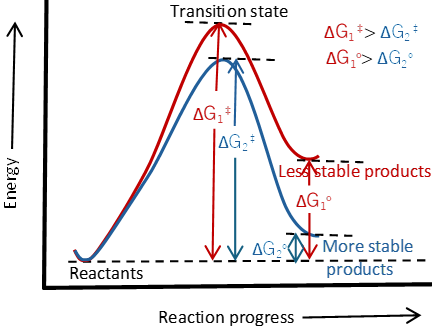 In the cases of isomeric products, the more stable the product, the less is the Gibbs free energy change \(\ce{\Delta G{\circ}}\), and usually lower the activation energy \(\ce{\Delta G^{\ddagger}}\) than for the less stable product, as illustrated in the figure on the right margin. The rate-determining steps for 1-chloropropane and 2-chloropropane formation form propane are the following.
\(\ce{\overset{\Huge\cdot}{Cl} + H-CH2-CH2-CH3 -> \color{blue}\underset{Primary \; radical}{\overset{\Huge\cdot}{C}H2-CH2-CH3}\color{black} + H-Cl}\), and
\(\ce{\overset{\Huge\cdot}{Cl} + CH3-\overset{\overset{\Huge\ce{H}}|}{C}H-CH3 -> \color{blue}\underset{Secondary \; radical}{CH3-\overset{\Huge\cdot}{C}H-CH3}\color{black} + H-Cl}\)
Since substitution of a secondary \(\ce{H}\) occurred 4.5 times more than a primary \(\ce{H}\), it can be concluded that secondary radical \(\ce{CH3-\overset{\Huge\cdot}{C}H-CH3}\) is more stable than the primary radical \(\ce{\overset{\Huge\cdot}{C}H2-CH2-CH3}\). This conclusion is supported by experimental results showing that \(\ce{C-H}\) bond dissociation energy is less for a primary \(\ce{H}\) than for a secondary \(\ce{H}\). The bond dissociation energies \(\ce{\Delta H^{\circ}}\) of different types of \(\ce{H}\) are shown below, along with the names of \(\ce{Hs}\) and radicals shown underneath the corresponding structure.
\(\ce{\underset{Acetylenic\;H}{\color{blue}H\color{black}-C\equiv CH} -> \underset{Acetylenic\; radical}{\overset{\Huge\cdot}{C}\equiv CH} + \overset{\Huge\cdot}{H},\; \Delta H^{\circ} = 558 kJ/mol}\)
\(\ce{\underset{Vinylic\;H}{\color{blue}H\color{black}-CH= CH2} -> \underset{Vinylic\; radical}{\overset{\Huge\cdot}{C}H=CH2} + \overset{\Huge\cdot}{H},\; \Delta H^{\circ} = 464kJ/mol}\)
\(\ce{\underset{Methyl\;H}{\color{blue}H\color{black}-CH3} -> \underset{Methyl\; radical}{\overset{\Huge\cdot}{C}H3} + \overset{\Huge\cdot}{H},\; \Delta H^{\circ} = 439 kJ/mol}\)
\(\ce{\underset{Primary\;H}{\color{blue}H\color{black}-CH2-CH3} -> \underset{Primary\; radical}{\overset{\Huge\cdot}{C}H2-CH3} + \overset{\Huge\cdot}{H},\; \Delta H^{\circ} = 423 kJ/mol}\)
\(\ce{\underset{Secondary\;H}{CH3-\overset{\overset{\Huge{\color{blue}\ce{H}\color{black}}}|}{C}H-CH3} -> \underset{Secondary\; radical}{CH3-\overset{\Huge\cdot}{C}H-CH3} + \overset{\Huge\cdot}{H},\; \Delta H^{\circ} = 413 kJ/mol}\)
\(\ce{\underset{Tertiary\;H}{CH3-\!\!\!\!\!\!\!\underset{\underset{\Huge\;\;\ce{CH\LARGE3}}|}{\overset{\overset{\Huge{\color{blue}\ce{H}\color{black}}}|}{C}}\!\!\!\!\!\!-CH3} -> \underset{Tertiary\; radical}{CH3-\!\!\!\!\!\!\underset{\underset{\Huge\;\;\ce{CH\LARGE3}}|}{\overset{\Huge\cdot}{C}}\!\!\!\!\!\!-CH3} + \overset{\Huge\cdot}{H},\; \Delta H^{\circ} = 405 kJ/mol}\)
\(\ce{\underset{Benzylic\;H}{\color{blue}H\color{black}-CH2-C6H5} -> \underset{Benzylic\; radical}{\overset{\Huge\cdot}{C}H2-C6H5} + \overset{\Huge\cdot}{H},\; \Delta H^{\circ} = 376 kJ/mol}\)
\(\ce{\underset{Allylic\;H}{\color{blue}{H}\color{black}-CH2-CH=CH2} -> \underset{Allylic\; radical}{\overset{\Huge\cdot}{C}H2-CH=CH2} + \overset{\Huge\cdot}{H},\; \Delta H^{\circ} = 372 kJ/mol}\)
It can be concluded from the results presented above that the order of stability of radicals is the following:
\(\ce{\underset{Acetylenic\; radical}{\overset{\Huge\cdot}{C}\equiv CH}}\) < \(\ce{\underset{Vinylic\; radical}{\overset{\Huge\cdot}{C}H=CH2}}\) < \(\ce{\underset{Methyl\; radical}{\overset{\Huge\cdot}{C}H3}}\) < \(\ce{\underset{Primary\; radical}{\overset{\Huge\cdot}{C}H2-CH3}}\) < \(\ce{\underset{Secondary\; radical}{CH3{-}\overset{\Huge\cdot}{C}H-CH3}}\) < \(\ce{\underset{Tertiary\; radical}{CH3-\!\!\!\!\!\!\underset{\underset{\Huge\;\;\ce{CH\LARGE3}}|}{\overset{\Huge\cdot}{C}}\!\!\!\!\!\!-CH3}}\) < \(\ce{\underset{Benzylic\; radical}{\overset{\Huge\cdot}{C}H2-C6H5}}\) \(\approx\) \(\ce{\underset{Allylic\; radical}{\overset{\Huge\cdot}{C}H2-CH=CH2} }\)
, where any \(\ce{H}\) can be replaced with an alkyl \(\ce{R{-}}\) group and \(\ce{C6H5{-}}\) is a benzene ring. The factors that affect the stability of radicals include: i) hybridization of the atom, ii) hyperconjugation, and iii) resonance, that are described next.
Hybridization affects the stability of the radicals
In a homolytic bond breaking, the bonded atoms lose one valence electron and become a radical, which is an octet-incomplete and electron-deficient species. An \(\ce{s}\) orbital is spherical in shape, with electrons closer to and more tightly held by the nucleus than in a \(\ce{p}\) orbital. Therefore, an electron lost from an \(\ce{s}\) orbital requires more energy and causes more instability than an electron lost from a \(\ce{p}\) orbital. In hybrid orbitals, the \(\ce{s}\) character decreases in the following order: \(\ce{sp \; (50\%\; s) > sp^{2} \; (33\%\; s) > sp^{3}\; (20\%\; s)}\), which corresponds with the decrease in the instability of the radical with respect to hybridization in the same order: \(\ce{\underset{Acetylenic\; radical}{\overset{\Huge\cdot}{C}\equiv CH}}\) < \(\ce{\underset{Vinylic\; radical}{\overset{\Huge\cdot}{C}H=CH2}}\) < \(\ce{\underset{Methyl\; radical}{\overset{\Huge\cdot}{C}H3}}\).
Hyperconjugation affects the stability of the radicals
Hyperconjugation, which is a form of resonance between a \(p\) orbital and a \(\sigma\) bond, is responsible for the difference in the stability of methyl, primary, secondary, and tertiary radicals. As shown in Figure \(\PageIndex{1}\): a), two atoms bonded by a \(\sigma\) bond have \(p\) orbitals parallel to each other; they overlap to make a \(\pi\) bond. Parallel \(p\) orbitals on three or more consecutive atoms cause resonance, which is a stabilizing factor. As shown in Figure \(\PageIndex{1}\): b), when the two \(p\) orbitals are not parallel to each other the the overlap, \(\pi\) bond or the resonance between them becomes weaker and when they are at 90\ce{(^{o}}\) to each other, there is no overlap between, no \(\pi\) bond and no resonance. As shown in Figure \(\PageIndex{1}\): c), two atoms bonded by a \(\sigma\) bond have \(p\) orbital one one and second \(\sigma\) bond on the other that can orient nearly parallel to each other, some overlap happens between the \(p\) orbital and the \(\sigma\) bond causing a resonance, which is referred to as hyperconjugation. The hyperconjugation is less strong than resonances, but it does stabilize the radical, like resonance, by supplying some electrons from the \(\sigma\) bond to the electron-deficient \(p\) orbital.
 a)
 b)
 c)
Figure \(\PageIndex{2}\) shows that a methyl radical has no hyperconjugation, primary radical has one, secondary has two, and tertiary has three hyperconjugation, that explains the stability of radical increasing in the same order: \(\ce{\underset{Methyl\; radical}{\overset{\Huge\cdot}{C}H3}}\) < \(\ce{\underset{Primary\; radical}{\overset{\Huge\cdot}{C}H2-CH3}}\) < \(\ce{\underset{Secondary\; radical}{CH3{-}\overset{\Huge\cdot}{C}H-CH3}}\) < \(\ce{\underset{Tertiary\; radical}{CH3-\!\!\!\!\!\!\underset{\underset{\Huge\;\;\ce{CH\LARGE3}}|}{\overset{\Huge\cdot}{C}}\!\!\!\!\!\!-CH3}}\).
 a) Metyl radical
 b) Primary radical
 c) Secondary radical
 d) Tertiary radical
Resonance affects the stability of radicals
Figure \(\PageIndex{3}\) shows that resonance stabilizes the radical by distributing its electron deficiency over more than two atoms. Resonance is stronger than hyperconjugation. That is why a benzylic radical and an allylic radical stabilized by resonance are more stable than a tertiary radical stabilized by hyperconjugation:
 a) Resonance in an allylic radical
 b) Resonance in a benzylic radical
Selectivity in bromination vs chlorination of alkanes
Mono-bromination of propane forms two isomer products in the proportions shown below.
\(\ce{CH3-CH2-CH3 + Br2 ->[hv] \underset{2-bromopropane,\; 97\%}{CH3{-}\!\!\overset{\overset{\Huge{\;\ce{Br}}}|}{C}\!\!H-CH3} + \underset{1-bromopropane,\;3\%}{CH3-CH2-CH2-Cl}}\)
Six primary \(\ce{Hs}\) in two \(\ce{-CH3}\) groups yield 3% 1-bromopropane product, which means one primary \(\ce{H}\) contributes \(\frac{3\%}{6} = 0.5\%\) product. If secondary \(\ce{Hs}\) in \(\ce{-CH2{-}}\) react at the same rate as the primary \(\ce{Hs}\), they should have contributed \(0.5\% \times 2 = 1\%\) 2-bromopropane product. The actual yield of 2-bromopropane is 97%, which means secondary \(\ce{Hs}\) reacted \(\frac{97\%}{1\%} = 97\) times faster or more selective than the primary for substitution with \(\ce{Br}\). Similar analysis of monobromoniation of other alkanes, like \(\ce{CH3-\!\!\!\!\!\!\!\overset{\overset{\Huge\;\;\ce{CH\LARGE3}}|}{C}\!\!\!\!\!\!\!H-CH2-CH3}\), shows that a secondary \(\ce{H}\) is about 80 times more selective and a terriary \(\ce{H}\) is about 1600 time more selective than a primary \(\ce{H}\).
Selectivity of bromination for secondary \(\ce{H}\) 80 times for secondary \(\ce{H}\) and 1600 times for tertiary relative to primary is significantly higher than that of chlorination, 4.5 times for secondary and 5.5 times for tertiary. This difference is due to the relative stability of the transition state: the more stable (lower energy) the transition state, the lower the \(\ce{\Delta G^{\ddagger}}\), the faster the reaction. Transition states cannot be isolated and studied due to their short lifetime. However, the structure and energy of the transition state can be predicted from the structures and stabilities of reactants and products. The structure of the transition state is somewhere between the reactants and the products, with some bonds in the process of breaking or formation that are shown by dotted lines. Hammond's postulate predicts whether the structure and stability of the transition state resemble the reactants or the products. Hammond's postulate is described in the next section.
Hammond's postulate
Hammond's postulate, which is similar to and sometimes referred to as Leffler's assumption, states that the transition state resembles in structure and reactivity to the less stable species, reactants, or intermediates/products of the elementary reaction. As a corollary, it can be said that in an endothermic elementary reaction, intermediates/products are less stable, and any factor that stabilizes them also stabilizes the transition state. In an exothermic elementary reaction, the reactants are less stable, and any factor that stabilizes intermediates/products has less effect on the stability of the transition state.
The rate-determining step in the halogenation of alkanes is the abstraction of hydrogen from an alkane by a halide radical. This step is exothermic in chlorination with \(\ce{\Delta H^{\circ}} = -9 kJ/mol\) for abstraction of a primary \(\ce{H}\) and \(\ce{\Delta H^{\circ}}\) = -19 kJ/mol for abstraction of a secondary \(\ce{H}\) as shown below.
\(\ce{\overset{\Huge\cdot}{Cl} + H-CH2-CH2-CH3 -> \underset{Primary \; radical}{\overset{\Huge\cdot}{C}H2-CH2-CH3} + H-Cl ; \Delta H^{\circ} = -9 kJ/mol }\), and
\(\ce{\overset{\Huge\cdot}{Cl} + CH3-\overset{\overset{\huge H} |}{C}H-CH3 -> \underset{Secondary \; radical}{CH3-\overset{\Huge\cdot}{C}H-CH3} + H-Cl ; \Delta H^{\circ} = -19 kJ/mol }\)
The rate-determining step is endothermic in bromination with \(\Delta H^{\circ} = +57 kJ/mol\) for abstraction of a primary \(\ce{H}\) and \(\ce{\Delta H^{\circ}}\) = +47 kJ/mol for abstraction of a secondary \(\ce{H}\) as shown below.
\(\ce{\overset{\Huge\cdot}{Brl} + H-CH2-CH2-CH3 -> \underset{Primary \; radical}{\overset{\Huge\cdot}{C}H2-CH2-CH3} + H-Br ; \Delta H^{\circ} = +57 kJ/mol }\), and
\(\ce{\overset{\Huge\cdot}{Br} + CH3-\overset{\overset{\huge H} |}{C}H-CH3 -> \underset{Secondary \; radical}{CH3-\overset{\Huge\cdot}{C}H-CH3} + H-Br ; \Delta H^{\circ} = +47 kJ/mol }\)
The difference in \(\ce{\Delta H^{\circ}}\) for abstraction of primary \(\ce{H}\) and secondary \(\ce{H}\) is the same in chlorination (-9 kJ/mol -(-19 kJ/mol) = 10 kJ/mol) and bromination (+57 kJ/mol - (+47 kJ/mol) = 10 kJ/mol. However, this stability is reflected more in the transition state of secondary \(\ce{H}\) abstraction in bromination (9 kJ/mol more stable) than in chlorination (4 kJ/mol more stable) compared to the transition state of primary \(\ce{H}\) abstraction, as shown in Figure \(\PageIndex{4}\). The rate-determining step of bromination is endothermic, and any factor that stabilizes the radical intermediate stabilizes its transition state more than in the corresponding exothermic chlorination. It explains why bromination is more selective than chlorination in monohalogenation of alkanes.
 a) Chlorination
 b) Bromination
Which halogen should be chosen for the monohalogenation of alkanes?
The comparison of \(\ce{\Delta G^{\ddagger}}\) of the rate determing step of fluorination, chlorination, abomination, and iodination of methane is presented below.
\(\ce{\overset{\Huge\cdot}{F} + H-CH3 -> \overset{\Huge\cdot}{C}H3 + H-F, \Delta G^{\ddagger} = 5 kJ/mol}\)
\(\ce{\overset{\Huge\cdot}{Cl} + H-CH3 -> \overset{\Huge\cdot}{C}H3 + H-Cl, \Delta G^{\ddagger} = 17 kJ/mol}\)
\(\ce{\overset{\Huge\cdot}{Br} + H-CH3 -> \overset{\Huge\cdot}{C}H3 + H-Br, \Delta G^{\ddagger} = 75 kJ/mol}\)
\(\ce{\overset{\Huge\cdot}{I} + H-CH3 -> \overset{\Huge\cdot}{C}H3 + H-I, \Delta G^{\ddagger} = 140 kJ/mol}\)
Experimental results of halogenation of methane and other alkanes agree with the above comparative values of \(\ce{\Delta G^{\ddagger}}\), i.e., fluorine reacts explosively with alkanes, chlorine reacts at a fast but controlable rate at room temperature, bromine reacts slower at room temperature but at a moderate rate upon heating the mixture, and iodine does not react. Generally, alkanes are halogenated using chlorine or bromine, as reaction with fluorine is explosive and not controllable, and iodine does not react.
Between chlorination and bromination, chlorination is the choice for monohalogenation of alkanes when there is only one type of \(\ce{H}\) to be substituted, as in the following examples.
\(\ce{CH4 + Cl2 ->[hv] CH3-Cl + HCl}\)
\(\ce{CH3-CH3 + Cl2 ->[hv] CH3-CH2-Cl + HCl}\)
\(\ce{CH3-\!\!\!\!\!\!\!\underset{\underset{\Huge \;\;{\ce{CH}}{\Large _3}}|}{ \overset{\overset{\Huge\;\;{\ce{CH}}{\Large_3}}|}{C}}\!\!\!\!\!\!\!-CH3 + Cl2 ->[hv] CH3\ce{-} \!\!\!\!\!\!\!\underset{\underset{\Huge \;\;{\ce{CH}}{\Large _3}}|}{ \overset{\overset{\Huge\;\;{\ce{CH}}{\Large_3}}|}{C}}\!\!\!\!\!\!\! -CH3-Cl + HCl}\)
Chlorination is preferred over bromination because chlorination is cheaper, reacts faster, and is controllable at room temperature, while bromine is expensive, reacts more slowly, and needs heating to react at a moderate rate.
For the rest of the alkanes that have more than one type of \(\ce{H}\), the choice between chlorination and bromination depends on the selectivity and the abundance of the type of \(\ce{H}\) intended to be substituted. Chlorination is less selective and it is a better choice when substitution of a less selective but more abundant type of \(\ce{H}\) is needed. Bromination is more selective, and it is a better choice when the substitution of a more selective type of hydrogen is needed. This choice becomes clear after the following example exercises of monochlorination and monobromination of 2-methylpropane.
Given that selectivity ratio of chlorine for primary, secondary, and tertiary \(\ce{H}\) is 1:4.5:5.5, predicted ratio of products of mono-chlorination of 2-methylpropane \(\ce{CH3-\!\!\!\!\!\!\!\underset{\underset{\Huge \;\;{\ce{CH}}{\Large _3}}|}{ \overset{\overset{\Huge{\ce{H}}}|}{C}}\!\!\!\!\!\!\!-CH3}\).
Solution
Mono-chlorination of 2-methylpropane produces to isomeric products, as shown below.
\(\ce{\underset{2-methylpropane}{CH3-\!\!\!\!\!\!\!\underset{\underset{\Huge \;\;{\ce{CH}}{\Large _3}}|}{ \overset{\overset{\Huge{\ce{H}}}|}{C}}\!\!\!\!\!\!\!-CH3} + Cl2 ->[hv] \underset{1-chloro-2-methylpropeane}{CH3-\!\!\!\!\!\!\!\underset{\underset{\Huge\;\;{\ce{CH}}{\Large _3}}|}{ \overset{\overset{\Huge{\ce{H}}}|}{C}}\!\!\!\!\!\!-CH2-Cl} + \underset{2-chloro-2-methylpropane}{CH3-\!\!\!\!\!\!\!\!\underset{\underset{\Huge\;\;{\ce{CH}}{\Large _3}}|}{ \overset{\overset{\Huge{\,\ce{Cl}}}|}{C}}\!\!\!\!\!\!\!-CH3} }\)
\(\text{Relative amount of each product} = \text{number of \(\ce{H}\) that lead to it} \times \text{the selectivity of the type of \(\ce{H}\)}\)
\(\%\text{ of each product} = \dfrac{\text{Relative amount of the product}}{\text{sum of the relative amounts of all products}} \times 100\)
These calculations are shown below.
| Product isomer | Relative amount | % amount |
| \(\ce{\underset{1-chloro-2-methylpropeane}{CH3-\!\!\!\!\!\!\!\underset{\underset{\Huge\;\;{\ce{CH}}{\Large _3}}|}{\overset{\overset{\Huge{\ce{H}}}|}{C}}\!\!\!\!\!\!\!-CH2-Cl}}\) | \(9 \times 1 = 9\) | \(\frac{9}{14.5}\times 100 = 62\%\) |
| \(\ce{\underset{2-chloro-2-methylpropeane}{CH3-\!\!\!\!\!\!\!\underset{\underset{\Huge\;\;{\ce{CH}}{\Large _3}}|}{\overset{\overset{\Huge{\,\ce{Cl}}}|}{C}}\!\!\!\!\!\!\!-CH3}}\) | \(1 \times 5.5 = 5.5\) | \(\frac{5.5}{14.5}\times 100 = 38\%\) |
Given that selectivity ratio of bromine for primary, secondary, and tertiary \(\ce{H}\) is 1:80:1600, predicted ratio of products of mono-bromination of 2-methylpropane \(\ce{CH3-\!\!\!\!\!\!\!\underset{\underset{\Huge\;\;{\ce{CH}}{\Large _3}}|}{\overset{\overset{\Huge{\ce{H}}}|}{C}}\!\!\!\!\!\!\!-CH3}\).
Solution
Mono-bromination of 2-methylpropane produces to isomeric products, as shown below.
\(\ce{\underset{2-methylpropane}{CH3-\!\!\!\!\!\!\!\underset{\underset{\Huge\;\;{\ce{CH}}{\Large _3}}|}{\overset{\overset{\Huge{\ce{H}}}|}{C}}\!\!\!\!\!\!\!-CH3} + Br2 ->[hv] \underset{1-bromo-2-methylpropeane}{CH3-\!\!\!\!\!\!\!\underset{\underset{\Huge\;\;{\ce{CH}}{\Large _3}}|}{\overset{\overset{\Huge{\ce{H}}}|}{C}}\!\!\!\!\!\!\!-CH2-Br} + \underset{2-bromo-2-methylpropane}{CH3-\!\!\!\!\!\!\!\underset{\underset{\Huge\;\;{\ce{CH}}{\Large _3}}|}{\overset{\overset{\Huge{\,\ce{Br}}}|}{C}}\!\!\!\!\!\!\!-CH3} }\)
\(\text{Relative amount of each product} = \text{number of \(\ce{H}\) that lead to it} \times \text{the selectivity of the type of \(\ce{H}\)}\)
\(\%\text{ of each product} = \dfrac{\text{Relative amount of the product}}{\text{sum of the relative amounts of all products}} \times 100\)
These calculations are shown below.
| Product isomer | Relative amount | % amount |
| \(\ce{\underset{1-bromo-2-methylpropeane}{CH3-\!\!\!\!\!\!\!\underset{\underset{\Huge\;\;{\ce{CH}}{\Large _3}}|}{\overset{\overset{\Huge{\ce{H}}}|}{C}}\!\!\!\!\!\!\!-CH2-Br}}\) | \(9 \times 1 = 9\) | \(\frac{1}{1601}\times 100 = \approx 0\%\) |
| \(\ce{\underset{1-bromo-2-methylpropeane}{CH3-\!\!\!\!\!\!\!\underset{\underset{\Huge\;\;{\ce{CH}}{\Large _3}}|}{\overset{\overset{\Huge{\,\ce{Br}}}|}{C}}\!\!\!\!\!\!\!-CH3}}\) |
\(1 \times 1600 = 1600\) |
\(\frac{1600}{1601}\times 100 = \approx 100\%\) |
It can be observed from the above two example calcultions that if primary \(\color{blue}\ce{H}\) of 2-methylpropane \(\ce{CH3-\!\!\!\!\!\!\!\underset{\underset{\Huge \;\;{\ce{CH}}{\Large _3}}|}{ \overset{\overset{\Huge{\ce{H}}}|}{C}}\!\!\!\!\!\!\!-CH2-\color{blue}H}\) needs substitution with a halogen, chlorination is a better choice that will yield 62% desired product and bromination is not a choice as it will yield negliglble amount of the desired product. On the other hand, if seconday \(\color{red}\ce{H}\) of 2-methylpropane \(\ce{CH3-\!\!\!\!\!\!\!\underset{\underset{\Huge \;\;{\ce{CH}}{\Large _3}}|}{ \overset{\overset{\Huge{\color{red}\ce{H}\color{black}}}|}{C}}\!\!\!\!\!\!\!-CH3}\) needs substitution with a halogen, bromination is a better choice that will yield \(\approx\)100% desired product while chlorination is not prefered as it will yield only 38% the desired product. In general, chlorination is preferred when the more abundant \(\ce{H}\) is intended to substitute, and bromination is preferred when a more selective \(\ce{H}\) is intended to substitute in a mono-halogenation of an alkane.