

5.2: Chemical properties of alkanes
- Page ID
- 540222

\( \newcommand{\vecs}[1]{\overset { \scriptstyle \rightharpoonup} {\mathbf{#1}} } \)
\( \newcommand{\vecd}[1]{\overset{-\!-\!\rightharpoonup}{\vphantom{a}\smash {#1}}} \)
\( \newcommand{\dsum}{\displaystyle\sum\limits} \)
\( \newcommand{\dint}{\displaystyle\int\limits} \)
\( \newcommand{\dlim}{\displaystyle\lim\limits} \)
\( \newcommand{\id}{\mathrm{id}}\) \( \newcommand{\Span}{\mathrm{span}}\)
( \newcommand{\kernel}{\mathrm{null}\,}\) \( \newcommand{\range}{\mathrm{range}\,}\)
\( \newcommand{\RealPart}{\mathrm{Re}}\) \( \newcommand{\ImaginaryPart}{\mathrm{Im}}\)
\( \newcommand{\Argument}{\mathrm{Arg}}\) \( \newcommand{\norm}[1]{\| #1 \|}\)
\( \newcommand{\inner}[2]{\langle #1, #2 \rangle}\)
\( \newcommand{\Span}{\mathrm{span}}\)
\( \newcommand{\id}{\mathrm{id}}\)
\( \newcommand{\Span}{\mathrm{span}}\)
\( \newcommand{\kernel}{\mathrm{null}\,}\)
\( \newcommand{\range}{\mathrm{range}\,}\)
\( \newcommand{\RealPart}{\mathrm{Re}}\)
\( \newcommand{\ImaginaryPart}{\mathrm{Im}}\)
\( \newcommand{\Argument}{\mathrm{Arg}}\)
\( \newcommand{\norm}[1]{\| #1 \|}\)
\( \newcommand{\inner}[2]{\langle #1, #2 \rangle}\)
\( \newcommand{\Span}{\mathrm{span}}\) \( \newcommand{\AA}{\unicode[.8,0]{x212B}}\)
\( \newcommand{\vectorA}[1]{\vec{#1}} % arrow\)
\( \newcommand{\vectorAt}[1]{\vec{\text{#1}}} % arrow\)
\( \newcommand{\vectorB}[1]{\overset { \scriptstyle \rightharpoonup} {\mathbf{#1}} } \)
\( \newcommand{\vectorC}[1]{\textbf{#1}} \)
\( \newcommand{\vectorD}[1]{\overrightarrow{#1}} \)
\( \newcommand{\vectorDt}[1]{\overrightarrow{\text{#1}}} \)
\( \newcommand{\vectE}[1]{\overset{-\!-\!\rightharpoonup}{\vphantom{a}\smash{\mathbf {#1}}}} \)
\( \newcommand{\vecs}[1]{\overset { \scriptstyle \rightharpoonup} {\mathbf{#1}} } \)
\(\newcommand{\longvect}{\overrightarrow}\)
\( \newcommand{\vecd}[1]{\overset{-\!-\!\rightharpoonup}{\vphantom{a}\smash {#1}}} \)
\(\newcommand{\ket}[1]{\left| #1 \right>}\)
\(\newcommand{\bra}[1]{\left< #1 \right|}\)
\(\newcommand{\braket}[2]{\left< #1 \vphantom{#2} \right| \left. #2 \vphantom{#1} \right>}\)
\(\newcommand{\braopket}[3]{\left< #1 \vphantom{#2}\vphantom{#3} \right| #2 \vphantom{#1}\vphantom{#3} \left| #3 \vphantom{#1}\vphantom{#2} \right>}\)
\(\newcommand{\qmvec}[1]{\mathbf{\vec{#1}}}\)
\(\newcommand{\op}[1]{\hat{\mathbf{#1}}}\)
\(\newcommand{\expect}[1]{\langle #1 \rangle}\)
\(\newcommand{\dfn}[1]{\emph{\textbf{#1}}}\)
\(\newcommand{\avec}{\mathbf a}\) \(\newcommand{\bvec}{\mathbf b}\) \(\newcommand{\cvec}{\mathbf c}\) \(\newcommand{\dvec}{\mathbf d}\) \(\newcommand{\dtil}{\widetilde{\mathbf d}}\) \(\newcommand{\evec}{\mathbf e}\) \(\newcommand{\fvec}{\mathbf f}\) \(\newcommand{\nvec}{\mathbf n}\) \(\newcommand{\pvec}{\mathbf p}\) \(\newcommand{\qvec}{\mathbf q}\) \(\newcommand{\svec}{\mathbf s}\) \(\newcommand{\tvec}{\mathbf t}\) \(\newcommand{\uvec}{\mathbf u}\) \(\newcommand{\vvec}{\mathbf v}\) \(\newcommand{\wvec}{\mathbf w}\) \(\newcommand{\xvec}{\mathbf x}\) \(\newcommand{\yvec}{\mathbf y}\) \(\newcommand{\zvec}{\mathbf z}\) \(\newcommand{\rvec}{\mathbf r}\) \(\newcommand{\mvec}{\mathbf m}\) \(\newcommand{\zerovec}{\mathbf 0}\) \(\newcommand{\onevec}{\mathbf 1}\) \(\newcommand{\real}{\mathbb R}\) \(\newcommand{\twovec}[2]{\left[\begin{array}{r}#1 \\ #2 \end{array}\right]}\) \(\newcommand{\ctwovec}[2]{\left[\begin{array}{c}#1 \\ #2 \end{array}\right]}\) \(\newcommand{\threevec}[3]{\left[\begin{array}{r}#1 \\ #2 \\ #3 \end{array}\right]}\) \(\newcommand{\cthreevec}[3]{\left[\begin{array}{c}#1 \\ #2 \\ #3 \end{array}\right]}\) \(\newcommand{\fourvec}[4]{\left[\begin{array}{r}#1 \\ #2 \\ #3 \\ #4 \end{array}\right]}\) \(\newcommand{\cfourvec}[4]{\left[\begin{array}{c}#1 \\ #2 \\ #3 \\ #4 \end{array}\right]}\) \(\newcommand{\fivevec}[5]{\left[\begin{array}{r}#1 \\ #2 \\ #3 \\ #4 \\ #5 \\ \end{array}\right]}\) \(\newcommand{\cfivevec}[5]{\left[\begin{array}{c}#1 \\ #2 \\ #3 \\ #4 \\ #5 \\ \end{array}\right]}\) \(\newcommand{\mattwo}[4]{\left[\begin{array}{rr}#1 \amp #2 \\ #3 \amp #4 \\ \end{array}\right]}\) \(\newcommand{\laspan}[1]{\text{Span}\{#1\}}\) \(\newcommand{\bcal}{\cal B}\) \(\newcommand{\ccal}{\cal C}\) \(\newcommand{\scal}{\cal S}\) \(\newcommand{\wcal}{\cal W}\) \(\newcommand{\ecal}{\cal E}\) \(\newcommand{\coords}[2]{\left\{#1\right\}_{#2}}\) \(\newcommand{\gray}[1]{\color{gray}{#1}}\) \(\newcommand{\lgray}[1]{\color{lightgray}{#1}}\) \(\newcommand{\rank}{\operatorname{rank}}\) \(\newcommand{\row}{\text{Row}}\) \(\newcommand{\col}{\text{Col}}\) \(\renewcommand{\row}{\text{Row}}\) \(\newcommand{\nul}{\text{Nul}}\) \(\newcommand{\var}{\text{Var}}\) \(\newcommand{\corr}{\text{corr}}\) \(\newcommand{\len}[1]{\left|#1\right|}\) \(\newcommand{\bbar}{\overline{\bvec}}\) \(\newcommand{\bhat}{\widehat{\bvec}}\) \(\newcommand{\bperp}{\bvec^\perp}\) \(\newcommand{\xhat}{\widehat{\xvec}}\) \(\newcommand{\vhat}{\widehat{\vvec}}\) \(\newcommand{\uhat}{\widehat{\uvec}}\) \(\newcommand{\what}{\widehat{\wvec}}\) \(\newcommand{\Sighat}{\widehat{\Sigma}}\) \(\newcommand{\lt}{<}\) \(\newcommand{\gt}{>}\) \(\newcommand{\amp}{&}\) \(\definecolor{fillinmathshade}{gray}{0.9}\)
Chemical properties of alkanes are dictated by the nonpolar nature of \(\ce{C-C}\) and \(\ce{C-H}\) bonds in them. Being nonpolar, they do not undergo polar reactions, which are the majority of organic reactions. Therefore, alkanes have little reactivity and are often referred to as paraffin, meaning little affinity. However, alkanes undergo homolytic bond breaking and making that are radical reactions. Their main use, as fuel in combustion processes, is a well-known example of radical reactions of alkanes. Halogenation is another well-known radical reaction class that converts nonpolar alkanes into polar haloalkanes. Haloalkanes are then used as solvents or as a raw material for the synthesis of other organic compounds.
Combustion of alkanes
 Hydrocarbons found in petroleum, coal, and natural gas are primarily consumed in combustion processes for producing heat, as shown in the left margin with an example of natural gas burning in a kitchen stove (Copyright; Public domain) . The process begins by ignition, where ground state \(\ce{O2}\) converts into excited state \(\ce{O2^{\ast}}\) by absorbing thermal energy. The \(\ce{O2^{\ast}}\) reacts with alkanes \(\ce{RH}\), initiating radical species, as in the following reactions.
\(\ce{R-H + O2^{\ast} -> R^{\!\Huge\cdot} + ^{\!\Huge\cdot}OOH}\)
\(\ce{R-H + O2^{\ast} -> RO^{\!\Huge\cdot} + ^{\!\Huge\cdot}OH}\)
The radicals are reactive species that react further in a complex series of reactions, ultimately breaking weaker \(\ce{C-C}\), \(\ce{C-H}\), and \(ce{O-O}\) bonds of alkanes and oxygen with stronger \(\ce{C-O}\) and \(\ce{O-H}\) bonds of \(\ce{CO2}\), \(\ce{H2O}\), and releasing heat. Once ignited, the heat released from the process is sufficient to sustain the reaction until all of the fuel (alkanes) or the oxidizer (oxygen) is consumed. The combustion reaction of octane is shown below as an example.
\(\ce{2CH3CH2CH2CH2CH2CH2CH2CH3 + + 25\frac{1}{2}O2 -> 16CO2 + 18H2O \;\;\;\Delta H^{\circ} = 10,920 kJ/mol}\)
Octane rating of gasoline

 The primary use of alkanes is as a fuel in combustion processes. The combustion of gasoline in internal combustion engines is sometimes not a smooth process; it may involve small explosions, known as knocking, which can damage the engine. Octane rating is a measure of the performance of gasoline in an internal combustion engine -the higher the number, the better the fuel burns. The structure shown on the left margin is 2,2,4-Trimethylpentane (mp -107.4 oC, bp 99.3 oC) that has an octane number of 100, and heptane (mp −90.5 oC, bp 98.4 oC, shown on the right margin) has an octane number of 0. These two compounds are used as a reference in the octane rating.
 A gasoline sample is tested for anti-knock property in a test engine and compared with the anti-knock property of a mixture of 2,2,4-Trimethylpentane and heptane.
The percentage, by volume, of 2,2,4-trimethylpentane in the mixture that has the same anti-knock property as the test fuel is the octane number of the fuel.
The octane rating of regular grade gasoline is 87, that of mid-grade is 89-90, and of premium grade is 91-94, as shown in the figure on the right margin from a gasoline pump in Virginia, USA (Copyright: Public domain
Catalytic cracking and catalytic hydrocracking of petroleum
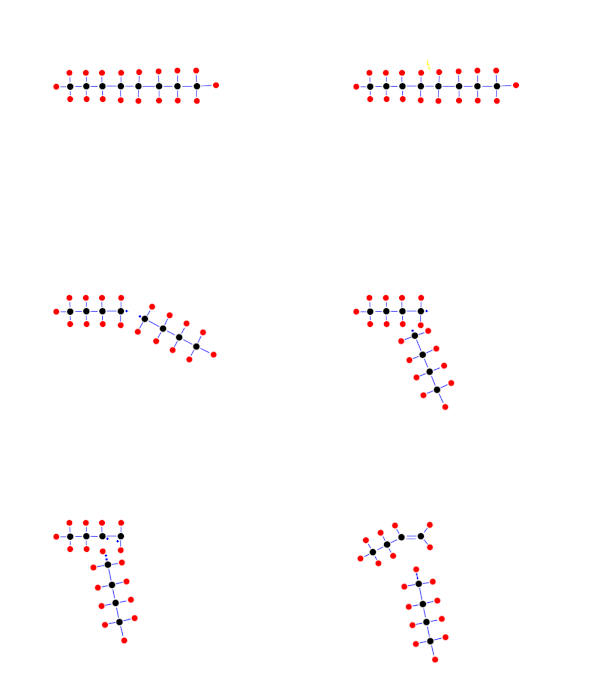
 Petroleum fractions with carbon chains of more than ten \(\ce{Cs}\) are less valuable fuel than carbon chains of five to ten in gasoline. The petroleum industry has developed processes of breaking the longer chain alkene fractions into smaller chain alkanes to add to gasoline, as a catalytic cracking unit at Onesti Refinery, shown in the left margin (Copyright: Public domain). These processes are based on homolytic \(\ce{C-C}\) bond breaking by thermal energy in the presence of a suitable catalyst, a process called catalytic cracking, as illustrated in an example reaction below and shown in a simulation on the right margin.

There are several variations of petroleum cracking processes, e.g., \(\ce{H2}\) may be added to facilitate the reaction in a process called catalytic hydrocracking, as illustrated in an example reaction below.

Heat of combustion as a measure of the stability of alkanes
Heat released or absorbed during a chemical reaction depends on the difference in the potential energy between the reactants and products. If the same reactant undergoes different reactions, yielding different products, the relative stability of the products can be estimated from the difference in the heat of reaction. Similarly, if the same products are obtained from a different set of reactants, the relative stability of the reactants can be estimated from the difference in the heat of reaction. For example, t he combustion of hexane is shown below, where \(\Delta \text H^{\circ}\) is the change in enthalpy (heat released) when 1 mol of hexane is completely burned in oxygen.
 \(\ce{ + 9\frac{1}{2}O2 -> 6CO2 + 7H2O \;\;\;\Delta H^{\circ} = 4163 kJ/mol}\)
When the same reaction is repeated with its branched isomer 2-methyl pentane, the \(\Delta \text H ^ {\circ}\) is 5 kJ/mol less, and with more branched isomer 2,2-dimethylbutane, the \(\Delta \text H ^ {\circ}\) is 9 kJ/mol less, as shown in the reaction equations below.
 \(\ce{ + 9\frac{1}{2}O2 -> 6CO2 + 7H2O \;\;\;\Delta H^{\circ} = 4158 kj/mol}\)
 \(\ce{ + 9\frac{1}{2}O2 -> 6CO2 + 7H2O \;\;\;\Delta H^{\circ} = 4154 kj/mol}\)
Since the products in the three cases are exactly the same, the differences in \(\Delta \text H ^ {\circ}\) allow estimating the relative stability of the isomers, i.e., 2-methylpentane is 5 kJ/mol more stable than hexane, and 2,2-dimethylbutane is 9 kJ/mol more stable than hexane. In general, the more branched isomers of alkanes are more stable, as illustrated in the figure on the right margin (Copyright; public domain). This is because there are more intramolecular London dispersion forces, making them more stable in the branched than in the straight-chain alkanes.
Halogenation of alkanes
Exposing a mixture of alkane and halogen (chlorine or bromine) to UV light or heat at ~100oC converts alkanes to haloalkanes, as shown below for the reaction of \(\ce{CH4}\) with \(\ce{Cl2}\) to \(\ce{CH3-Cl}\) conversion.
\(\ce{Cl2 + CH4 ->[\text{UV or heat}]CH3Cl + HCl}\)
This reaction converts relatively less reactive alkanes to more reactive haloalkanes having polar \(\ce{\overset{\delta{+}}{C}{-}\overset{\delta{-}}{Cl}}\) or \(\ce{\overset{\delta{+}}{C}{-}\overset{\delta{-}}{Br}}\) bond. The haloalkanes are used in the polar reactions described in later sections. However, this reaction is not very useful for laboratory organic synthesis as the product of the reaction competes with the initial alkane, resulting in a mixture of products, as shown in the following reactions.
\(\ce{Cl2 + CH3Cl ->[\text{UV or heat}]CH2Cl2 + HCl}\)
\(\ce{Cl2 + CH2Cl2 ->[\text{UV or heat}]CHCl3 + HCl}\)
\(\ce{Cl2 + CHCl3 ->[\text{UV or heat}]CCl4 + HCl}\)
This problem becomes more complex when the alkanes have more than one type of hydrogen in them, such as primary, secondary, and tertiary hydrogen in branched alkanes. Industries make use of chemical principles to optimize the reaction for the desired product. For example, monohaloalkane products can not compete effectively when the initial alkane concentration is high at the beginning of the reaction. So, in an industrial process, the reaction is stopped after a partial conversion to optimize production of monohalogened product. The product is isolated, and the reactants are recycled. Similarly, the rate of reactions of a primary, secondary, and tertiary hydrogens are significantly different, which allows optimizing the reaction for the desired product. Understanding of the reaction mechanism helps optimize the reaction for the desired products. The radical reaction mechanism of halogenation of alkanes is discussed in more detail in the next section.