

4.7: Lewis acids and bases
- Page ID
- 535664

\( \newcommand{\vecs}[1]{\overset { \scriptstyle \rightharpoonup} {\mathbf{#1}} } \)
\( \newcommand{\vecd}[1]{\overset{-\!-\!\rightharpoonup}{\vphantom{a}\smash {#1}}} \)
\( \newcommand{\dsum}{\displaystyle\sum\limits} \)
\( \newcommand{\dint}{\displaystyle\int\limits} \)
\( \newcommand{\dlim}{\displaystyle\lim\limits} \)
\( \newcommand{\id}{\mathrm{id}}\) \( \newcommand{\Span}{\mathrm{span}}\)
( \newcommand{\kernel}{\mathrm{null}\,}\) \( \newcommand{\range}{\mathrm{range}\,}\)
\( \newcommand{\RealPart}{\mathrm{Re}}\) \( \newcommand{\ImaginaryPart}{\mathrm{Im}}\)
\( \newcommand{\Argument}{\mathrm{Arg}}\) \( \newcommand{\norm}[1]{\| #1 \|}\)
\( \newcommand{\inner}[2]{\langle #1, #2 \rangle}\)
\( \newcommand{\Span}{\mathrm{span}}\)
\( \newcommand{\id}{\mathrm{id}}\)
\( \newcommand{\Span}{\mathrm{span}}\)
\( \newcommand{\kernel}{\mathrm{null}\,}\)
\( \newcommand{\range}{\mathrm{range}\,}\)
\( \newcommand{\RealPart}{\mathrm{Re}}\)
\( \newcommand{\ImaginaryPart}{\mathrm{Im}}\)
\( \newcommand{\Argument}{\mathrm{Arg}}\)
\( \newcommand{\norm}[1]{\| #1 \|}\)
\( \newcommand{\inner}[2]{\langle #1, #2 \rangle}\)
\( \newcommand{\Span}{\mathrm{span}}\) \( \newcommand{\AA}{\unicode[.8,0]{x212B}}\)
\( \newcommand{\vectorA}[1]{\vec{#1}} % arrow\)
\( \newcommand{\vectorAt}[1]{\vec{\text{#1}}} % arrow\)
\( \newcommand{\vectorB}[1]{\overset { \scriptstyle \rightharpoonup} {\mathbf{#1}} } \)
\( \newcommand{\vectorC}[1]{\textbf{#1}} \)
\( \newcommand{\vectorD}[1]{\overrightarrow{#1}} \)
\( \newcommand{\vectorDt}[1]{\overrightarrow{\text{#1}}} \)
\( \newcommand{\vectE}[1]{\overset{-\!-\!\rightharpoonup}{\vphantom{a}\smash{\mathbf {#1}}}} \)
\( \newcommand{\vecs}[1]{\overset { \scriptstyle \rightharpoonup} {\mathbf{#1}} } \)
\(\newcommand{\longvect}{\overrightarrow}\)
\( \newcommand{\vecd}[1]{\overset{-\!-\!\rightharpoonup}{\vphantom{a}\smash {#1}}} \)
\(\newcommand{\ket}[1]{\left| #1 \right>}\)
\(\newcommand{\bra}[1]{\left< #1 \right|}\)
\(\newcommand{\braket}[2]{\left< #1 \vphantom{#2} \right| \left. #2 \vphantom{#1} \right>}\)
\(\newcommand{\braopket}[3]{\left< #1 \vphantom{#2}\vphantom{#3} \right| #2 \vphantom{#1}\vphantom{#3} \left| #3 \vphantom{#1}\vphantom{#2} \right>}\)
\(\newcommand{\qmvec}[1]{\mathbf{\vec{#1}}}\)
\(\newcommand{\op}[1]{\hat{\mathbf{#1}}}\)
\(\newcommand{\expect}[1]{\langle #1 \rangle}\)
\(\newcommand{\dfn}[1]{\emph{\textbf{#1}}}\)
\(\newcommand{\avec}{\mathbf a}\) \(\newcommand{\bvec}{\mathbf b}\) \(\newcommand{\cvec}{\mathbf c}\) \(\newcommand{\dvec}{\mathbf d}\) \(\newcommand{\dtil}{\widetilde{\mathbf d}}\) \(\newcommand{\evec}{\mathbf e}\) \(\newcommand{\fvec}{\mathbf f}\) \(\newcommand{\nvec}{\mathbf n}\) \(\newcommand{\pvec}{\mathbf p}\) \(\newcommand{\qvec}{\mathbf q}\) \(\newcommand{\svec}{\mathbf s}\) \(\newcommand{\tvec}{\mathbf t}\) \(\newcommand{\uvec}{\mathbf u}\) \(\newcommand{\vvec}{\mathbf v}\) \(\newcommand{\wvec}{\mathbf w}\) \(\newcommand{\xvec}{\mathbf x}\) \(\newcommand{\yvec}{\mathbf y}\) \(\newcommand{\zvec}{\mathbf z}\) \(\newcommand{\rvec}{\mathbf r}\) \(\newcommand{\mvec}{\mathbf m}\) \(\newcommand{\zerovec}{\mathbf 0}\) \(\newcommand{\onevec}{\mathbf 1}\) \(\newcommand{\real}{\mathbb R}\) \(\newcommand{\twovec}[2]{\left[\begin{array}{r}#1 \\ #2 \end{array}\right]}\) \(\newcommand{\ctwovec}[2]{\left[\begin{array}{c}#1 \\ #2 \end{array}\right]}\) \(\newcommand{\threevec}[3]{\left[\begin{array}{r}#1 \\ #2 \\ #3 \end{array}\right]}\) \(\newcommand{\cthreevec}[3]{\left[\begin{array}{c}#1 \\ #2 \\ #3 \end{array}\right]}\) \(\newcommand{\fourvec}[4]{\left[\begin{array}{r}#1 \\ #2 \\ #3 \\ #4 \end{array}\right]}\) \(\newcommand{\cfourvec}[4]{\left[\begin{array}{c}#1 \\ #2 \\ #3 \\ #4 \end{array}\right]}\) \(\newcommand{\fivevec}[5]{\left[\begin{array}{r}#1 \\ #2 \\ #3 \\ #4 \\ #5 \\ \end{array}\right]}\) \(\newcommand{\cfivevec}[5]{\left[\begin{array}{c}#1 \\ #2 \\ #3 \\ #4 \\ #5 \\ \end{array}\right]}\) \(\newcommand{\mattwo}[4]{\left[\begin{array}{rr}#1 \amp #2 \\ #3 \amp #4 \\ \end{array}\right]}\) \(\newcommand{\laspan}[1]{\text{Span}\{#1\}}\) \(\newcommand{\bcal}{\cal B}\) \(\newcommand{\ccal}{\cal C}\) \(\newcommand{\scal}{\cal S}\) \(\newcommand{\wcal}{\cal W}\) \(\newcommand{\ecal}{\cal E}\) \(\newcommand{\coords}[2]{\left\{#1\right\}_{#2}}\) \(\newcommand{\gray}[1]{\color{gray}{#1}}\) \(\newcommand{\lgray}[1]{\color{lightgray}{#1}}\) \(\newcommand{\rank}{\operatorname{rank}}\) \(\newcommand{\row}{\text{Row}}\) \(\newcommand{\col}{\text{Col}}\) \(\renewcommand{\row}{\text{Row}}\) \(\newcommand{\nul}{\text{Nul}}\) \(\newcommand{\var}{\text{Var}}\) \(\newcommand{\corr}{\text{corr}}\) \(\newcommand{\len}[1]{\left|#1\right|}\) \(\newcommand{\bbar}{\overline{\bvec}}\) \(\newcommand{\bhat}{\widehat{\bvec}}\) \(\newcommand{\bperp}{\bvec^\perp}\) \(\newcommand{\xhat}{\widehat{\xvec}}\) \(\newcommand{\vhat}{\widehat{\vvec}}\) \(\newcommand{\uhat}{\widehat{\uvec}}\) \(\newcommand{\what}{\widehat{\wvec}}\) \(\newcommand{\Sighat}{\widehat{\Sigma}}\) \(\newcommand{\lt}{<}\) \(\newcommand{\gt}{>}\) \(\newcommand{\amp}{&}\) \(\definecolor{fillinmathshade}{gray}{0.9}\)
Prelude to Lewis acid-base concept
Chemical reactions are making and/or breaking bonds. A covalent bond is a shared pair of electrons, which is nonpolar if the bonding electrons are equally shared or polar if the bonding electrons are not equally shared. A covalent bond is formed in two ways: i) each two atoms contribute one electron each to make the covalent bond, or ii) one atom contributes both the electrons and the other uses an empty orbital to make a new bond called a dative covalent bond, as illustrated in Figure \(\PageIndex{1}\).
 a) Non-polar covalent bond
 b) Polar covalent bond
 c) Dative bond
Brønsted-Lowry acid-base reactions are proton-exchange reactions. Looking at them from the movement of electrons, bases donate a lone pair of electrons to make a dative bond with a proton, making a conjugate acid. Since \(\ce{H}\) can not have more than one covalent bond, it breaks its previous bond, leaving the bonding electrons as a lone pair on the conjugate base. Lewis' concept of acids and bases is based on the electron donation by bases and electron acceptance by acids.
Electron movements in chemical reactions are usually shown by curly arrows. Arrows are also used in multiple other ways in chemical reaction equations. A quick overview of the use of arrows and conventions followed in using curly arrows in chemistry is presented next, before defining Lewis acids and bases.
Arrows are used in different ways in chemistry. The most common uses of arrows are listed below.
- A reaction arrow \(\ce{->}\) separates reactants on the left side from products on the right side.
- An equilibrium arrow \(\rightleftarrows\) or \(\ce{<=>}\) separates reactants and products that are at equilibrium with each other.
- An equilibrium with a larger arrow pointing to products \(\ce{<=>>}\) is used for product-favored equilibrium, i.e., products are more abundant than reactants at equilibrium.
- An equilibrium with a larger arrow pointing to reactants \(\ce{<<=>}\) products is used for a product-favored equilibrium, i.e., products are more abundant than reactants at equilibrium.
- A resonance arrow \(\leftrightarrow\) separates resonance contributors.
- A curly arrow \(\huge\curvearrowright\) shows imaginary movement of a valence electron-pair in resonance or actual movement of a valence electron-pair in a chemical reaction.
- A curly harpoon
 (half-headed arrow or fish-hook arrow) shows imaginary movement of a single valence electron in resonance or actual movement of a single valence electron in a chemical reaction.
Movement of a valence electron-pair in a chemical reaction is shown by a curly arrow \(\huge\curvearrowright\). The tail of the arrow is placed where the electrons to be moved are located, and the head points where the electrons move to (\(\text {tail} {\huge\curvearrowright}\text head\)). The conventions for placing the tail and the head of the curly arrow are the following.
- When a bonding electron pair moves, the tail of the curly arrow is placed in the middle of the bond. For example, in this hypothetical reaction the bonding electron in

- When a lone pair moves, the tail is placed on the atom bearing the lone pair. For example in this hypothetical rection lone pair on \(\ce{B:^{-}}\) moves:
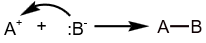
- When the electron movement results in a new bond, the head of the curly arrow points to the middle of the new bond. For example, in this hypothetical reaction new bond \(\ce{B-X}\) is formed:
- When electron movements result in a new lone pair, the head points to the atom that will bear the lone pair. For example, in this hypothetical reaction \(\ce{X-Y}\) bonding electron-pair moves and \(\ce{B}\) bears the new lone pair:

- The movement of a single electron is shown by a curly harpoon (half-headed arrow or fish-hook arrow) following the same rules as for a regular curly arrow.
Definitions of Lewis acid and base
A molecular or a chemical species that can coordinate with a Lewis base by accepting a pair of electrons from it and forming a Lewis adduct is called a Lewis acid.
A molecule or a chemical species that is able to coordinate with a Lewis acid by providing a pair of electrons, forming a Lewis adduct, is called a Lewis base.
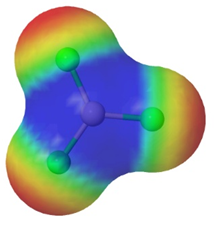
In simple words, a Lewis is a lone pair acceptor, and a Lewis base is a lone pair donor in a chemical reaction forming a Lewis adduct. A Lewis acid has an empty orbital, usually the lowest unoccupied molecular orbital (LUMO), capable of accepting a lone pair from a Lewis base. For example, \(\ce{Al}\) in \(\ce{AlCl3}\) is octet incomplete, having LUMO, as shown in Figure \(\PageIndex{2}\) a), capable of accepting a lone pair to make a dative bond that completes its octet. The electron-deficiency on \(\ce{Al}\) in \(\ce{AlCl3}\) can be observed by \(delta +\) (blue) region in its electrostatic potential map, as shown in Figure \(\PageIndex{2}\) b).
 a) HOMO of aluminum trichloride
 b) ESP of aluminum trichloride
 c) HOMO of ammonia
 d) ESP of ammonia
Lewis bases have the highest occupied molecular orbital (HOMO) that is localized and capable of donating an electron pair to make a covalent bond. For example, \(\ce{N}\) in \(\ce{:\!NH3}\) has a lone pair in HOMO that is localized (lone pair) that it can donate. The HOMO of \(\ce{:\!NH3}\) is shown in Figure \(\PageIndex{2}\) c), and its electrostatic potential map shows an electron-rich (red) region on \(\ce{N}\) as shown in Figure \(\PageIndex{2}\) d). \(\ce{AlCl3}\) is a Lewis acid and \(\ce{:\!NH3}\) is a Lewis base: they react by Lewis acid-base reaction, shown below, producing Lewis adduct \(\ce{Cl3\overset{-}{Al}-\overset{+}{N}H3}\).
\(\ce{Cl3Al +\!\!\!\!\!\!\!\!\!\!\!\!\!\!\overset{\Huge\curvearrowleft}{\:\:\:\:\:\:\:\:\:\::\!\!N}H3 -> \underset{Lewis \: aduct}{Cl3\overset{-}{Al}-\overset{+}{N}H3}}\)

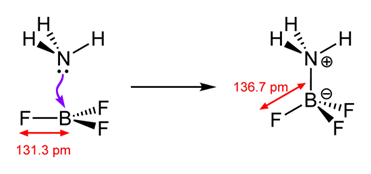 Boron trifluoride \(\ce{BF3}\) is another example of a Lewis acid with octent incomplete on \(\ce{B}\) that undergoes Lewis acid-base reaction with Lewis base \(\ce{:\!NH3}\) as shown in the figure on the right margin.
All Brønsted-Lowry acids are Lewis acids in which the acidic \(\ce{H}\) accepts a lone pair in its LUMO, and all Brønsted-Lowry bases are Lewis bases that donate a lone pair from their HOMO to the acids. Since \(\ce{H}\) can not have two covalent bonds, it breaks its previous covalent bond, leaving the bonding electrons as a lone pair on the conjugate base. Lewis acid-base reactions are a much broader category of reactions that include Brønsted-Lowry acid-base reactions, nearly all polar organic reactions, and the formation of coordination compounds of transition metals. The figure on the left margin shows that Arrhenius acid-base pairs are a subclass of Bronsted-Lowry acid-base pairs, which, in turn, are a subclass of Lewis acid-base pairs.
Electrophile and nucleophile
Most organic reactions are polar reactions in which a positively charged region of a species receives an electron pair from a negatively charged or partially negatively charged region of another species that has a lone pair to donate.
The electron recipient in the polar reactions is called an electrophile, meaning electron lover, and the electron donor is called a nucleophile or nucleus lover.
For example, in the reaction shown below \(\color{red}\ce{CH3-H2\overset{\delta +}{C}-\overset{\overset{\Large\delta -}{\Large\cdot\cdot}}{\underset{\Large\cdot\cdot}{Cl}}\!:}\) is an electrophile receiving electrons on \(\ce{\overset{\delta +}{C}}\) and \(\color{blue} \ce{^{-}{:\overset{\Large\cdot\cdot}{\underset{\Large\cdot\cdot}{\ce{O}}}H}}\) is a nucleophile donating a lone pair to make a new bond. Since \(\ce{\overset{\delta +}{C}}\) of the electrophile can not have five bonds, it brakes a polar covalent bond \(\ce{\overset{\delta +}{C}-\overset{\delta -}{Cl}}\) leaving electron on the departing nucleophile \(\color{blue}\ce{:\!\overset{\Large\cdot\cdot}{\underset{\Large\cdot\cdot}{Cl}}\!:^{-}}\) as it makes a new bond with the incoming nucleophile. Overall reaction is called a nucleophilic substitution reaction.

Below is another example where \(\color{blue} \ce{CH3CH=CH2}\) is a nucleophile donating \(\pi\) electrons to \(\ce{\overset{\delta +}{H}}\) end of the electrophile \(\color{red} \ce{\overset{\delta +}{H}-\overset{\delta -}{\overset{\Large\cdot\cdot}{\underset{\Large\cdot\cdot}{Cl}}\!:}}\). Since \(\ce{\overset{\delta +}{H}}\) of the electrophile can not have two bonds, it brakes a polar covalent bond \(\ce{\overset{\delta +}{H}-\overset{\delta -}{Cl}}\) leaving electron on the departing nucleophile \(\color{blue}\ce{:\!\overset{\Large\cdot\cdot}{\underset{\Large\cdot\cdot}{Cl}}\!:^{-}}\) as it makes a new bond with the incoming nucleophile.

This is a two-step reaction, in which the products of the first step are reactants of the second step. In the second step, \(\color{red}\ce{CH3\overset{\delta +}{C}H-CH3}\) is an electrophile and \(\color{blue}\ce{:\!\overset{\Large\cdot\cdot}{\underset{\Large\cdot\cdot}{Cl}}\!:^{-}}\) is a nucleophile. The electrophile and the nucleophile add in the second step. The overall reaction is an electrophilic addition reaction.
\(\color{red}\ce{CH3-H2\overset{\delta +}{C}-\overset{\overset{\Large\delta -}{\Large\cdot\cdot}}{\underset{\Large\cdot\cdot}{Cl}}\!:}\) in the first reaction above is a Lewis acid and \(\color{blue} \ce{CH3CH=CH2}\) in the second reaction is a Lewis base. Simillarly, \(\color{red} \ce{\overset{\delta +}{H}-\overset{\delta -}{\overset{\Large\cdot\cdot}{\underset{\Large\cdot\cdot}{Cl}}\!:}}\) and \(\color{blue} \ce{^{-}{:\!\overset{\Large\cdot\cdot}{\underset{\Large\cdot\cdot}{O}}H}}\) are Brønsted-Lowry acid and base, respectively, which can also be called Lewis acid and Lewis base. The question is, what term should be used for electron donors and acceptors, and when? The answer to this question is addressed in the next section.
What should electron donors and acceptors in organic reactions be called?
Brønsted-Lowry acid-base reactions, Lewis acid-base reactions, and polar reactions between electrophile and nucleophile are all reactions between electron pair acceptors and donors. The terms Brønsted-Lowry acid, Lewis acid, and electrophile, referring to electron pair acceptors, have diffused boundaries and in some situations are used interchangeably. Same is true about Brønsted-Lowry base, Lewis base, and nucleophile, referring to electron pair donors. However, a distinction can be made between them in most cases. The following conventions can specify which term to use where, in most cases.
- When an electron pair acceptor is a proton, the electron pair acceptor is Brønsted-Lowry acid and the donor is Brønsted-Lowry base, which are usually termed as an acid and a base. The acid-base reactions are inherently fast. Therefore, acidity is related to thermodynamic properties, i.e., stability. For example, if the products are more stable than the reactants, the acid is stronger, \(\ce{K_{eq}}\) is more than one, \(\ce{\Delta G^{\circ}}\) is negative, and the reaction is product-favored. In other words, the acidity properties are related to proton exchange reactions, and they are about the thermodynamic aspects of the reactions.
- When an electron pair acceptor is a proton receiving lone-pair from a heteroatom of an organic compound, the reaction is termed an acid-base reaction, or a proton-exchange reaction, or a protonation and depreciation reaction.
- However, when the electron donor is a carbon species, it is usually termed a nucleophile. For example, \(\color{blue} \ce{CH3CH=CH2}\) donating its \(\pi\)-electron pair to the proton of \(\color{red} \ce{\overset{\delta +}{H}-\overset{\delta -}{\overset{\Large\cdot\cdot}{\underset{\Large\cdot\cdot}{Cl}}\!:}}\), \(\color{blue} \ce{CH3CH=CH2}\) is an electrophile and \(\color{blue} \ce{CH3CH=CH2}\) donating its \(\pi\)-electron pair to the proton of \(\color{red} \ce{\overset{\delta +}{H}-\overset{\delta -}{\overset{\Large\cdot\cdot}{\underset{\Large\cdot\cdot}{Cl}}\!:}}\) is a nucleophile.
- When an electron-pair acceptor is a specie other than a proton, often a \(\ce{C}\) in polar organic reactions, the electron-pair recipient is called an electrophile and the electron donor a nucleophile. The electrophile-nucleophile reactions are not necessarily equilibrium reactions; they are often a one-way reaction, and the properties refer to kinetic aspects of the reaction. For example, a stronger electrophile is the one that reacts faster with a reference nucleophile and vice versa.
- Lewis acid-base is a broader term that encompasses Brønsted-Lowry acid bases, nucleophiles, and electrophiles. It is specifically used when the electron pair acceptor is not a proton or a carbon, and the reference pertains to the thermodynamic aspect of the reaction. The electron lone-pair donors to transition metals in inorganic chemistry are usually called chelates, and the products of the reaction are usually called coordination compounds. So, Lewis acid-base terms are usually limited to electron-deficient metal compounds like \(\ce{AlCl3}\) or transition metal complexes like \(\ce{FeBr3}\) that are employed as catalysts in organic reactions. For example, alkyl halides like \(\color{red}\ce{CH3-H2\overset{\delta +}{C}-\overset{\overset{\Large\delta -}{\Large\cdot\cdot}}{\underset{\Large\cdot\cdot}{Cl}}\!:}\), are electrophiles, as shown in one reaction above, but not enough reactive to accept \(\pi\)-electrons of an aromatic ring. \(\ce{AlCl3}\) is employed as a Lewis acid catalyst to convert it into a strong electrophile by the following reaction. \[\ce{\underset{Lewis\;base}{CH3-CH2-Cl}\!\!\! \overset{\HUGE\curvearrowright}{+}\!\!\!\!\!\underset{Lewis\;acid}{AlCl3}-> \underset{Lewis\;adduct}{[AlCl4]^{-}} + \underset{Strong\;electrophile}{CH3\overset{+}{C}H2}}\nonumber\] Similarly, \(\ce{FeBr3}\) is employed as a Lewis acid catalyst to convert weak electrophile \(\ce{Br2}\) into a strong electrophile by the following reaction. \[\ce{\underset{Lewis\;base}{Br-Br}\!\!\!\! \overset{\HUGE\curvearrowright}{+}\!\!\!\!\underset{Lewis\;acid}{FeBr3}-> \underset{Lewis\;adduct}{[FeBr4]^{-}} + \underset{Strong\;electrophile}{Br^{+}}}\nonumber\]