

4.1: Importane of acids, bases and their reactions
- Page ID
- 536714
\( \newcommand{\vecs}[1]{\overset { \scriptstyle \rightharpoonup} {\mathbf{#1}} } \)
\( \newcommand{\vecd}[1]{\overset{-\!-\!\rightharpoonup}{\vphantom{a}\smash {#1}}} \)
\( \newcommand{\dsum}{\displaystyle\sum\limits} \)
\( \newcommand{\dint}{\displaystyle\int\limits} \)
\( \newcommand{\dlim}{\displaystyle\lim\limits} \)
\( \newcommand{\id}{\mathrm{id}}\) \( \newcommand{\Span}{\mathrm{span}}\)
( \newcommand{\kernel}{\mathrm{null}\,}\) \( \newcommand{\range}{\mathrm{range}\,}\)
\( \newcommand{\RealPart}{\mathrm{Re}}\) \( \newcommand{\ImaginaryPart}{\mathrm{Im}}\)
\( \newcommand{\Argument}{\mathrm{Arg}}\) \( \newcommand{\norm}[1]{\| #1 \|}\)
\( \newcommand{\inner}[2]{\langle #1, #2 \rangle}\)
\( \newcommand{\Span}{\mathrm{span}}\)
\( \newcommand{\id}{\mathrm{id}}\)
\( \newcommand{\Span}{\mathrm{span}}\)
\( \newcommand{\kernel}{\mathrm{null}\,}\)
\( \newcommand{\range}{\mathrm{range}\,}\)
\( \newcommand{\RealPart}{\mathrm{Re}}\)
\( \newcommand{\ImaginaryPart}{\mathrm{Im}}\)
\( \newcommand{\Argument}{\mathrm{Arg}}\)
\( \newcommand{\norm}[1]{\| #1 \|}\)
\( \newcommand{\inner}[2]{\langle #1, #2 \rangle}\)
\( \newcommand{\Span}{\mathrm{span}}\) \( \newcommand{\AA}{\unicode[.8,0]{x212B}}\)
\( \newcommand{\vectorA}[1]{\vec{#1}} % arrow\)
\( \newcommand{\vectorAt}[1]{\vec{\text{#1}}} % arrow\)
\( \newcommand{\vectorB}[1]{\overset { \scriptstyle \rightharpoonup} {\mathbf{#1}} } \)
\( \newcommand{\vectorC}[1]{\textbf{#1}} \)
\( \newcommand{\vectorD}[1]{\overrightarrow{#1}} \)
\( \newcommand{\vectorDt}[1]{\overrightarrow{\text{#1}}} \)
\( \newcommand{\vectE}[1]{\overset{-\!-\!\rightharpoonup}{\vphantom{a}\smash{\mathbf {#1}}}} \)
\( \newcommand{\vecs}[1]{\overset { \scriptstyle \rightharpoonup} {\mathbf{#1}} } \)
\(\newcommand{\longvect}{\overrightarrow}\)
\( \newcommand{\vecd}[1]{\overset{-\!-\!\rightharpoonup}{\vphantom{a}\smash {#1}}} \)
\(\newcommand{\ket}[1]{\left| #1 \right>}\)
\(\newcommand{\bra}[1]{\left< #1 \right|}\)
\(\newcommand{\braket}[2]{\left< #1 \vphantom{#2} \right| \left. #2 \vphantom{#1} \right>}\)
\(\newcommand{\braopket}[3]{\left< #1 \vphantom{#2}\vphantom{#3} \right| #2 \vphantom{#1}\vphantom{#3} \left| #3 \vphantom{#1}\vphantom{#2} \right>}\)
\(\newcommand{\qmvec}[1]{\mathbf{\vec{#1}}}\)
\(\newcommand{\op}[1]{\hat{\mathbf{#1}}}\)
\(\newcommand{\expect}[1]{\langle #1 \rangle}\)
\(\newcommand{\dfn}[1]{\emph{\textbf{#1}}}\)
\(\newcommand{\avec}{\mathbf a}\) \(\newcommand{\bvec}{\mathbf b}\) \(\newcommand{\cvec}{\mathbf c}\) \(\newcommand{\dvec}{\mathbf d}\) \(\newcommand{\dtil}{\widetilde{\mathbf d}}\) \(\newcommand{\evec}{\mathbf e}\) \(\newcommand{\fvec}{\mathbf f}\) \(\newcommand{\nvec}{\mathbf n}\) \(\newcommand{\pvec}{\mathbf p}\) \(\newcommand{\qvec}{\mathbf q}\) \(\newcommand{\svec}{\mathbf s}\) \(\newcommand{\tvec}{\mathbf t}\) \(\newcommand{\uvec}{\mathbf u}\) \(\newcommand{\vvec}{\mathbf v}\) \(\newcommand{\wvec}{\mathbf w}\) \(\newcommand{\xvec}{\mathbf x}\) \(\newcommand{\yvec}{\mathbf y}\) \(\newcommand{\zvec}{\mathbf z}\) \(\newcommand{\rvec}{\mathbf r}\) \(\newcommand{\mvec}{\mathbf m}\) \(\newcommand{\zerovec}{\mathbf 0}\) \(\newcommand{\onevec}{\mathbf 1}\) \(\newcommand{\real}{\mathbb R}\) \(\newcommand{\twovec}[2]{\left[\begin{array}{r}#1 \\ #2 \end{array}\right]}\) \(\newcommand{\ctwovec}[2]{\left[\begin{array}{c}#1 \\ #2 \end{array}\right]}\) \(\newcommand{\threevec}[3]{\left[\begin{array}{r}#1 \\ #2 \\ #3 \end{array}\right]}\) \(\newcommand{\cthreevec}[3]{\left[\begin{array}{c}#1 \\ #2 \\ #3 \end{array}\right]}\) \(\newcommand{\fourvec}[4]{\left[\begin{array}{r}#1 \\ #2 \\ #3 \\ #4 \end{array}\right]}\) \(\newcommand{\cfourvec}[4]{\left[\begin{array}{c}#1 \\ #2 \\ #3 \\ #4 \end{array}\right]}\) \(\newcommand{\fivevec}[5]{\left[\begin{array}{r}#1 \\ #2 \\ #3 \\ #4 \\ #5 \\ \end{array}\right]}\) \(\newcommand{\cfivevec}[5]{\left[\begin{array}{c}#1 \\ #2 \\ #3 \\ #4 \\ #5 \\ \end{array}\right]}\) \(\newcommand{\mattwo}[4]{\left[\begin{array}{rr}#1 \amp #2 \\ #3 \amp #4 \\ \end{array}\right]}\) \(\newcommand{\laspan}[1]{\text{Span}\{#1\}}\) \(\newcommand{\bcal}{\cal B}\) \(\newcommand{\ccal}{\cal C}\) \(\newcommand{\scal}{\cal S}\) \(\newcommand{\wcal}{\cal W}\) \(\newcommand{\ecal}{\cal E}\) \(\newcommand{\coords}[2]{\left\{#1\right\}_{#2}}\) \(\newcommand{\gray}[1]{\color{gray}{#1}}\) \(\newcommand{\lgray}[1]{\color{lightgray}{#1}}\) \(\newcommand{\rank}{\operatorname{rank}}\) \(\newcommand{\row}{\text{Row}}\) \(\newcommand{\col}{\text{Col}}\) \(\renewcommand{\row}{\text{Row}}\) \(\newcommand{\nul}{\text{Nul}}\) \(\newcommand{\var}{\text{Var}}\) \(\newcommand{\corr}{\text{corr}}\) \(\newcommand{\len}[1]{\left|#1\right|}\) \(\newcommand{\bbar}{\overline{\bvec}}\) \(\newcommand{\bhat}{\widehat{\bvec}}\) \(\newcommand{\bperp}{\bvec^\perp}\) \(\newcommand{\xhat}{\widehat{\xvec}}\) \(\newcommand{\vhat}{\widehat{\vvec}}\) \(\newcommand{\uhat}{\widehat{\uvec}}\) \(\newcommand{\what}{\widehat{\wvec}}\) \(\newcommand{\Sighat}{\widehat{\Sigma}}\) \(\newcommand{\lt}{<}\) \(\newcommand{\gt}{>}\) \(\newcommand{\amp}{&}\) \(\definecolor{fillinmathshade}{gray}{0.9}\)
What is a chemical reaction?
A chemical reaction is a process of rearrangement of atoms in a substance.
For example, the combustion of methane is a chemical reaction.
\(\ce{CH4 + 2O2 -> CO2 + 2H2O}\)
It involves making and/or breaking chemical bonds. There are a vast number of chemical reactions that are classified in several ways. Organic reactions are usually classified in three major categories based on the way the covalent bonds in them are made and broken. These include free radical reactions, polar reactions, and pericyclic reactions. In a free radical reaction, bonds are made and broken through hemolytic bond making and breaking. Polar reactions involve heterolytic bond making and breaking. Pericyclic reactions are a class of organic reactions in which the reactants come together, making a cyclic transition state in which bonds are being formed in one part and broken in another, in a concerted fashion.
 Free radical reactions are relatively less common because hemolytic bond breaking requires energy, which is usually supplied in the form of thermal energy, as in the combustion process, or by absorption of a photon of electromagnetic radiation. Once formed, the free radicals are usually very reactive and often challenging to control due to their high reactivity. Pericyclic reactions are also less common due to geometry requirements, particularly the orbital symmetry needed for the overlapping orbitals, making new bonds. Polar reactions involve polar bonds, which are usually more prone to break because the bonding electrons are already unequally shared in them. The process is facilitated by electrostatic attraction between reactants, i.e., the \(\delta +\) end of a polar bond, called an electrophile, needing electrons, attracts the \(\delta -\) end of the other reactant, called a nucleophile that can donate electrons to make a new bond. For example, \(\ce{\overset{\delta +}{H}}\) of \(\ce{HCl}\) is attracted to \(\ce{\overset{\delta -}{O}}\) of \(\ce{H2O}\), as illustrated in the figure on the right margin. Therefore, polar bonds are part of functional groups, i.e., the reactive sites in organic molecules. Polar reactions are the most common and the most versatile class of organic chemical reactions.
Acid-base reactions
A proton exchange reaction is an acid-base reaction.
For example, the following reaction in which a proton is exchanged between \(\ce{HCl}\) and the \(\ce{-OH}\) group of ethanol is an acid-base reaction.
\(\ce{{H}-\overset{\overset{\Huge{\ce{H}}}|}{\underset{\underset{\Huge{\ce{H}}}|}{C}}-\overset{\overset{\Huge{\ce{H}}}|}{\underset{\underset{\Huge{\ce{H}}}|}{C}}-\overset{\huge\cdot\cdot}{\underset{\huge\cdot\cdot}{O}}-H\;\; +\;\; H-\overset{\huge\cdot\cdot}{\underset{\huge\cdot\cdot}{Cl}}{\Large :} -> {H}-\overset{\overset{\Huge{\ce{H}}}|}{\underset{\underset{\Huge{\ce{H}}}|}{C}}-\overset{\overset{\Huge{\ce{H}}}|}{\underset{\underset{\Huge{\ce{H}}}|}{C}}-\!\!\!\overset{{\huge\;\;\cdot\cdot} +}{\underset{\underset{\Huge{\ce{H}}}|}{O}}\!\!\!-H \;\;+\;\; {\Large :}\overset{\huge\cdot\cdot}{\underset{\huge\cdot\cdot}{Cl}}{\Large :}^{-} }\)
Acid-base reactions are a subclass of polar reactions involving hydrogen polar bonds \(\ce{\overset{\delta -}{A}-\overset{\delta +}{H}}\). Being electron deficient,\(\ce{ -\overset{\delta +}{H}}\) tends to gain electrons from atoms of other molecules that may have electron-rich regions or lone pairs. Since \(\ce{H}\) can make one bond, when it gains electrons, making a new bond, it breaks its previous bond, leaving electrons with the more electronegative atom. This proton exchange reaction is important in biochemistry because \(\ce{H}\) is a primary constituent of organic compounds that make up living things and a primary constituent of \(\ce{H2O}\), which is usually the reaction medium in living things.
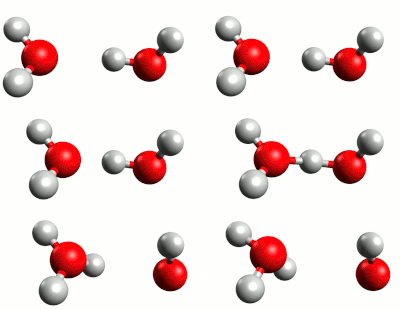 Two aspects of a chemical reaction are important: i) kinetics, i.e., how fast the reaction happens, and ii) thermodynamics, i.e., how much energy is released or absorbed during the reaction per unit amount reacted. The rate of reaction is related to the energy barrier, called activation energy: the lower the activation energy, the faster the reaction. Kinetics is generally not considered for acid-base reactions because they are inherently fast. This is because \(\ce{H}\) is the smallest atom that can penetrate tight spaces to reach the reactive site with little resistance compared to other atoms that face space restrictions, called steric strain. It is facilitated by high charge density due to high charge to volume ratio on \(\ce{H}\). For example, proton exchange between water molecules in an aqueous medium takes place as illustrated in the simulation on the right margin (Copyright: Manuel Almagro Rivas, CC BY-SA 4.0, via Wikimedia Commons) at a rate of \(1.3\times 10^{11} M^{-1}s^{-1}\), which is among the fastest reactions known. Kinetics of acids and bases are usually not discussed as it is fast, but their thermodynamics is usually the focus of discussion. Thermodynamics is related to the relative potential energies of reactants and products, which determines the extent of proton donation, i.e., the ratio of products to reactants at equilibrium, and the free energy change
The importance of acid-base reactions lies in the fact that the reactivity of the sites donating and receiving a proton is significantly changed. For example, in the dissociation of water (\(\ce{H2O + H2O <<=> H3O^{+} + ^{-}OH}\)), products (\(\ce{H3O^{+}}\) and \(\ce{^{-}OH}\)) are millions of times more reactive than the reactant \(\ce{H2O}\). It is evident from the fact that, at equilibrium about two in a billion molecules exist in in ionized form (\(\ce{H3O^{+}}\) and \(\ce{^{-}OH}\)), still their rate of reaction (reverse reaction) is equal to forward reaction of neutral \(\ce{H2O}\). The ability of the acid-base reactions to significantly change the reactivity of the reactive sites, along with their fast rates of reaction, makes them ideal for catalysis. This explains why most of the enzyme-catalyzed reactions are based on acid-base reactions. It also highlights the importance of acids, bases, and their reactions described in this chapter.