

3.5: Assigning R/S stereodescriptors to chirally center
- Page ID
- 531785

\( \newcommand{\vecs}[1]{\overset { \scriptstyle \rightharpoonup} {\mathbf{#1}} } \)
\( \newcommand{\vecd}[1]{\overset{-\!-\!\rightharpoonup}{\vphantom{a}\smash {#1}}} \)
\( \newcommand{\dsum}{\displaystyle\sum\limits} \)
\( \newcommand{\dint}{\displaystyle\int\limits} \)
\( \newcommand{\dlim}{\displaystyle\lim\limits} \)
\( \newcommand{\id}{\mathrm{id}}\) \( \newcommand{\Span}{\mathrm{span}}\)
( \newcommand{\kernel}{\mathrm{null}\,}\) \( \newcommand{\range}{\mathrm{range}\,}\)
\( \newcommand{\RealPart}{\mathrm{Re}}\) \( \newcommand{\ImaginaryPart}{\mathrm{Im}}\)
\( \newcommand{\Argument}{\mathrm{Arg}}\) \( \newcommand{\norm}[1]{\| #1 \|}\)
\( \newcommand{\inner}[2]{\langle #1, #2 \rangle}\)
\( \newcommand{\Span}{\mathrm{span}}\)
\( \newcommand{\id}{\mathrm{id}}\)
\( \newcommand{\Span}{\mathrm{span}}\)
\( \newcommand{\kernel}{\mathrm{null}\,}\)
\( \newcommand{\range}{\mathrm{range}\,}\)
\( \newcommand{\RealPart}{\mathrm{Re}}\)
\( \newcommand{\ImaginaryPart}{\mathrm{Im}}\)
\( \newcommand{\Argument}{\mathrm{Arg}}\)
\( \newcommand{\norm}[1]{\| #1 \|}\)
\( \newcommand{\inner}[2]{\langle #1, #2 \rangle}\)
\( \newcommand{\Span}{\mathrm{span}}\) \( \newcommand{\AA}{\unicode[.8,0]{x212B}}\)
\( \newcommand{\vectorA}[1]{\vec{#1}} % arrow\)
\( \newcommand{\vectorAt}[1]{\vec{\text{#1}}} % arrow\)
\( \newcommand{\vectorB}[1]{\overset { \scriptstyle \rightharpoonup} {\mathbf{#1}} } \)
\( \newcommand{\vectorC}[1]{\textbf{#1}} \)
\( \newcommand{\vectorD}[1]{\overrightarrow{#1}} \)
\( \newcommand{\vectorDt}[1]{\overrightarrow{\text{#1}}} \)
\( \newcommand{\vectE}[1]{\overset{-\!-\!\rightharpoonup}{\vphantom{a}\smash{\mathbf {#1}}}} \)
\( \newcommand{\vecs}[1]{\overset { \scriptstyle \rightharpoonup} {\mathbf{#1}} } \)
\(\newcommand{\longvect}{\overrightarrow}\)
\( \newcommand{\vecd}[1]{\overset{-\!-\!\rightharpoonup}{\vphantom{a}\smash {#1}}} \)
\(\newcommand{\ket}[1]{\left| #1 \right>}\)
\(\newcommand{\bra}[1]{\left< #1 \right|}\)
\(\newcommand{\braket}[2]{\left< #1 \vphantom{#2} \right| \left. #2 \vphantom{#1} \right>}\)
\(\newcommand{\braopket}[3]{\left< #1 \vphantom{#2}\vphantom{#3} \right| #2 \vphantom{#1}\vphantom{#3} \left| #3 \vphantom{#1}\vphantom{#2} \right>}\)
\(\newcommand{\qmvec}[1]{\mathbf{\vec{#1}}}\)
\(\newcommand{\op}[1]{\hat{\mathbf{#1}}}\)
\(\newcommand{\expect}[1]{\langle #1 \rangle}\)
\(\newcommand{\dfn}[1]{\emph{\textbf{#1}}}\)
\(\newcommand{\avec}{\mathbf a}\) \(\newcommand{\bvec}{\mathbf b}\) \(\newcommand{\cvec}{\mathbf c}\) \(\newcommand{\dvec}{\mathbf d}\) \(\newcommand{\dtil}{\widetilde{\mathbf d}}\) \(\newcommand{\evec}{\mathbf e}\) \(\newcommand{\fvec}{\mathbf f}\) \(\newcommand{\nvec}{\mathbf n}\) \(\newcommand{\pvec}{\mathbf p}\) \(\newcommand{\qvec}{\mathbf q}\) \(\newcommand{\svec}{\mathbf s}\) \(\newcommand{\tvec}{\mathbf t}\) \(\newcommand{\uvec}{\mathbf u}\) \(\newcommand{\vvec}{\mathbf v}\) \(\newcommand{\wvec}{\mathbf w}\) \(\newcommand{\xvec}{\mathbf x}\) \(\newcommand{\yvec}{\mathbf y}\) \(\newcommand{\zvec}{\mathbf z}\) \(\newcommand{\rvec}{\mathbf r}\) \(\newcommand{\mvec}{\mathbf m}\) \(\newcommand{\zerovec}{\mathbf 0}\) \(\newcommand{\onevec}{\mathbf 1}\) \(\newcommand{\real}{\mathbb R}\) \(\newcommand{\twovec}[2]{\left[\begin{array}{r}#1 \\ #2 \end{array}\right]}\) \(\newcommand{\ctwovec}[2]{\left[\begin{array}{c}#1 \\ #2 \end{array}\right]}\) \(\newcommand{\threevec}[3]{\left[\begin{array}{r}#1 \\ #2 \\ #3 \end{array}\right]}\) \(\newcommand{\cthreevec}[3]{\left[\begin{array}{c}#1 \\ #2 \\ #3 \end{array}\right]}\) \(\newcommand{\fourvec}[4]{\left[\begin{array}{r}#1 \\ #2 \\ #3 \\ #4 \end{array}\right]}\) \(\newcommand{\cfourvec}[4]{\left[\begin{array}{c}#1 \\ #2 \\ #3 \\ #4 \end{array}\right]}\) \(\newcommand{\fivevec}[5]{\left[\begin{array}{r}#1 \\ #2 \\ #3 \\ #4 \\ #5 \\ \end{array}\right]}\) \(\newcommand{\cfivevec}[5]{\left[\begin{array}{c}#1 \\ #2 \\ #3 \\ #4 \\ #5 \\ \end{array}\right]}\) \(\newcommand{\mattwo}[4]{\left[\begin{array}{rr}#1 \amp #2 \\ #3 \amp #4 \\ \end{array}\right]}\) \(\newcommand{\laspan}[1]{\text{Span}\{#1\}}\) \(\newcommand{\bcal}{\cal B}\) \(\newcommand{\ccal}{\cal C}\) \(\newcommand{\scal}{\cal S}\) \(\newcommand{\wcal}{\cal W}\) \(\newcommand{\ecal}{\cal E}\) \(\newcommand{\coords}[2]{\left\{#1\right\}_{#2}}\) \(\newcommand{\gray}[1]{\color{gray}{#1}}\) \(\newcommand{\lgray}[1]{\color{lightgray}{#1}}\) \(\newcommand{\rank}{\operatorname{rank}}\) \(\newcommand{\row}{\text{Row}}\) \(\newcommand{\col}{\text{Col}}\) \(\renewcommand{\row}{\text{Row}}\) \(\newcommand{\nul}{\text{Nul}}\) \(\newcommand{\var}{\text{Var}}\) \(\newcommand{\corr}{\text{corr}}\) \(\newcommand{\len}[1]{\left|#1\right|}\) \(\newcommand{\bbar}{\overline{\bvec}}\) \(\newcommand{\bhat}{\widehat{\bvec}}\) \(\newcommand{\bperp}{\bvec^\perp}\) \(\newcommand{\xhat}{\widehat{\xvec}}\) \(\newcommand{\vhat}{\widehat{\vvec}}\) \(\newcommand{\uhat}{\widehat{\uvec}}\) \(\newcommand{\what}{\widehat{\wvec}}\) \(\newcommand{\Sighat}{\widehat{\Sigma}}\) \(\newcommand{\lt}{<}\) \(\newcommand{\gt}{>}\) \(\newcommand{\amp}{&}\) \(\definecolor{fillinmathshade}{gray}{0.9}\)
Necessaity for assigning R/S stereodescriptors to chirality centers
A compound containing a \(\ce{C}\)-chirality center, i.e., an asymmetric carbon, is chiral. A chiral molecule has an enantiomer, which is its nonsuperposable mirror image. For example, the central \(\ce{C}\) of 1-chloroethanol is a chirality center. It exists in two configurations that are enantiomers, as shown in Figure \(\PageIndex{1}\) a). If the enantiomer on the left is moved to superpose on the other, only \(\ce{-Cl}\) superpose, the other three \(\ce{-OH}\), \(\ce{-CH3}\), and \(\ce{-H}\) mismatch. Rotate the enantiomer on the left along \(\ce{C-Cl}\) bond axis by 120\(^o\) clockwise and superpose. This time \(\ce{-Cl}\) and \(\ce{-OH}\) superpose while \(\ce{-CH3}\), and \(\ce{-H}\) mismatch, as shown in Figure \(\PageIndex{1}\)(b). No matter how an enantiomer with one chirality center is moved to superpose on the other, at most two substituents can match, leaving two mismatched.
 a) Enantiomers of 1-chloroethanol
 b) the enantiomers superposed
 (1R)-1-chloroethanol
 (1S)-1-chloroethanol
No matter how an enantiomer with one chirality center is moved to superpose on the other, at most two substituents can match, leaving two mismatched.
As an exercise, interactive models of enantiomers of alanine -an amino acid with one chirality center are provided in Figure \(\PageIndex{2}\). Try to rotate one enantiomer and see how it superposes on the other to verify the above statement. The skeletal drawings and the common names of the two enantiomers (L-alanine and D-alanine) are shown in the last two structures in Figure \(\PageIndex{2}\).
 D-Alanine
 L-Alanine
The IUPAC name of a compound containing a chirality center is incomplete without specifying which of the two configurations it refers to. IUPAC nomenclature uses R/S stereodescriptors, preceded by the locant number of the chiral center if needed, enclosed in brackets, and separated from the rest of the name by a hyphen. It requires assigning priority to the four substituents on a chirality center, followed by assigning R/S stereodescriptors based on the relative orientations of the substituents with respect to their priorities.
CIP priority sequence rules
The following rules assign priorities 1, 2, 3, and 4, where 1 is the highest priority and 4 the lowest.
- Compare the atomic number of the atoms directly bonded to the chirality center (one bond away): the higher the atomic number, the higher the priority.
- When isotopes are compared, the higher the atomic weight, the higher the priority.
- When one of the substituents is a lone pair, it is the lowest priority, #4.
- If there is a tie, compare the atoms two bonds away: arrange the atoms in a substituted two bonds away from the chirality center according to atomic number and compare them with those of the other substituent. Stop at the first point of difference. The constituent of a higher atomic number at the first point of difference has higher priority over the other.
- If there is a tie, compare atoms three bonds away, then four bonds away, and so on, until the first point of difference is reached.
- IF there is a tie, compare isomeric structures: (Z) is preferred over (E) and (R) is preferred over (S).
The application of rule#1 and rule#2 is explained in the following with examples. Special case of how to compare atoms in a double or a triple bond is explained next. The application of rule#3 is explained later after learning how to assign stereodescriptors R/S to a chirality center, or E/Z to diastereomers containing a double bond.
- Rule#1, the priority of the four groups in
 is: \(\overleftarrow{\ce{-OH > -NH2 > -CH3 > -H}}\).
- Rule#2, applied to
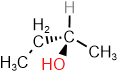 , there is a tie between \(\ce{-CH3}\) and \(\ce{-CH2-CH3}\) at first bond away; comparison of atoms two bonds away: \(\ce{H, H, H}\) versus \(\ce{C, H, H}\) assigns higher priority to \(\ce{-CH2-CH3}\) over \(\ce{-CH3}\), i.e., the priority order is: \(\overleftarrow{\ce{-OH > -CH2-CH3 > -CH3 > -H}}\).
The atoms of a double bond are treated as connected twice, and the atoms of a triple bond are treated as connected three times, i.e., \(\ce{-CH=CH2}\) is treated as \(\ce{-\overset{\overset{\Huge{\ce{C}}}|}{\underset{\underset{\Huge{\ce{H}}}|}{C}}-\overset{\overset{\Huge{\ce{C}}}|}{\underset{\underset{\Huge{\ce{H}}}|}{C}}-H}\) and \(\ce{-C\equiv CH}\) is treated as \(\ce{-\overset{\overset{\Huge{\ce{C}}}|}{\underset{\underset{\Huge{\ce{C}}}|}{C}}-\overset{\overset{\Huge{\ce{C}}}|}{\underset{\underset{\Huge{\ce{C}}}|}{C}}-H}\)
- Suppose \(\ce{-CH=CH2}\) and \(\ce{-C\equiv CH}\) attached to a chirality center are compared: the atoms one bond away are \(\ce{C}\) versus \(\ce{C}\), i.e., a tie; the atoms two bonds away are \(\ce{C,C,\overline{H}}\) versus \(\ce{C,C,\overline{C}}\), assigning higher priority to \(\ce{-C\equiv CH}\).
- Suppose \(\ce{-CH=CH2}\) and \(\ce{-CH=CH-CH3}\) attached to a chirality center are compared: there is a tie at one bond and two bonds away, but at three bonds away \(\ce{C,\overline{H}, H}\) versus \(\ce{C,\overline{C}, H}\), assigning higher priority to \(\ce{-CH=CH-CH3}\).
- Suppose \(\ce{-C\equiv CH}\) and \(\ce{-C\equiv C-CH3}\) attached to a chirality center are compared: there is a tie at one bond and two bonds away, but at three bonds away \(\ce{C,C, \overline{H}}\) versus \(\ce{C,C, \overline{C}}\), assigning higher priority to \(\ce{-C\equiv C-CH3}\).
The rule is to stop at the first point of difference, even if the order may change later. For example, comparing \(\ce{-\overset{\overset{\Huge{\ce{F}}}|}{\underset{\underset{\Huge{\ce{H}}}|}{C}}-OH}\) and \(\ce{-\!\!\!\!\!\!\overset{\overset{\Huge{\ce{F}}}|}{\underset{\underset{\Huge{\,\,\,\ce{NH\LARGE2}}}|}{C}}\!\!\!\!\!\!-CH3}\) attached to a chirallity center, there is a tie at one bond away, but at two bonds away \(\ce{F,\overline{O}, H}\) versus \(\ce{F,\overline{N}, C}\), assigning higher priority to \(\ce{-\overset{\overset{\Huge{\ce{F}}}|}{\underset{\underset{\Huge{\ce{H}}}|}{C}}-OH}\) based on the first point of difference \(\ce{O}\) versus \(\ce{N}\), eventhough the proriat at the next atom \(\ce{H}\) versus \(\ce{C}\) is reversed.
Assigning R/S stereodescriptors
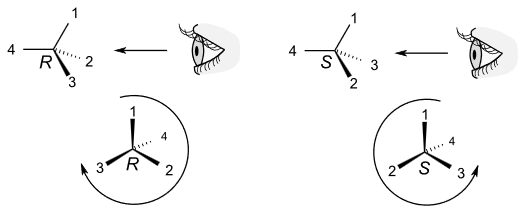 Assign a priority sequence of 1 > 2 > 3 > 4 to the four substituents on the chirality center according to CIP priority rules.
- Reorient the molecule to place the lowest priority #4 on a bond going away from the viewer, i.e., on a hashed wedge in a perspective drawing or on a vertical line in Fisher projection. (Ignore this step if the lowest priority #4 is already on the hashed wedge.)
- Draw a circular arrow going from #1 to #2 to #3: i) if the arrow is clockwise, assign rectus (R), which means right in Latin, and ii) if the arrow is counterclockwise, assign sinister (S), which means left in Latin, as illustrated in the figure on the right margin (Copyright; Roland.chem, CC0, via Wikimedia Commons).
- The R/S stereodescriptor is usually italicized, preceded by locant, placed in parentheses, and separated by a hyphen before the name.
- If there is more than one chirality center, the R/S stereodescriptors are separated by a comma.
IUPAC names (1R)-1-chloroethanol and (1S)-1-chloroethanol are examples of it, as shown in the last two structures in Figure \(\PageIndex{1}\) where the priority numbers and the circular arrows are in blue.
Easier ways for assigning R/S stereodescriptors
After assigning CIP priority sequence, if the lowest priority substituent #4 is at the hashed wedge in perspective drawing or on a vertical line in Fisher projection, the assignment of R/S stereodescriptor is straightforward: if the circular arrow from #1 to #2 to #3 is clockwise, the configuration is R, otherwise it is S. If this is not the case, than the molecules has to be re-oriented to place the lowest priority substituent at a bond going away from the viewer before drawing the circular arrow from #1 to #2 to #3. It requires visualizing the rotation of a 3D structure and redrawing, which is a complex and error-prone process. Two strategies are recommended in textbooks to address this issue. Follow one of the two that you find easier for you.
One swap of any two groups reverses the configuration
It can be observed from the exercises suggested in Figure \(\PageIndex{2}\) that overlapping enantiomers can match two substituents of the chirality center, but the other two mismatch. Swapping the two mismatched substituents in one enantiomer inverts its configuration, resulting in identical structures that superpose on each other, as illustrated in Figure \(\PageIndex{3}\).
 180\(^o\) rotation around a bond, superposition, and one swap of two groups.
 109.5\(^o\) rotation, superposition, and one swap of two groups.
A general rule is that an odd number of swaps (exchanges) of substituents invert the configuration, and an even number of swaps (exchanges) retain the configuration. Based on this general rule, if the lowest priority group #4 is not on hashed wedge in a perspective drawing or not on a vertical line in a Fisher projection, swap it with with the substituent on the hashed wedge/vertical line, find the configuration as usual and then revers it, i.e., if the circular arrow from #1 to #2 to #3 is clockwise, the configuration R is reversed to S, as illustrated in Figure \(\PageIndex{4}\).

Hand rule for assigning R/S stereodescriptors to a chirality center
This rule requires reading the 3D orientation of the four substituents of the chirality center from the drawing. The rule is:
- visualize the 3D orientation of substituents 1, 2, 3, and 4 and curl the figures of the right-hand in the direction of priority #1 to #2, or #2 to #3, or #3 to #1; if the thumb is pointing in the direction of the lowest priority (#4), the structure is right-handed; assign rectus (R);
- if not, repeat with the left hand and the thumb points towards #4, the structure is left-handed, assign sinister (S)
Figure \(\PageIndex{5}\) shows the practical application of the hand rule in different situations using perspective drawing models. Figure \(\PageIndex{6}\) shows its application in perspective drawing and the Fisher projections of enantiomers of alanine in which \(\ce{-NH2}\) is #1, \(\ce{-COOH}\) is #2, \(\ce{-CH3}\) is #3, and \(\ce{-H}\) is #4.
 Left-handed finger curving 1 to 2
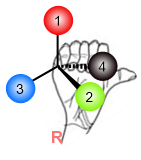 Right-hand finger curving 1 to 2
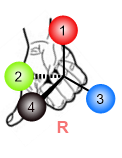 Right-hand finger curving 3 to 1
 Left-hand finger curving 1 to 2
 Right-hand finger curving 2 to 3
 Perspective drawing with the left hand (left) and the right hand (right)
 Fisher projections with the left hand (left) and the right hand (right)
An example of applying the hand rule to interactive models is given below. It is suggested to practice the hand rule on enantiomers of alanine in Figure \(\PageIndex{2}\), where perspective drawings and interactive models of both enantiomers are shown, and their configurations, (R) or (S), are mentioned in the figure caption.
Camphor
 Camphor
 Glyceraldehyde
Solution
The given enantiomer of camphor has both chiral centers in R-configuration, and the given enantiomer of glyceraldehyde has S-configuration. It is illustrated in the figure below where the priority order around the corresponding chirality is shown in blue numbers along with the right hand for R and left hand for S configurations. Note that the implicit \(\ce{-H}\) on the chirality center \(\ce{C}\)4 of camphor is going away from the viewer, and on the chirality center of glyceraldehyde is pointing towards the viewer on a solid wedge, which is shown in the answers below.
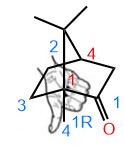 \(\ce{C}\)1 of the given enantiomer of camphor is R
 and \(\ce{C}\)4 is also R.
 Chirality center of the given enantiomer of glyceraldehyde is S.
E/Z Stereodescriptors for double bond systems
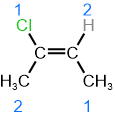
R/S stereodescriptors define the configuration of chiral centers. In the case of polysubstituted cycloalkanes, cis/trans stereodescriptors are used to indicate the relative orientation of two substituents on the same side (cis) or the opposite sides (trans); but have been replaced with R/S stereodescriptors in IUPAC nomenclature. However, cis/trans isomers of alkene and related double bond systems do not have chirality centers. The two stereogenic centers of alkenes usually have one \(\ce{-H}\) and another substituent. Cis/trans usually refers to the relationship of substituents other than \(\ce{-H}\). It becomes confusing when both substituents are other than \(\ce{-H}\). For example, if the structure shown on the right margin is named cis-2-chlorobut-2-ene, it is not clear \(\ce{-Cl}\) on one and \(\ce{-CH3}\) on the other stereogenic carbons are cis or \(\ce{-CH3}\) on one and \(\ce{-CH3}\) on the other are cis. To avoid this confusion, IUPAC has replaced cis/trans with E/Z stereodescriptors for double-bond systems, such as alkenes.
The following steps assign E or Z to the diastereomers of the double bond system.
- Assign priorities 1 and 2 to the two substituents of one stereogenic center using CIP priority, where 1 is higher priority and 2 is lower.
- Do the same to the second stereogenic center.
- If the two high-priority (#1) substituents on the two stereogenic centers are on the same side, assign zusammen (Z), which means together (cis) in German; otherwise, assign entgegen (E), which in German means opposite (trans). The E/Z capital, italicized, preceded by its locant, placed in brackets before the name, and separated by a hyphen from the name.
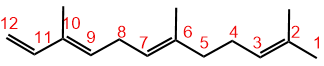
- If there is more than one double bond systems, the corresponding E and/or Z are preceded by the locant number and separated by a comma.
Figure \(\PageIndex{9}\) provides examples of the applications of the above rules.


Breaking the tie in CIP sequencing based on isomeric structures
Rule #3 of CIP sequencing, described earlier, is as follows.
IF there is a tie, compare isomeric structures: \(Z\) is preferred over \(E\) and \(R\) is preferred over \(S\).
Examples in Figure \(\PageIndex{10}\) are a practical explanation of this rule. In example 'a)', there is tie between two alkenyl substituents at one, two, and three bonds away, but the tie is broken at four bonds away, where \(\ce{\overline {C}, H, H}\) versus \(\ce{\overline{H}, H, H}\) makes \(E\) branch preferred over \(Z\) by Rule#2, resulting in \(R\) configuration of the chiral center. Note that all stereodescriptors are placed together in parentheses, separated by commas. However, in example 'b)', the tie does not break by rule #1 and rule #2. The tie is broken by Rule #3, making \(Z\) the preferred branch over \(E\) and assigning an \(S\) configuration to the chirality center.
 a) (2Z,4R,5E)-4-methylocta-2,5-diene
 b) (2Z,4S,5E)-4-methylhepta-2,5-diene
 c) (2S,3R,4R)-1,2,3,4-tetrachloropentane
 d) (2R,3s,4S)-2,3,4-trichloropentane
In example 'c)', there is tie between two alkyl substituents at one, and two bonds away but the tie is broken at three bonds away, where \(\ce{\overline {Cl}, H, H}\) versus \(\ce{\overline{H}, H, H}\) makes \(S\) configuraiton side preferred over \(R\) by Rule#2, resulting in \(R\) configuration of the chiral center at locant#3. However, in example 'd)', the tie does not break by rule #1 and rule #2. The tie is broken by Rule #3, making \(R\) preferred over \(S\) and assigning an \(s\) configuration to the chirality center at locant#3.
A pseudochirality center has four different substituents, but two of them are identical except for the configuration of the chirality centers that are non-superposable mirror images of each other. A compound with a pseudochiral center is meso, having a symmetry plane that passes through the pseudochiral center. A pseudochiral center is assigned a lowercase italic \(r\)/\(s\) stereodescriptor, to distinguish it from a regular chiral center. For example, the structure in Figure \(\PageIndex{10}\) d) has a pseudochiral center at locant#3 that is assigned \(s\) configuration.