

2.4: Organic nomenclature -functional group containing compounds
- Page ID
- 531775

\( \newcommand{\vecs}[1]{\overset { \scriptstyle \rightharpoonup} {\mathbf{#1}} } \)
\( \newcommand{\vecd}[1]{\overset{-\!-\!\rightharpoonup}{\vphantom{a}\smash {#1}}} \)
\( \newcommand{\dsum}{\displaystyle\sum\limits} \)
\( \newcommand{\dint}{\displaystyle\int\limits} \)
\( \newcommand{\dlim}{\displaystyle\lim\limits} \)
\( \newcommand{\id}{\mathrm{id}}\) \( \newcommand{\Span}{\mathrm{span}}\)
( \newcommand{\kernel}{\mathrm{null}\,}\) \( \newcommand{\range}{\mathrm{range}\,}\)
\( \newcommand{\RealPart}{\mathrm{Re}}\) \( \newcommand{\ImaginaryPart}{\mathrm{Im}}\)
\( \newcommand{\Argument}{\mathrm{Arg}}\) \( \newcommand{\norm}[1]{\| #1 \|}\)
\( \newcommand{\inner}[2]{\langle #1, #2 \rangle}\)
\( \newcommand{\Span}{\mathrm{span}}\)
\( \newcommand{\id}{\mathrm{id}}\)
\( \newcommand{\Span}{\mathrm{span}}\)
\( \newcommand{\kernel}{\mathrm{null}\,}\)
\( \newcommand{\range}{\mathrm{range}\,}\)
\( \newcommand{\RealPart}{\mathrm{Re}}\)
\( \newcommand{\ImaginaryPart}{\mathrm{Im}}\)
\( \newcommand{\Argument}{\mathrm{Arg}}\)
\( \newcommand{\norm}[1]{\| #1 \|}\)
\( \newcommand{\inner}[2]{\langle #1, #2 \rangle}\)
\( \newcommand{\Span}{\mathrm{span}}\) \( \newcommand{\AA}{\unicode[.8,0]{x212B}}\)
\( \newcommand{\vectorA}[1]{\vec{#1}} % arrow\)
\( \newcommand{\vectorAt}[1]{\vec{\text{#1}}} % arrow\)
\( \newcommand{\vectorB}[1]{\overset { \scriptstyle \rightharpoonup} {\mathbf{#1}} } \)
\( \newcommand{\vectorC}[1]{\textbf{#1}} \)
\( \newcommand{\vectorD}[1]{\overrightarrow{#1}} \)
\( \newcommand{\vectorDt}[1]{\overrightarrow{\text{#1}}} \)
\( \newcommand{\vectE}[1]{\overset{-\!-\!\rightharpoonup}{\vphantom{a}\smash{\mathbf {#1}}}} \)
\( \newcommand{\vecs}[1]{\overset { \scriptstyle \rightharpoonup} {\mathbf{#1}} } \)
\(\newcommand{\longvect}{\overrightarrow}\)
\( \newcommand{\vecd}[1]{\overset{-\!-\!\rightharpoonup}{\vphantom{a}\smash {#1}}} \)
\(\newcommand{\ket}[1]{\left| #1 \right>}\)
\(\newcommand{\bra}[1]{\left< #1 \right|}\)
\(\newcommand{\braket}[2]{\left< #1 \vphantom{#2} \right| \left. #2 \vphantom{#1} \right>}\)
\(\newcommand{\braopket}[3]{\left< #1 \vphantom{#2}\vphantom{#3} \right| #2 \vphantom{#1}\vphantom{#3} \left| #3 \vphantom{#1}\vphantom{#2} \right>}\)
\(\newcommand{\qmvec}[1]{\mathbf{\vec{#1}}}\)
\(\newcommand{\op}[1]{\hat{\mathbf{#1}}}\)
\(\newcommand{\expect}[1]{\langle #1 \rangle}\)
\(\newcommand{\dfn}[1]{\emph{\textbf{#1}}}\)
\(\newcommand{\avec}{\mathbf a}\) \(\newcommand{\bvec}{\mathbf b}\) \(\newcommand{\cvec}{\mathbf c}\) \(\newcommand{\dvec}{\mathbf d}\) \(\newcommand{\dtil}{\widetilde{\mathbf d}}\) \(\newcommand{\evec}{\mathbf e}\) \(\newcommand{\fvec}{\mathbf f}\) \(\newcommand{\nvec}{\mathbf n}\) \(\newcommand{\pvec}{\mathbf p}\) \(\newcommand{\qvec}{\mathbf q}\) \(\newcommand{\svec}{\mathbf s}\) \(\newcommand{\tvec}{\mathbf t}\) \(\newcommand{\uvec}{\mathbf u}\) \(\newcommand{\vvec}{\mathbf v}\) \(\newcommand{\wvec}{\mathbf w}\) \(\newcommand{\xvec}{\mathbf x}\) \(\newcommand{\yvec}{\mathbf y}\) \(\newcommand{\zvec}{\mathbf z}\) \(\newcommand{\rvec}{\mathbf r}\) \(\newcommand{\mvec}{\mathbf m}\) \(\newcommand{\zerovec}{\mathbf 0}\) \(\newcommand{\onevec}{\mathbf 1}\) \(\newcommand{\real}{\mathbb R}\) \(\newcommand{\twovec}[2]{\left[\begin{array}{r}#1 \\ #2 \end{array}\right]}\) \(\newcommand{\ctwovec}[2]{\left[\begin{array}{c}#1 \\ #2 \end{array}\right]}\) \(\newcommand{\threevec}[3]{\left[\begin{array}{r}#1 \\ #2 \\ #3 \end{array}\right]}\) \(\newcommand{\cthreevec}[3]{\left[\begin{array}{c}#1 \\ #2 \\ #3 \end{array}\right]}\) \(\newcommand{\fourvec}[4]{\left[\begin{array}{r}#1 \\ #2 \\ #3 \\ #4 \end{array}\right]}\) \(\newcommand{\cfourvec}[4]{\left[\begin{array}{c}#1 \\ #2 \\ #3 \\ #4 \end{array}\right]}\) \(\newcommand{\fivevec}[5]{\left[\begin{array}{r}#1 \\ #2 \\ #3 \\ #4 \\ #5 \\ \end{array}\right]}\) \(\newcommand{\cfivevec}[5]{\left[\begin{array}{c}#1 \\ #2 \\ #3 \\ #4 \\ #5 \\ \end{array}\right]}\) \(\newcommand{\mattwo}[4]{\left[\begin{array}{rr}#1 \amp #2 \\ #3 \amp #4 \\ \end{array}\right]}\) \(\newcommand{\laspan}[1]{\text{Span}\{#1\}}\) \(\newcommand{\bcal}{\cal B}\) \(\newcommand{\ccal}{\cal C}\) \(\newcommand{\scal}{\cal S}\) \(\newcommand{\wcal}{\cal W}\) \(\newcommand{\ecal}{\cal E}\) \(\newcommand{\coords}[2]{\left\{#1\right\}_{#2}}\) \(\newcommand{\gray}[1]{\color{gray}{#1}}\) \(\newcommand{\lgray}[1]{\color{lightgray}{#1}}\) \(\newcommand{\rank}{\operatorname{rank}}\) \(\newcommand{\row}{\text{Row}}\) \(\newcommand{\col}{\text{Col}}\) \(\renewcommand{\row}{\text{Row}}\) \(\newcommand{\nul}{\text{Nul}}\) \(\newcommand{\var}{\text{Var}}\) \(\newcommand{\corr}{\text{corr}}\) \(\newcommand{\len}[1]{\left|#1\right|}\) \(\newcommand{\bbar}{\overline{\bvec}}\) \(\newcommand{\bhat}{\widehat{\bvec}}\) \(\newcommand{\bperp}{\bvec^\perp}\) \(\newcommand{\xhat}{\widehat{\xvec}}\) \(\newcommand{\vhat}{\widehat{\vvec}}\) \(\newcommand{\uhat}{\widehat{\uvec}}\) \(\newcommand{\what}{\widehat{\wvec}}\) \(\newcommand{\Sighat}{\widehat{\Sigma}}\) \(\newcommand{\lt}{<}\) \(\newcommand{\gt}{>}\) \(\newcommand{\amp}{&}\) \(\definecolor{fillinmathshade}{gray}{0.9}\)
Alkene
An alkene is named using the rules for the corresponding alkane, with the following modifications.
- Suffix -ane is replaced with -ene, preceded by the locant number of the \(\ce{C=C}\) group.
- If there are multiple \(\ce{C=C}\) groups, use multiplier, diene, triene, etc., and insert the locant number of each double bond.
- Numbering of the parent chain begins from the end that assigns a lower number to the first \(\ce{C}\) of the \(\ce{C=C}\) group that becomes its locant, in preference over alkyl substituents.
- If \(\ce{C=C}\) group receives the same locant from either end, the preference goes to the first branch following the relevant rules for branched alkane.
- In a cycloalkene, the carbons in the \(\ce{C=C}\) group are always #1 and #2, continuing clockwise or counterclockwise, whichever assigns a lower set of locant numbers to other \(\ce{C=C}\) if there is any, and after it to the other substituents according to the rules for branched alkane and cycloalkane.
- Locant number is not needed if there is one \(\ce{C=C}\) in a cycloalkene, as it is always #.
- According to the new IUPAC rule, the parent chain is the longest chain, whether it contains \(\ce{C=C}\) group in it or not.
- If the \(\ce{C=C}\) group is in a branch, the branch is named according to the rules for alkane branches, but with the -yl suffix of the branch replaced with -enyl suffix preceded by the locant number of the \(\ce{C=C}\) group in the branch.
| Structure: |  |
 |
 |
 |
 |
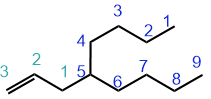 |
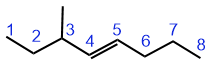
| IUPAC name: | but-1-ene | buta-1,3-diene | 5,5-dimethylcyclohexa-1,3-diene | (4E)-3-methyloct-4-ene | cyclopentene | 5-(prop-2-en-1-yl)nonane |
| Alkene rule#: | Rule#1 & #2 | Rule#1, part 2** | Rule#2, part 2, and Rule#3** |
Rule#2, part 2* |
Rule#3, part 2 | Rule#4 |
|
* (4E) is stereodescriptor for a trans- alkyl groups around \(\ce{C=C}\), at \(\ce{C}\)4. The sterodescriptors are explained in the next chapter. ** last letter -a in the Greek multipliers buta, penta, hexa, etc. is elided when the next alphabet is a vowel, but in these examples it is retained as the next alphabet is not a vowel. |
||||||
Alkyne
An alkyne, i.e., a hydrocarbon containing at least one \(\ce{C\equiv C}\), is named by the same rules as an alkene, but with the following changes.
- The suffix -ene is replaced with -yne.
- When both \(\ce{C=C}\) and \(\ce{C\equiv C}\) groups are present, the suffix becomes en-yne, preceded by their corresponding locant.
- Both \(\ce{C=C}\) and \(\ce{C\equiv C}\) groups have equal priority in numbering the parent chain, except when there is a tie, preference goes to \(\ce{C=C}\).
| Structure: |  |
 |
 |
 |
| IUPAC name | 5-methylhept-3-yne | 3-methylhept-1-ene-4-yne | 3,5-dimethylhex-4-ene-1-yne | pent-1-en-4-yne |
| Alkyne Rule#: | Rule#1 | Rule#1, part 2 | Rule#2 | Rule#2 |
Aromatic hydrocarbons
Aromaticity is described in a separate chapter. Nomenclature of benzene and its derivatives -the most common class of aromatic compounds is described here.
- A six-\(\ce{C}\) cycle with alternate single and double bonds takes the parent name benzene.
- A substituted benzene is named following the rules for a substituted cycloalkane with the parent name benzene.
- Alternatives to using locant numbers: a 1,2-relationship can be replaced with "ortho" or "o", a 1,3-relationship with "meta" or "m-", and a 1,4-relationship with "para" or "p-".
- Some groups, when they are the most senior among substituents on a benzene, take a combination of benzene and the functional group parent name; the benzene \(\ce{C}\) bearing the group is #1 in numbering in this case.
- Benzene ring as a substituent is named phenyl.
| Structure: |  |
 |
 |
 |
 |
| IUPAC name | benzene | ethylbenzene | 1,2-diethylbenzene or o-diethylbenzene | 1,3-diethylbenzene or m-diethylbenzene | 1,4-diethylbenzene or p-diethylbenzene |
| Aromatic rule#: | Rule#1 | Rule#2 | Rule#2 and Rule#3 | Rule#2 and Rule#3 | Rule#2 and Rule#3 |
| Structure: |  |
 |
 |
 |
 |
 |
| IUPAC name | toluene | anisol | styrene | aniline | phenol | benzaldehyde |
| Structure: | 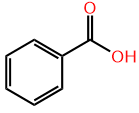 |
 |
 |
 |
 |
 |
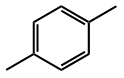
| IUPAC name | benzoic acid | 1,2-dimethylbenzene or o-xylene * | 1,3-dimethylbenzene or m-xylene |
1,4-dimethylbenzene or p-xylene |
2-ethylphenol | 2-phenylethan-1-amine ** |
| * Dimethylbenzene is also named xylene. ** This example is added for explaining rule#5, i.e., benzene ring as substituent is named phenyl, otherwise the nomenclature involving characteristic functional groups is described in the next section | ||||||
Non-characteristic functional groups
In the structure of organic compounds, \(\ce{-R}\) is used to refer to the rest of the organic structure, or a \(\ce{H}\) atom, or an alkyl branch. \(\ce{-R}\) is not a functional group, but it is a group in IUPAC nomenclature. A double bond \(\ce{C=C}\) and a triple bond \(\ce{C\equiv C}\) are functional groups that have preference over an alkyl group in parent chain numbering but no preference over any characteristic group. Benzene ring of an aromatic ring is represented as \(\phi\)- or as \(\ce{-C6H5}\). An alkyl group as a parent chain, \(\ce{C=C}\), and \(\ce{C\equiv C}\) always take a primary suffix -an-, -en-, or -yn-, as shown in the Table. These suffixes end with the letter -e, i.e., -ane, -ene, or -yne, if there is no characteristic functional group in the compound. The benzene ring, as a branch, is designated by the prefix phenyl, and as the parent chain, it is named benzene. There are some other non-characteristic functional groups, e.g., alkyl halides \(\ce{R-X}\), nitro \(\ce{-\!\!\overset{+}{\underset{\underset{\Huge\,{\ce{O}}}|\!\!|\enspace}{N}}\!\!-\overset{-}{O}}\), also written in condensed form as \(\ce{-NO2}\), azido \(\ce{-N=\overset{+}{N}=\overset{-}{N}}\), also written in condensed form as \(\ce{-N3}\), etc., that take only a prefix and are treated like alkyl branches without any preference, except for the alphabetical order among the substituents. Main non-characteristic groups are listed in Table \(\PageIndex{5}\) along with their suffix or prefix, and their use in nomenclature is explained with examples in \(\PageIndex{6}\).
| Structure: | \(\ce{-R}\) | \(\ce{>C=C<}\) | \(\ce{-C\equiv C{-}}\) |  |
\(\ce{-F}\) | \(\ce{-Cl}\) | \(\ce{-Br}\) | \(\ce{-I}\) | \(\ce{-NO2}\) | \(\ce{-O-R}\) | \(\ce{-N3}\) |
| Suffix: | -an- | -en- | -yn- | -benzene | - | - | - | - | - | - | - |
| Prefix: | - | - | - | phenyl- | fluoro- | chloro- | bromo- | iodo- | nitro- | alkoxy- | azido- |
| Structure: |  |
 |
 |
 |
 |
| IUPAC Name | 2-bromo-2-methylpropane | iodomethane | 2,4,6-trinitrotoluene or 2-methyl-1,3,5-trinitrobenzene | methoxyethane | azidobenzene |
Alkyl halide
Compounds containing an alkyl group bonded to a halogen, i.e., \(\ce{R-X}\), where \(\ce{X}\) is \(\ce{F}\), \(\ce{Cl}\), \(\ce{Br}\), or \(\ce{I}\), are a class of organic compounds called alkyl halides. In substitutive IUPAC nomenclature, described above, the alkyl group is the parent and halide, i.e., fluoro, chloro, bromo, or iodo as a substituent, equal in priority to alkyl branches. The substitutive name is preferred, the IUPAC name, but they can also be named by functional class nomenclature, where alkyl groups are listed in alphabetical order, followed by the class name, separated by spaces. For example, \(\ce{CH3-Br}\) is named bromomethane in substitutive nomenclature and named methyl bromide in functional class nomenclature. Similarly, \(\ce{(CH3)3-Br}\) is 2-bromo-2-methylpropaen in substitutive nomenclature, and it is tertiary butyl bromide in functional class nomenclature.
Ether
Compounds containing two alkyl groups bonded to oxygen, i.e., \(\ce{R-O-R'}\), are a class of organic compounds called ethers. In substitutive nomenclature, the longer alkyl group is the parent, and the shorter alkyl group plus oxygen is the alkoxy substituent. In functional class nomenclature, the alkyl groups are listed in alphabetical order, followed by the class name ether, separated by spaces. For example, \(\ce{CH3CH2-O-CH3}\) is named "methoxyethane" in substitutive nomenclature and named "ethyl methyl ether" in functional class nomenclature. Similarly, a common organic solvent \(\ce{CH3CH2-O-CH2CH3}\) is named ethoxyethane or diethyl ether.

 Cyclic ethers have a \(\ce{C}\) in the cyclic structure replaced with an \(\ce{O}\). Their nomenclature is not described here, but their name will be provided wherever needed. The structure shown on the left is tetrahydrofuran, a five-membered cyclic ether, which is a common organic solvent. The structure on the right is oxirane, also known as epoxyethane, a three-membered cyclic ether that is a reactive compound used as a reagent in organic synthesis.
Characteristic functional groups
Characteristic functional groups have a seniority order, as listed in Table \(\PageIndex{7}\) for the most common groups.
| Functional class | Lewis structure | Condensed formula* | Suffix | Prefix |
| Carboxylate |
\(\ce{-\overset{\!\!\overset{\Huge {\:\ce{O}}}|\!\!|\,}{C}-O^{-}}\) \(\ce{-\overset{\!\!\overset{\Huge {\:\ce{O}}}|\!\!|\,}{(C)}-O^{-}}\) |
\(\ce{-COO^{-}}\) \(\ce{-(C)OO^{-}}\) |
carboxylate oate |
carboxylato |
| Carboxylic acid |
\(\ce{-\overset{\!\!\overset{\Huge {\:\ce{O}}}|\!\!|\,}{C}-OH}\) \(\ce{-\overset{\!\!\overset{\Huge {\:\ce{O}}}|\!\!|\,}{(C)}-OH}\)
|
\(\ce{-COOH}\) \(\ce{-(C)OOH}\) |
carboxylic acid oic acid |
carboxy |
| Ester |
\(\ce{-\overset{\!\!\overset{\Huge {\:\ce{O}}}|\!\!|\,}{C}-O-R}\) \(\ce{-\overset{\!\!\overset{\Huge {\:\ce{O}}}|\!\!|\,}{(C)}-O-R}\) |
\(\ce{-COOR}\) \(\ce{-(C)OOR}\) |
Alkyl ....carboxylate** Alkyl ....oate** |
alkoxycarbonyl |
| Acid halide |
\(\ce{-\overset{\!\!\overset{\Huge {\:\ce{O}}}|\!\!|\,}{C}-X}\) \(\ce{-\overset{\!\!\overset{\huge {\:O}}|\!\!|\,}{(C)}-X}\) |
\(\ce{-COX}\) \(\ce{-(C)OX}\) |
carbonyl halide oyl halide |
halocarbonyl |
| Amide |
\(\ce{-\overset{\!\!\overset{\Huge {\:\ce{O}}}|\!\!|\,}{C}-NRR'}\) \(\ce{-\overset{\!\!\overset{\Huge {\:\ce{O}}}|\!\!|\,}{(C)}-NRR'}\) |
\(\ce{-CONRR'}\) \(\ce{-(C)ONRR'}\) |
carboxamide amide |
carbamoyl or amino-oxo |
| Nitrile |
\(\ce{-C\equiv N}\) \(\ce{-(C)\equiv N}\) |
\(\ce{-CN}\) \(\ce{-(C)N}\) |
carbonitrile nitrile |
cyano |
| Aldehyde |
\(\ce{-\overset{\!\!\overset{\Huge {\:\ce{O}}}|\!\!|\,}{C}-H}\) \(\ce{-\overset{\!\!\overset{\Huge {\:\ce{O}}}|\!\!|\,}{(C)}-H}\) |
\(\ce{-CHO}\) \(\ce{-(C)HO}\) |
Carbaldehyde al |
formyl oxo |
| Ketone | \(\ce{R-\overset{\!\!\overset{\Huge {\:\ce{O}}}|\!\!|\,}{C}-R'}\) | \(\ce{>C=O}\) | one | oxo |
| Alcohol | \(\ce{-OH}\) | - | ol | hydroxy |
| Thiol | \(\ce{-SH}\) | - | thiol | sulfanyl*** |
| Amine | \(\ce{-NRR'}\) | - | amine | amino |
| Imine | \(\ce{R'-\overset{\!\!\!\!\!\overset{\Huge {\:\;\ce{NR}}}|\!\!\!\!\!\!|\,}{C}-R''}\) | imine | imino | |
|
* (C) means the carbon is counted in the parent chain, and \(\ce{C}\) means it is part of the functional group, but not counted in the parent chain. ** \(\ce{R}\) is an alkyl group expressed as a separate prefix, but in the cases of amides, amines, and imines, it may be alkyl that is expressed as prefix N-alkyl or it may be \(\ce{H}\) which is not expressed separate. *** The suffix "mercepto" was used in early nomenclature, which is replaced with sulfanyl in the current version of IUPAC nomenclature. |
||||
A compound containing one or more characteristic functional groups is named by the IUPAC rules described before for hydrocarbons, but with the following changes.
- The parent chain is the longest chain containing the most senior functional group, even if it is not the longest chain without it.
- The parent chain is numbered from a direction that assigns the lowest possible number to the most senior group, in preference to other substituents.
- The last letter 'e' of the primary suffixes ane, ene, or yne is replaced with the suffix of the most senior group, preceded by its locant, and other groups are listed as prefixes in alphabetic order, preceded by their locant number.
- When there is an alkyl group on \(\ce{N}\) in addition to the parent chain, its locant is \(\ce{N}\), i.e., it is listed as \(\ce{N-alkyl}\).
 For example, the structure on the right is named N-methyl-3-propylhept-6-en-2-amine, where amine is the parent functional group. The parent is the longest chain containing an amine; it is heptane, not octane (Rule #1). The parent chain is numbered from left to right to assign a lower number to the amine in preference to the other side that would have assigned #1 to the \(\ce{C=C}\) group (Rule#2). The last letter "e" is replaced with "amine", preceded by its locant number (Rule #3). Methyl group on \(\ce{N}\) is listed as N-methyl (Rule#3).
 Depending on the arrangement of a \(\ce{C}\)-containing functional group on the parent chain, the \(\ce{C}\) of the functional group may be numbered as a part of the parent chain, or it may be a separate attachment.
 For example, the structure on the left is butanedicarboxylic in which \(\ce{C}\) of the functional group is part of the parent chain. In contrast, the structure on the right is cyclohexanecarboxylic acid, in which the (\ce{C}\) of the functional group is not a part of the parent chain. Note that in both cases, the locant number is not written in the name as it is understood. Also note that the last "e" of -ane is not dropped when the following letter is not a vowel, as in cyclohexanecarboxylic acid. Further examples are in the following sections.
Amine
A \(\ce{N}\) single bonded to one or more hydrocarbons is a class of organic compound called an amine. A \(\ce{N}\) single bonded to one alkyl group \(\ce{R-NH2}\) is a primary amine, singel bonded to two alkyl groups \(\ce{{R}-\underset{\LARGE{\ce{H}}}{N}-R'}\) is a secondary amine and single bonded to three alkyl groups is \(\ce{{R'}-\underset{\underset {\;\;\Huge{\!\ce{R}}}|}{N}-R''}\) is a tertiary amine. The following rules name amines.
- A primary amine is named as alkanamine.
- A secondary amine is named as N-alkylalkanamine, where the longer chain alkyl is the parent and the smaller in the N-alkyl substituent.
- A tertiary amine is named as N-alkyl-N-alkylamine, where the longest chain alkyl is the parent and the smaller ones are listed as N-alkyl substituents in alphabetical order.
- When a senior group is present, the amine group takes the suffix "-amino".
The following examples illustrate the above rules with practical applications.
| Structure: |  |
 |
 |
 |
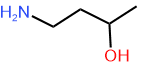 |
| Prefered IUPAC name: | propan-2-amine | N-methylpropan-1-amine | N-ethyl-N-methylbutan-2-amine | N,N-dimethylmethanamine | 4-amino-butan-2-ol |
| Amine rule: | Rule#1 | Rule#2 | Rule#3 | Rule#3 | Rule#4 |
Among the important aromatic amiens: an amine group on a benzene takes the parent name aniline, a benzene ring with one \(\ce{C}\) replaced with \(\ce{N}\) is pyridine, illustrated below along with purine and pyrimidine structures that are found in nucleic acid.
 |
 |
 |
 |
| aniline | pyridine | purine | pyrimidine |
Alcohol and thiol
\(\ce{-OH}\) is an alcohol group. The class of organic compounds that contains an alcohol group is called alcohol. An alcohol is designated primary, secondary, or tertiary depending on whether it is on a primary, secondary, or tertiary \(\ce{C}\).
- An alcohol \(\ce{-OH}\) is a characteristic group in IUPAC nomenclature, taking the suffix -ol if it is a senior or the prefix hydroxy if there is another more senior group present.
- An alcohol group on a benzene ring together takes the parent name phenol, provided there is no other more senior group present.
- \(\ce{-SH}\) is the sulphur analogue of alcohol, called thiol, that takes the suffix -thiol in IUPAC nomenclature or, when there is a more senior group present, it takes the prefix sulfanyl-.
An alcohol is designated primary, secondary, or tertiary depending on whether it is on a primary, secondary, or tertiary \(\ce{C}\). Alcohol also has functional class names, which are usually alkyl alcohol. The following examples explain the IUPAC naming of alcohols and thiols with applied examples.
| Structure: |  |
 |
 |
 |
 |
 |
 |
 |
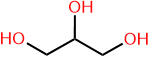
| IUPAC name: | ethanol | propan-2-ol | 2-methyl-2-propanol | propan-1,2,3-triol | 2-methylphenol | 3-hydroxypropanoic acid | ethanthiol | 2-sulfanylethan-1-ol |
| Functional class name; | ethyl alcohol | isopropyl alcohol | tert-butyl alcohol | Common name: Glycerol | - | - | - | - |
| Comment | a primary alcohol | a secondary alcohol | a tertiary alcohol | use of a multipler | aromatic alcohol | alcohol as not a senior group | - | \(\ce{-SH}\) as not a senior group |
Aldehyde, ketone, and imine
A \(\ce{>C=O}\) is a carbonyl group. It has several subgroups, which differ in the two groups attached to the carbonyl \(\ce{C}\). For example, when one of the group attached to the carbonyl \(\ce{C}\) is \(\ce{H}\) it is an aldehyde \(\ce{-\overset{\!\!\overset{\Huge {\:\ce{O}}}|\!\!|\,}{C}-H}\), which is usually written in abbreviated form as \(\ce{-CHO}\). When both groups attached to the carbonyl \(\ce{C}\) are alkyl groups, it is a \(\ce{R-\overset{\!\!\overset{\Huge {\:\ce{O}}}|\!\!|\,}{C}-R'}\). When \(\ce{O}\) of an aldehydel or a ketone is replaced with \(\ce{N}\) it is an imine \(\ce{R'-\overset{\!\!\!\!\!\overset{\Huge {\:\;\ce{NR}}}|\!\!\!\!\!\!|\,}{C}-R''}\), where \(\ce{R}\) could be an alkyl or a \(\ce{H}\). The class of organic compound containing aldehyde, ketone, or imine groups are called aldehydes, ketones, and imines, respectively.
- When carbonyl \(\ce{C}\) of an aldehyde is counted in the parent, numbering begins from the carbonyl \(\ce{C}\) and it takes the suffix -al when it is senior or the prefix oxo- when it is not a senior group.
- When carbonyl \(\ce{C}\) of an aldehyde is not counted in the parent, numbering begins from the carbonyl \(\ce{C}\) and it takes the suffix -carbaldehyde when it is senior or prefix formyl- when it is not a senior group. Single aldehyde does not need locant as it is alway #1.
- An aldehyde and benzene ring together take the parent name benzaldehyde, with the numbering of the benzene ring beginning from the point of attachment of the aldehyde group.
- When an aldehyde on a benzene ring is not the senior group, it takes the prefix -carbaldehyde.
- A ketone takes the suffix -one (pronounced as own) when it is senior, and the numbering begins from the end that assigns it a lower locant. Alternatively, it takes the prefix oxo- when it is not a senior group.
- Although not preferred, ketones can be named by functional class nomenclature, listing alkyl groups in alphabetical order, followed by the word 'ketone', separated by spaces.
- An imine takes the suffix -imine when it is senior or the prefix imino- when it is not a senior group and follows the parent chain numbering convention of the corresponding aldehyde or ketone.
The following examples illustrate the above rules with practical applications.
| Structure: |  |
 |
 |
 |
 |
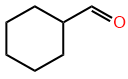
| IUPAC name: | methanal or formaldehyde | ethanal or acetaldehyde | cyclohexanecarbaldehyde | 3-formylcyclohexane-1-carboxylic acid | 3-oxopropanoic acid |
| Comment: | 2nd Name is also accepted. | 2nd Name is also accepted | Carbonyl \(\ce{C}\) is not counted in the parent chain. | Aldehyde is not senior, and the carbonyl \(\ce{C}\) is not counted in the parent chain. | Aldehyde is not senior, and the carbonyl \(\ce{C}\) is counted in the parent chain. |
| Structure: |  |
 |
 |
 |
 |
| IUPAC name: | propanon or acetone | pent-4-en-2-one | 3-oxobutanal | 3-chlorobenzaldehyde | N-methylpentane-3-imine |
| Comment: | 2nd name is also accepted | Ketone is a senior group | Aldehyde is a senior group | Aldehyde is a senior group on the benzene ring | imine nomenclatuere |
Carboxylic acids and their derivatives
A carboxylic acid group has a carbonyl \(\ce{C=O}\) and an alcohol \(\ce{-OH}\) groups together, i.e., \(\ce{-\overset{\!\!\overset{\Huge {\:\ce{O}}}|\!\!|\,}{C}-OH}\). There are several related groups, called carboxylic acid derivatives, which differ in the \(\ce{-\overset{\!\!\overset{\Huge {\:\ce{O}}}|\!\!|\,}{C}-OH}\). For example,
- carboxylate anion \(\ce{-\overset{\!\!\overset{\Huge {\:\ce{O}}}|\!\!|\,}{C}-O^{-}}\) has \(\ce{H}\) of the \(\ce{-OH}\) is removed as a proton leaving the bonding electrons on \(\ce{O}\),
- ester \(\ce{-\overset{\!\!\overset{\Huge {\:\ce{O}}}|\!\!|\,}{C}-OR}\) has \(\ce{H}\) of the \(\ce{-OH}\) group repalced with an alkyl \(\ce{R}\) group,
- amide \(\ce{-\overset{\!\!\overset{\Huge {\:\ce{O}}}|\!\!|\,}{C}-NRR'}\) has \(\ce{H}\) of the \(\ce{-OH}\) group repalced with an amine \(\ce{-NRR'}\) group,
- acid halide \(\ce{-\overset{\!\!\overset{\Huge {\:\ce{O}}}|\!\!|\,}{C}-X}\) has the \(\ce{-OH}\) replaced with a halide (fluoride \(\ce{-F}\), chloride \(\ce{-Cl}\), bromide \(\ce{-Br}\), or iodide \(\ce{-I}\)) group.
- Nitrile \(\ce{-C\equiv N}\) has both \(\ce{O}\) atoms of a carboxylic acid group \(\ce{-\overset{\!\!\overset{\Huge {\:\ce{O}}}|\!\!|\,}{C}-OH}\) repalced with \(\ce{N}\)
Carboxylic acids and their derivatives are named by following the rules described so far, but with the following changes.
- When the carbonyl-\(\ce{C}\) is counted in the parent chain and the group is the senior, numbering begins from the carbonyl-\(\ce{C}\) and: carboxylic acid \(\ce{-\overset{\!\!\overset{\Huge {\:\ce{O}}}|\!\!|\,}{C}-OH}\) takes suffix -oic acid; carboxylate anion \(\ce{-\overset{\!\!\overset{\Huge {\:\ce{O}}}|\!\!|\,}{C}-O^{-}}\) takes suffix -oate; ester \(\ce{-\overset{\!\!\overset{\Huge {\:\ce{O}}}|\!\!|\,}{C}-OR}\) takes prefix + suffix alkyl-....oate; acid halide \(\ce{-\overset{\!\!\overset{\Huge {\:\ce{O}}}|\!\!|\,}{C}-X}\) takes suffix -oyl halide; amide \(\ce{-\overset{\!\!\overset{\Huge {\:\ce{O}}}|\!\!|\,}{C}-NRR'}\) takes prefix + suffix N-alkyl-N-alkyl....amide; and nitrile \(\ce{-CN}\) takes suffix -nitrile.
- When these groups are not the most senior, carboxylic acid \(\ce{-\overset{\!\!\overset{\Huge {\:\ce{O}}}|\!\!|\,}{C}-OH}\) takes prefix carboxy-; carboxylate anion \(\ce{-\overset{\!\!\overset{\Huge {\:\ce{O}}}|\!\!|\,}{C}-O^{-}}\) takes prefix carboxylato; ester \(\ce{-\overset{\!\!\overset{\Huge {\:\ce{O}}}|\!\!|\,}{C}-OR}\) takes alkoxycarbonyl-; acid halide \(\ce{-\overset{\!\!\overset{\Huge {\:\ce{O}}}|\!\!|\,}{C}-X}\) takes halocarbonyl-; amide \(\ce{-\overset{\!\!\overset{\Huge {\:\ce{O}}}|\!\!|\,}{C}-NRR'}\) takes carbamoyl or amino-oxo-; and nitrile \(\ce{-CN}\) takes prefix cyano-.
- When the carbonyl-\(\ce{C}\) is not counted in the parent chain and the group is the senior, numbering is is done to assign lowest number to them and carboxylic acid \(\ce{-\overset{\!\!\overset{\Huge {\:\ce{O}}}|\!\!|\,}{C}-OH}\) takes suffix -carboxylic acid; carboxylate anion \(\ce{-\overset{\!\!\overset{\Huge {\:\ce{O}}}|\!\!|\,}{C}-O^{-}}\) takes suffix --carboxylate; ester \(\ce{-\overset{\!\!\overset{\Huge {\:\ce{O}}}|\!\!|\,}{C}-OR}\) takes prefix + suffix alkyl-....carboxylate; acid halide \(\ce{-\overset{\!\!\overset{\Huge {\:\ce{O}}}|\!\!|\,}{C}-X}\) takes suffix -carbonyl halide; amide \(\ce{-\overset{\!\!\overset{\Huge {\:\ce{O}}}|\!\!|\,}{C}-NRR'}\) takes prefix + suffix N-alkyl-N-alkyl....carboxamide; and nitrile \(\ce{-CN}\) takes suffix -carbonitrile.
- When these groups are not the most senior, their prefixes are the same as those in Rule #1, Part 2.
The following examples illustrate the above rules with practical applications.
| Structure: |  |
 |
 |
 |
 |
 |
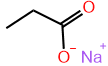
| IUPAC name: | propanoic acid | sodium propanoate | methyl propanoate | propanoyl chloride | N-methylpropanamide | propanenitrile |
| Comment: | a carboxylic acid | a carboxylate anion | an ester | an acid halide | an amide | a nitrile |
| Structure: |  |
 |
 |
 |
 |
| IUPAC name: | 2-amino-3-carboxypropanoate | 4-methox-4-oxobutanoic acid | 4-chloro-4-oxobutanoic acid | 4-amino-4-oxobutanoic acid | 3-cyanopropanoic acid |
| Comment: | prefix carboxy- for \(\ce{-COOH}\) | prefix alkoxycarbonyl for \(\ce{-COOR}\) | prefix halocarbonyl for \(\ce{-COX}\) | prefix amino-oxo for \(\ce{-CONRR'}\) | prefix cyano- for \(\ce{-CN}\) |
| Structure: |  |
 |
 |
 |
 |
 |
| IUPAC name: | cyclohexanecarboxylic acid | potassium cyclohexanecarboxylate | methyl cyclohexanearboxylate | cyclohexanecarbonyl chloride | N-methylcyclohexanecarboxamide | cyclohexanecarbonitrile |
| Comment: | a carboxylic acid | a carboxylate anion | an ester | an acid halide | an amide | a nitrile |
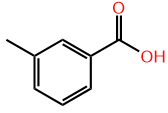
 A carboxylic acid on a benzene ring is collectively referred to as benzoic acid, e.g., the structure on the left is 3-methylbenzoic acid. An aldehyde on a benzene ring is collectively referred to as benzaldehyde; for example, the structure on the right is 3-bromobenzaldehyde.
Methanoic acid \(\ce{H-\overset{\!\!\overset{\Huge {\:\ce{O}}}|\!\!|\,}{C}-OH}\) and ethanoic acid \(\ce{CH3-\overset{\!\!\overset{\Huge {\:\ce{O}}}|\!\!|\,}{C}-OH}\) have trivial names formic acid and acetic acid, respectively, which are accepted as alternate IUPAC names for these compounds.