

2.2: Resonance
- Page ID
- 523123

\( \newcommand{\vecs}[1]{\overset { \scriptstyle \rightharpoonup} {\mathbf{#1}} } \)
\( \newcommand{\vecd}[1]{\overset{-\!-\!\rightharpoonup}{\vphantom{a}\smash {#1}}} \)
\( \newcommand{\dsum}{\displaystyle\sum\limits} \)
\( \newcommand{\dint}{\displaystyle\int\limits} \)
\( \newcommand{\dlim}{\displaystyle\lim\limits} \)
\( \newcommand{\id}{\mathrm{id}}\) \( \newcommand{\Span}{\mathrm{span}}\)
( \newcommand{\kernel}{\mathrm{null}\,}\) \( \newcommand{\range}{\mathrm{range}\,}\)
\( \newcommand{\RealPart}{\mathrm{Re}}\) \( \newcommand{\ImaginaryPart}{\mathrm{Im}}\)
\( \newcommand{\Argument}{\mathrm{Arg}}\) \( \newcommand{\norm}[1]{\| #1 \|}\)
\( \newcommand{\inner}[2]{\langle #1, #2 \rangle}\)
\( \newcommand{\Span}{\mathrm{span}}\)
\( \newcommand{\id}{\mathrm{id}}\)
\( \newcommand{\Span}{\mathrm{span}}\)
\( \newcommand{\kernel}{\mathrm{null}\,}\)
\( \newcommand{\range}{\mathrm{range}\,}\)
\( \newcommand{\RealPart}{\mathrm{Re}}\)
\( \newcommand{\ImaginaryPart}{\mathrm{Im}}\)
\( \newcommand{\Argument}{\mathrm{Arg}}\)
\( \newcommand{\norm}[1]{\| #1 \|}\)
\( \newcommand{\inner}[2]{\langle #1, #2 \rangle}\)
\( \newcommand{\Span}{\mathrm{span}}\) \( \newcommand{\AA}{\unicode[.8,0]{x212B}}\)
\( \newcommand{\vectorA}[1]{\vec{#1}} % arrow\)
\( \newcommand{\vectorAt}[1]{\vec{\text{#1}}} % arrow\)
\( \newcommand{\vectorB}[1]{\overset { \scriptstyle \rightharpoonup} {\mathbf{#1}} } \)
\( \newcommand{\vectorC}[1]{\textbf{#1}} \)
\( \newcommand{\vectorD}[1]{\overrightarrow{#1}} \)
\( \newcommand{\vectorDt}[1]{\overrightarrow{\text{#1}}} \)
\( \newcommand{\vectE}[1]{\overset{-\!-\!\rightharpoonup}{\vphantom{a}\smash{\mathbf {#1}}}} \)
\( \newcommand{\vecs}[1]{\overset { \scriptstyle \rightharpoonup} {\mathbf{#1}} } \)
\(\newcommand{\longvect}{\overrightarrow}\)
\( \newcommand{\vecd}[1]{\overset{-\!-\!\rightharpoonup}{\vphantom{a}\smash {#1}}} \)
\(\newcommand{\ket}[1]{\left| #1 \right>}\)
\(\newcommand{\bra}[1]{\left< #1 \right|}\)
\(\newcommand{\braket}[2]{\left< #1 \vphantom{#2} \right| \left. #2 \vphantom{#1} \right>}\)
\(\newcommand{\braopket}[3]{\left< #1 \vphantom{#2}\vphantom{#3} \right| #2 \vphantom{#1}\vphantom{#3} \left| #3 \vphantom{#1}\vphantom{#2} \right>}\)
\(\newcommand{\qmvec}[1]{\mathbf{\vec{#1}}}\)
\(\newcommand{\op}[1]{\hat{\mathbf{#1}}}\)
\(\newcommand{\expect}[1]{\langle #1 \rangle}\)
\(\newcommand{\dfn}[1]{\emph{\textbf{#1}}}\)
\(\newcommand{\avec}{\mathbf a}\) \(\newcommand{\bvec}{\mathbf b}\) \(\newcommand{\cvec}{\mathbf c}\) \(\newcommand{\dvec}{\mathbf d}\) \(\newcommand{\dtil}{\widetilde{\mathbf d}}\) \(\newcommand{\evec}{\mathbf e}\) \(\newcommand{\fvec}{\mathbf f}\) \(\newcommand{\nvec}{\mathbf n}\) \(\newcommand{\pvec}{\mathbf p}\) \(\newcommand{\qvec}{\mathbf q}\) \(\newcommand{\svec}{\mathbf s}\) \(\newcommand{\tvec}{\mathbf t}\) \(\newcommand{\uvec}{\mathbf u}\) \(\newcommand{\vvec}{\mathbf v}\) \(\newcommand{\wvec}{\mathbf w}\) \(\newcommand{\xvec}{\mathbf x}\) \(\newcommand{\yvec}{\mathbf y}\) \(\newcommand{\zvec}{\mathbf z}\) \(\newcommand{\rvec}{\mathbf r}\) \(\newcommand{\mvec}{\mathbf m}\) \(\newcommand{\zerovec}{\mathbf 0}\) \(\newcommand{\onevec}{\mathbf 1}\) \(\newcommand{\real}{\mathbb R}\) \(\newcommand{\twovec}[2]{\left[\begin{array}{r}#1 \\ #2 \end{array}\right]}\) \(\newcommand{\ctwovec}[2]{\left[\begin{array}{c}#1 \\ #2 \end{array}\right]}\) \(\newcommand{\threevec}[3]{\left[\begin{array}{r}#1 \\ #2 \\ #3 \end{array}\right]}\) \(\newcommand{\cthreevec}[3]{\left[\begin{array}{c}#1 \\ #2 \\ #3 \end{array}\right]}\) \(\newcommand{\fourvec}[4]{\left[\begin{array}{r}#1 \\ #2 \\ #3 \\ #4 \end{array}\right]}\) \(\newcommand{\cfourvec}[4]{\left[\begin{array}{c}#1 \\ #2 \\ #3 \\ #4 \end{array}\right]}\) \(\newcommand{\fivevec}[5]{\left[\begin{array}{r}#1 \\ #2 \\ #3 \\ #4 \\ #5 \\ \end{array}\right]}\) \(\newcommand{\cfivevec}[5]{\left[\begin{array}{c}#1 \\ #2 \\ #3 \\ #4 \\ #5 \\ \end{array}\right]}\) \(\newcommand{\mattwo}[4]{\left[\begin{array}{rr}#1 \amp #2 \\ #3 \amp #4 \\ \end{array}\right]}\) \(\newcommand{\laspan}[1]{\text{Span}\{#1\}}\) \(\newcommand{\bcal}{\cal B}\) \(\newcommand{\ccal}{\cal C}\) \(\newcommand{\scal}{\cal S}\) \(\newcommand{\wcal}{\cal W}\) \(\newcommand{\ecal}{\cal E}\) \(\newcommand{\coords}[2]{\left\{#1\right\}_{#2}}\) \(\newcommand{\gray}[1]{\color{gray}{#1}}\) \(\newcommand{\lgray}[1]{\color{lightgray}{#1}}\) \(\newcommand{\rank}{\operatorname{rank}}\) \(\newcommand{\row}{\text{Row}}\) \(\newcommand{\col}{\text{Col}}\) \(\renewcommand{\row}{\text{Row}}\) \(\newcommand{\nul}{\text{Nul}}\) \(\newcommand{\var}{\text{Var}}\) \(\newcommand{\corr}{\text{corr}}\) \(\newcommand{\len}[1]{\left|#1\right|}\) \(\newcommand{\bbar}{\overline{\bvec}}\) \(\newcommand{\bhat}{\widehat{\bvec}}\) \(\newcommand{\bperp}{\bvec^\perp}\) \(\newcommand{\xhat}{\widehat{\xvec}}\) \(\newcommand{\vhat}{\widehat{\vvec}}\) \(\newcommand{\uhat}{\widehat{\uvec}}\) \(\newcommand{\what}{\widehat{\wvec}}\) \(\newcommand{\Sighat}{\widehat{\Sigma}}\) \(\newcommand{\lt}{<}\) \(\newcommand{\gt}{>}\) \(\newcommand{\amp}{&}\) \(\definecolor{fillinmathshade}{gray}{0.9}\)
Delocalized electrons and resonance
Valence electrons of an atom are associated with one atom. A covalent bond is formed when two valence electrons are shared between two atoms. Bond formation always releases energy because of the increased attraction between the bonding electrons and the two nuclei. The same amount of energy, called the bond dissociation energy (BDE), is needed to separate the bonded atoms back into free atoms. The higher the bond dissociation energy, the stronger the bond.
Localized electrons
Bonding electrons associated with two atoms and nonbonding valence electrons associated with one atom in a molecule are called localized electrons.
Lewis structures, or skeletal structures, drawn based on valence bond theory, describe localized electrons as covalent bonds between two atoms and nonbonding electrons as lone pairs (two dots) or unpaired electrons (single dot) on one atom in a molecule. For example, three \(\sigma\) bonding electrons and one lone pair in ammonia \(\ce{{H}-\overset{\!\LARGE\:\cdot\:\!\cdot}{\underset{\underset{\Huge{\ce{H}}}|}{N}}-H}\) are localized electrons.
Delocalized electrons
In some molecules, the bonding electrons can spread over more than two atoms, and the nonbonding electrons over more than one atom.
Bonding electrons spread over more than two atoms, and nonbonding valence electrons spread over more than one atom in a molecule are called delocalized electrons.
Delocalization of the valence electrons releases more energy due to the increased attraction between the electrons and the multiple nuclei than the bonding energy of the structures with localized electrons. This additional release of energy resulting from the delocalization of valence electrons is called delocalization energy.
The valence bond theory described so far has a defect in that it represents only the localized valence electrons. It fails to model molecules or ions that involve delocalized electrons. For example, Lewis structure of prop-2-en-1-ide could be \(\ce{{H}-\underset{\underset{\Huge{\ce{H}}}|}{C}=\underset{\underset{\Huge{\ce{H}}}|}{C}-\!\!\overset{\;{\LARGE\:\cdot\:\!\cdot -}}{\underset{\underset{\Huge{\ce{H}}}|}{C}}\!\!-H}\) or \(\ce{{H}-\!\!\overset{\;{\LARGE\:\cdot\:\!\cdot -}}{\underset{\underset{\Huge{\ce{H}}}|}{C}}\!\!-\underset{\underset{\Huge{\ce{H}}}|}{C}=\underset{\underset{\Huge{\ce{H}}}|}{C}-H}\) which corrspond to skeletal strucuture  or
 . These structures are equivalent and imply one double bond and one single bond between carbons, and one carbon bears a lone pair that causes a -1 charge. Neither structure models the actual molecule. According to the experimental facts, the actual molecule has two equal carbon-carbon bonds, which are between a single and a double bond, and both terminal carbons bear \({\small -}\frac{1}{2}\) charge. This is because the \(\pi\) bonding electrons are delocalized over three \(\ce{C}\) atoms, and the lone pair responsible for the -1 charge is also delocalized over the two terminal \(\ce{C}\) atoms.
Resonance and related terms
Visualizing the actual molecule as a hybrid of the two Lewis structures of 1-propenyl anion leads to the following model  where the solid line represents a \(\sigma\) bond and the dotted line represents half \(\pi\) bond, i.e., a \(\pi\) bond spred over three atoms. It models the actual molecule in which both \(\ce{C}\) to \(ce{C}\) bonds are equal and the charge is also equal to \({\small -}\frac{1}{2}\) on each terminal \(\ce{C}\). This is the basis of the concept of resonance introduced to valence bond theory to improve the modeling of molecules or ions that involve delocalized electrons.
Resonance is a concept in the valence bond theory to describe delocalized valence electrons by drawing two or more accurate, hypothetical Lewis structures, called resonance contributors, differing in the distribution of delocalized electrons, such that the actual structure, called the resonance hybrid, can be visualized as a weighted average of the resonance contributors. The extra energy released due to the delocalization of some valence electrons in the resonance hybrid compared to the most stable resonance contributor is the resonance energy, also referred to as delocalization energy or resonance stabilization
For example, the two hypothetical skeletal structures of 1-propenyl anion, i.e., skeletal structure and, are resonance contributors, and the actual ion that is an average or hybrid of them is a resonance hybrid. The resonance energy of 1-propenyl anion is estimated to be about 71 to 75 kJ/mol.
Figure \(\PageIndex{1}\) shows benzene \(\ce{C6H6}\) molecule that has six-membered cyclic chain. The two resonance contributors have alternate single and double bonds between \(\ce{C}\) atoms, and the resonance hybrid has all \(\ce{C}\) to \(\ce{C}\) bonds equal and in the middle of single and double bonds. Note that the resonance contributors are separated by resonance arrow \(\ce{<->}\) to distinguish it from a reaction arrow \(\ce{->}\) or an equilibrium arrows \(\ce{<=>}\). This distinction is needed because resonance is not a chemical reaction. Resonance contributors are hypothetical, not real. The resonance hybrid is a real entity, and it is separated by an equivalent sign \(\equiv\) from the hypothetical contributors.

Note that in the example of 1-propenyl anion and benzene, there are two equivalent resonance contributors, and they contribute equally, i.e., 50:50, to the resonance hybrid. This is not always the case. Examples will be described in the later sections where there are more than two resonance contributors, and they may or may not be equal. In those situations, the more stable the contributor, the more it contributes to the hybrid. In other words, when the resonance contributors are unequal, the resonance hybrid resembles the most stable contributor more than the less stable one.
Hybridization of lone pair-bearing atoms involved in resonance
According to the assignment of hybridization described so far, the two double bonded \(\ce{C=C}\) atoms of prop-2-en-1-ide resonance contributor \(\ce{{H}-\underset{\underset{\Huge{\ce{H}}}|}{C}=\underset{\underset{\Huge{\ce{H}}}|}{C}-\!\!\overset{\;{\LARGE\:\cdot\:\!\cdot -}}{\underset{\underset{\Huge{\ce{H}}}|}{C}}\!\!-H}\) are \(sp^2\) having a \(\pi\) bond between two \(p\) orbitals and the third \(\ce{C}\) bearing a lone pair is \(sp^3\) hybridized with a lone piar in an \(sp^3\) orbital. However, a \(\ce{C}\) or any other lone pair bearing atom bonded to an \(sp^2\) or \(sp\) hybridized atom, is actually \(sp^2\) instead of \(sp^3\) hybridized with lone pair in the \(p\) orbital. This allows more effective overlap between the two \(p\) orbitals, which is needed for the delocalization. In summary, when a lone pair is involved in resonance, the lone pair-bearing atom is \(sp^2\) instead of \(sp^3\) hybridized with the lone pair in the \(p\) orbital.
Delocalization in molecular orbital (MO) theory
According to MO theory, atomic orbitals \(\psi\) combine and produce an equal number of molecular orbitals \(\Psi\). For example, prop-2-en-1-ide \(\ce{{H}-\underset{\underset{\Huge{\ce{H}}}|}{C}=\underset{\underset{\Huge{\ce{H}}}|}{C}-\!\!\overset{\;{\LARGE\:\cdot\:\!\cdot -}}{\underset{\underset{\Huge{\ce{H}}}|}{C}}\!\!-H}\) has three \(sp^2\) \(\ce{C}\) atoms, two with \(p\) orbital occopied with one electron and one with a lone piar (two electrons). The three \(p\) atomic orbitals combine to form three molecular orbitals: \(\Psi_{1}\), i.e., a bonding MO, \(\Psi_{2}\), i.e., a nonbonding MO, and \(\Psi_{3}\), i.e., an antibonding MO, as illustrated in Figure \(\PageIndex{2}\). Two electrons occupy \(\Psi_{1}\) representing \(\pi\) bond spread over thee \(\ce{C}\) atoms. The other two occupy the next higher energy \(\Psi_{2}\) representing \({\small -}\frac{1}{2}\) charge on each terminal \(\ce{C}\) atom. This agrees with the experimental results about the 1-propenyl anion.
 p-AOs
 \(\Psi_1\) Bonding MO
 \(\Psi_2\) Nonbonding MO
 \(\Psi_3\) Antibonding MO
Although MO theory better models delocalized electrons, it will be less often used due to its complexity compared to VB theory, which incorporates the resonance concept.
- When more than one correct Lewis structure can be drawn for a compound, these are called resonance contributing structures.
- The actual structure of the compound that is deduced by assuming it is a hybrid of the contributing structures is called the resonance hybrid.
- The extra stability of the resonance hybrid due to the resonance is called resonance stabilization.
- The contributing structures do not exist; they are just the correct Lewis structures that help deduce the resonance hybrid. Consequently, the double-headed arrow does not show a chemical reaction; it is used only to separate the contributing structures of a compound.
Drawing resonance contributors
Resonance describes delocalized valence electrons. There are three types of valence electrons in molecules and ions: \(\sigma\) bonding, \(\pi\) bonding, and nonbonding electrons. Focus on \(\pi\) bonding and nonbonding electrons and avoid involving \(\sigma\) bonding electrons. Resonance involving \(\sigma\) bonds is rare and will be described separately when needed in this course. Resonance being described here involves \(\pi\) bonding in \(sp^2\) or \(sp\) hybridized atoms, between consecutive \(p\) orbitals that are parallel or almost parallel to each other. Therefore, lone pair bearing atoms involved in resonance are \(sp^2 \) instead of \(sp^3\) with the lone pair in \(p\) orbital.
Movement of electrons and curly arrows
Movement of electrons is shown by curly arrows \(\color{red} \huge\curvearrowright\). The tail of the arrow is placed where the electrons to be moved are located, and the head points where the electrons move to (\(\color{red}\text {tail} {\huge\curvearrowright}\text head\)). The arrow color is red here for emphasis only; it can be any color. When a \(\pi\) bond moves, the tail of the curly arrow is placed in the middle of the bond, and when a lone pair moves, the tail is placed on the atom bearing the lone pair. When the electron movement results in a new \(\pi\) bond, the head of the curly arrow points to the middle of the bond, and when it makes a new lone pair, the head points to the atom that will bear the lone pair. These conventions of using curly arrows to show electron movements are explained below with the examples of drawing resonance contributors.
Delocalization of electrons between two consecutive atoms
There are two possibilities for this situation.
 A \(\pi\) bond between two atoms can become a lone pair on one of the two atoms, as shown in the figure on the right. Note the tail of the arrow is in the middle of the \(\pi\) bond that moves, and the head is pointing to \(\ce{O}\) on which the \(\pi\) electrons end up as a new lone pair. Also note that the formal charge of the atom that lost a shared \(\pi\) electrons increases by +1, and the formal charge of the atom that gained it decreases by -1.
- The reverse of the above step, i.e., a lone pair becomes a \(\pi\) bond between two consecutive atoms as shown in the figure on the left. Note that the tail of the arrow is on \(\ce{O}\) from which a lone pair moves and points to the middle of the \(\pi\) bond that is formed.

 The formal charge of the atom that gains a shared \(\pi\) electron decreases by -1 (i.e., decreases from +1 to 0 on \(\ce{C}\)), and that of the atom that loses the lone pair in exchange for a shared \(\pi\) bond increases by +1 (i.e., increases form -1 to 0 on \(\ce{O}\)). Another example is shown in the figure on the right.
 Do not violate the octet rule for second row elements (duet rule for \(\ce{H}\), i.e., any second row element can not have more than eight valence electrons in any resonance contributor. For example, the figure on the right is not a resonance because \(\ce{N}\) in the second structure has ten valence electrons (five covalent bonds).
 Exceptions to the octant rule included the following.
- An incomplete octet is acceptable. For example, \(\ce{C}|) in the resonance contributor shown on the left has six valence electrons (three covalent bonds) and it is an acceptable structure.
- Third row and higher elements may have more than eight valence electrons. For example \(\ce{P}\) in \(\ce{P}\) in \(\ce{\small HO-\!\!\!\!{\overset{\overset{\huge\!\!\enspace{\ce{O}}}|\!\!|\enspace}{\underset{\underset{\huge\,\,{\ce{OH}}} |}{\ce{P}}}}\!\!\!\!-OH}\) has five covalent bonds, i.e., ten valence electrons and \(\ce{S}\) in \(\ce{\small HO-\!\!{\overset{\overset{\huge\!\!\enspace{\ce{O}}}|\!\!|\enspace}{\underset{\underset{\huge\!\!\enspace{\ce{O}}}|\!\!|\enspace}{\ce{S}}}}\!\!-OH}\) has six covalent bonds, i.e., twelve valence electrons (note: two lone pairs on each oxygen in theses two structcures are omitted for simplicity). Although it is usually explained by the involvement of inner \((n-1)d \) orbitals in the bonding, it is controversial. This controversy will be discussed later.
Delocalization of electrons between three consecutive atoms
Allylic position is the atom or a structure feature directly bonded to a doble bonded atom, as illustrated with one example in the following: \(\ce{\underbrace{CH3-CH2}_{not\;allylic}-\!\!\underbrace{\overset{\;\;\Large\cdot\cdot\text-}{C}\!\! H}_{allylic}-\underbrace{CH=CH2}_{double\; bond}}\).
A lone pair, a positive charge, or an unpaired electron (radical) moves to the third position on an allylic system, with a simultaneous movement of the \(\pi\) bond between three consecutive \(sp^2\) or \(sp\) atoms, as illustrated in Figure \(\PageIndex{3}\).
 a)
 b)
 c)
Note that curly arrows \(\color{red} \huge\curvearrowright\) show the following:
- movement of electrons and not the movement of positive charge, e.g., in Figure \(\PageIndex{3}\) a), two arrows are used, one for lone pair and one for \(\pi\) electrons and only one in Figure \(\PageIndex{3}\) b) for \(pi\) electrons, and
- a regular curly arrows \(\color{red} \huge\curvearrowright\) show movement of two electrons, a lone pair or a \(\pi\)-bonding pair, as in Figure \(\PageIndex{3}\) a) and b) and curly half-headed arrows
 show movement of a single electron, as in Figure \(\PageIndex{3}\) c).
Note that Figure \(\PageIndex{3}\) c) one of the two \(\pi\) bonding electrons moves to the right to pair-up with the unpaired allylic electron to make a new \(\pi\) bond and the second electron moves to the left to become an unpaired nonbonding electron on the right terminal \(\ce{C}\). The allylic lone pair, positive charge, or radical moves to the third atom with a simultaneous movement of \(\pi\) bond between three consecutive \(sp^2\) or \(sp\) atoms.
A second row element with octet complete can not receive electrons by resonance because it will exceed octet, as illustrated in Figure \(\PageIndex{4}\) a) and b). However, it can receive electrons, provided it loses one simultaneously, as illustrated in Figure \(\PageIndex{4}\) c) and d). Note that when an atom receives electrons and loses an equal number of electrons, its valence electrons are not changed, and its formal charge is also not changed.
 a)
 b)
 c)
 d)
Figure \(\PageIndex{5}\) shows more examples of resonance in allylic systems.
 a)
 b)
 c)
 d)
Delocalization of electrons in a conjugated double-bond system
- Three or more consecutive atoms with \(p\) orbitals that can overlap with each other are a conjugated system in which electrons can delocalize. For example, ethenol \(\ce{{H}-\underset{\underset{\Huge{\ce{H}}}|}{C}=\underset{\underset{\Huge{\ce{H}}}|}{C}-\overset{\!\Large\:\cdot\:\!\cdot}{\underset{\!\Large\:\cdot\:\!\cdot}{O}}-H}\), is a conjugated system of three atom in which two \(\ce{C}\) and \(\ce{O}\) atoms are \(sp^2\) hybridized with parallel \(p\) orbitals taht can overlap.
- Alternating double and single bonds are conjugated double bonds. For example, \(\ce{{H}-\underset{\underset{\Huge{\ce{H}}}|}{C}=\underset{\underset{\Huge{\ce{H}}}|}{C}-\underset{\underset{\Huge{\ce{H}}}|}{C}=\underset{\underset{\Huge{\ce{H}}}|}{C}-\overset{\overset{\Huge{\ce{H}}}|}{\underset{\underset{\Huge{\ce{H}}}|}{C}}-H}\) is a conjugated double bond system of four atoms, but \(\ce{{H}-\underset{\underset{\Huge{\ce{H}}}|}{C}=\underset{\underset{\Huge{\ce{H}}}|}{C}-\overset{\overset{\Huge{\ce{H}}}|}{\underset{\underset{\Huge{\ce{H}}}|}{C}}-\underset{\underset{\Huge{\ce{H}}}|}{C}=\underset{\underset{\Huge{\ce{H}}}|}{C}-H}\) is not because the middle carbon is \(sp^3\) that breaks the conjugation.
Benzene is a conjugated double-bond system of three double bonds in a cyclic structure, as shown in Figure \(\PageIndex{6}\) a). Moving one \(\pi\)-bond between three consecutive atoms of a conjugated double system is not valid, as it will exceed the octet of the atom receiving the new double bond, as illustrated in \(\PageIndex{6}\) a). However, moving all \(\pi\)-bonds simultaneously avoids this problem and leads to a valid second resonance contributor, as shown in Figure \(\PageIndex{6}\) b). Each \(\ce{C}\) receives a \(\pi\)-bond and loses one at the same time, with no change in its valence electrons and formal charge.
 a)
 b)
Delocalization in more than three conjugated atoms
A system of three or more conjugated atoms usually has more than two total resonance contributors. The resonance contributors can be drawn from any one starting structure by step-by-step applying the procedure of two or three conjugated atoms described above. For example, Figure \(\PageIndex{7}\) shows five resonance contributors of phenol drawing by consecutive steps of allylic lone pair resonance between three atoms. The resonance hybrid is also shown, illustrating the \(\delta+\) and \(\delta-\) regions in the molecule.
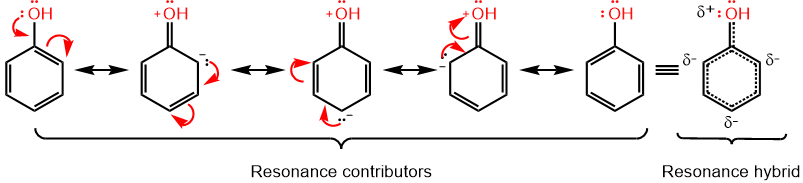
Figure \(\PageIndex{8}\) is another example, illustrated by the case of resonance in benzaldehyde.

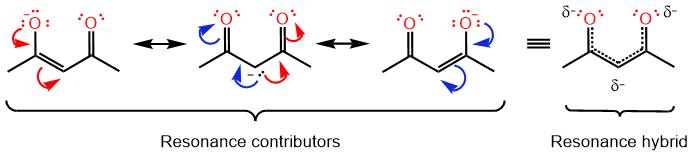
The curly arrows in the examples described so far depict the electron movements in the forward direction. The same steps can be applied in the reverse direction. For example, Figure \(\PageIndex{9}\) shows a drawing of resonance contributors by using red arrows in the forward direction and blue arrows for the reverse direction.
Recognizing a localized and a delocalized lone pair
A lone pair is delocalized when the atom bearing it is directly bonded to \(sp^2\) or \(sp\) hybridized atom. For example, lone pair on \(\ce{N}\) in \(\ce{{H}-\underset{\underset{\Huge{\ce{H}}}|}{C}=\underset{\underset{\Huge{\ce{H}}}|}{C}-\overset{\huge\cdot\cdot}{\underset{\underset{\Huge{\ce{H}}}|}{N}}-\overset{\overset{\Huge{\ce{H}}}|}{\underset{\underset{\Huge{\ce{H}}}|}{C}}-H}\) is delocalized and the \(\ce{N}\) is \(sp^2\) instead of \(sp^3\). Otherwise, the lone pair is localized. For example, lone pair on \(\ce{N}\) in \(\ce{{H}-\underset{\underset{\Huge{\ce{H}}}|}{C}=\underset{\underset{\Huge{\ce{H}}}|}{C}-\overset{\overset{\Huge{\ce{H}}}|}{\underset{\underset{\Huge{\ce{H}}}|}{C}}-\overset{\huge\cdot\cdot}{\underset{\underset{\Huge{\ce{H}}}|}{N}}-H}\) is localized and the \(\ce{N}\) is \(sp^3\) hybridized.

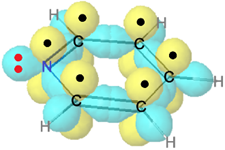
 The structure of pyrrole is shown in the figure on the left. The \(sp^2\) orbitals of pyrrole are shown in blue and \(p\) orbitals in yellow in the figure on the right (drawing using https://chemagic.org/molecules/amini.html, Copyright: Public domain). \(\ce{N}\) of pyrrole is \(sp^2\) hybridized. Its lone pair is in a \(p\)-orbital and it is delocalized as shown in Figure \(\PageIndex{10}\).
 However, when a lone pair is in an orbital that is perpendicular to the \(p\)-orbitals of neighboring atoms, it is localized. Orbitals perpendicular to each other can not overlap to make a \(\pi\)-bond. For example, pyrazole has a structure similar to pyrrole with one more \(\ce{N}\) in the ring, as shown in the figure on the left. One \(\ce{N}\) of pyrazole has a delocalized lone pair in \(p\) orbital. The second \(\ce{N}\) (highlighted in yellow) has a \(p\) orbital occupied by one electron that is involved in \(\pi\) -bonding, while the lone pair occupies a \(sp^2\) orbital, as shown in Figure \(\PageIndex{10}\).
 This \(sp^2\) orbital is perpendicular to \(p\) orbitals, and the lone pair in it is localized. Pyridine is another compound with a similar structure, as shown in the figure on the right. Lone pair on \(\ce{N}\) of pyridine is also in \(sp^2\)-orbital and localized, as illustrated in Figure \(\PageIndex{10}\). Similarly one lone pair on \(\ce{O}\) of ethenol \(\ce{{H}-\underset{\underset{\Huge{\ce{H}}}|}{C}=\underset{\underset{\Huge{\ce{H}}}|}{C}-\overset{\!\Large\:\cdot\:\!\cdot}{\underset{\!\Large\:\cdot\:\!\cdot}{O}}-H}\) is in a \(p\)-orbital and delocalized, while the second is in an \(sp^2\)-orbital and localized.
 Pyrrole
 Pyrazole
 Pyridine
Estimating the relative importance of the resonance contributors
If the resonance contributors are equal, they contribute equally to the resonance hybrid. For example, the acetate ion has two equal resonance contributors and the carbonate ion has three. Their resonance hybrids are the average of the resonance contributors, as shown in Figure \(\PageIndex{11}\).
 Acetate ion
 Carbonate ion
Often, the resonance contributors are not equal. In these cases, the more stable resonance contributors contribute more to the hybrid, i.e., the structure of the hybrid resembles the more stable contributors than the less stable ones. The more the difference in the energy of the contributors, the weaker the resonance and the less the resonance stabilization.
Rules for estimating the relative importance of resonance contributors
The following rules, in the decreasing order of importance, are used to estimate the relative importance of resonance contributors.
- More atoms with an octet are more stable and are a more important contributor.
- A structure with an octet is complete and also has more covalent bonds, making it more stable than a structure with an incomplete octet.
- Structures with fewer formal charges are more stable and more important contributors than those with more formal charges.
- The more the unlike charges (+ and -) are separated, the less stable the structure.
- A negative charge on a more electronegative atom is more stable than a negative charge on a less electronegative atom.
- A positive charge on a more electropositive atom is more stable than a positive charge on a less electropositive atom.
 The application of these rules is explained with the help of the following examples. Structure I of \(\ce{CH3NH\overset{+}{C}HCH3}\) in the figure on the right, has octet incomplete on \(\ce{C}\) and should be minor according to rule#1, but II has positive charge on a more electronegative \(\ce{N}\) and should be minor according to rule#3. Rule#1 is more important and overrides rule#3, making II a major and I a minor contributor.
 The structure II of \(\ce{H2C=O}\) in the figure on the left is a major contributor with octet completeness on all atoms and no charge separation, I is minor because of the octet of \(\ce{C}\) incomplete (rule#1) and charge separation (rule#2), and III is negligible because of octet of \(\ce{O}\) incomplete (rule#1), charge separation (rule#2), and positive charge on electronegative \(\ce{O}\) (rule#3). Usually, there is no need to draw negligible contributors.
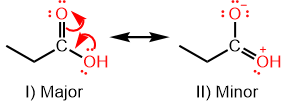 In the structures of propanoic acid \(\ce{CH3CH2COOH}\) shown in the figure on the right, II is minor because of more formal charges (rule#2), i.e., positive on one and negative on the other \(\ce{O}\) and I with no formal charges is major.
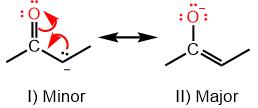 In the structures of an anion of a ketone shown in the figure on the left, II is major due to the negative charge on the more electronegative \(\ce{O}\) than on \(\ce{C}\) in I (rule#3).
 In the example of the figure on the right, I is major with octet complete (rule1) and no charge separation (rule#2), II is minor with octet complete but two formal charges (rule#2), and III) is negligible with two formal charges (rule#2) and incomplete octet on \(\ce{C}\) (rule#1).
Comparing resonance stabilization of similar compounds
In addition to estimating the relative importance of resonance contributors of the same compounds, the above three rules described in the previous section can also be applied to assess the relative importance of resonance or resonance stabilization in similar compounds. For example, comparing the resonance donation of lone pair on \(\ce{N}\) in acetamide \(\ce{CH3-\overset{\!\!\overset{\Huge{\:\ce{O}}}|\!\!|\,}{C}-\overset{\huge\cdot\cdot}{\underset{\underset{\Huge{\ce{H}}}|}{N}}-H}\) and on \(\ce{O}\) in acetic acid \(\ce{CH3-\overset{\!\!\overset{\Huge{\:\ce{O}}}|\!\!|\,}{C}-\overset{\huge\cdot\cdot}{\underset{\huge\cdot\cdot}{O}}-H}\), the former is a stronger resonance due to less electronegative \(\ce{N}\) being more able to donate its lone pair than \(\ce{O}\). In addition to octet completeness, formal charges, and electronegativity factors, the relative size of orbitals overlapping is also a critical factor in determining the extent of resonance when comparing different compounds.
The orbitals of comparable sizes overlap more effectively, resulting in stronger resonance than orbitals of different sizes -the larger the difference in the sizes, the weaker the resonance.
For example, resonance donation of lone pair on \(\ce{Cl}\) in acetyl chloride \(\ce{CH3-\overset{\!\!\overset{\Huge{\:\ce{O}}}|\!\!|\,}{C}-\overset{\huge\cdot\cdot}{\underset{\huge\cdot\cdot}{Cl}}\!\!\Large :}\) is negligivel due to \(3p\)-orbital of \(\ce{Cl}\) being significantly larger than \(2p\)-orbitals of \(\ce{C}\), \(\ce{O}\), and \(\ce{N}\), as shown in Figure \(\PageIndex{12}\).

 Acetic acid
 Acetyl chloride
A controversy over hypervalent or octet-valent states of \(\ce{P}\) and \(\ce{S}\) compounds
A structure with a central atom of a third-row or higher main group element having more than eight valence electrons is called hypervalent or expanded octet state.

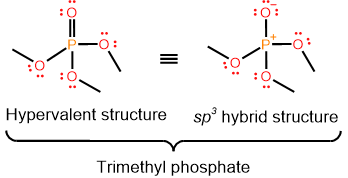 \(\ce{P}\) and \(\ce{S}\) have some compounds that follow the octet rule, and some are hypervalent. For example, the structure of trimethyl phosphine (\(\ce{(CH3)3P}\) is trigonal pyramidal, i.e., \(sp^3\)-hybridized structure, as shown in the figure on the left. However, trimethyl phosphate is usually written with five covalent bonds on \(\ce{P}\), which is a hypervalent structure, as shown in the figure on the right. The hypervalent structures are explained by involving \(d\)-orbitals in the hybridization. However, modern research indicates these compounds can be correctly represented as \(sp^3\)-hybrid structures with formal charges, as illustrated in the figure on the right, where \(\ce{\equiv}\) is the equivalent sign.
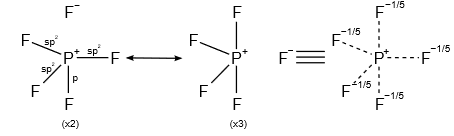
Phosphorus pentafluoride \(\ce{PF5}\) is another example of a hypervalent structure. This structure is considered as \(dsp^3\)-hybrid phosphorus, which according to VSEPR theory has a trigonal bipyramidal structure, as shown in Figure \(\PageIndex{13}\) a). Three bonds that form a triangular planar portion of \(\ce{PF5}\) are called equatorial bonds, and two bonds perpendicular to the triangular plane are called axial. The \(\ce{PF5}\) can be represent with eight valence electrons on \(\ce{P}\) as a hybrid of five resonance structures, each with four covalent bonds and one ionic bond, as illustrated in \(\PageIndex{13}\) b).
 a)
 b
 Several compounds of \(\ce{S}\) are depicted as hypervalent structures. For example, \(\ce{S}\) in sulfuric acid \(\ce{H2SO4}\) is usually represented as a hypervalent structure with six covalent bonds (twelve valence electrons) on \(\ce{S}\) as shown in the figure on the right. However, its \(sp^3\)-hybrid structure, shown in the figure on the right, with 2+ formal charge on \(\ce{S}\) and -1 formal charge on two \(\ce{O}\), is being increasingly accepted as its proper structure.
It should be mentioned here that, despite the controversy over hypervalent versus \(sp^3\)-hybrid structure described above, IUPAC recommends drawing expanded octet structures for these \(\ce{S}\) and \(\ce{P}\) compounds. Therefore, these structures will usually be drawn as hypervalent structures in this book, except when needed otherwise.