

4.3: Proton Exchange in Ethanol-Water Mixtures
- Page ID
- 366657

\( \newcommand{\vecs}[1]{\overset { \scriptstyle \rightharpoonup} {\mathbf{#1}} } \)
\( \newcommand{\vecd}[1]{\overset{-\!-\!\rightharpoonup}{\vphantom{a}\smash {#1}}} \)
\( \newcommand{\dsum}{\displaystyle\sum\limits} \)
\( \newcommand{\dint}{\displaystyle\int\limits} \)
\( \newcommand{\dlim}{\displaystyle\lim\limits} \)
\( \newcommand{\id}{\mathrm{id}}\) \( \newcommand{\Span}{\mathrm{span}}\)
( \newcommand{\kernel}{\mathrm{null}\,}\) \( \newcommand{\range}{\mathrm{range}\,}\)
\( \newcommand{\RealPart}{\mathrm{Re}}\) \( \newcommand{\ImaginaryPart}{\mathrm{Im}}\)
\( \newcommand{\Argument}{\mathrm{Arg}}\) \( \newcommand{\norm}[1]{\| #1 \|}\)
\( \newcommand{\inner}[2]{\langle #1, #2 \rangle}\)
\( \newcommand{\Span}{\mathrm{span}}\)
\( \newcommand{\id}{\mathrm{id}}\)
\( \newcommand{\Span}{\mathrm{span}}\)
\( \newcommand{\kernel}{\mathrm{null}\,}\)
\( \newcommand{\range}{\mathrm{range}\,}\)
\( \newcommand{\RealPart}{\mathrm{Re}}\)
\( \newcommand{\ImaginaryPart}{\mathrm{Im}}\)
\( \newcommand{\Argument}{\mathrm{Arg}}\)
\( \newcommand{\norm}[1]{\| #1 \|}\)
\( \newcommand{\inner}[2]{\langle #1, #2 \rangle}\)
\( \newcommand{\Span}{\mathrm{span}}\) \( \newcommand{\AA}{\unicode[.8,0]{x212B}}\)
\( \newcommand{\vectorA}[1]{\vec{#1}} % arrow\)
\( \newcommand{\vectorAt}[1]{\vec{\text{#1}}} % arrow\)
\( \newcommand{\vectorB}[1]{\overset { \scriptstyle \rightharpoonup} {\mathbf{#1}} } \)
\( \newcommand{\vectorC}[1]{\textbf{#1}} \)
\( \newcommand{\vectorD}[1]{\overrightarrow{#1}} \)
\( \newcommand{\vectorDt}[1]{\overrightarrow{\text{#1}}} \)
\( \newcommand{\vectE}[1]{\overset{-\!-\!\rightharpoonup}{\vphantom{a}\smash{\mathbf {#1}}}} \)
\( \newcommand{\vecs}[1]{\overset { \scriptstyle \rightharpoonup} {\mathbf{#1}} } \)
\(\newcommand{\longvect}{\overrightarrow}\)
\( \newcommand{\vecd}[1]{\overset{-\!-\!\rightharpoonup}{\vphantom{a}\smash {#1}}} \)
\(\newcommand{\ket}[1]{\left| #1 \right>}\)
\(\newcommand{\bra}[1]{\left< #1 \right|}\)
\(\newcommand{\braket}[2]{\left< #1 \vphantom{#2} \right| \left. #2 \vphantom{#1} \right>}\)
\(\newcommand{\braopket}[3]{\left< #1 \vphantom{#2}\vphantom{#3} \right| #2 \vphantom{#1}\vphantom{#3} \left| #3 \vphantom{#1}\vphantom{#2} \right>}\)
\(\newcommand{\qmvec}[1]{\mathbf{\vec{#1}}}\)
\(\newcommand{\op}[1]{\hat{\mathbf{#1}}}\)
\(\newcommand{\expect}[1]{\langle #1 \rangle}\)
\(\newcommand{\dfn}[1]{\emph{\textbf{#1}}}\)
\(\newcommand{\avec}{\mathbf a}\) \(\newcommand{\bvec}{\mathbf b}\) \(\newcommand{\cvec}{\mathbf c}\) \(\newcommand{\dvec}{\mathbf d}\) \(\newcommand{\dtil}{\widetilde{\mathbf d}}\) \(\newcommand{\evec}{\mathbf e}\) \(\newcommand{\fvec}{\mathbf f}\) \(\newcommand{\nvec}{\mathbf n}\) \(\newcommand{\pvec}{\mathbf p}\) \(\newcommand{\qvec}{\mathbf q}\) \(\newcommand{\svec}{\mathbf s}\) \(\newcommand{\tvec}{\mathbf t}\) \(\newcommand{\uvec}{\mathbf u}\) \(\newcommand{\vvec}{\mathbf v}\) \(\newcommand{\wvec}{\mathbf w}\) \(\newcommand{\xvec}{\mathbf x}\) \(\newcommand{\yvec}{\mathbf y}\) \(\newcommand{\zvec}{\mathbf z}\) \(\newcommand{\rvec}{\mathbf r}\) \(\newcommand{\mvec}{\mathbf m}\) \(\newcommand{\zerovec}{\mathbf 0}\) \(\newcommand{\onevec}{\mathbf 1}\) \(\newcommand{\real}{\mathbb R}\) \(\newcommand{\twovec}[2]{\left[\begin{array}{r}#1 \\ #2 \end{array}\right]}\) \(\newcommand{\ctwovec}[2]{\left[\begin{array}{c}#1 \\ #2 \end{array}\right]}\) \(\newcommand{\threevec}[3]{\left[\begin{array}{r}#1 \\ #2 \\ #3 \end{array}\right]}\) \(\newcommand{\cthreevec}[3]{\left[\begin{array}{c}#1 \\ #2 \\ #3 \end{array}\right]}\) \(\newcommand{\fourvec}[4]{\left[\begin{array}{r}#1 \\ #2 \\ #3 \\ #4 \end{array}\right]}\) \(\newcommand{\cfourvec}[4]{\left[\begin{array}{c}#1 \\ #2 \\ #3 \\ #4 \end{array}\right]}\) \(\newcommand{\fivevec}[5]{\left[\begin{array}{r}#1 \\ #2 \\ #3 \\ #4 \\ #5 \\ \end{array}\right]}\) \(\newcommand{\cfivevec}[5]{\left[\begin{array}{c}#1 \\ #2 \\ #3 \\ #4 \\ #5 \\ \end{array}\right]}\) \(\newcommand{\mattwo}[4]{\left[\begin{array}{rr}#1 \amp #2 \\ #3 \amp #4 \\ \end{array}\right]}\) \(\newcommand{\laspan}[1]{\text{Span}\{#1\}}\) \(\newcommand{\bcal}{\cal B}\) \(\newcommand{\ccal}{\cal C}\) \(\newcommand{\scal}{\cal S}\) \(\newcommand{\wcal}{\cal W}\) \(\newcommand{\ecal}{\cal E}\) \(\newcommand{\coords}[2]{\left\{#1\right\}_{#2}}\) \(\newcommand{\gray}[1]{\color{gray}{#1}}\) \(\newcommand{\lgray}[1]{\color{lightgray}{#1}}\) \(\newcommand{\rank}{\operatorname{rank}}\) \(\newcommand{\row}{\text{Row}}\) \(\newcommand{\col}{\text{Col}}\) \(\renewcommand{\row}{\text{Row}}\) \(\newcommand{\nul}{\text{Nul}}\) \(\newcommand{\var}{\text{Var}}\) \(\newcommand{\corr}{\text{corr}}\) \(\newcommand{\len}[1]{\left|#1\right|}\) \(\newcommand{\bbar}{\overline{\bvec}}\) \(\newcommand{\bhat}{\widehat{\bvec}}\) \(\newcommand{\bperp}{\bvec^\perp}\) \(\newcommand{\xhat}{\widehat{\xvec}}\) \(\newcommand{\vhat}{\widehat{\vvec}}\) \(\newcommand{\uhat}{\widehat{\uvec}}\) \(\newcommand{\what}{\widehat{\wvec}}\) \(\newcommand{\Sighat}{\widehat{\Sigma}}\) \(\newcommand{\lt}{<}\) \(\newcommand{\gt}{>}\) \(\newcommand{\amp}{&}\) \(\definecolor{fillinmathshade}{gray}{0.9}\)
The work of Weinberg and Zimmerman3 on the hydroxyl resonance in mixtures of ethanol and water is particularly interesting because it rounds out the picture of proton-exchange phenomena discussed earlier in connection with mixtures of acetic acid and water. We shall consider first mixtures of ethanol and water with relatively high water content.

The NMR spectrum (Fig. 4-4) of such a mixture with 30 per cent water shows three principal groups of resonance lines. The two groups at high fields arise from the ethyl protons as evidenced by the customary four-three pattern of spin-spin splitting. The large peak at low fields is the hydroxyl resonance and represents an average ethanol-water hydroxyl resulting from rapid exchange. As will be seen from Fig. 4-5, the position of this line is relatively insensitive to the composition of the mixture, down to about 25 per cent water. Now, the spectrum of ethanol containing only little water (and no acid or base or other substance which might catalyze exchange between the hydroxyls) is seen in Fig. 4-4 to have a quite different appearance from ethanol containing water in which exchange is rapid. At low fields, two groups of peaks appear instead of one. These represent the separate resonances of the water and the hydroxyl protons of ethanol in the mixture and can be easily distinguished by the fact that the alcohol hydroxyl resonance is split into three because of spin-spin coupling between the hydroxyl and methylene protons. The protons of the individual water molecules are, of course, equivalent, and their respective resonance is not split. In nonexchanging ethanol, the methylene resonance is seen to be substantially more complex than for exchanging ethanol. This is because the protons of the methylene group are coupled to both the methyl and the hydroxyl protons. If the coupling constants were equal, the methylene resonance would be expected to be split into five lines. This is approximately what is observed although complications are introduced because the respective J's are not exactly equal.

When rapid exchange sets in, the splitting caused by coupling between the hydroxyl and the methylene protons disappears somewhat sooner than the water and alcohol hydroxyl resonances merge to a single line. The splitting disappears with rapid exchange because as a given hydroxyl proton moves from alcohol to water to alcohol, etc., it experiences local fields produced by different combinations of the two spins of the methylene protons of different alcohol molecules. It does not stay on any one molecule long enough to give a resonance line corresponding to its particular spin combination. Instead, the exchanging proton acts as though it were experiencing an average of the possible CH2 magnetic quantum numbers which is zero and, of course, would produce no splitting.
The reason that the spin-spin splittings between the hydroxyl and methylene protons disappear somewhat before the two hydroxyl lines merge into an average is because a splitting of about 5 cps will be averaged to zero by a process having a mean proton lifetime in the various states of less than 0.07 sec. On the other hand, two hydroxyl lines some 30 cps apart will be averaged by exchange only when the mean lifetime is less than about 0.015 sec. This type of situation where the same reaction process causes differently spaced lines to be averaged separately is particularly advantageous, since it allows determination of more than one rate constant as a function of temperature or concentration. Thus, two values of the rate of hydrogen exchange between water and alcohol as a function of concentration can be obtained by increasing the amount of water in the alcohol so as to wash out successively the hydroxyl-methylene spin-spin couplings and the separate hydroxyl resonances. Similarly, with a given alcohol-water composition, the rate of exchange could be ascertained at two different temperatures by determining the temperatures for separate averaging of the spin-spin couplings and the chemical shift, respectively.
The data presented in Fig. 4-5 show that the mean lifetime of a proton before exchange on the left of the transition point is greater than 0.015 sec, less than 0.015 sec on the right of the transition point, and about 0.015 sec in the neighborhood of the transition point. Acids and bases are powerful catalysts for the hydroxyl exchange, since alcohol samples which show the three-line hydroxyl resonance immediately give a single hydroxyl resonance when minute amounts of a strong acid or base are added. The kinetic order of acid or base in causing this exchange has not as yet been obtained accurately.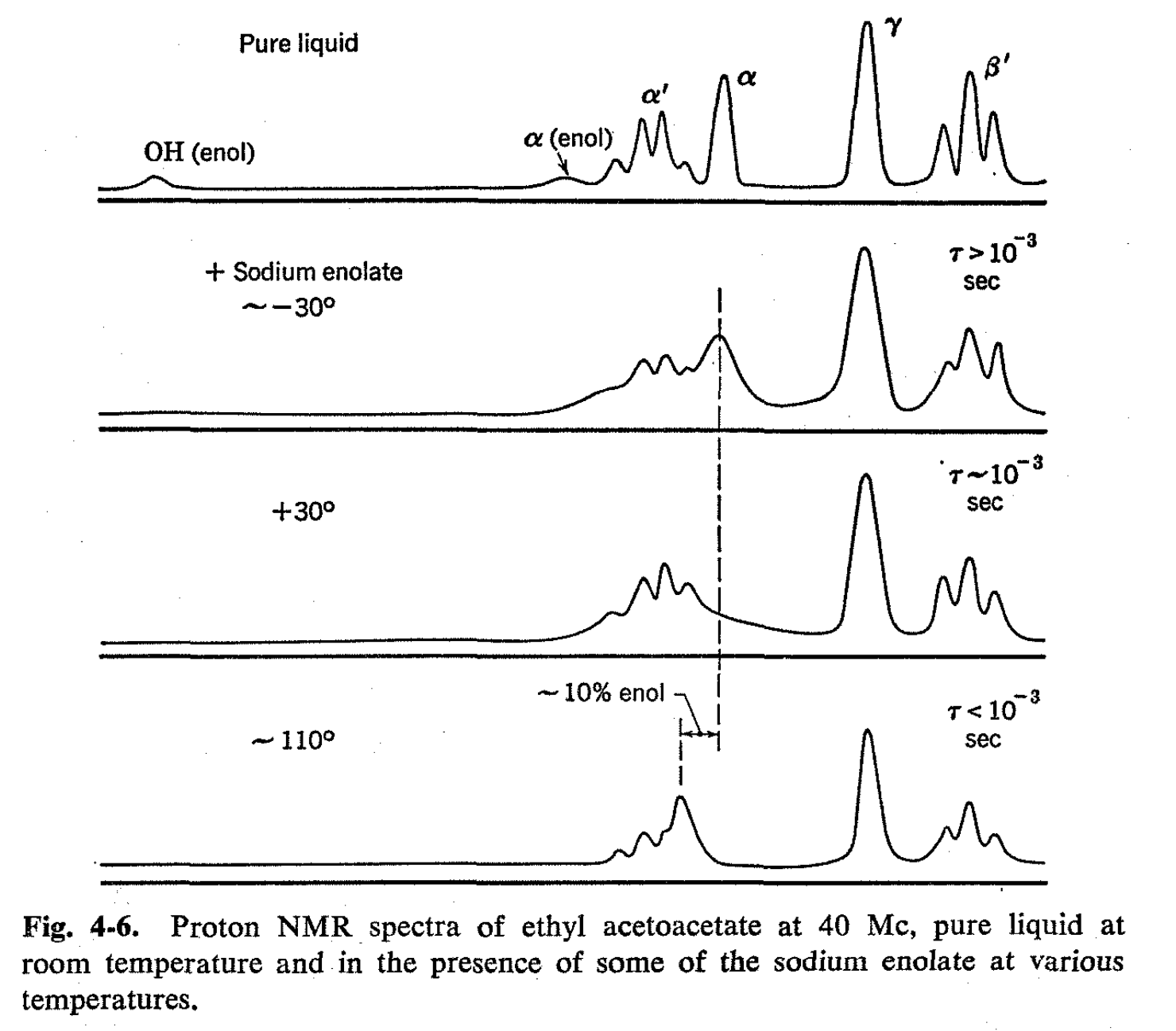
3 I. Weinberg and J. R. Zimmerman, J. Chem. Phys., 23, 748 (1955).